
Oracle 1Z0-1122-26 Real Exam Dumps [September 2026 Update]
Our Oracle 1Z0-1122-26 real exam questions provide authentic and updated preparation material for the Oracle Cloud Infrastructure AI Foundations Associate certification. Each question is carefully checked by AI professionals and includes verified answers with easy-to-follow explanations. With free demo questions and Cert Empire’s exam simulator, you can prepare smarter and improve your 1Z0-1122-26 exam readiness.
What Users Are Saying:
OCI AI Services is the largest single domain on the 1Z0-1122-26 exam at approximately 20% of questions – and it is the domain where general AI knowledge most clearly fails to substitute for OCI-specific knowledge. Supervised learning, neural networks, transformers, attention mechanisms, and RAG are AI concepts that appear in hundreds of courses and textbooks. What does not appear in general AI courses is the question pattern that dominates the OCI AI Services domain: a business scenario describes a specific requirement, and the candidate must identify which OCI AI service correctly addresses it. OCI Language (natural language processing – entity extraction, sentiment analysis, text classification in 25+ languages), OCI Vision (image classification, object detection, OCR), OCI Speech (audio transcription), OCI Document Understanding (extracting data from documents – invoices, receipts, medical forms using pre-built and custom models), and OCI Digital Assistant (building conversational chatbots with NLP and built-in skill templates) each serve different input types and output different results. A candidate who knows that “AI Vision” does image processing and “AI Language” does text processing is approximately correct – but the exam tests more precisely: when a requirement involves extracting line items from an uploaded PDF invoice, the answer is OCI Document Understanding (not OCI Vision, which processes images, not structured document extraction). When a requirement involves an employee-facing HR chatbot that handles benefit inquiries in multiple intents, the answer is OCI Digital Assistant (not OCI Language, which provides NLP primitives, not conversational interfaces). These distinctions require knowing each OCI AI Service’s specific function, not just its general category.
The Oracle 1Z0-1122-26 (Oracle Cloud Infrastructure 2026 AI Foundations Associate) is a FREE Oracle certification validating foundational knowledge of AI, Machine Learning, Deep Learning, Generative AI, and OCI’s AI service portfolio. No prerequisites. The exam covers the AI concepts that underpin modern AI systems and maps them to OCI’s specific service implementations. No prior AI or ML experience is required – the credential is specifically designed as an entry point.
Cert Empire’s 1Z0-1122-26 exam questions are built with OCI AI Services at 20% weight – matching the real exam’s domain distribution and testing service-to-use-case mapping at the specificity the real exam uses.
Exam Snapshot
| Field | Details |
| Exam Code | 1Z0-1122-26 |
| Exam Name | Oracle Cloud Infrastructure 2026 AI Foundations Associate |
| Vendor | Oracle |
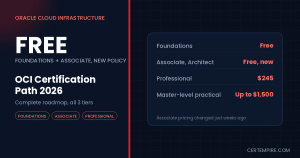
| Cost | FREE (via Oracle MyLearn after completing the OCI AI Foundations learning path) |
| Number of Questions | Approximately 40-50 |
| Duration | 60-90 minutes |
| Passing Score | 65% |
| Delivery | Online (Oracle certification platform) |
| Prerequisites | None (no prior AI/ML or coding experience required) |
| Target Audience | Beginners in AI, cloud professionals expanding to AI, business analysts, developers, students new to AI/ML |
Domain Breakdown
| Domain | Approximate Weight |
| Intro to OCI AI Services | ~20% – Largest domain |
| Generative AI and LLMs | ~18% |
| Deep Learning and Neural Networks | ~17% |
| Machine Learning Foundations | ~17% |
| AI Fundamentals | ~15% |
| OCI Generative AI Service and AI Infrastructure | ~13% |
Domain 1: AI Fundamentals (~15%)
The AI hierarchy: AI is the broad field of creating systems that perform tasks requiring human-like intelligence. Machine Learning is the subset of AI where systems learn from data rather than explicit programming. Deep Learning is the subset of Machine Learning that uses neural networks with many layers. The exam tests this three-level hierarchy and can ask candidates to correctly place a described technology at the right level.
Types of AI by capability: The exam tests the distinction between Narrow AI (also called Weak AI – systems designed for one specific task: a chess engine, an image classifier, a recommendation system) versus the theoretical concepts of General AI (human-level reasoning across all domains – not currently achieved) and Superintelligence (beyond human capability – theoretical). All current practical AI systems are Narrow AI.
Machine learning learning paradigms: The exam tests three learning paradigms:
- Supervised learning: The model trains on labeled data – each training example has an input and a known correct output. Applications: spam classification (input: email text, output: spam/not spam), house price prediction (input: features, output: price), image classification (input: image, output: class label).
- Unsupervised learning: The model finds patterns in unlabeled data without predefined output categories. Applications: customer segmentation, anomaly detection, topic modeling.
- Reinforcement learning: An agent learns by taking actions in an environment and receiving reward or penalty signals. Applications: game playing (AlphaGo), robotics, recommendation optimization.
Domain 2: Machine Learning Foundations (~17%)
Common ML algorithms the exam tests:
Linear regression: Predicts a continuous output value from input features by finding the best-fit line. Use case: predicting sales figures, forecasting demand.
Logistic regression (despite the name, a classification algorithm): Predicts class probabilities from binary or multi-class outcomes. Use case: customer churn prediction (will this customer leave: yes/no).
Decision trees: Split data into branches based on feature thresholds to make predictions. Interpretable and intuitive. Use case: loan approval decisions.
Random forests: Ensemble of decision trees whose predictions are averaged or voted. More robust than individual trees. Use case: fraud detection.
Support Vector Machines (SVM): Finds the maximum-margin hyperplane separating classes in feature space. Use case: text classification, image classification.
Model training and evaluation:
Training, validation, and test sets: Training data builds the model; validation data tunes hyperparameters; test data provides the final unbiased performance estimate. The exam tests why the test set must never be used during training (data leakage) and why a validation set is needed separately from the test set.
Overfitting vs. underfitting: Overfitting is when a model learns the training data too specifically and performs poorly on new data (low training error, high test error). Underfitting is when a model is too simple to capture the patterns in data (high error on both training and test data). The exam tests how to detect each (learning curves) and how to address each (regularization for overfitting, more complex model or more features for underfitting).
Evaluation metrics: Accuracy (fraction of correct predictions), precision (of all positive predictions, what fraction are correct), recall (of all actual positives, what fraction were predicted correctly), F1 score (harmonic mean of precision and recall – appropriate when both false positives and false negatives matter). The exam tests when each metric is appropriate: accuracy is misleading for imbalanced datasets; F1 is appropriate when both types of errors matter.
Domain 3: Deep Learning and Neural Networks (~17%)
Neural network architecture: A neural network consists of an input layer (receives raw features), one or more hidden layers (learn intermediate representations), and an output layer (produces predictions). The exam tests what each layer component is: neurons (processing units), weights (learned parameters that scale input signals), biases (learned offsets), and activation functions (non-linear functions applied to neuron outputs that enable learning of complex patterns).
Activation functions the exam tests:
- ReLU (Rectified Linear Unit): f(x) = max(0, x). Most commonly used in hidden layers. Returns 0 for negative inputs, linear for positive inputs. Computationally efficient, reduces the vanishing gradient problem.
- Sigmoid: Maps any input to a value between 0 and 1. Used in the output layer for binary classification (output represents probability).
- Softmax: Maps multiple outputs to a probability distribution that sums to 1. Used in the output layer for multi-class classification.
CNN (Convolutional Neural Networks): Specialized for grid-structured data – primarily images. Convolutional layers apply learned filters across the input to detect local features (edges, textures, shapes at increasing levels of abstraction). The exam tests CNNs as the architecture for image classification, object detection, and video analysis.
RNN (Recurrent Neural Networks) and LSTM: RNNs process sequential data by maintaining a hidden state that captures information from previous time steps. LSTMs (Long Short-Term Memory) are a refined RNN variant that better handles long-term dependencies using gating mechanisms. The exam tests RNNs for sequential data (time series, text before transformers became dominant).
Transformers and attention mechanism: The Transformer architecture uses the attention mechanism to process all positions in a sequence simultaneously (unlike RNNs, which process sequentially). Self-attention allows each token to “attend to” (learn contextual relationships with) all other tokens in the sequence. The exam tests the Transformer as the foundational architecture for modern LLMs and why it replaced RNNs for language tasks: parallelization during training, ability to capture long-range dependencies.
Domain 4: Generative AI and LLMs (~18%)
What LLMs are: Large Language Models are neural networks (specifically Transformer-based) trained on massive text corpora to predict the next token in a sequence. Emergent capabilities from scale include: reasoning, summarization, code generation, translation, and conversation. The exam tests the pre-training process (next-token prediction on internet-scale text), what “parameters” are in an LLM (the weights – typically billions), and why scale matters (larger models exhibit qualitatively better reasoning).
Prompting techniques the exam tests:
Zero-shot prompting: Asking the LLM to perform a task with no examples provided. “Translate the following to French:” with no French examples.
Few-shot prompting: Providing a few input-output examples in the prompt before asking the LLM to perform the task. Often dramatically improves output quality for specific formats or tasks.
Chain-of-Thought (CoT) prompting: Instructing the LLM to reason step-by-step before giving its final answer – “Let’s think step by step” – improves accuracy on multi-step reasoning tasks.
Fine-tuning: Adapting a pre-trained LLM to a specific domain or task by training it further on a smaller, domain-specific dataset. Fine-tuning updates the model’s weights. The exam tests when fine-tuning is appropriate (when the task requires consistently specific output format, domain-specific vocabulary, or behavior the base model lacks) versus prompting (when the task is within the base model’s capability and few-shot examples suffice).
Retrieval-Augmented Generation (RAG): RAG grounds LLM responses in specific external documents by retrieving relevant content from a vector database and including it in the LLM’s context. The exam tests RAG components: the embedding model (converts documents and queries to vectors), the vector store (indexes document embeddings for similarity search), the retrieval step (finding the most relevant document chunks for a given query), and the generation step (the LLM produces an answer using both the query and the retrieved context).
Responsible AI principles the exam tests: Fairness (AI systems should not discriminate based on protected characteristics), Transparency (how the AI makes decisions should be explainable), Privacy (personal data used for training and inference must be protected), Accountability (humans should remain responsible for AI decisions), and Reliability (AI systems should behave consistently and safely). The exam tests these principles and what each requires in practice.
Domain 5: OCI AI Services (~20%) – Largest Domain
This domain tests service-to-use-case mapping – knowing which specific OCI AI service correctly addresses a described business requirement.
OCI Language
What OCI Language provides: Pre-trained NLP models for text analysis. No custom model training required for supported languages and tasks.
OCI Language capabilities the exam tests:
- Entity recognition: Identifying and classifying named entities in text (persons, organizations, locations, dates, monetary amounts).
- Sentiment analysis: Determining the overall sentiment of text (positive, negative, neutral) and the aspect-level sentiment (sentiment toward specific mentioned aspects).
- Text classification: Categorizing text into predefined categories.
- Key phrase extraction: Identifying the most important phrases in a document.
- Language detection: Automatically identifying which of 30+ languages the text is written in.
- Translation: Translating text between supported language pairs.
When OCI Language is the correct exam answer: Text input, NLP output tasks that do not involve conversation flow, document interface, images, or audio. Analyzing customer review sentiment, extracting entities from news articles, categorizing support tickets.
OCI Vision
What OCI Vision provides: Pre-trained and custom-trainable computer vision models for image and video analysis.
OCI Vision capabilities the exam tests:
- Image classification: Identifying what is depicted in an image from a set of predefined classes.
- Object detection: Identifying and locating multiple objects within an image with bounding boxes.
- Image text detection (OCR): Extracting text visible in an image.
- Custom image models: Training custom image classifiers or object detectors on organization-specific image datasets.
When OCI Vision is the correct exam answer: Image input, computer vision output. Detecting defects in manufacturing images, classifying product photos, identifying objects in security camera feeds.
OCI Vision vs. OCI Document Understanding: This is the most frequently confused distinction on the exam. OCI Vision handles raw images. OCI Document Understanding handles structured documents (PDFs, invoices, forms) where the goal is data extraction, not just text recognition. If the requirement involves an uploaded PDF invoice and the goal is extracting specific fields (vendor name, invoice date, line items, totals), the answer is OCI Document Understanding – not OCI Vision, even though invoice processing involves “seeing” the document.
OCI Speech
What OCI Speech provides: Automatic speech recognition (ASR) – converting audio files or streams to text. Supports multiple languages and can be fine-tuned for domain-specific vocabulary.
When OCI Speech is the correct exam answer: Audio input, text output. Transcribing call center recordings, converting podcast audio to text, generating subtitles for video content.
OCI Document Understanding
What OCI Document Understanding provides: Extracting structured data from documents using pre-built models for common document types (invoices, receipts, medical forms, ID cards) and custom-trainable models for organization-specific documents.
Document Understanding capabilities the exam tests:
- Key-value extraction: Identifying and extracting specific labeled fields from forms (e.g., “Invoice Date: 2026-03-15″ extracted as key=”Invoice Date”, value=”2026-03-15″).
- Table extraction: Identifying tables in documents and extracting the structured tabular data.
- Document classification: Categorizing documents by type (invoice, purchase order, contract).
- Pre-built models: Invoice model, receipt model, driver’s license model, passport model – ready to use without custom training.
When OCI Document Understanding is the correct exam answer: Document input (PDF, image of a form, scanned invoice), structured data extraction output. Processing submitted expense receipts, extracting data from insurance claim forms, digitizing paper records.
OCI Digital Assistant
What OCI Digital Assistant provides: A platform for building conversational AI chatbots (digital assistants) that can be deployed across multiple channels (web, mobile apps, messaging platforms). Provides NLP understanding, intent detection, entity extraction from conversation, dialog management, and built-in skill templates for common business use cases.
Key concepts the exam tests:
- Intents: The goals or actions a user wants to accomplish (get account balance, reset password, book appointment). Each intent is trained on example utterances.
- Entities: Specific pieces of information relevant to the conversation (account number, date, product name). Entities are extracted from user messages.
- Skills: Modular conversational flows handling specific topics. A Digital Assistant can combine multiple skills.
- Channels: The interfaces through which the digital assistant is deployed (web widget, Slack, Microsoft Teams, Facebook Messenger).
When OCI Digital Assistant is the correct exam answer: When the requirement involves a conversational interface, multi-turn dialog, intent-based navigation, or chatbot deployment. Building an HR chatbot for employee self-service, a customer service assistant for an e-commerce site, an IT helpdesk bot.
Domain 6: OCI Generative AI Service and AI Infrastructure (~13%)
OCI Generative AI Service: Oracle’s managed service for deploying large language models within OCI. Provides access to pre-trained foundation models (Cohere models, Meta Llama models) through a managed API. The exam tests three OCI Generative AI capabilities:
- Text generation: Generating text responses from prompts using foundation models.
- Summarization: Condensing long documents into concise summaries.
- Embedding: Generating vector embeddings from text for use in vector search.
Dedicated AI Clusters: When consistent, high-throughput AI inference is required (not shared infrastructure), OCI offers Dedicated AI Clusters – reserved GPU capacity for a specific customer’s Generative AI workload. The exam tests when Dedicated AI Clusters are appropriate (when shared capacity limits throughput or when data isolation requirements prevent use of shared infrastructure).
OCI Supercluster and GPU infrastructure: For training large foundation models and running large-scale inference, OCI Supercluster provides massively parallel GPU clusters with high-bandwidth networking (RDMA/RoCEv2 – the same lossless fabric architecture covered in the Cisco 300-640 DCAI exam). The exam tests Supercluster at the awareness level: OCI Supercluster provides the GPU infrastructure foundation for training LLMs, with RDMA networking enabling efficient GPU-to-GPU communication during distributed training.
Oracle Database 23ai/26ai AI Vector Search as GenAI integration: The OCI Generative AI Service integrates with Oracle Database’s AI Vector Search to implement RAG patterns natively. Documents are embedded using OCI Generative AI’s embedding model, vectors are stored in Oracle Database, and the LLM retrieves grounded context through vector search queries before generating responses. The exam tests this integration pattern.
5 Study Tips for Oracle 1Z0-1122-26
- Tip 1: Memorize the five OCI AI Services (Language, Vision, Speech, Document Understanding, Digital Assistant) with their specific input types and output types. The exam presents a business scenario and tests which service is correct. The most common wrong answers come from confusing services with overlapping but distinct functions (especially Vision vs. Document Understanding, and Language vs. Digital Assistant).
- Tip 2: Study the Transformer architecture and attention mechanism at the conceptual level. LLMs are Transformer-based, and the exam tests why Transformers replaced RNNs and how self-attention enables the parallel processing that makes LLMs scalable.
- Tip 3: Study RAG components specifically: embedding model, vector store, retrieval step, generation step. Know what each component does and how they connect into the full RAG pipeline.
- Tip 4: Study the three prompting techniques (zero-shot, few-shot, chain-of-thought) with examples of when each is appropriate.
- Tip 5: Practice with Cert Empire’s 1Z0-1122-26 exam questions with OCI AI Services at 20% weight – the single largest domain – and service-to-use-case mapping questions as the primary format.
Best Study Resources
- Cert Empire 1Z0-1122-26 exam questions PDF and practice simulator (2026 edition).
- Oracle MyLearn: OCI AI Foundations learning path (free, includes the exam attempt).
- AGuideToCloud.com OCI AI Foundations study guide and 250 free practice questions (aguidetocloud.com/cert-tracker/oci-ai-foundations).
- OpenExamPrep.com OCI AI Foundations free practice questions.
- Udemy: “1Z0-1122-26: OCI AI Foundations Associate 2026” courses (multiple providers, free tiers available).
Career Opportunities After 1Z0-1122-26
- AI/ML Engineer (Entry Level)
- Cloud AI Solutions Consultant
- Data Analyst with AI Tooling
- Developer (AI-Augmented)
- Product Manager (AI Features)
The 1Z0-1122-26 is specifically designed as an accessible entry credential – free, no prerequisites, foundational level. It validates conceptual AI literacy and OCI AI service awareness that opens the path to advanced OCI AI certifications and demonstrates AI commitment to employers without requiring prior AI engineering experience.
Why Candidates Choose Cert Empire for Oracle 1Z0-1122-26 Preparation
✔ OCI AI Services domain at 20% weight with service-to-use-case mapping questions. Our questions present business scenarios and test which specific OCI AI Service correctly addresses the requirement – with particular attention to Vision vs. Document Understanding and Language vs. Digital Assistant distinctions.
✔ LLM and Generative AI questions at exam depth. We test Transformer architecture, attention mechanisms, fine-tuning vs. prompting, and RAG components at the foundational conceptual level the exam uses.
✔ Responsible AI principle questions. Our questions cover fairness, transparency, privacy, accountability, and reliability principles with scenario context.
✔ OCI Generative AI Service and Supercluster awareness questions. We test OCI Generative AI capabilities (generation, summarization, embedding), Dedicated AI Clusters, and Oracle Database vector search integration.
✔ Backed by a full money-back guarantee. If our exam questions do not help you pass, we refund your purchase.
FAQ’s
What is Oracle 1Z0-1122-26?
1Z0-1122-26 is the Oracle Cloud Infrastructure 2026 AI Foundations Associate exam – a free certification validating foundational knowledge of AI, Machine Learning, Deep Learning, Generative AI, and OCI’s AI service portfolio.
Is the 1Z0-1122-26 exam free?
Yes. After completing the OCI AI Foundations learning path on Oracle MyLearn, the exam is available at no cost.
Which domain has the most questions?
Intro to OCI AI Services at approximately 20% – the largest single domain. It tests service-to-use-case mapping for OCI Language, OCI Vision, OCI Speech, OCI Document Understanding, and OCI Digital Assistant.
What is the difference between OCI Vision and OCI Document Understanding?
OCI Vision handles raw image processing tasks (classification, object detection, text in images). OCI Document Understanding handles structured document analysis (extracting specific fields like vendor names, dates, and line items from invoices, forms, and receipts). If the input is a PDF invoice and the goal is field extraction, use OCI Document Understanding.
Do I need prior AI experience for this exam?
No. The 1Z0-1122-26 is designed for beginners. The learning path starts from foundational AI concepts with no assumed prior knowledge.
Related Certifications Worth Exploring
Oracle 1Z0-1122-26 certified professionals expanding their Oracle AI credential portfolio will find our Oracle Agentic AI Foundations Associate (1Z0-1157-26) exam questions page covers agentic AI concepts, AI agents, orchestration, OCI Enterprise AI Agents, and AI Database integrations that complement the broader AI and machine learning foundations covered by 1Z0-1122-26. For those advancing into professional-level Oracle AI Database expertise, our Oracle AI Database Administration Professional (1Z0-183) exam questions page covers advanced Oracle AI Database administration and AI-enabled database capabilities that build naturally on foundational Oracle AI knowledge.
Related Posts
-

-
-
-
-
-




Reviews
There are no reviews yet.