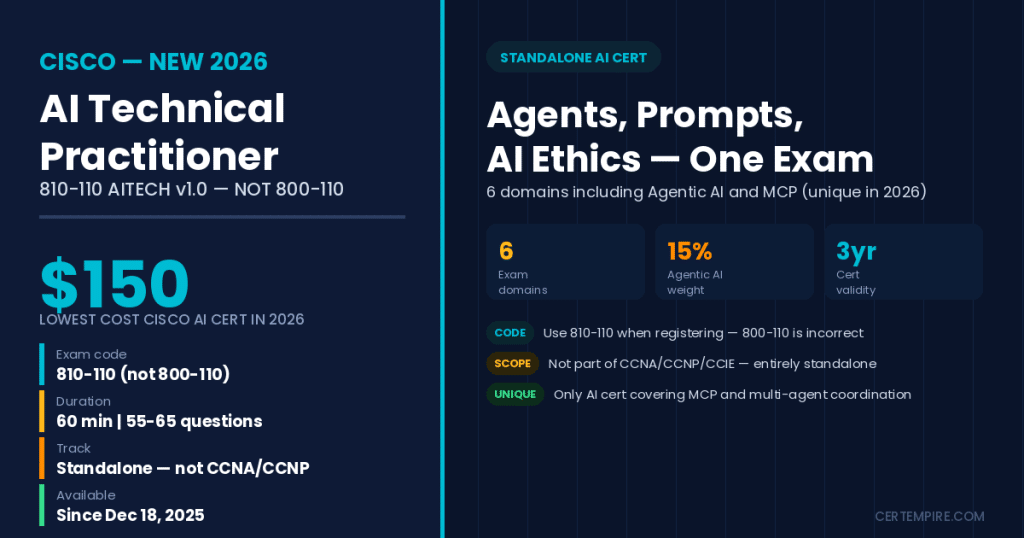
The Cisco AI Technical Practitioner certification (exam code 810-110 AITECH v1.0) is Cisco’s standalone credential for IT and technical professionals who need to build, integrate, and manage AI-powered solutions in enterprise environments. It costs $150, runs 60 minutes, covers six domains across generative AI, prompt engineering, ethics, data analysis, workflow automation, and agentic AI, and has been available for testing since December 18, 2025. It sits entirely outside Cisco’s CCNA/CCNP/CCIE track structure.
Important note on exam codes: Cisco officially lists the certification as 810-110, not 800-110. Some third-party resources incorrectly list it as 800-110. Always use 810-110 when registering through Pearson VUE.
Quick Facts Table
| Detail | Specification |
| Certification name | Cisco AI Technical Practitioner |
| Exam code | 810-110 AITECH v1.0 |
| Duration | 60 minutes |
| Questions | 55-65 |
| Passing score | Pass/fail (no scaled score published) |
| Cost | $150 USD |
| Prerequisites | None (intermediate technical background recommended) |
| Validity | 3 years |
| Delivery | Pearson VUE (test center or OnVUE online proctoring) |
| Available since | December 18, 2025 |
| Part of CCNA/CCNP/CCIE track? | No, standalone certification |
| Renewal | Continuing Education credits or retake |
What Makes This Certification Different
At $150, the Cisco AI Technical Practitioner is one of the lowest-cost AI certifications from a major vendor in 2026. For comparison: CompTIA exams cost $350-$425, AWS exams run $150-$300 (with specialty exams at $300), and Cisco’s own CCNA costs $330. The low price point makes it accessible as a first AI credential or as an addition to an existing certification portfolio without significant budget commitment.
The exam is also different in scope from other entry-level AI certifications like Microsoft’s AI-901. AI-901 focuses on AI concepts and Azure AI services. The Cisco AITECH exam covers practical, hands-on AI skills: building prompts, designing agentic systems, integrating AI into development workflows, and understanding data governance and security for AI deployments. It tests whether you can do AI work, not just describe it.
The agentic AI domain is the most forward-looking aspect of the exam. Most AI certifications in 2026 do not cover autonomous AI agents at all, or treat them as an emerging concept. Cisco allocated 15 percent of the exam to agentic architectures, tool use, multi-agent coordination, and Model Context Protocol (MCP). This reflects where enterprise AI is actually heading and makes the certification more durable than exams built entirely around static model usage.
Exam Domains and What They Cover
| Domain | Approximate Weight | What it tests |
| 1. Generative AI Models | ~20% | LLM families, diffusion models, model hosting (cloud vs local), use cases |
| 2. Prompt Engineering | ~20% | Prompt structure, zero-shot, few-shot, chain-of-thought, output format control |
| 3. AI Ethics and Security | ~15% | Data privacy, bias, responsible AI, governance frameworks, AI-specific security |
| 4. Data Research and Analysis | ~15% | Data preparation, cleaning, vectorization, RAG architecture concepts |
| 5. AI for Code and Workflow Optimization | ~15% | AI-assisted development, CI/CD integration, testing with AI, workflow automation |
| 6. Agentic AI | ~15% | Agent architectures, tool use, multi-agent coordination, MCP, human oversight |
Cisco does not publish exact domain weightings in the same way CompTIA does. The percentages above are derived from the official exam topics document and community exam reports. All six domains are confirmed testable content.
Domain 1 (Generative AI Models) tests your ability to choose the right type of AI model for a given task. You need to understand the difference between LLMs and diffusion models, know why you would use a locally hosted model versus a cloud-hosted API (cost, data privacy, latency), and understand common enterprise AI use cases like summarization, code generation, and content creation.
Domain 2 (Prompt Engineering) is the most immediately practical domain. You need to be able to write effective prompts using structured techniques, understand how context window size affects output quality, and recognize when different prompting strategies (zero-shot, few-shot, chain-of-thought) are appropriate.
Domain 3 (AI Ethics and Security) reflects the reality that deploying AI in enterprise environments without governance controls creates real business and regulatory risk. The exam covers bias detection, data privacy requirements, model security vulnerabilities (prompt injection, data poisoning), and responsible AI frameworks.
Domain 6 (Agentic AI) is the domain that most differentiates this certification from competing AI credentials. It covers how autonomous AI agents use tools, how multi-agent systems coordinate, and how Model Context Protocol (MCP) enables agents to interact with external systems. Understanding human-in-the-loop design and escalation patterns is part of this domain.
Who This Certification Is For
The Cisco AI Technical Practitioner is designed for a broader audience than most technical certifications. Cisco targets it at professionals who work with AI tools in their daily workflows, not only developers building AI systems from scratch.
| Role | Why AITECH is relevant |
| Network and infrastructure engineers | AI tools are entering network management, monitoring, and AIOps |
| IT support professionals | AI assistants and automated workflows are changing help desk operations |
| Data analysts | AI-assisted data preparation, analysis, and visualization tools |
| Software developers | AI-assisted coding, debugging, unit testing, and code review |
| Solution architects | Designing AI-integrated enterprise solutions |
| Technical project managers | Understanding AI capabilities, risks, and governance for project oversight |
| Business analysts | AI-powered workflow automation and process optimization |
The certification is not designed for AI researchers building foundation models or data scientists training models from scratch. If your target role is AI/ML engineering at the research level, AWS Machine Learning Specialty or Microsoft AI-102/AI-103 are more appropriate credentials.
How It Fits the Cisco Certification Ecosystem
The AITECH certification sits entirely outside Cisco’s traditional CCNA/CCNP/CCIE track structure. It does not replace, supplement, or provide credit toward any existing Cisco certification track.
Cisco’s AI certification portfolio in 2026 currently includes two credentials:
AIBIZ (AI Business Practitioner): Cisco’s business-focused AI awareness certification. Targets managers, business leaders, and non-technical professionals. No exam required — completed through a training badge pathway. Not a proctored exam credential.
AITECH (AI Technical Practitioner): The technical, proctored exam credential. Targets IT and technical professionals who actually build, integrate, or manage AI systems.
| Comparison point | AITECH 810-110 | AIBIZ pathway |
| Proctored exam? | Yes | No (training badge only) |
| Technical depth | High | Conceptual overview |
| Target audience | IT/technical professionals | Business users and managers |
| Cost | $150 | Free (training-only) |
| Credential type | Cisco certification (verifiable) | Training badge |
The AITECH is also distinct from Cisco’s CCNA Automation (200-901), which focuses specifically on network automation using Python, APIs, and Cisco networking platforms. AITECH covers general AI and agentic AI across enterprise workflows, not specifically Cisco network automation tooling.
How It Compares to Other Entry-Level AI Certifications
| Certification | Vendor | Cost | Focus | Level |
| AITECH 810-110 | Cisco | $150 | Practical AI, agents, workflow automation | Entry/Intermediate |
| AI-901 (AI Fundamentals) | Microsoft | $165 | Azure AI concepts, ML basics | Fundamentals |
| AIF-C01 (AI Practitioner) | AWS | $100 | AWS AI services, foundational concepts | Foundational |
| CompTIA SecAI+ (new 2026) | CompTIA | $400 | AI-enabled security tools | Entry/Security focus |
| Google Cloud Digital Leader | $200 | Cloud and AI strategy | Non-technical |
Cisco AITECH occupies a unique position: more technically deep than Microsoft’s AI-901 or AWS’s AIF-C01, explicitly covering agentic AI that none of the others address, and priced at a level that makes stacking with other credentials practical.
Preparation Strategy
Start with the official exam topics. Cisco publishes the full 810-110 AITECH exam topic list on learningnetwork.cisco.com. Download it before opening any study material. Every exam question is drawn from these topics.
Use the Cisco U. Learning Path. Cisco provides an official AITECH learning path on Cisco U. that covers all six domains with labs and applied scenarios. This is the most aligned study resource available and includes pre and post-assessments. After completing the learning path, use free IT certification practice tests to identify knowledge gaps and gain more experience with exam-style questions.
Practice prompting in a live environment. Domain 2 (Prompt Engineering) cannot be adequately prepared through reading alone. Open a real LLM (Claude, GPT-4, Gemini) and practice writing prompts for different output requirements. Experiment with zero-shot vs few-shot approaches, control output format with instructions, and observe how context window size affects response quality.
Study agentic AI concepts specifically. Domain 6 is the most distinctive and least covered area in existing study materials. Focus on: what a tool-using agent is, how MCP works conceptually, what multi-agent orchestration patterns look like, and when human-in-the-loop oversight is required versus when an agent can act autonomously.
Understand AI security and governance. Domain 3 is more important than its weight suggests. Enterprise AI deployments are subject to data privacy regulations, bias audit requirements, and AI-specific security vulnerabilities like prompt injection. Candidates from networking or infrastructure backgrounds often underinvest here.
| Preparation timeline | Background | Study hours |
| 4-6 weeks | Technical background, familiar with AI tools | 40-60 hours |
| 6-8 weeks | IT professional, limited AI exposure | 60-80 hours |
| 8-10 weeks | Non-technical background, new to AI | 80-100 hours |
Career Context
The Cisco AI Technical Practitioner is early enough in its existence that specific salary premium data is not yet available from large survey sources. The broader context is clear: AI skills are the fastest-growing requirement across IT job postings in 2026. A credential that demonstrates practical AI integration knowledge, prompt engineering ability, and understanding of enterprise AI governance is a meaningful differentiator across every technical role category.
The $150 cost makes it a reasonable investment regardless of whether AI is your primary career focus. As an addition to CCNA, CompTIA certifications, or Microsoft Azure credentials, it signals that you understand how AI integrates with the infrastructure and security domains those credentials cover.
FAQs
Is the Cisco AITECH exam code 800-110 or 810-110?
The correct exam code is 810-110 AITECH v1.0. Some third-party resources incorrectly list it as 800-110. Always use 810-110 when searching or registering through Pearson VUE.
Does the AITECH certification count toward CCNA, CCNP, or CCIE?
No. The AITECH certification sits entirely outside Cisco’s CCNA/CCNP/CCIE track structure. It does not provide credit toward or replace any existing Cisco certification track credential.
How hard is the 810-110 AITECH exam?
The exam is described as entry to intermediate difficulty with no published pass rate from Cisco. Candidates with hands-on experience using AI tools in their work and understanding of enterprise IT environments are the target audience. The agentic AI and data governance domains are the most distinctive areas to study specifically.
Is the Cisco AITECH better than Microsoft AI-901?
They target different audiences. AI-901 is Microsoft’s Azure-aligned AI fundamentals for professionals entering the Azure ecosystem. AITECH is vendor-neutral, covers agentic AI that AI-901 does not address, and is more technically deep. The right choice depends on your primary cloud platform and how much practical AI integration work you do.
Can I take AITECH without any AI background?
Yes. There are no enforced prerequisites. However, Cisco recommends an intermediate technical background. Candidates with no prior exposure to AI concepts will need more preparation time across all six domains, particularly generative AI models and prompt engineering.
How long is the AITECH certification valid?
Three years, renewable through Continuing Education credits or by retaking the exam before expiry.
What is Model Context Protocol (MCP) and why is it on the exam?
MCP is an open standard that allows AI agents to interact with external tools, APIs, and data sources in a structured way. It is tested in the Agentic AI domain because it is the primary mechanism through which autonomous AI agents extend their capabilities beyond their training data. Understanding MCP at a conceptual level is required for the agentic AI section.
Is there a free practice exam or study resource from Cisco?
Cisco provides the official learning path through Cisco U., which includes assessments. The AITECH exam topics list is free to download from Cisco’s Learning Network at learningnetwork.cisco.com. CertEmpire’s 810-110 exam questions provide additional practice in the actual exam question format.
Does AITECH replace or relate to Cisco’s older AI-related content?
The AITECH is a new, standalone certification. Cisco had previously offered some AI content within CCNP tracks (Catalyst Center AI Analytics) but AITECH is the first dedicated AI practitioner certification Cisco has launched.
What is the difference between AITECH and CCNA Automation?
CCNA Automation (200-901) covers network automation using Python, REST APIs, NETCONF/YANG, and Cisco networking platform APIs. AITECH covers general AI integration, generative AI, prompt engineering, and agentic AI across enterprise workflows. Different skills, different audiences, different career paths.