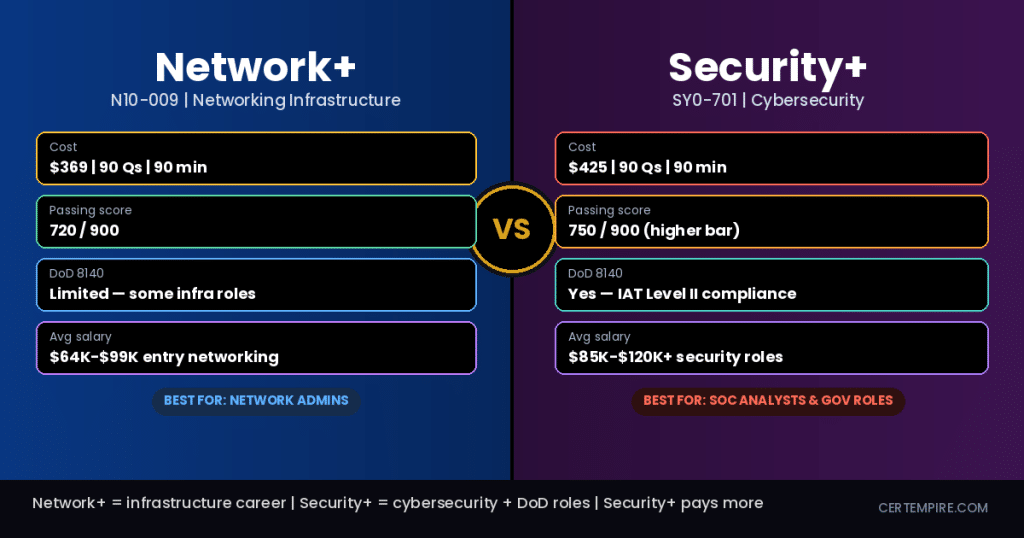
CompTIA Network+ (N10-009) is the right next certification if your career target is networking infrastructure — configuring, managing, and troubleshooting wired and wireless networks. CompTIA Security+ (SY0-701) is the right next certification if your career target is cybersecurity — protecting systems, responding to threats, and qualifying for roles that require DoD 8140 compliance. They are not competing certifications for the same career: they open different job families at different salary levels.
Quick Comparison Table
| Factor | Network+ N10-009 | Security+ SY0-701 |
| Focus | Network infrastructure | Cybersecurity fundamentals |
| Exam questions | Up to 90 | Up to 90 |
| Duration | 90 minutes | 90 minutes |
| Passing score | 720 / 900 | 750 / 900 |
| Cost | $369 USD | $425 USD |
| Recommended experience | 9-12 months IT + A+ | 2 years IT + networking knowledge |
| DoD 8140 compliance | Limited infrastructure roles | IAT Level II (most security roles) |
| Renewal | 3 years (30 CEUs) | 3 years (50 CEUs) |
| Average US salary | $64,000-$95,000 | $85,000-$120,000+ |
| Best for | Network admin, infrastructure | SOC analyst, security analyst |
| Next certification | CCNA 200-301 | CompTIA CySA+ |
The Core Difference: Infrastructure vs Security
Both certifications sit at roughly the same experience level in CompTIA’s path, but they test fundamentally different skills for fundamentally different jobs.
Network+ is about building and maintaining the infrastructure. If your daily work involves configuring routers, troubleshooting VLANs, setting up wireless access points, or fixing broken network connections, Network+ validates those skills.
Security+ is about protecting that infrastructure and the systems that run on it. If your daily work or career target involves detecting threats, analyzing vulnerabilities, implementing security controls, or responding to incidents, Security+ is the credential that opens those roles.
| Career dimension | Network+ | Security+ |
| Primary question they answer | “How do I build and fix this network?” | “How do I protect these systems from attack?” |
| Core skills | Routing, switching, wireless, VLANs, DNS, DHCP | Threat analysis, IAM, cryptography, incident response |
| Typical job titles | Network Administrator, Network Technician, NOC Analyst | Security Analyst, SOC Analyst, Information Security Specialist |
| Industries most relevant | Any organization with infrastructure | Government, defense, healthcare, finance, all sectors |
| DoD/government role | Limited | IAT Level II for most security positions |
| Natural next certification | CCNA 200-301 | CompTIA CySA+ |
What Network+ N10-009 Actually Tests
Network+ N10-009 is the current version, released June 2024 to replace N10-008. It added meaningful coverage of cloud networking, software-defined networking, zero trust at the conceptual level, and updated wireless standards.
| Domain | Weight | What it covers |
| Networking Concepts | 23% | OSI model, TCP/IP, IPv4/IPv6, ports, protocols, cloud models |
| Network Implementations | 19% | Switching (VLANs, STP), routing, wireless standards, cabling |
| Network Operations | 16% | Monitoring, traffic analysis, SNMP, performance baselines |
| Network Security | 19% | Firewalls, IDS/IPS, VPNs, authentication, zero trust basics |
| Network Troubleshooting | 23% | Systematic troubleshooting, tools (ping, traceroute, Wireshark) |
Network Security at 19% means Security is part of Network+, but as a supporting concept, not the primary focus. You will learn enough about firewalls and VPNs to configure and maintain them in a network environment. You will not develop the depth in threat response, risk management, or security operations that Security+ provides.
What Security+ SY0-701 Actually Tests
Security+ SY0-701, launched November 2023, shifted significantly toward Security Operations (28% — the heaviest single domain), reflecting what hiring managers say they actually need from entry-level security hires: people who can work in a SOC, not just recite security definitions.
| Domain | Weight | What it covers |
| General Security Concepts | 12% | Controls, frameworks, cryptography basics, authentication methods |
| Threats, Vulnerabilities and Mitigations | 22% | Attack types, malware, social engineering, vulnerability scanning |
| Security Architecture | 18% | Network segmentation, zero trust implementation, cloud security, hybrid environments |
| Security Operations | 28% | SIEM, incident response, forensics, log analysis, threat hunting |
| Security Program Management | 20% | Risk management, compliance, data governance, auditing |
Security Operations at 28% is the single largest domain and where most candidates with a pure study-without-experience background lose the most points. The performance-based questions in this domain require recognizing what a real incident looks like and what to do about it, not just defining terms.
Note on SY0-701 retirement: CompTIA estimates SY0-701 retirement in late 2026, following its standard three-year update cycle from the November 2023 launch. Verify the current active version on CompTIA’s website before scheduling.
Difficulty Comparison
Both exams use the same format (multiple-choice and performance-based questions, 90 minutes) but their difficulty profiles differ.
Network+ difficulty is technical and operational. Subnetting fluency, knowing your OSI layers cold, and being able to interpret a network diagram under time pressure are the core challenges. Performance-based questions simulate real troubleshooting scenarios. Working through N10-009 Network+ practice questions can help you apply troubleshooting methods and become more comfortable with exam-style scenarios.
Security+ difficulty is conceptual and analytical. Many questions present a scenario and ask what the best course of action is, or ask you to identify what type of attack is being described. The Security Operations domain is hardest for candidates without real SOC or incident response experience.
| Difficulty factor | Network+ | Security+ |
| Hardest topic | Subnetting, VLANs, protocol knowledge | Security Operations, risk management |
| PBQ style | Network diagram troubleshooting | Scenario-based security decisions |
| Study time needed | 8-12 weeks | 10-14 weeks |
| Experience matters | Significantly | Very significantly |
| First-attempt pass rate | Estimated 70-80% | Estimated 65-75% |
The DoD 8140 Difference
The most concrete, measurable difference between Network+ and Security+ from a career opportunity standpoint is DoD compliance.
Security+ satisfies DoD Directive 8140/8570 IAT Level II requirements, which is the baseline standard for the majority of US federal government cybersecurity positions, military IT security roles, and defense contractor information assurance jobs.
Network+ does not carry the same DoD baseline requirement for security roles. It may satisfy some infrastructure-focused positions but does not open the government cybersecurity role pipeline the way Security+ does.
If you are targeting federal government IT, military IT support, defense contracting, or clearance-eligible cybersecurity work, Security+ is not optional. It is the credential that makes you eligible for those positions.
Salary and Career Paths
| Certification | Entry role | US salary range | With 3-5 years experience |
| Network+ | Network Technician, Help Desk | $50,000-$70,000 | $75,000-$100,000 |
| Network+ | Network Administrator | $67,000-$99,000 | $90,000-$120,000 |
| Security+ | Security Analyst (entry) | $65,000-$85,000 | $90,000-$120,000 |
| Security+ | SOC Analyst (Tier 1) | $60,000-$80,000 | $95,000-$130,000+ |
| Network+ + Security+ | Security-aware network engineer | $80,000-$110,000 | $110,000-$145,000 |
Security+ opens roles with a higher salary ceiling because cybersecurity demand continues to outpace supply. ISC2’s 2024 Cybersecurity Workforce Study identified a global shortfall of 4.8 million cybersecurity professionals. That supply gap drives both higher starting salaries and faster advancement for Security+ holders compared to Network+ holders in pure networking roles.
Which Should You Take First
| Your situation | Right choice |
| You want to be a network engineer or admin | Network+ |
| You want to work in cybersecurity or a SOC | Security+ |
| You are targeting government or DoD roles | Security+ |
| You have A+ and want networking specialization | Network+ |
| You have A+ and want security specialization | Security+ |
| You already hold Network+ and want more | Security+ as a natural next step |
| You want both eventually | Network+ first, Security+ second |
| You have no IT experience at all | A+ first, then Network+ or Security+ |
Should You Take Both
Many IT professionals hold both Network+ and Security+, and the combination is more valuable than either alone. CompTIA’s stackable credential program automatically awards the CSIS (CompTIA Secure Infrastructure Specialist) designation when you hold A+, Network+, and Security+ simultaneously, no additional exam required.
From a practical standpoint, the security content on Security+ makes significantly more sense once you understand how networks actually work. Many Security+ domains reference network infrastructure concepts directly. Candidates who hold Network+ first consistently report the Security+ content feels more intuitive, particularly in the Security Architecture domain where network segmentation, firewall placement, and zero trust network design are tested.
Where Each Certification Leads
| After Network+ | After Security+ |
| CCNA 200-301 (Cisco networking) | CompTIA CySA+ (intermediate security analyst) |
| CompTIA Linux+ (system admin) | CompTIA PenTest+ (penetration testing) |
| CompTIA Server+ (server infrastructure) | CISSP (senior security leadership) |
| CompTIA Cloud+ (cloud networking) | SC-200 (Microsoft security operations) |
| CCNP Enterprise (senior networking) | CompTIA SecurityX (advanced practitioner) |
FAQs
Is Network+ or Security+ harder?
Security+ is slightly harder for most candidates. The passing score is higher (750 vs 720), the Security Operations domain tests scenario-based judgment that experience makes easier, and the total study time requirement is longer. Network+ is harder specifically in the subnetting and protocol areas for candidates without a networking background.
Can I skip Network+ and go straight to Security+?
Yes. No formal prerequisites are enforced by CompTIA. However, Security+ tests network concepts in several domains. Candidates without networking knowledge consistently find Security+ harder. CompTIA’s own recommendation is network knowledge equivalent to Network+ before attempting Security+.
Does Network+ satisfy DoD 8140 requirements?
Network+ satisfies requirements for some infrastructure-focused positions but does not satisfy the IAT Level II baseline requirement for most cybersecurity roles. Security+ is the certification that opens the majority of DoD and federal government cybersecurity positions.
Which pays more, Network+ or Security+?
Security+ correlates with higher salaries. Cybersecurity roles commanding $85,000 to $120,000 are the typical entry point for Security+ holders. Network+ administrators average $67,000 to $99,000. The gap grows with experience as cybersecurity specialists advance faster than general network administrators in most markets.
Do Network+ and Security+ expire at the same time?
Both expire after three years, but renewal requirements differ. Network+ requires 30 continuing education units (CEUs). Security+ requires 50 CEUs. Both can be renewed by passing a higher-level CompTIA certification that includes the lower credential, for example, CySA+ renews Security+.
What is the CompTIA trifecta?
The CompTIA trifecta refers to holding A+, Network+, and Security+ together. This combination earns the CSIS (CompTIA Secure Infrastructure Specialist) stackable credential automatically and signals a broad IT foundation with a security specialization to employers.
How long does it take to prepare for each?
Network+ typically requires 8 to 12 weeks at 10 hours per week for candidates with some IT experience. Security+ typically requires 10 to 14 weeks at the same pace. During this preparation period, SY0-701 Security+ practice questions can help candidates check their understanding and identify topics that need more attention. Both exams also benefit significantly from hands-on experience, real or simulated.
Is Security+ enough to get a cybersecurity job?
Security+ is one of the most requested entry-level cybersecurity credentials in job postings and opens a genuinely large number of positions. However, most job listings also expect some combination of hands-on experience, additional technical skills, or supplementary credentials. Security+ gets you through the ATS filter; your experience and interview performance determine whether you get the role.
What comes after Network+ if I want to specialize in networking?
CCNA 200-301 is the most direct next step for networking specialization. It is Cisco-specific, more demanding than Network+, and the credential most enterprise networking job postings require or prefer. Our Network+ vs CCNA guide covers this comparison in detail.
What comes after Security+ if I want to advance in cybersecurity?
CompTIA CySA+ (CS0-003) is the most common next step for blue team and SOC analyst careers. It builds directly on Security+’s threat detection and incident response content at a deeper operational level. Our CySA+ vs SecurityX guide covers the intermediate and advanced CompTIA security track options.