
Salesforce Application-Architect Real Exam Dumps [October 2026 Update]
Our Salesforce Application Architect Exam Questions provide accurate and up-to-date preparation material for the Salesforce Certified Application Architect certification. Developed around Salesforce’s current exam focus, the questions reflect real scenarios involving data modeling, application design, security architecture, declarative and programmatic development, integration patterns, and scalable Salesforce solution architecture. With verified answers, clear explanations, and exam-style practice, you can confidently prepare to validate your Salesforce application architecture expertise.
What Users Are Saying:
SALESFORCE APPLICATION-ARCHITECT – There Is No Application Architect Exam. There Are Four.
Before preparing for the Salesforce Certified Application Architect credential, every candidate needs to understand one thing: there is no standalone Application Architect exam to schedule. There is no separate application, no additional fee, and no separate review board. The credential is automatically awarded by Salesforce the moment you have passed all four prerequisite certifications.
Those four prerequisites are:
- Salesforce Certified Platform App Builder
- Salesforce Certified Platform Developer I
- Salesforce Certified Platform Data Architect (formerly Data Architecture and Management Designer)
- Salesforce Certified Platform Sharing and Visibility Architect (formerly Sharing and Visibility Designer)
Every “Application-Architect dumps” search is really a search for preparation across these four exams. That is exactly what Cert Empire provides – practice materials for each of the four certification paths, individually and as a preparation portfolio designed to build toward the Application Architect credential.
Why This Credential Exists and What It Proves
Salesforce designed the Application Architect credential to mark a specific threshold: the point at which a Salesforce professional has demonstrated expert-level mastery across the four disciplines that determine whether an enterprise Salesforce implementation is designed well.
Not configured well. Not used well. Designed well – the architectural judgment layer that determines whether a Salesforce solution scales, performs, stays secure, integrates cleanly, and remains maintainable as the business evolves.
The credential has a total cost of $1,200 for first attempts across all four exams (Platform App Builder $200, Platform Developer I $200, Platform Data Architect $400, Platform Sharing and Visibility Architect $400). Retakes add cost. Most candidates take eight to eighteen months from starting this journey to earning the credential – not because the exams are individually impossible, but because each one requires genuine operational depth that cannot be crammed in a weekend.
Salesforce uses scenario-based questions filtered specifically to test whether candidates have real-world architectural experience, not just exam preparation. At the architect tier, the questions are designed to surface whether you have actually made architectural decisions in production Salesforce environments. Candidates without that experience find the exams much harder than those who have.
This is one of the most respected credentials in the Salesforce ecosystem. It is the foundation of the path toward System Architect and Technical Architect – Salesforce’s highest professional recognition.
The Salesforce Architect Credential Pathway
Understanding the full architect pathway helps candidates plan their journey and understand what Application Architect unlocks.
Application Architect is the first major destination. It is earned automatically by passing the four prerequisites described above. It represents mastery of application-layer Salesforce architecture.
System Architect is the parallel credential, earned by passing four different prerequisites: Integration Architect, Identity and Access Management Architect, Development Lifecycle and Deployment Architect, and one additional credential. Like Application Architect, System Architect is automatically awarded.
Certified Technical Architect (CTA) is Salesforce’s highest credential, requiring both Application Architect and System Architect and passing a rigorous review board with a live presentation to a panel of senior architects. The CTA is one of the most difficult IT credentials in existence.
Application Architect is not the end of the journey. For most people who earn it, it is the beginning of the serious architect track.
The Four Prerequisite Exams: What Each Tests and Why Each Matters
Platform App Builder – The Declarative Foundation
Exam code: ADMN-202 (approximate) | Cost: $200 | Format: 60 questions, 90 minutes, 63% passing
The Platform App Builder certification validates declarative development competency – the ability to design and build custom Salesforce applications using Salesforce’s point-and-click tools without writing code. For architects, declarative capability matters because the best Salesforce architecture uses declarative solutions wherever possible, reserving programmatic development for requirements that genuinely cannot be met declaratively.
App Builder-level knowledge includes object modeling, field types and relationships, record types, page layouts, Lightning App Builder and Experience Builder, validation rules, formula fields, roll-up summaries, Flow builder for automation, approval processes, reports and dashboards, security model fundamentals (profiles, permissions sets, sharing model), and data management.
The Platform App Builder is often the first certification in the architect path because its breadth of coverage establishes the Salesforce platform vocabulary and mental model that all subsequent certifications build on. Candidates who attempt the higher-tier architect certifications without solid App Builder-level knowledge find gaps in their understanding that show up in unexpected places.
Platform Developer I – The Programmatic Layer
Exam code: PDI | Cost: $200 | Format: 60 questions, 105 minutes, 65% passing
Platform Developer I certifies proficiency in Apex (Salesforce’s Java-like programming language) and Lightning Web Components (Salesforce’s JavaScript component framework), Salesforce Object Query Language (SOQL), Salesforce Object Search Language (SOSL), the Salesforce data model from a developer perspective, governor limits, test classes and code coverage requirements, and deployment tools.
For architects, Platform Developer I knowledge matters because architectural decisions about when to use declarative versus programmatic solutions require understanding what programmatic solutions actually involve – the development effort, the maintenance overhead, the testing requirements, and the governor limit implications. An architect who cannot read and understand Apex cannot evaluate whether a proposed programmatic solution is well-designed.
Governor limits are among the most specifically tested developer concepts with architectural implications. Salesforce’s governor limits – maximum SOQL queries per transaction, maximum DML statements per transaction, maximum CPU time per transaction – are the constraints that determine when an architectural pattern that works in small implementations breaks in large ones. Understanding governor limits at a developer depth is required for making sound architectural decisions about automation, integration, and data processing.
Platform Data Architect – The Data Layer
Exam code: Plat-Arch-201 | Cost: $400 | Format: 60 questions, 105 minutes, 67% passing
This is the exam with the most direct architectural weight. Platform Data Architect validates expert-level competency in designing data models, managing large data volumes, implementing Master Data Management, and architecting data governance programs.
For architects, data model design is foundational: every other aspect of a Salesforce solution – performance, sharing, automation, integration – is affected by how the data model is structured. A data model designed with appropriate use of objects, relationships, and fields enables efficient queries and clean automation. A poorly designed data model creates performance problems, forces workarounds, and accumulates technical debt that becomes increasingly expensive to fix.
Large data volumes (LDV) is the data architect topic that most directly connects to production system behavior. Candidates who have not designed Salesforce implementations with millions of records find LDV questions more specific than expected – they test knowledge of sharing calculation deferral, skinny tables, PK chunking, and indexing strategies that only matter at enterprise scale.
Cert Empire provides dedicated Platform Data Architect preparation at this page. Because Plat-Arch-201 is a $400 exam and one of the technically deepest certifications in the Application Architect path, targeted preparation for it specifically is highly recommended rather than relying on general architect study materials.
Platform Sharing and Visibility Architect – The Security Layer
Exam code: Sharing-and-Visibility-Architect | Cost: $400 | Format: 60 questions, 105 minutes, 67% passing
The Platform Sharing and Visibility Architect certification validates expert-level competency in designing and implementing Salesforce’s record-level security model – the system that determines which users can see which records.
Salesforce’s sharing model is notoriously complex. The interaction between Organization-Wide Defaults (OWD), role hierarchies, sharing rules, manual sharing, Apex managed sharing, and implicit sharing creates a security model that can produce unexpected behavior when not carefully designed. The Sharing and Visibility Architect exam tests whether candidates have the depth to design sharing architectures that are both secure and performant.
Performance is specifically tied to sharing in Salesforce because complex sharing configurations – large numbers of sharing rules, deeply nested role hierarchies, extensive programmatic sharing – require significant platform computation to evaluate. Sharing calculations on large record sets can create performance problems, and the architect must design sharing configurations that meet security requirements without creating excessive computation overhead.
The architectural insight that this exam validates: security and performance are not independent concerns in Salesforce. Sharing model decisions are simultaneously security decisions and performance decisions, and architects must think about them both at once.
How the Four Exams Build on Each Other
Candidates who prepare each certification in isolation – finishing one exam and immediately starting fresh preparation for the next – miss the way these four certifications form a connected architectural curriculum.
Platform App Builder establishes the declarative foundation. Platform Developer I adds the programmatic layer on top of it. Platform Data Architect deepens the data model foundation that both declarative and programmatic development operates on. Platform Sharing and Visibility Architect adds the security model that sits across the entire data layer.
By the time you have prepared for all four, you have built a mental model of Salesforce architecture where every declarative and programmatic capability operates on a carefully designed data model secured by a deliberately designed sharing configuration. That complete mental model is exactly what the Application Architect credential certifies.
This connected view also creates preparation efficiency. The data model concepts introduced at the App Builder level are deepened in the Data Architect exam. The governor limit concepts introduced at the Platform Developer I level become architectural constraints in the Data Architect exam’s large data volume section. The sharing model security principles introduced in App Builder are mastered in the Sharing and Visibility Architect exam.
Candidates who study these certifications as a connected curriculum – reinforcing and deepening shared concepts across all four – reach Application Architect faster and with stronger understanding than those who treat each as an isolated study project.
The Preparation Order That Most Candidates Follow
No officially required sequence exists. Most candidates follow this order based on knowledge dependencies:
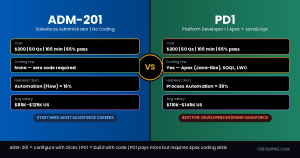
Step 1: Salesforce Administrator (ADM-201) – Not one of the four required credentials but an almost-universal first step. App Builder assumes platform familiarity that ADM-201 establishes. Most candidates have ADM-201 before starting the Application Architect path. Cert Empire provides Salesforce ADM-201 preparation here.
Step 2: Platform App Builder – Broadens declarative knowledge beyond ADM-201, introduces the full Lightning platform capabilities, and establishes the platform mental model that Platform Developer I builds on.
Step 3: Platform Developer I – Adds programmatic capabilities (Apex, LWC, SOQL, governor limits) that the developer perspective on Salesforce architecture requires.
Step 4: Platform Data Architect (Plat-Arch-201) – Deepens data model knowledge from App Builder, adds LDV, MDM, and data governance. Requires both declarative and developer knowledge from steps 2 and 3. Cert Empire provides Platform Data Architect preparation here.
Step 5: Platform Sharing and Visibility Architect – Builds on the data model from Plat-Arch-201 to add the full sharing and security architecture layer. By this point, candidates understand what data they are securing and can think about sharing architecture decisions in full context.
Application Architect credential automatically awarded when all four are in hand.
What the Architect-Level Exams Test That Developer and Admin Exams Do Not
Understanding what shifts when you move from the developer/admin tier to the architect tier prepares you mentally for what the $400 architect exams actually test.
At the admin and developer tier, most exam questions ask: “which feature does this?” or “what is the correct syntax for this?” These are knowledge questions with single correct answers derivable from the documentation.
At the architect tier, exam questions ask: “given these business requirements and these constraints, which architectural approach best balances security, performance, scalability, and maintainability?” These are judgment questions where multiple options are technically possible, the tradeoffs between them are real, and selecting the right answer requires understanding why one architectural approach is superior to another in the described context.
The Platform Data Architect question about whether to use a skinny table or custom indexing for a described large data volume scenario. The Sharing and Visibility Architect question about whether to use sharing rules or Apex managed sharing for a described complex security requirement. These questions do not have answers in a documentation page – they require understanding the full architectural context of each option and reasoning about which fits the described situation best.
This is why the architect exams cost $400 rather than $200. Salesforce is specifically trying to identify candidates with operational architectural experience, not just candidates who studied exam guides.
What Cert Empire’s Application Architect Preparation Provides
The Application Architect credential requires passing four separate exams. Cert Empire provides targeted preparation for the complete path.
✔ Platform Data Architect (Plat-Arch-201) preparation – the pivotal $400 exam
The Data Architect exam is the most technical and most architecturally demanding of the four prerequisites. Cert Empire’s Platform Data Architect preparation covers data skew, sharing calculation deferral, skinny tables, PK chunking, MDM implementation styles, Big Objects versus standard objects, and data governance – all at the architectural judgment depth the exam requires.
✔ Foundation preparation for Platform App Builder and Administrator
Cert Empire’s ADM-201 Administrator preparation provides the platform foundation that the Application Architect path builds on. Platform App Builder preparation is available through our complete Salesforce catalog.
✔ Scenario-based questions matching the architect exam format
All four architect-path exams use scenario-based questions that require architectural judgment, not just knowledge recall. Our practice questions present enterprise scenarios with multiple plausible architectural approaches and require selecting the option that best balances all stated requirements and constraints.
✔ Practice under real exam conditions with the Cert Empire Exam Simulator
The Cert Empire exam simulator replicates the timed format and scenario-based question style for each of the four prerequisite exams. After every session, it identifies specific knowledge gaps – not just which exam domain to study more but which specific architectural judgment scenarios need more practice.
✔ Instant access, 90-day free updates, and 24/7 support
Materials for each exam are available immediately after purchase. 90-day updates are included with each purchase as Salesforce updates exam content with seasonal releases. Support is available around the clock.
✔ Full money-back guarantee
If any preparation materials do not meet your expectations, you receive a full refund. Explore our complete Salesforce certification catalog.
Realistic Expectations Before You Start This Path
The Application Architect credential is earned over months, not weeks. Being realistic about the journey prevents the most common failure mode: starting strong, burning out on the third exam because the preparation was not paced for a multi-month credential journey.
Salesforce recommends five or more years of experience before attempting the architect-tier credentials. That recommendation is not arbitrary – the scenario questions on the $400 exams are specifically designed to distinguish between candidates who have read about architectural decisions and candidates who have made them in production environments.
Candidates with three to four years of solid Salesforce experience can succeed on these exams with thorough preparation, but they need to be deliberate about building the architectural reasoning skills the exams test – not just the product knowledge.
The most common path to Application Architect for active Salesforce professionals runs eight to twelve months: two to three months per certification in sequence, with each certification reinforcing understanding of the previous ones.
FAQS
Is there a standalone Salesforce Application Architect exam?
No. The Salesforce Certified Application Architect credential is automatically awarded when you pass all four prerequisite certifications: Platform App Builder, Platform Developer I, Platform Data Architect (Plat-Arch-201), and Platform Sharing and Visibility Architect. There is no separate Application Architect exam to schedule, no additional fee, and no review board for this credential (unlike the CTA).
What are the four prerequisite certifications for Application Architect?
Platform App Builder ($200, 60 questions, 90 minutes, 63% passing), Platform Developer I ($200, 60 questions, 105 minutes, 65% passing), Platform Data Architect – also known as Plat-Arch-201 ($400, 60 questions, 105 minutes, 67% passing), and Platform Sharing and Visibility Architect ($400, 60 questions, 105 minutes, 67% passing). Total first-attempt cost: $1,200.
What does Application Architect unlock in the Salesforce certification pathway?
Application Architect is one of two domain architect credentials that together qualify a candidate to attempt the Salesforce Certified Technical Architect (CTA) Review Board – Salesforce’s highest credential. The other domain architect credential is System Architect, earned by passing Integration Architect, Identity and Access Management Architect, and Development Lifecycle and Deployment Architect. Holding both Application Architect and System Architect qualifies candidates for the CTA process.
How long does it typically take to earn the Application Architect credential?
Most candidates take eight to eighteen months from starting the journey to earning the credential, depending on prior Salesforce experience and study pace. Salesforce professionals with five or more years of hands-on experience in enterprise Salesforce implementations can often complete the path in eight to twelve months with focused preparation. Candidates with less experience typically need twelve to eighteen months.
Which of the four prerequisite exams is the most challenging?
Platform Data Architect (Plat-Arch-201) and Platform Sharing and Visibility Architect are both $400 architect-tier exams and are significantly more challenging than the $200 developer and admin exams. Between the two, the Platform Data Architect exam is most frequently cited as the most technically demanding due to its coverage of large data volume strategies, MDM implementation styles, and the architectural depth of its data governance questions.
Is ADM-201 required for Application Architect?
ADM-201 (Salesforce Administrator) is not one of the four required prerequisites for Application Architect. However, Platform App Builder assumes substantial Salesforce platform knowledge that ADM-201 establishes, and most candidates who attempt the Application Architect path have ADM-201 first. Attempting Platform App Builder without ADM-201-level knowledge creates unnecessary difficulty.
Reviews
Related Posts
-

-
-
-
-
-

Priya –
How long did it take you to get through all the dumps? Any tips for pacing study sessions?
Priya –
Yep, it took me about 2 weeks, just doing a few sections each night after work. I’d say don’t try to rush-maybe focus on one topic per session and actually review the explanations, not just the answers. Taking short notes helped me remember tricky stuff.
Parker J. –
Does anyone know if these exam dumps work well on a tablet or mobile? Also, if I switch devices, will my progress or bookmarks sync automatically or do I have to start over each time?
Parker J. –
Yeah, works fine on my phone. Progress didn’t sync though-I had to mark stuff again on each device.
Parker J. –
Agree, same for me-no syncing across devices, so I just use one to keep it simple.
Mia B. –
Is there any kind of refund or guarantee if these dumps turn out not to match the actual exam format? Just want to know before buying.