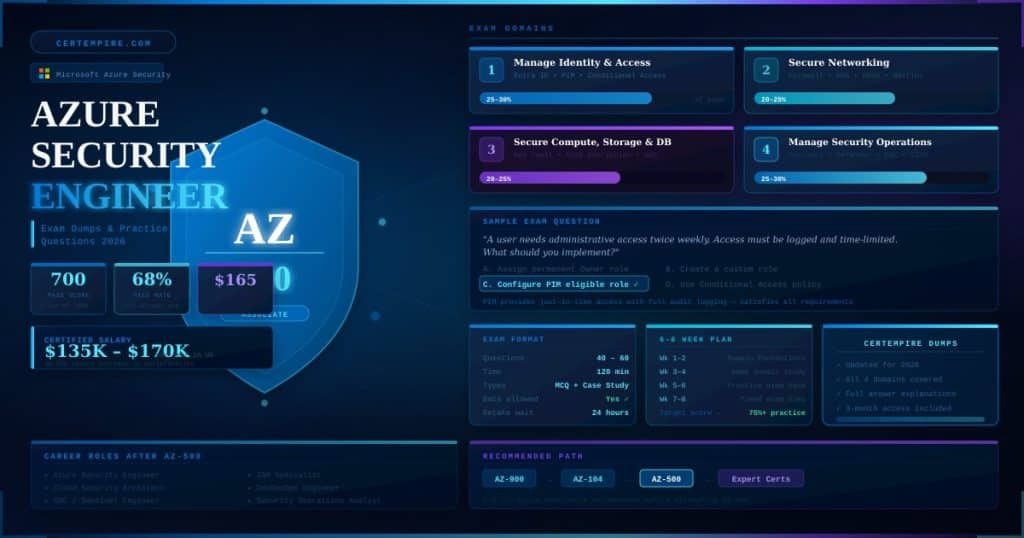
What you are looking for: Updated AZ-500 exam questions and answers that reflect the current exam blueprint, cover all four domains, and prepare you to pass Microsoft Certified: Azure Security Engineer Associate on your first attempt. CertEmpire’s AZ-500 dumps are reviewed by our certified Microsoft professional, updated continuously to match the latest exam content, and built to mirror the actual exam format. Hence, there are no surprises on test day.
AZ-500 Exam Overview: What You Are Preparing For
The AZ-500, officially titled Microsoft Azure Security Technologies, is the exam that earns you the Microsoft Certified: Azure Security Engineer Associate credential. It validates your ability to implement security controls across Azure environments, manage identity and access, protect data and applications, and respond to security threats using Microsoft’s security toolset.
As an Azure security engineer, you implement, manage, monitor and secure resources in Azure and multi-cloud environments. With your knowledge, you are also able to recommend which configurations and services can be used to protect identities, data, applications and networks.
While technically an associate level exam, AZ-500 is one of the more difficult associate-level Microsoft certification exams. You are expected to have practical experience in administering Azure hybrid environments
The exam is not just theoretical. It tests how you apply Azure security tools in real scenarios, which is exactly why exam preparation using scenario-based questions that mirror the actual format is so critical to first-attempt success.
AZ-500 Exam at a Glance
| Detail | Specification |
| Exam Code | AZ-500 |
| Full Name | Microsoft Azure Security Technologies |
| Credential Earned | Microsoft Certified: Azure Security Engineer Associate |
| Number of Questions | 40 to 60 |
| Time Allowed | 120 to 150 minutes |
| Passing Score | 700 out of 1000 |
| Exam Cost | $165 USD (regional pricing applies) |
| Languages | English, Japanese, Chinese (Simplified), Korean |
| Retake Policy | 24 hours after first failure, 14 days after subsequent attempts |
| Maximum Attempts | 5 per 12-month period |
| Renewal | Annual renewal required |
The Azure AZ-500 exam has 40 to 60 questions, 120 minutes time limit, 700 out of 1000 passing score, and costs $165 USD. Pass rate is around 68%.
Candidates who do not pass the AZ-500 exam can retake it after waiting 24 hours from their previous attempt. They are allowed a total of five attempts in 12 months. After five attempts, candidates must wait 12 months before retaking the exam.
AZ-500 Exam Domains: What the Questions Actually Cover
The AZ-500 exam is organized into four domains. Every question in CertEmpire’s AZ-500 dumps maps to one of these domains, weighted to reflect the actual exam distribution.
Domain 1: Manage Identity and Access (25–30%)
This is the largest domain and consistently the most heavily tested area on the AZ-500. Candidates must demonstrate mastery of Microsoft Entra ID (formerly Azure Active Directory), identity protection, privileged identity management, and conditional access policies.
Key topics in this domain include configuring Microsoft Entra ID for workload identities, implementing Privileged Identity Management (PIM) for just-in-time access, configuring and managing Conditional Access policies, implementing multi-factor authentication, managing external identities and guest access, configuring Azure AD Connect and hybrid identity scenarios, implementing identity protection policies, and managing service principals and managed identities.
Sample question from this domain:
You have an Azure subscription. You need to ensure that users can only access Azure resources from devices that are joined to your on-premises Active Directory domain. Which Conditional Access policy condition should you configure?
A. Sign-in risk B. Device platforms C. Device state — Hybrid Azure AD joined D. Locations
Correct answer: C
Configuring the Device state condition set to Hybrid Azure AD Joined ensures that Conditional Access policies only allow access from devices that have been joined to both on-premises Active Directory and Azure AD. This is the correct control for enforcing domain-joined device compliance in a hybrid environment.
Domain 2: Secure Networking (20–25%)
This domain covers network security controls within Azure including virtual network security, perimeter protection, network monitoring, and securing connectivity between Azure resources and on-premises environments.
Key topics include implementing Azure Firewall and Azure Firewall Manager, configuring network security groups and application security groups, implementing Azure DDoS Protection, configuring Azure Bastion for secure remote access, implementing Azure Private Link and private endpoints, configuring VPN Gateway and ExpressRoute security, implementing Web Application Firewall (WAF) policies, and configuring network monitoring with Network Watcher.
Sample question from this domain:
You have an Azure virtual network named VNet1 that contains several virtual machines. You need to ensure that traffic between the virtual machines is inspected and filtered. The solution must minimize administrative overhead. What should you implement?
A. Azure Application Gateway B. Azure Firewall with forced tunneling C. Network security groups on each subnet D. Azure Firewall deployed to VNet1
Correct answer: D
Azure Firewall deployed to the virtual network provides centralized traffic inspection and filtering for all traffic within and between subnets with minimal per-resource configuration. NSGs on each subnet require per-subnet management and do not provide deep packet inspection.
Domain 3: Secure Compute, Storage, and Databases (20–25%)
This domain tests your ability to apply security controls to Azure compute resources, storage accounts, and database services. It is increasingly important as cloud workloads become more complex and data protection regulations more demanding.
Key topics include configuring just-in-time VM access, implementing disk encryption with Azure Disk Encryption and Server-Side Encryption, securing Azure Kubernetes Service clusters, configuring container registry security, implementing storage account security including shared access signatures and storage firewall rules, enabling Advanced Threat Protection for Azure SQL Database, configuring Azure Key Vault for secrets, keys, and certificate management, and implementing customer-managed keys.
Sample question from this domain:
You have an Azure Key Vault that stores several secrets. You need to ensure that a specific application can read secrets from the Key Vault but cannot create or delete secrets. The solution must follow the principle of least privilege. What should you configure?
A. Assign the application the Key Vault Contributor role at the Key Vault scope B. Assign the application the Key Vault Secrets User role at the Key Vault scope C. Assign the application the Key Vault Administrator role at the Key Vault scope D. Grant the application Owner permissions on the Key Vault
Correct answer: B
The Key Vault Secrets User role provides read-only access to secrets without granting create, update, or delete permissions. This satisfies the principle of least privilege. Key Vault Contributor grants management plane access, not data plane access to secrets.
Domain 4: Manage Security Operations (25–30%)
This domain covers Microsoft’s security monitoring and response toolset, including Microsoft Sentinel, Microsoft Defender for Cloud, and the broader Microsoft security ecosystem. It is equally weighted with Domain 1 and requires understanding of how to configure, operate, and respond to security alerts.
Key topics include configuring Microsoft Defender for Cloud and security policies, implementing Microsoft Sentinel workspaces and data connectors, creating and managing Sentinel analytics rules and workbooks, configuring continuous export and workflow automation, implementing Azure Monitor and Log Analytics for security monitoring, managing security alerts and incidents, configuring Microsoft Defender for servers, containers, databases, and storage, implementing regulatory compliance dashboards, and creating and running Kusto Query Language (KQL) queries for security investigation.
Sample question from this domain:
You have a Microsoft Sentinel workspace. You receive an alert indicating a potential brute force attack against one of your virtual machines. You need to automatically isolate the affected virtual machine when this alert is triggered. What should you configure in Microsoft Sentinel?
A. A workbook B. An analytics rule with an entity mapping C. A playbook connected to an automation rule D. A hunting query
Correct answer: C
Automation rules in Microsoft Sentinel can trigger playbooks automatically when specific alerts are generated. The playbook, built using Azure Logic Apps, executes the isolation action against the affected virtual machine. Workbooks are for visualization and hunting queries are for proactive threat detection, not automated response.
AZ-500 Question Types: Know What You Will Face
For AZ-500, you are mostly likely to see the following question types: Multiple choice where there are multiple possible answers and only one answer is correct, multiple choice multiple select where one or more answers are correct, drag and drop where you have movable options that you must correctly place, built list reorder where you move options and place them in the correct order, and active screen where you select or mark options on a screen element such as a desktop window.
You can open learn.microsoft.com inside the exam UI to consult product documentation in a split pane. Time continues, and access is limited to documentation only.
This open-documentation feature sounds helpful but is a time trap for unprepared candidates. Candidates who rely on looking things up during the exam almost always run out of time. The documentation access is useful only for confirming syntax or specific configuration details, not for learning concepts from scratch during the exam. Practice under timed conditions without documentation dependence.
The AZ-500 certification exam is split into five major sections, each with different types of questions. These include multiple choice, case study, drag and drop, and short answer questions.
Case study questions present a complex multi-page scenario describing a company’s Azure environment, requirements, and constraints. You must answer several questions based solely on the information provided in the case study. These questions require careful reading and the ability to extract relevant requirements from a large amount of text, which is exactly what the scenario-based questions in CertEmpire’s AZ-500 dumps train you to do.
AZ-500 Sample Questions and Answers by Topic
The following questions represent the style and difficulty level of what appears on the actual AZ-500 exam. Each covers a high-frequency topic area.
Q: Microsoft Defender for Cloud — Regulatory Compliance
Your organization needs to demonstrate compliance with ISO 27001 requirements across your Azure subscriptions. You need to view a compliance dashboard showing current compliance status against ISO 27001 controls. What should you use?
A. Microsoft Sentinel compliance workbook B. Microsoft Defender for Cloud regulatory compliance dashboard C. Azure Policy compliance report D. Azure Monitor compliance alerts
Answer: B — Microsoft Defender for Cloud’s regulatory compliance dashboard maps your Azure resource configurations to specific controls within compliance frameworks including ISO 27001, PCI DSS, SOC 2, and others. Azure Policy provides individual policy compliance data but not the mapped framework view.
Q: Privileged Identity Management — Just-in-Time Access
You have an Azure subscription. A user named User1 needs to perform administrative tasks in the subscription approximately twice per week. You need to ensure that User1 has administrative access only when needed and that all activations are logged. Which solution should you implement?
A. Assign User1 the Owner role permanently B. Configure User1 as an eligible member for a privileged role using PIM C. Create a custom role for User1 with Owner permissions D. Configure a Conditional Access policy restricting User1’s access
Answer: B — Privileged Identity Management allows eligible role assignments where users can activate their role for a defined time window when needed. All activations are logged and can require approval and MFA. Permanent role assignments do not satisfy the just-in-time requirement.
Q: Azure Sentinel — Data Connectors
You deploy Microsoft Sentinel and need to ingest security events from your Azure Active Directory tenant including sign-in logs and audit logs. What should you configure?
A. Azure Monitor Diagnostic Settings sending logs to the Sentinel workspace B. The Microsoft Entra ID data connector in Microsoft Sentinel C. A Log Analytics agent on each domain controller D. Azure Event Hub with a Sentinel analytics rule
Answer: B — The Microsoft Entra ID data connector in Microsoft Sentinel is the purpose-built connector for ingesting Azure AD sign-in logs and audit logs. It connects directly to the Entra ID log stream without requiring agents or diagnostic setting configuration.
Q: Storage Security — Shared Access Signatures
You have a storage account that contains a container with sensitive financial reports. You need to grant a partner organization temporary read access to a specific blob for 48 hours. The access must automatically expire and must not require sharing the storage account key. What should you use?
A. A stored access policy assigned to the container B. A service-level SAS token with a defined expiry time C. An account-level SAS token D. Azure AD role assignment for the partner’s service principal
Answer: B — A service-level SAS token grants access to a specific resource within the storage account for a defined time period without exposing the storage account key. Setting an expiry time 48 hours in the future satisfies the automatic expiration requirement.
Q: Network Security — Azure Firewall vs NSG
You have an Azure virtual network with multiple subnets. You need to implement a solution that provides centralized outbound traffic filtering for all subnets, blocks traffic to known malicious IP addresses using threat intelligence feeds, and generates logs of all allowed and denied traffic. What should you deploy?
A. Network security groups on each subnet B. Azure Application Gateway with WAF C. Azure Firewall Premium with threat intelligence enabled D. Azure DDoS Protection Standard
Answer: C — Azure Firewall Premium provides centralized outbound traffic filtering across all subnets, integrates with Microsoft threat intelligence to block known malicious IPs automatically, and logs all traffic to Log Analytics. NSGs provide per-subnet filtering but lack centralized management and built-in threat intelligence.
Q: Key Vault — Certificate Management
You have an application running in Azure App Service that requires an SSL/TLS certificate. You need to store the certificate securely and ensure that the application can retrieve it without storing credentials in application code. What should you configure?
A. Store the certificate in Azure Blob Storage with a SAS token in the application settings B. Store the certificate in Azure Key Vault and configure the App Service with a managed identity C. Upload the certificate directly to the App Service TLS/SSL settings D. Store the certificate in Azure Files and mount it to the App Service
Answer: B — Storing the certificate in Azure Key Vault and using a managed identity to authenticate the App Service to Key Vault eliminates the need for credentials in application code entirely. The managed identity provides automatic, credential-free authentication that follows the principle of eliminating secret management from application code.
How CertEmpire’s AZ-500 Dumps Are Built
CertEmpire’s AZ-500 exam questions are designed to help you think like an actual cloud security professional. These practice questions mirror the Microsoft exam pattern, guiding you through what’s required to pass the exam on your first attempt.
Cloud security is an ever-evolving field, so being current is the cornerstone of AZ-500 exam prep. CertEmpire’s certified exam coaches keep the content of the practice questions up to date with the latest exam requirements so that you always have the latest exam questions and resources available to you.
Every question in the CertEmpire AZ-500 dumps includes a full explanation of the correct answer and why each incorrect option is wrong. This explanation layer is what separates effective exam preparation from simple answer memorization. Understanding the reasoning behind each answer builds the judgment that the AZ-500’s scenario-based questions actually test.
Enjoy full, unrestricted access for three months, long enough to practice, revise, and retake simulations until you are satisfied with your results.
AZ-500 Salary and Career Outcomes
The financial case for AZ-500 is strong. Professionals with Azure AZ-500 certification typically earn $135,000 to $170,000 per year in the US. The certification often leads to a 10 to 20% salary increase and opens doors to senior roles.
Passing AZ-500 can boost your salary with an average of $100,000+ per year, make you eligible for top-tier cybersecurity roles, improve your credibility as a certified Azure Security Engineer, and help you stand out in the high-demand cloud security job market.
Job titles available to AZ-500 certified professionals include Azure Security Engineer, Cloud Security Architect, Security Operations Analyst, SOC Analyst, Microsoft Sentinel Engineer, Identity and Access Management Specialist, Cloud Infrastructure Security Engineer, and DevSecOps Engineer.
Cloud security is one of the fastest-growing disciplines in IT. Every organization operating on Azure needs professionals who can implement and manage the security controls that protect their cloud environment. The AZ-500 certification is the direct credential that validates exactly those skills.
AZ-500 Study Plan: 6 to 8 Weeks to Pass
Most candidates need 6 to 8 weeks of dedicated study to pass. Using practice questions and study guides significantly improves your chances.
Here is the study sequence that consistently produces first-attempt passes.
Weeks 1 to 2: Domain foundations
Download the official AZ-500 exam skills outline from Microsoft Learn. Work through the official Microsoft Learn paths for each domain. Focus on understanding the purpose and function of each Azure security service before drilling into configuration details. Set up a free Azure account and explore the Microsoft Defender for Cloud dashboard, Microsoft Sentinel workspace, Key Vault, and Entra ID PIM interface hands-on.
Weeks 3 to 4: Deep domain work
Work through each domain systematically with a focus on the highest-weighted areas: Manage Identity and Access and Manage Security Operations each carry 25 to 30 percent of the exam. Cover Conditional Access policies, PIM configuration, Sentinel analytics rules, Defender for Cloud security policies, and Key Vault in detail. Practice KQL queries for log analysis as these appear directly in exam scenarios.
Weeks 5 to 6: Practice exam intensity
This is where CertEmpire’s AZ-500 dumps become the primary study tool. Take full-length timed practice exams under real exam conditions. Review every incorrect answer in detail using the provided explanations. Identify your weak domains and return to Microsoft Learn content for those specific areas. Aim to score consistently above 75% on practice exams before booking your test date.
Practice answering questions while occasionally confirming syntax or behaviors in product docs. This mirrors the embedded documentation experience and trains your time management.
Weeks 7 to 8: Exam readiness and final preparation
Focus exclusively on the practice exams available at https://certempire.com/practice-tests/free-az-500-practice-questions/ and weak area review. Simulate the exam environment including time pressure and the discipline of not spending more than two minutes on any single question. By week eight, consistent scores above 80% in timed practice indicate strong first-attempt readiness.
AZ-500 Prerequisites and Recommended Background
There are no mandatory exam requirements for the AZ-500 exam. But you definitely should prepare for AZ-500 by first preparing for and passing at least the AZ-900 certification exam. You will also benefit from any other certification exams that will help reinforce your foundational knowledge, including the AZ-104 exam, AZ-204, AZ-800, and even AZ-305.
Recommended background for AZ-500 candidates includes one to two years of hands-on Azure experience, familiarity with Microsoft Entra ID (Azure AD) and identity concepts, basic understanding of networking concepts including VNets, subnets, NSGs, and routing, experience with Azure Portal and comfort with PowerShell or Azure CLI for security configuration tasks.
Understanding PowerShell, Azure CLI, and JSON is helpful for the AZ-500 exam.These are not tested directly as coding skills but appear in scenario questions where you must identify correct commands or configuration syntax.
AZ-500 Exam Day Strategy
Time management is critical. With 40 to 60 questions in 120 minutes, you have approximately two to three minutes per question. Flag difficult questions and move on. Return to flagged questions after completing the full exam rather than spending ten minutes on a single question and running out of time.
No points will be deducted from your score for wrong answers. Therefore, attempt all questions even if you are unsure. Be aware that not all the exam questions will count towards your final mark.
Read scenario questions carefully. Many questions hinge on subtle requirements such as “only from managed devices.” The differentiating detail is almost always in the requirements section of the scenario. Read the requirements before reading the answer options.
Use documentation access strategically. The embedded Microsoft Learn documentation is available during the exam but time keeps running. Use it only to confirm a specific configuration detail you almost remember, not to research concepts from scratch.
For case studies, read the requirements first. In case study questions, go to the requirements tab before reading the full scenario. Knowing what you need to find makes reading the scenario significantly more efficient.
Frequently Asked Questions
How many questions are on the AZ-500 exam?
The Azure AZ-500 exam has 40 to 60 questions with a 120 minute time limit.
Microsoft does not publish the exact question count for any specific exam sitting.
What is the passing score for AZ-500?
The passing score is 700 out of 1000. This passing score is based on a statistical analysis of all candidates’ performance and reflects the minimum knowledge required to show proficiency in each area of security administration.
How difficult is the AZ-500 exam?
AZ-500 is one of the more difficult associate-level Microsoft certification exams. The industry first-attempt pass rate is approximately 68%, meaning roughly one in three candidates fails on their first attempt without adequate preparation.
Can I use notes or documentation during the AZ-500 exam?
You can open learn.microsoft.com inside the exam UI to consult product documentation in a split pane during the exam. Time continues, and access is limited to documentation, not Q&A, your profile, or practice items.
How long is the AZ-500 certification valid?
The AZ-500 certification requires annual renewal. Microsoft offers a free online renewal assessment through Microsoft Learn that allows you to renew without retaking the full proctored exam.
What happens if I fail the AZ-500?
Candidates who do not pass the AZ-500 exam can retake it after waiting 24 hours from their previous attempt. They are allowed a total of five attempts in 12 months.
How much does the AZ-500 exam cost?
The AZ-500 certification exam is currently $165 USD and the price is subject to change and local currency conversion. Academic pricing is also available for students. Microsoft moved to regionalized pricing in November 2024, so your local price may differ from the USD figure.
How long should I study for AZ-500?
Most candidates need 6 to 8 weeks of dedicated study to pass, assuming studying 1 to 2 hours daily. Candidates with strong existing Azure security experience may require less time.
Why CertEmpire AZ-500 Dumps Outperform the Competition
The AZ-500 exam tests applied security judgment, not definition recall. A question does not ask you to define what Azure Firewall is. It presents a scenario with specific requirements and asks you to choose between four plausible Azure security solutions, each of which could be correct under different circumstances.
Passing the AZ-500 certification is about developing the aptitude required of a Microsoft security engineer. Loaded with detailed explanations and extensive references, CertEmpire’s AZ-500 exam questions are designed to help you think like an actual cloud security professional.
Every question in the CertEmpire AZ-500 prep material is built around this principle. The questions present real Azure security scenarios. The answer explanations explain not just which answer is correct but why each incorrect option falls short under the specific requirements given. This explanation depth is what builds the scenario reasoning skill that the AZ-500 actually tests.
Cert Empire offers free practice tests for the AZ-500 exam. Start with the free questions to experience the format and difficulty level before committing to the full question bank.
The AZ-500 exam has a 68% first-attempt pass rate across all candidates. Candidates who prepare with quality scenario-based practice materials consistently outperform that average. The difference between passing and failing is not how much time you spend studying. It is whether your preparation matches what the exam actually tests.