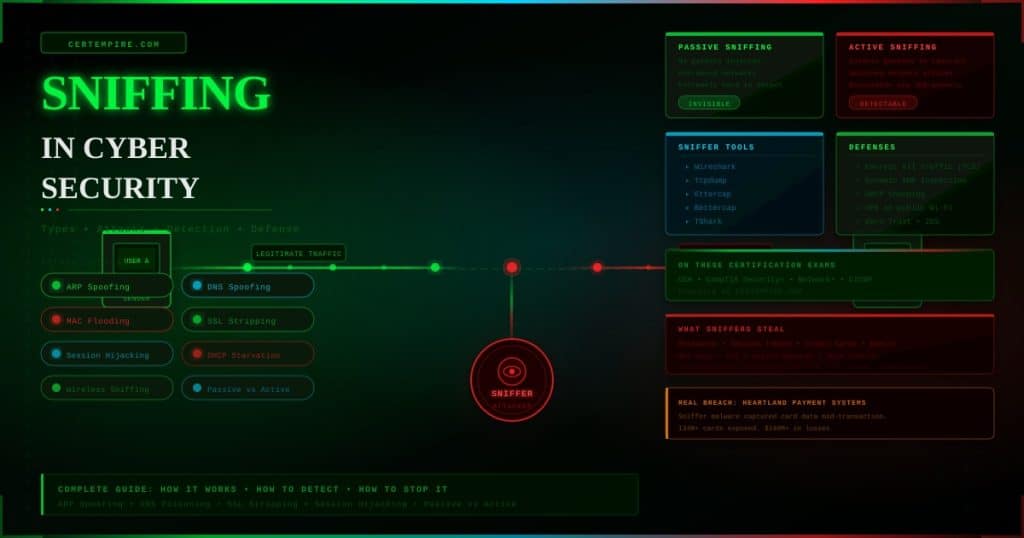
What this guide covers: Network sniffing is one of the most foundational attack techniques in cybersecurity, and one of the most misunderstood. This guide explains exactly what sniffing is, how passive and active attacks work, every attack method in detail, real-world examples of sniffing being used in major breaches, the tools defenders and attackers both use, and a complete prevention framework you can apply immediately. If you are studying for a cybersecurity certification, every concept in this guide maps directly to exam objectives for Security+, CEH, CISSP, and CompTIA Network+.
What Is Sniffing in Cyber Security?
Sniffing is a term used to describe the unauthorized interception of data packets as they travel across a network. These data packets contain valuable information, such as login credentials, personal details, financial transactions, or other sensitive data. Cybercriminals employ specialized tools or software to capture and analyze these packets, allowing them to extract valuable information without the knowledge of the sender or recipient.
Think of a network like a highway and data packets like vehicles moving along it. Network sniffing is the equivalent of installing a camera at the side of the road that records every vehicle passing by, reading the cargo each one carries. When the highway is properly enclosed and monitored, this is impossible. When it is open, poorly segmented, or unencrypted, everything is readable to anyone who positions themselves correctly.
In its simplest form, sniffing is the act of intercepting and monitoring traffic on a network. This can be done using software that captures all data packets passing through a given network interface or by using hardware devices explicitly designed for this purpose. Ethical hackers can use sniffing to gain tremendous insights into the workings of a network and the behavior of its users, which can be used to improve an organization’s cybersecurity. However, when employed by malicious hackers, sniffing can be used to launch devastating attacks against unsuspecting targets.
Sniffing is a process of monitoring and capturing all data packets passing through a given network. Sniffers can be hardware or software installed in the system.
The dual nature of sniffing is critical to understand. The same tool, technique, and methodology that a network administrator uses to troubleshoot a slow connection is the same one an attacker uses to harvest credentials from employees in a coffee shop. Context and authorization are what separate legitimate network analysis from criminal interception.
Sniffing is one of the most common reconnaissance techniques used during penetration testing and cyberattacks, especially in unsecured or poorly segmented network environments. In today’s interconnected landscape of cloud platforms, IoT devices, mobile networks, and remote work environments, the attack surface has expanded exponentially. Sniffing remains a top threat especially when data is transmitted in unencrypted formats such as HTTP and FTP, when public or open Wi-Fi is used without a VPN, and when networks lack proper segmentation or intrusion detection.
How Sniffing Works: The Technical Foundation
To understand sniffing attacks, you need to understand how data moves across a network and where the interception opportunity exists.
Every time you send data across a network, whether it is a login request, an email, a file transfer, or a web page load, that data is broken into packets. Each packet contains a header with routing information (source and destination IP addresses, ports, protocol) and a payload containing the actual data. Packets travel from router to router, switch to switch, until they reach their destination, where they are reassembled into the original message.
Under normal operation, a network interface card (NIC) only processes packets addressed to its own MAC address. It sees all the traffic on the network segment but discards anything not meant for it. Sniffing exploits a mode called promiscuous mode.
Promiscuous Mode: When a network adapter is placed in promiscuous mode, it captures and processes every packet that travels across the network segment, regardless of the destination address. The adapter stops discarding traffic that is not addressed to it and instead passes all of it to the capturing software for analysis.
Promiscuous mode is a network adapter setting that allows it to receive all traffic on the network, not just traffic addressed to it.
This is how sniffer software works at the hardware level. The operating system is configured to accept all packets rather than only those addressed to the local machine, and the sniffer software records, decodes, and stores everything that passes through.
What data can be captured by sniffing?
Sniffers intercept packets at the data link layer, capturing traffic such as emails, credentials, and file transfers, especially in unencrypted channels. Sniffing can collect usernames, passwords, emails, credit card numbers, browser sessions, and other sensitive unencrypted data.
The critical qualifier is “unencrypted.” Properly encrypted traffic can still be captured by a sniffer but cannot be read without the decryption key. This is why encryption is the foundational defense against sniffing and why protocols like HTTP, FTP, and Telnet remain dangerously vulnerable even in 2026.
Passive Sniffing vs Active Sniffing
The first major distinction in sniffing attacks is between passive and active techniques. They work differently, target different network environments, and have very different detectability profiles.
Passive Sniffing
Passive sniffing involves the passive monitoring and capturing of network traffic without actively injecting any packets into the network. Attackers use tools like packet sniffers to intercept data packets as they traverse the network. Passive sniffing is harder to detect than active sniffing since it does not generate additional traffic.
Passive sniffing is the eavesdropper who sits quietly in a room and listens. No interaction with the network. No injected packets. No modification of traffic. The attacker simply listens to everything that flows past a network interface placed in promiscuous mode.
Passive sniffing is most effective on hub-based networks. Unlike switches, which forward packets only to the specific port of the intended recipient, hubs broadcast every packet to all ports on the network. This means every device on a hub-connected network receives every packet from every other device, making passive sniffing trivially easy. Any attacker on the same hub segment can capture all traffic from all other devices without generating a single additional packet or triggering any network anomaly.
The primary danger of passive sniffing is its invisibility. Because it generates no additional network traffic and requires no interaction with target systems, it produces no logs, no alerts, and no anomalies that standard monitoring tools can detect. It can run indefinitely on a compromised or physically accessed system without discovery.
Active Sniffing
Unlike passive sniffing, active sniffing involves injecting packets into the network to facilitate the interception of data traffic. This method allows attackers to manipulate network traffic, insert malicious payloads, or perform other nefarious activities.
Modern enterprise networks use switches rather than hubs. Switches are intelligent devices that maintain a MAC address table and forward packets only to the port connected to the intended recipient’s MAC address. This means a passively listening attacker on a switched network only sees broadcast traffic and traffic specifically addressed to their own MAC address, making passive sniffing largely ineffective.
Active sniffing overcomes this limitation through manipulation. Rather than simply listening, the attacker injects specially crafted packets into the network to manipulate routing tables, MAC address tables, or ARP caches so that traffic intended for other devices is redirected through the attacker’s machine. The attacker becomes an invisible relay, receiving traffic, reading it, and forwarding it on to the legitimate destination so neither party notices the interception.
Active packet sniffing attacks are easier to detect than passive attacks. Most packet sniffing attacks are passive, meaning they silently gather data while it is passing through your network, which makes them extremely difficult to detect. However, an active sniffer is forced to communicate with the network it is monitoring, which causes the network to become overloaded with traffic and makes it simpler to identify.
The tradeoff for the attacker is detectability. Active sniffing generates network traffic and interactions that intrusion detection systems, network monitoring tools, and properly configured security teams can identify. This is why detection tooling and network monitoring are so important even when all traffic is encrypted: active sniffing leaves traces.
Types of Sniffing Attacks
Active sniffing encompasses several specific attack techniques, each exploiting a different network protocol or mechanism. These are the attack types most frequently tested in cybersecurity certification exams and most commonly seen in real-world incidents.
ARP Spoofing (ARP Poisoning)
ARP stands for Address Resolution Protocol. ARP is the mechanism that maps IP addresses to MAC addresses on a local network. When Device A wants to communicate with Device B, it sends an ARP request broadcasting “who has IP address X?” Device B responds with its MAC address, and Device A caches this mapping in its ARP table to use for future communications.
ARP spoofing involves manipulating the ARP to link an attacker’s address to a legitimate IP address.
In an ARP spoofing attack, the attacker sends falsified ARP reply messages to the network without being asked. These fake ARP replies associate the attacker’s MAC address with the IP address of a legitimate device, such as the default gateway or another workstation. Once devices on the network update their ARP caches with this false information, they begin sending traffic intended for the legitimate device to the attacker’s machine instead.
ARP spoofing is where attackers send falsified ARP messages to link their MAC address with the IP address of a legitimate device, intercepting data meant for that device.
The attacker then forwards the intercepted traffic to the legitimate destination, creating a transparent man-in-the-middle position. All communication flows through the attacker, who reads or modifies it in transit. The communicating parties are unaware anything is wrong because their traffic appears to arrive normally.
ARP spoofing is the foundation for most active man-in-the-middle attacks on local area networks. It is the technique that makes attacks like session hijacking, credential theft, and SSL stripping possible on switched networks.
Defense against ARP spoofing: Dynamic ARP Inspection (DAI) on managed switches, static ARP entries for critical systems, encryption of all traffic so intercepted content is unreadable, and network monitoring for ARP anomalies.
DNS Spoofing (DNS Cache Poisoning)
DNS spoofing alters the domain name system, redirecting users to malicious sites.
DNS is the phonebook of the internet. When you type a domain name into your browser, your system queries a DNS resolver to translate that name into an IP address. DNS spoofing attacks corrupt this translation process by injecting false DNS records that redirect users to attacker-controlled IP addresses instead of the legitimate destinations.
DNS spoofing involves altering DNS resolution processes to redirect users to malicious sites.
In the sniffing context, DNS spoofing is used to redirect victims to attacker-controlled servers that mimic legitimate sites. The victim believes they are connecting to their bank, email provider, or corporate VPN, but they are actually sending their credentials directly to the attacker’s infrastructure. Even if the attacker cannot decrypt the victim’s actual network traffic, DNS spoofing allows them to create a fake endpoint that accepts the traffic directly.
DNS spoofing can be accomplished through ARP poisoning (position the attacker between the victim and their DNS resolver), through compromising a DNS resolver directly, or through BGP hijacking at the routing level in more sophisticated attacks.
Defense against DNS spoofing: DNSSEC (DNS Security Extensions) which cryptographically validates DNS responses, DNS over HTTPS (DoH), and DNS over TLS (DoT) which encrypt DNS queries, network monitoring for anomalous DNS responses, and certificate validation which causes browser warnings when a fake site lacks a trusted certificate.
DHCP Starvation and Rogue DHCP Server Attacks
DHCP (Dynamic Host Configuration Protocol) is the service that automatically assigns IP addresses, subnet masks, default gateways, and DNS server addresses to devices when they join a network.
In a DHCP starvation attack, the attacker floods the DHCP server with spoofed requests, exhausting the pool of available IP addresses. When the legitimate DHCP server has no addresses left to distribute, the attacker sets up a rogue DHCP server. New devices joining the network request an IP address, receive one from the rogue server, and the attacker uses this opportunity to assign themselves as the default gateway or DNS server in the configuration they provide. All subsequent network traffic from the victim flows through the attacker.
Defense against DHCP attacks: DHCP snooping on managed switches, which validates DHCP messages and restricts which ports can respond to DHCP requests, and port security features that limit MAC address flooding.
MAC Flooding
Every switch maintains a Content Addressable Memory (CAM) table that maps MAC addresses to switch ports. When a switch knows which port a MAC address is connected to, it forwards packets only to that port. If the switch does not have an entry for a destination MAC address, it broadcasts the packet to all ports, effectively behaving like a hub.
In a MAC flooding attack, the attacker sends massive numbers of frames with spoofed, randomly generated source MAC addresses. The switch CAM table fills completely and can no longer store new legitimate entries. When the table overflows, the switch enters “fail-open” mode and begins broadcasting all traffic to all ports, just like a hub. The attacker can then capture all broadcast traffic passively, effectively defeating the switched network’s protection.
Defense against MAC flooding: Port security features on managed switches that limit the number of MAC addresses per port, VLAN segmentation to contain broadcast domains, and network monitoring for CAM table overflow events.
Session Hijacking
HTTP session hijacking captures web session data, allowing attackers to impersonate users.
After a user authenticates to a web application, the server typically issues a session token, often stored as a cookie, that identifies that authenticated session for subsequent requests. The server trusts that whoever presents this token is the legitimate authenticated user.
In a session hijacking attack, the attacker intercepts the session token through sniffing. Once they have a valid session token, they can make requests to the web application as if they were the authenticated user, without ever needing the user’s password. The original user may remain logged in and unaware that their session is being simultaneously used by an attacker.
Session hijacking through sniffing was dramatically more common before HTTPS became universal. When session cookies were transmitted over unencrypted HTTP connections, any attacker on the same network could trivially capture them with a basic sniffer. Tools specifically designed for this attack made it trivially easy to execute against users on open Wi-Fi networks.
Defense against session hijacking: HTTPS everywhere with HSTS (HTTP Strict Transport Security), HttpOnly and Secure flags on session cookies, session token rotation after privilege changes, short session timeouts, and binding sessions to client IP addresses or TLS fingerprints where feasible.
SSL Stripping
SSL stripping is a sophisticated active sniffing technique that downgrades HTTPS connections to HTTP by exploiting the transition moment when a user’s browser first connects to a site.
The attacker, positioned between the victim and the web server through ARP spoofing, intercepts the initial HTTP request and establishes their own HTTPS connection with the legitimate server. The attacker then serves the victim an HTTP version of the page rather than the HTTPS version. The victim’s browser shows an unencrypted connection while the attacker maintains an encrypted connection to the real server, relaying modified content and harvesting all credentials and data in plaintext.
From the victim’s perspective, the website loads normally. Most users do not check whether their connection is HTTP or HTTPS, and even those who do may not notice the missing padlock icon.
Defense against SSL stripping: HSTS with long max-age values and the preload directive, which instructs browsers to never connect to the site over HTTP regardless of what an attacker tells them. Browser HSTS preload lists make SSL stripping impossible against sites that are registered in the preload list. Monitoring for certificate anomalies and training users to verify HTTPS connections before entering credentials.
Wireless Sniffing
Wireless sniffing targets data transmitted over insecure Wi-Fi connections, capturing information like login credentials and financial transactions.
Wireless networks are particularly vulnerable to sniffing because radio signals broadcast in all directions through the air. Any device within range of a wireless access point receives all the radio signals, even if the packets within those signals are not addressed to it. Unlike wired networks where physical access to the cable or a switch port is required, wireless sniffing requires only proximity to the network.
Sniffing attacks are especially prevalent in environments where wireless networks are used, as attackers do not require physical access to network hardware to conduct the attack.
On unencrypted or weakly encrypted wireless networks, all traffic is readable to any attacker within range. Even on WPA2-encrypted networks, an attacker who has the network password can decrypt traffic from other clients by capturing the four-way handshake that occurs when each client authenticates. WPA3 addresses this through Simultaneous Authentication of Equals (SAE), which provides forward secrecy and prevents decryption of other clients’ traffic even with the network password.
Public Wi-Fi networks in airports, hotels, coffee shops, and conference venues are the highest-risk environment for wireless sniffing. These networks often have no encryption, large numbers of simultaneous users, and no mechanism to prevent one client from capturing traffic from another.
Defense against wireless sniffing: WPA3 encryption on all corporate wireless networks, mandatory VPN for all wireless connections particularly on public networks, avoiding transmission of sensitive data over unencrypted wireless connections, and network access controls that prevent client-to-client communication.
Real-World Sniffing Attacks: What Actually Happened
Understanding sniffing in the abstract is useful. Understanding what it looks like when it succeeds against real organizations makes the threat concrete and the defenses urgent.
The Heartland Payment Systems Breach
The breach of one of the largest credit card processors in the US was orchestrated by a sophisticated operation. The threat actors installed malware on Heartland’s network to steal payment card data as it was being processed. This type of attack is known as a sniffer because it intercepts data in transit.
This breach remains one of the most instructive examples of network-level sniffing deployed at scale. The attackers did not steal stored card data. They intercepted card data in the moment it was processed, before it could be encrypted and stored. The sniffer malware positioned itself in the processing pipeline and captured card numbers, expiration dates, and track data in the brief window when the data existed in unencrypted form for processing.
The Home Depot Breach
Attackers gained access to the company’s network via a third-party vendor’s credentials and then installed custom-built malware on the self-checkout systems in US and Canadian stores. This malware acted as a sniffer, capturing credit and debit card information as customers swiped their cards. The attack went undetected for months, from April to September 2014.
The Home Depot breach illustrates the danger of network sniffing combined with third-party access. The initial access was through a vendor’s compromised credentials, not through breaking into Home Depot’s own systems. Once inside, the sniffer malware ran undetected for five months, capturing payment card data at the point of sale, in the moment between the card swipe and the encrypted transmission to the payment processor.
The Snowflake Credential Campaign (2024)
In May 2024, a significant breach involving the cloud data platform Snowflake was linked to compromised user credentials, impacting several high-profile organizations including Santander Bank, Ticketmaster, and AT&T. The breach was the result of compromised credentials circulating on the dark web, stemming from information stealer malware infections. These compromised accounts, which did not have Multi-Factor Authentication enabled, provided attackers with unauthorized access to organizations’ Snowflake systems.
The Snowflake campaign represents the modern evolution of credential harvesting. Information stealer malware, which acts as a persistent network and system sniffer harvesting browser-saved passwords, session cookies, and authentication tokens from infected devices, generated the credentials that fueled the campaign. The malware captured credentials at the moment of use, before they were encrypted in transit, exactly the same principle as traditional network sniffing but operating on the endpoint rather than the network.
These breaches share a common thread: data was captured in an unprotected state during a window of vulnerability, either during transmission before encryption, at the processing layer before storage encryption, or at the endpoint before the credential was transmitted. Closing those windows is the entire goal of sniffing defense.
Sniffing Tools: What Attackers and Defenders Both Use
The same tools serve both legitimate network analysis and malicious sniffing. Understanding these tools is essential knowledge for cybersecurity professionals and is tested directly on CEH, CompTIA Security+, and Network+ certification exams.
Wireshark
Wireshark is the most widely used network protocol analyzer in the world. It captures network traffic in real time, decodes hundreds of protocols, and provides a powerful filtering and analysis interface. Network administrators use it daily for troubleshooting. Penetration testers use it to analyze captured traffic during assessments. Attackers use it for the same reasons.
Wireshark can be run in promiscuous mode to capture all traffic on a network segment. It saves captures in PCAP format that can be analyzed offline. Its protocol dissectors can decode and display the contents of HTTP, FTP, Telnet, SMTP, and other unencrypted protocol traffic in readable form.
Tcpdump
Tcpdump is the command-line equivalent of Wireshark, available on virtually every Unix and Linux system. It is often the tool of choice on servers and systems where a graphical interface is not available. Tcpdump captures are saved in PCAP format and can be transferred for analysis in Wireshark.
Ettercap
Ettercap is used for man-in-the-middle attacks. It automates ARP spoofing, SSL stripping, and session hijacking, providing a point-and-click interface for executing active sniffing attacks against targets on local networks. Ettercap is a standard tool in penetration testing toolkits and is explicitly included in CEH and OSCP curricula.
Cain and Abel
Cain and Abel is commonly used in Windows environments. It is a password recovery and network sniffing tool for Windows that includes ARP poisoning, passive network sniffing, and password hash cracking capabilities. While it has not been updated in years, it remains a reference tool in certification curricula.
TShark
TShark is a terminal-based version of Wireshark. It provides Wireshark’s protocol dissection and filtering capabilities in a command-line interface, making it useful for capturing on remote systems and for scripted analysis of network traffic.
Bettercap
Bettercap is the modern successor to Ettercap, actively maintained and significantly more capable. It supports ARP spoofing, DNS spoofing, HTTP and HTTPS sniffing, Wi-Fi monitoring and deauthentication, Bluetooth sniffing, and a web-based interface for managing attacks. It is the tool of choice for modern wireless network assessments and is increasingly referenced in penetration testing certifications.
Knowing these tools is exam-critical. The CEH certification tests knowledge of specific sniffing tools, their capabilities, and their appropriate use in ethical hacking engagements. The CertEmpire CEH practice exam resources include questions covering sniffing tool selection, attack technique identification, and defense recommendations, mapped to the current CEH exam blueprint.
How to Detect Sniffing Attacks
Detection is the hardest part of defending against sniffing, particularly against passive attacks. However, several techniques can identify sniffing activity on a network.
Promiscuous Mode Detection
You can use tools like Nmap, Netstat, and Wireshark to detect sniffing activity by identifying promiscuous mode network cards or unusual traffic patterns.
Nmap’s –script sniffer-detect script sends specific packets to each host on a network and analyzes the responses to identify whether a host’s network adapter is in promiscuous mode. On Windows systems, the network adapter promiscuous mode status can be queried through the registry or through network monitoring utilities.
ARP Table Monitoring
Since ARP spoofing is the foundation of most active sniffing attacks, monitoring ARP tables for anomalous entries is one of the most practical detection techniques. Legitimate ARP caches are relatively stable. Sudden changes in the MAC address associated with the default gateway IP, or rapid ARP cache updates for many hosts, indicate ARP spoofing in progress.
Intrusion detection systems like Snort can be configured with ARP anomaly detection rules. Network management platforms that track MAC-to-IP mappings can alert when associations change unexpectedly.
Ping and DNS Response Time Analysis
A host running a sniffer and relaying traffic introduces a slight latency into communications because it is processing each packet before forwarding it. Comparing ping response times between direct connections and connections through suspected relay hosts can reveal intermediate sniffer nodes. This technique is not definitive but can corroborate other detection signals.
Intrusion Detection Systems (IDS)
Intrusion Detection Systems play a pivotal role in identifying and mitigating sniffing activities. Systems like Snort, Zeek, and Security Onion analyze network traffic in real-time, using a combination of signature-based, anomaly-based, and stateful protocol analysis to detect suspicious activities. Implementing IDS provides an early warning system that helps in detecting potential threats before they can cause harm.
Snort can be configured to detect MAC flooding, ARP spoofing patterns, DHCP starvation attacks, and promiscuous mode probing. Zeek (formerly Bro) provides deep protocol analysis and can identify unusual network behavior patterns that indicate active sniffing. Security Onion packages these tools with a management interface and dashboards for enterprise-scale network monitoring.
Traffic Volume Analysis
Active sniffing attacks, particularly MAC flooding and DHCP starvation, generate significantly more network traffic than normal operations. Baseline traffic analysis and automated alerting on traffic volume anomalies can flag these attacks in their early stages before significant damage occurs.
How to Prevent Sniffing Attacks: A Complete Defense Framework
Prevention operates at multiple layers simultaneously. No single control stops all sniffing attacks. Defense in depth is the only approach that works.
Encryption: The Non-Negotiable Foundation
Network sniffing attacks can be detected and prevented using a combination of encryption protocols, secure authentication mechanisms, network monitoring tools, and robust network design principles. Implementing Transport Layer Security (TLS) for all traffic that contains credentials and, after authentication is successful, all traffic that carries session tokens is recommended. Using HTTPS for login pages protects passwords from sniffing attacks.
Encryption is the single most important sniffing defense. Even if an attacker successfully positions themselves to capture all network traffic, encrypted traffic is computationally infeasible to read without the decryption key. The entire value proposition of sniffing attacks against encrypted traffic collapses.
Specific encryption requirements for sniffing defense include TLS 1.2 or 1.3 for all web traffic with no HTTP fallback, HSTS with preloading for public-facing web services, VPN for all remote access and particularly for any use of public wireless networks, SSH instead of Telnet for all remote administration, SFTP or FTPS instead of FTP for all file transfers, and S/MIME or PGP for email encryption where confidentiality is critical.
Legacy protocols that transmit credentials in plaintext, including Telnet, FTP, HTTP basic authentication, and POP3 without TLS, must be eliminated from any network environment that handles sensitive data. Their continued use makes sniffing attacks trivial.
Network Segmentation and Zero Trust
Segmentation limits the broadcast domain, reducing the scope for sniffers to access sensitive data from multiple areas.
A flat network where every device can reach every other device on the same broadcast domain is a sniffing attacker’s ideal environment. Proper network segmentation divides the network into zones based on trust level and function, limits broadcast domains to small groups of related devices, and enforces access controls between zones through firewalls and access control lists.
As of 2026, organizations are adopting AI-based threat detection, advanced encryption protocols, and Zero Trust models to combat sniffing.
Zero Trust architecture takes this further by eliminating the concept of implicit trust entirely. Every connection is authenticated and authorized regardless of network location. Even a device on the internal corporate network cannot access resources without verified identity and explicit authorization. This eliminates the scenario where a compromised internal device can passively sniff all corporate traffic.
Switch Security Features
Several features available on managed enterprise switches directly counter active sniffing attacks.
Dynamic ARP Inspection (DAI) validates ARP packets against a DHCP snooping binding table. Only ARP packets with matching IP-to-MAC mappings from the DHCP binding table are forwarded. Forged ARP replies from an attacker attempting ARP spoofing are dropped before they can corrupt the ARP caches of other devices.
DHCP Snooping creates a binding table of legitimate DHCP assignments and restricts which switch ports can respond to DHCP requests. Only designated trusted ports connected to DHCP servers can send DHCP offers and acknowledgments. Rogue DHCP servers on access ports are blocked automatically.
Port Security limits the number of MAC addresses that can be associated with each switch port. When a port sees more MAC addresses than its configured limit, the switch can shut down the port, restrict traffic, or generate an alert. This directly counters MAC flooding attacks that try to overflow the CAM table.
Private VLANs prevent direct communication between devices within the same VLAN, eliminating client-to-client sniffing on shared network segments.
Strong Authentication and Multi-Factor Authentication
Stolen credentials are the prize that makes credential-targeting sniffing attacks valuable. Even if an attacker captures credentials through sniffing, strong multi-factor authentication makes those captured credentials significantly less useful.
IBM’s 2024 data showed compromised credentials in 16% of breaches, and by 2025 Verizon reports 22% of breaches started that way.
MFA requires a second factor that the attacker does not have even if they have captured the password. Hardware security keys, such as FIDO2-compliant devices, are the strongest form of MFA because they are phishing and sniffing resistant by design. They sign a challenge that is specific to the legitimate website’s origin, making them useless even if captured by a man-in-the-middle attacker.
Certificate-based authentication eliminates passwords entirely for device and user authentication, removing the credential-stealing opportunity that drives most network sniffing attacks.
VPN for All Remote and Wireless Access
Always use secure connections including VPN and HTTPS, avoid public Wi-Fi without protection, and keep software up to date.
A VPN creates an encrypted tunnel between the client device and the corporate network, encrypting all traffic before it leaves the device. Even if an attacker successfully captures all wireless traffic in a coffee shop or airport, the encrypted VPN tunnel makes the captured traffic unreadable. The attacker sees only the encrypted outer envelope of VPN packets, not the contents.
Split tunneling configurations, where only corporate traffic goes through the VPN and internet traffic breaks out directly, should be evaluated carefully. If the goal is to protect against wireless sniffing in public environments, all-traffic VPN routing provides stronger protection.
Wireless Network Security
WPA3 is the current standard for wireless network security and should be deployed on all corporate wireless infrastructure. WPA3’s Simultaneous Authentication of Equals (SAE) handshake provides forward secrecy, meaning that capturing the four-way handshake and the network password is insufficient to decrypt traffic from other clients, unlike WPA2 which is vulnerable to this attack.
For enterprise wireless deployments, WPA3-Enterprise with 802.1X authentication and certificate-based client authentication provides the strongest available wireless security, eliminating shared passwords entirely and binding each client connection to a verified digital identity.
Sniffing in Ethical Hacking and Penetration Testing
Understanding sniffing from an offensive perspective is required knowledge for ethical hackers and penetration testers. Sniffing is a core component of network-layer reconnaissance and man-in-the-middle testing during authorized security assessments.
Ethical hackers can use sniffing to gain tremendous insights into the workings of a network and the behavior of its users, which can be used to improve an organization’s cybersecurity.
In an authorized penetration test, sniffing techniques are used to identify unencrypted protocols in use on the network, capture credentials transmitted in cleartext, identify legacy or misconfigured services that expose sensitive data, demonstrate the impact of ARP spoofing and man-in-the-middle positioning, and validate that network segmentation controls are working as designed.
The ethical hacker’s goal is to find and demonstrate these vulnerabilities before a malicious attacker does, giving the organization the opportunity to remediate before real damage occurs.
Using sniffers without permission is illegal in most countries. However, authorized sniffing is essential for ethical hackers who always ensure they have explicit authorization before conducting any network sniffing.
Authorization is absolute. Network sniffing without explicit written authorization from the system owner is illegal in virtually every jurisdiction and can result in criminal prosecution under computer fraud and abuse laws. There are no gray areas. Written authorization that explicitly includes network sniffing activities is required before any ethical hacker touches a packet capture tool.
Sniffing is directly tested in the CEH (Certified Ethical Hacker) certification, which dedicates an entire module to sniffing techniques, tools, and countermeasures. It appears in CompTIA Security+ exam objectives covering network attacks and defenses. It is tested in CISSP within the network security domain. And it is a core topic in CompTIA Network+ as part of understanding how switches, ARP, and network protocols work.
The CertEmpire certification practice resources cover sniffing-related topics across CEH, Security+, CISSP, and Network+ with scenario-based practice questions that mirror the format and difficulty of the actual exams. If sniffing is on your exam blueprint, practicing these questions is the most efficient way to verify your readiness before your test date.
Sniffing and Compliance: What the Regulations Require
Sniffing defenses are not just a security best practice. They are increasingly a regulatory requirement.
PCI DSS (Payment Card Industry Data Security Standard) requires encryption of cardholder data in transit, network segmentation, and prohibition of unencrypted legacy protocols on networks that handle payment data. The Heartland and Home Depot breaches described earlier directly violated these requirements and resulted in significant fines and liability.
HIPAA (Health Insurance Portability and Accountability Act) requires encryption of protected health information in transit, network monitoring, and access controls that prevent unauthorized interception of patient data. Healthcare organizations running unencrypted internal networks face regulatory liability when sniffing attacks result in PHI exposure.
GDPR (General Data Protection Regulation) requires appropriate technical measures to protect personal data, explicitly including encryption of data in transit. A sniffing attack that exposes personal data of EU residents can trigger mandatory breach notification and regulatory investigation.
ISO 27001 includes controls for network security management, encrypted communications, and intrusion detection that directly address sniffing threats. Organizations pursuing ISO 27001 certification are expected to demonstrate that their network architecture prevents unauthorized traffic interception.
Understanding the regulatory context of sniffing defenses is particularly important for CISSP candidates, as the exam tests the ability to align security controls with business and compliance requirements rather than simply knowing the technical details of the attacks.
Frequently Asked Questions
What is the difference between sniffing and spoofing?
Sniffing is the interception and capture of network traffic. Spoofing is the falsification of network identifiers such as MAC addresses, IP addresses, or ARP records. In practice, spoofing is often used to enable sniffing. ARP spoofing redirects traffic through the attacker so it can be sniffed. DNS spoofing redirects connections to attacker infrastructure. IP spoofing can help an attacker position themselves for traffic interception. They are distinct techniques that are often used together.
Can sniffing happen on HTTPS websites?
Standard network sniffing captures encrypted HTTPS traffic but cannot read its contents without the private key. However, SSL stripping attacks can downgrade HTTPS connections to HTTP where sniffing becomes effective again. HSTS and certificate pinning prevent SSL stripping. Additionally, endpoint-based information stealers capture credentials before they are encrypted, bypassing transport-layer protections entirely.
Is Wireshark illegal to use?
Wireshark itself is a legal tool. Using it on your own network or on networks where you have explicit authorization is legal and legitimate. Using it to capture traffic on networks you do not own and do not have authorization to monitor is illegal under computer fraud and abuse laws in most jurisdictions. Authorization is what determines legality, not the tool itself.
What data is most at risk from sniffing attacks?
Sniffing can collect usernames, passwords, emails, credit card numbers, browser sessions, and other sensitive unencrypted data. The data at highest risk is anything transmitted over protocols that do not encrypt their payloads: HTTP, FTP, Telnet, SMTP without TLS, POP3 without TLS, and SNMP v1 and v2.
How do I know if someone is sniffing my network?
Active sniffing attacks can be detected through ARP table monitoring, promiscuous mode detection using tools like Nmap, and IDS alerts. Passive sniffing is extremely difficult to detect because it generates no additional network traffic and leaves no traces on the network. The most reliable way to defend against passive sniffing is to assume it may be happening and encrypt all traffic so captured data is unreadable.
What certifications cover sniffing in depth?
The CEH (Certified Ethical Hacker) covers sniffing most thoroughly, dedicating an entire module to attack techniques, tools, and countermeasures. CompTIA Security+ covers sniffing within its network attack content. CompTIA Network+ covers the underlying network concepts that make sniffing possible. CISSP covers sniffing within network security domain content. All of these exams are covered in the CertEmpire practice exam library, where you can validate your sniffing knowledge before your test date.
The Bottom Line
Sniffing remains one of the most powerful techniques in both attacker and defender toolkits precisely because it operates at the fundamental level of how networks function. Data in motion is vulnerable. The protocols that carry most network traffic were not designed with confidentiality as a core requirement. And the tools that can capture that traffic are free, widely available, and trivially easy to operate.
The defenses are equally available. Encryption renders captured traffic unreadable. Network segmentation limits what any single attacker position can see. Switch security features defeat active sniffing techniques before they can redirect traffic. IDS and network monitoring catch the anomalies that active attacks necessarily create. Zero Trust architecture eliminates the implicit trust that makes lateral movement after a successful sniff so valuable.
Understanding sniffing at this level, both the attack mechanics and the defense architecture, is the difference between a cybersecurity professional who knows that sniffing is bad and one who can actually stop it.
For anyone studying toward the CEH, Security+, Network+, or CISSP, sniffing is a topic you will see on your exam. The CertEmpire certification practice resources are where you practice the scenario-based questions that turn conceptual understanding into exam-ready knowledge.