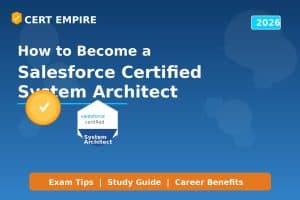
The Salesforce Certified System Architect credential has become one of the most sought-after certifications in the Salesforce ecosystem. As businesses continue their digital transformation journey in 2026, the demand for skilled System Architects who can design scalable, secure, and efficient Salesforce solutions has reached an all-time high. This comprehensive guide will walk you through everything you need to know about becoming a Salesforce Certified System Architect, from prerequisites to exam preparation strategies and career opportunities.
What is a Salesforce Certified System Architect?
A Salesforce Certified System Architect is an expert-level professional who possesses comprehensive knowledge of Salesforce architecture and can design complex technical solutions that meet business requirements. This certification validates your ability to assess architecture environments, identify risks, and design robust Salesforce solutions that scale with organizational growth.
The System Architect certification is actually composed of two separate certifications that you must obtain:
- Salesforce Certified Application Architect
- Salesforce Certified Data Architect
Once you’ve earned both credentials, you automatically qualify for the System Architect designation, demonstrating your mastery of both application design and data management principles within the Salesforce platform.
Why Pursue the Salesforce System Architect Certification in 2026?
Career Advancement Opportunities
The Salesforce ecosystem continues to expand rapidly, with over 150,000 companies worldwide using the platform. Organizations are actively seeking professionals who can architect enterprise-level solutions, making System Architects some of the most in-demand roles in the market.
Competitive Salary Expectations
According to recent industry data, Salesforce Certified System Architects command impressive salaries:
- Entry-level System Architects: $110,000 – $140,000 per year
- Mid-level System Architects: $140,000 – $180,000 per year
- Senior System Architects: $180,000 – $250,000+ per year
These figures can vary based on location, company size, and individual experience, but the certification consistently demonstrates strong ROI.
Professional Recognition
The System Architect certification places you in an elite group of Salesforce professionals. It’s recognized globally as a mark of technical excellence and strategic thinking capability, opening doors to consulting opportunities, leadership positions, and high-impact projects.
Prerequisites: What You Need Before Starting
Required Certifications
Before attempting either the Application Architect or Data Architect exams, you must first obtain:
- Salesforce Certified Platform App Builder – Demonstrates your ability to design, build, and implement custom applications using the declarative customization capabilities of the Salesforce Platform.
- Salesforce Certified Platform Developer I – Validates your knowledge and skills in building custom applications on the Salesforce Platform using programmatic capabilities.
Recommended Experience
While Salesforce doesn’t mandate specific years of experience, successful candidates typically have:
- 3-5 years of hands-on Salesforce experience across multiple clouds and implementations
- Real-world architecture experience designing solutions for complex business requirements
- Understanding of integration patterns and experience with APIs, middleware, and data migration
- Knowledge of software development lifecycle and agile methodologies
- Business analysis skills to translate business needs into technical solutions
Technical Skills Foundation
You should be comfortable with:
- Salesforce data model and schema design
- Security and sharing architecture
- Governor limits and performance optimization
- Integration patterns and best practices
- Mobile application considerations
- Lightning Platform capabilities
- DevOps and deployment strategies
Understanding the Two Architect Exams
Salesforce Certified Application Architect Exam
Exam Format:
- 60 multiple-choice questions
- 105 minutes to complete
- Passing score: 65%
- Registration fee: $400 USD
- Retake fee: $200 USD
Key Topics Covered:
- Domain Modeling and Data Governance (10%)
- Understanding complex data models
- Data governance frameworks
- Master data management principles
- Functional Requirements and User Interface (13%)
- Gathering and analyzing requirements
- UI/UX design principles
- Lightning Experience considerations
- Security and Sharing (13%)
- Object-level, field-level, and record-level security
- Sharing rules and role hierarchies
- External object security
- Business Logic and Process Automation (13%)
- Declarative automation (Flow, Process Builder)
- Apex triggers and best practices
- Complex business logic implementation
- Data Management (7%)
- Data migration strategies
- Data quality and deduplication
- Large data volume considerations
- Analytics, Reports, and Dashboards (7%)
- Reporting strategies for complex requirements
- Custom report types
- Einstein Analytics considerations
- Mobile (7%)
- Salesforce Mobile App customization
- Offline capabilities
- Mobile-first design principles
- Integration and Development Lifecycle (10%)
- API selection and design
- Integration patterns
- Deployment strategies
- Solution Design (20%)
- End-to-end solution architecture
- Scalability and performance
- Risk assessment and mitigation
Salesforce Certified Data Architect Exam
Exam Format:
- 60 multiple-choice questions
- 105 minutes to complete
- Passing score: 58%
- Registration fee: $400 USD
- Retake fee: $200 USD
Key Topics Covered:
- Data Modeling (25%)
- Complex data models
- Standard vs. custom objects
- Object relationships and considerations
- Master Data Management (5%)
- MDM principles and practices
- Golden record management
- Data governance
- Data Management (10%)
- Data lifecycle management
- Archiving strategies
- Data retention policies
- Large Data Volume (LDV) Considerations (20%)
- Query optimization
- Index strategies
- Skinny tables
- Platform features for LDV
- Data Quality (10%)
- Data quality frameworks
- Validation rules
- Duplicate management
- Data Migration (10%)
- Migration strategies and tools
- Legacy system migration
- Data transformation
- ETL and Data Integration (10%)
- Integration patterns
- API selection
- Middleware solutions
- Real-time vs. batch processing
- Security and Compliance (10%)
- Data privacy regulations (GDPR, CCPA)
- PII protection
- Field-level encryption
- Platform Shield
Step-by-Step Path to Certification
Step 1: Complete Prerequisites (3-6 months)
If you haven’t already, earn your Platform App Builder and Platform Developer I certifications. These foundational credentials will give you the technical knowledge needed for architect-level thinking.
Resources:
- Trailhead modules for each certification
- Official study guides from Salesforce
- Practice exams and mock tests
- Hands-on development in Developer Edition orgs
Step 2: Gain Real-World Experience (Ongoing)
Theory alone won’t prepare you for these exams. Seek opportunities to:
- Lead architecture discussions in your current role
- Design solutions for complex business requirements
- Work on projects involving integrations, data migrations, and custom development
- Review and optimize existing Salesforce implementations
- Participate in architecture review boards
Step 3: Choose Your First Exam
While you can take the exams in any order, many candidates start with Application Architect because:
- It covers broader Salesforce platform knowledge
- The concepts build naturally on App Builder skills
- It prepares you well for solution design thinking
However, if you have a strong data background or work primarily with data-intensive implementations, starting with Data Architect might be more natural.
Step 4: Deep Dive Study (2-3 months per exam)
Week 1-2: Assessment
- Review the official exam guide thoroughly
- Take a diagnostic practice exam
- Identify your weak areas
- Create a personalized study plan
Week 3-6: Knowledge Building
- Complete relevant Trailhead trails and modules
- Study official Salesforce documentation
- Read architecture whitepapers and implementation guides
- Join study groups or find a study partner
Week 7-10: Practical Application
- Build proof-of-concept solutions in Developer Edition
- Work through real-world scenarios
- Practice designing solutions on paper
- Review case studies and solution examples
Week 11-12: Intensive Review
- Take multiple practice exams under timed conditions
- Review incorrect answers thoroughly
- Focus on weak areas identified in practice tests
- Memorize key formulas, limits, and specifications
Step 5: Schedule and Take Your Exam
- Schedule your exam when you’re consistently scoring 75%+ on practice tests
- Choose a time when you’re typically most alert
- Arrive early (for in-person) or test your technical setup (for online proctoring)
- Read each question carefully and manage your time wisely
Step 6: Repeat for Second Exam
Once you pass your first architect exam, repeat the process for the second certification. Many candidates find the second exam easier because they’ve already developed architect-level thinking skills.
Essential Study Resources for 2026
Official Salesforce Resources
- Salesforce Certification Website
- Exam guides with topic weightings
- Sample questions
- Registration and scheduling
- Trailhead
- Architect Journey trails
- Superbadges for hands-on practice
- Expert-level modules
- Salesforce Documentation
- Implementation guides
- Best practices documentation
- Release notes for new features
- Salesforce Architects Portal
- Architecture diagrams
- Solution patterns
- Community discussions
Recommended Study Materials
- Focus on Force Study Guides
- Comprehensive exam preparation materials
- Practice questions with detailed explanations
- Regular updates for platform changes
- Salesforce Architecture Designer (PDF)
- Official reference guide
- Design patterns and anti-patterns
- Real-world scenarios
- Practice Exams
- Focus on Cert Empire practice tests
- Udemy practice exams
- Salesforce Ben community resources
- Community Resources
- Salesforce Architects LinkedIn group
- Reddit r/salesforce community
- Salesforce Stack Exchange
- YouTube channels focused on architecture
Study Groups and Mentorship
Consider joining or forming study groups where you can:
- Discuss complex scenarios
- Share learning resources
- Practice explaining architectures verbally
- Get feedback on your solution designs
- Stay motivated throughout the journey
Proven Exam Preparation Strategies
1. Think Like an Architect
The architect exams don’t just test your technical knowledge—they evaluate your decision-making process. For each scenario:
- Consider scalability and long-term maintenance
- Evaluate multiple solution options
- Weigh trade-offs between different approaches
- Think about total cost of ownership
- Consider user experience and business impact
2. Master the Art of Elimination
With multiple-choice questions:
- Eliminate obviously incorrect answers first
- Look for keywords that make answers too absolute (“always,” “never”)
- Choose the “most” correct answer when multiple seem viable
- Consider Salesforce best practices and recommended solutions
3. Understand, Don’t Memorize
Rather than memorizing facts:
- Understand the “why” behind architectural decisions
- Learn the principles that guide solution design
- Know when to use declarative vs. programmatic solutions
- Understand governor limits in context of architecture
4. Practice Scenario-Based Thinking
Most exam questions present scenarios requiring you to:
- Analyze business requirements
- Identify constraints and considerations
- Recommend appropriate solutions
- Justify your architectural choices
Practice by reviewing real-world case studies and explaining your reasoning out loud.
5. Focus on High-Weightage Topics
Prioritize topics with higher percentages in the exam guide:
For Application Architect:
- Solution Design (20%)
- Domain Modeling (10%)
- Security (13%)
- Business Logic (13%)
For Data Architect:
- Data Modeling (25%)
- Large Data Volume (20%)
While you need to know all topics, dedicate more time to these critical areas.
6. Stay Current with Platform Updates
Salesforce releases updates three times per year. Make sure you’re aware of:
- New features and capabilities
- Changes to existing functionality
- Deprecated features
- New best practices
Review release notes and attend Salesforce events or webinars.
Common Pitfalls to Avoid
1. Rushing the Prerequisites
Don’t attempt the architect exams without solid foundational knowledge. The prerequisite certifications exist for good reason—they build the technical base you need for architectural thinking.
2. Neglecting Hands-On Practice
Reading about concepts isn’t enough. Build solutions, test scenarios, and experiment with different approaches in Developer Edition orgs.
3. Ignoring Soft Skills
Architecture isn’t just technical—it requires:
- Communication skills to explain complex concepts
- Business acumen to understand organizational needs
- Problem-solving abilities to navigate constraints
- Stakeholder management capabilities
4. Underestimating Time Management
Both exams require you to answer 60 questions in 105 minutes—that’s less than 2 minutes per question. Practice under timed conditions to build speed and accuracy.
Career Opportunities After Certification
Roles You’ll Qualify For
- Salesforce Solution Architect
- Design end-to-end Salesforce solutions
- Lead technical discovery and requirements gathering
- Create architecture documentation and diagrams
- Enterprise Architect
- Define enterprise-wide Salesforce strategy
- Ensure alignment across multiple Salesforce orgs
- Guide technical governance and standards
- Technical Architect
- Deep technical design and code reviews
- Performance optimization and scalability planning
- Complex integration architecture
- Lead Salesforce Consultant
- Client-facing architecture consulting
- Presales technical support
- Implementation leadership
- Salesforce Practice Lead
- Build and lead Salesforce teams
- Define delivery methodologies
- Strategic planning and business development
Industries Actively Hiring
- Financial Services
- Healthcare and Life Sciences
- Manufacturing
- Retail and Consumer Goods
- Technology and Software
- Nonprofit and Education
- Professional Services
Freelance and Consulting Opportunities
Many System Architects work as independent consultants, commanding daily rates of $150-300+ per hour depending on expertise and location. This flexibility allows you to:
- Choose interesting projects
- Work with diverse clients
- Control your schedule
- Maximize earning potential
Maintaining Your Certification
Salesforce certifications require maintenance to stay current:
Annual Maintenance Requirements
- Complete maintenance modules on Trailhead each release cycle
- Stay updated with three annual Salesforce releases
- Maintain all prerequisite certifications
Continuing Education
Stay relevant by:
- Participating in Salesforce community events
- Attending Dreamforce and regional Salesforce events
- Contributing to the community through blogging or speaking
- Pursuing additional specialized certifications
- Building personal projects showcasing new features
Tips from Successful System Architects
“Start with a Strong Foundation”
“Don’t rush the prerequisites. The time I spent mastering App Builder and Developer I fundamentals paid dividends when I reached the architect exams. Strong basics make complex concepts much easier to grasp.” — Sarah M., System Architect
“Build Real Solutions”
“Every concept I learned, I built in a Dev org. This hands-on practice made theoretical knowledge stick and gave me confidence in my recommendations during the exam.” — James K., Technical Architect
“Join the Community”
“Study groups and architect forums were invaluable. Discussing scenarios with peers helped me think through edge cases I wouldn’t have considered alone.” — Priya R., Enterprise Architect
“Take Your Time”
“I initially failed the Data Architect exam by rushing through preparation. Taking three full months the second time, with structured study and practice exams, made all the difference.” — Michael T., Solution Architect
“Think Business First, Technology Second”
“The biggest mindset shift was realizing these exams test your ability to solve business problems, not just technical knowledge. Always start with ‘What’s the business trying to achieve?’ before jumping to solutions.” — Lisa C., Lead Consultant
2026 Exam Updates and Changes
As of 2026, Salesforce has introduced several updates to the architect certifications:
Enhanced Focus Areas
- AI and Einstein Features: Increased emphasis on AI-powered capabilities and Einstein recommendations
- Data Cloud Integration: Greater focus on Data Cloud architecture and implementation
- Industry-Specific Solutions: More questions around industry clouds and specialized solutions
- Flow Builder Advances: Updated coverage of advanced Flow capabilities and orchestration
New Platform Capabilities
Stay current with recent platform additions:
- Enhanced security features and Zero Trust architecture
- Improved mobile offline capabilities
- Advanced analytics and CRM Analytics features
- Hyperforce infrastructure considerations
- Sustainability Cloud and impact measurement
Certification Delivery Changes
- More scenario-based questions requiring multi-step reasoning
- Increased emphasis on real-world application
- Enhanced online proctoring capabilities
- Flexible scheduling options
Your Roadmap to Success
Becoming a Salesforce Certified System Architect in 2026 is an achievable goal with the right preparation strategy. Here’s your action plan:
Month 1-3: Build Your Foundation
- Complete prerequisite certifications if needed
- Gain hands-on experience with complex implementations
- Start engaging with the architect community
Month 4-6: First Architect Certification
- Choose Application or Data Architect based on your strengths
- Follow the study plan outlined in this guide
- Take practice exams and adjust your preparation
- Schedule and pass your first exam
Month 7-9: Second Architect Certification
- Apply lessons learned from your first exam
- Focus on your second architect certification
- Continue building practical experience
- Complete your System Architect credential
Month 10-12: Career Advancement
- Update your resume and LinkedIn profile
- Pursue architect-level opportunities
- Consider specialization certifications
- Mentor others beginning their architect journey
Conclusion
The Salesforce Certified System Architect certification represents the pinnacle of technical achievement in the Salesforce ecosystem. While the journey requires significant dedication, structured preparation, and hands-on experience, the professional and financial rewards make it one of the most valuable investments in your career.
Remember that becoming an architect isn’t just about passing exams—it’s about developing the mindset and skills to design solutions that transform businesses. Take your time, build real-world experience, and approach each exam with confidence in your preparation.
The Salesforce ecosystem continues to grow, and organizations need talented architects to guide their digital transformation initiatives. By earning your System Architect certification in 2026, you’re positioning yourself at the forefront of this exciting field.
Are you ready to take the next step in your Salesforce career? Start your architect journey today, and join the elite community of Salesforce Certified System Architects shaping the future of business technology.
Ready to Start Your Certification Journey?
Visit Salesforce Certification to register for your exams and explore additional resources. Don’t forget to join the Salesforce Architect community to connect with peers and stay updated on the latest platform developments.
How CertEmpire helps in this Journey?
We’re dedicated to helping IT professionals achieve their certification goals through comprehensive guides, expert tips, and community support. Explore more certification resources on our website to accelerate your career growth.