Free OGEA-101 Practice Test Questions and Answers (2026)

Last Update Check

View Mode
Q: 1
What information does the Architecture Requirements Repository within the Architecture Repository hold?
Options
24 comments in the community discussion
2
B , because the question mentions parameters and structures and that sounds like what supports governance. I know everyone points to D from the official guides, but in some practice tests B lines up with supporting the management around requirements. If you have time, check the official guide and a few practice exams b
2
Option D. The repo's purpose is to store requirements agreed by the Architecture Board, not guidelines or governance docs. Pretty sure that's what they're after here.
Q: 2
Complete the following sentence: Presenting different_________and_________to stakeholders helps architects to extract hidden agendas principles and requirements that could impact the final Target Architecture
Options
20 comments in the community discussion
2
C Views and viewpoints are standard TOGAF terms for capturing different stakeholder needs, so I think it's the best choice here.
1
Probably C. Alternatives and trade-offs like in A are about design decisions, but TOGAF always uses 'architecture views and viewpoints' for engaging stakeholders and teasing out all those hidden requirements. Pretty sure that's the intended answer, unless I'm missing something.
Q: 3
The_________________ensures that a project transitioning into implementation also smoothly transitions into appropriate Architecture Governance.
Options
18 comments in the community discussion
4
Option C is the way to go here. The Implementation Governance Model is what sets up rules and oversight so the project hands off properly into ongoing Architecture Governance. Pretty sure that's what the question wants, but let me know if you see it differently.
1
I see why people get stuck between C and D. C makes most sense here since the Implementation Governance Model actually defines how governance is handled as you move to implementation, with specific processes and responsibilities. D is more about the overall direction or high-level approach, not the day-to-day oversi
Q: 4
Which statement about Requirements Management is most correct?
Options
25 comments in the community discussion
5
D . TOGAF ADM puts Requirements Management at the center, not as a step in each phase (that's where C trips people up). D nails the ongoing, central role. Open to pushback if anyone thinks otherwise.
1
Probably D. Saw a similar question in practice sets, TOGAF always puts Requirements Management and stakeholder engagement at the center.
Q: 5
Consider the following statement. Projects may cycle between ADM phases, in planned cycles covering multiple phases. What does it illustrate?
Options
31 comments in the community discussion
2
I don’t think it’s A. B fits since cycling phases is iteration, not just requirements stuff.
1
C or B? ADM cycles can feel like requirements management too, but TOGAF calls that iteration. I've seen similar wording on practice tests and usually B is safest, though I wonder if A could trip people up.
Q: 6
Complete the sentence Business Transformation Readiness Assessment is_________________.
Options
27 comments in the community discussion
5
Makes sense to pick A for this. The assessment brings together business, IT, and leadership to check if everyone’s really ready for big changes. D is more about architecture validation, which isn’t the focus of a readiness check. If anyone’s seen a similar question in exam reports, it usually points to A too. Pretty su
1
Pretty sure it's D, not A. Validating architecture sounds closer to what the assessment does in most frameworks.
Q: 7
Which of the following supports the need to govern Enterprise Architecture?
Options
25 comments in the community discussion
4
Option C since B looks like a common trap (executive governance isn't mandatory for using TOGAF). C lines up with what exam guides say about value realization.
1
Its C. Best practice governance is mainly about ensuring value realization with EA, so fits what they're asking.
Q: 8
Complete the sentence The purpose of Enterprise Architecture is to_______________.
Options
27 comments in the community discussion
2
Option C here, not A. A is tempting since decisions are part of it, but exam phrasing usually points to "guide effective change" as the actual purpose. Saw this on a similar practice test.
1
B or C? I picked B since "control the bigger changes" feels like something EA would handle, especially for big transformations. But I can see how C is the safer textbook pick. Open to being wrong here.
Q: 9
Complete the sentence. The key purpose of Gap Analysis is to _____
Options
24 comments in the community discussion
4
Always get tricked on these phrased sentences, but Option B is the one TOGAF calls out in gap analysis.
2
So if Gap Analysis is mainly about comparing current and future states to see what functions are missing or duplicated, that lines up with B. It's not about nonfunctional requirements or specific products. I think this matches most TOGAF practice explanations, but open to pushback if someone sees it differently.
Q: 10
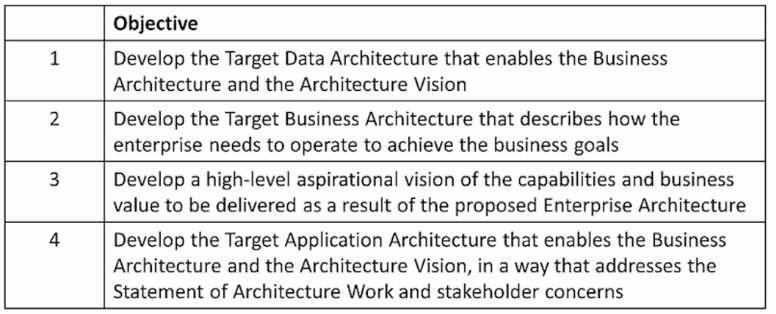
Consider the following ADM phases objectives. Open Group OGEA 101 question Which phase does each objective match?
Options
22 comments in the community discussion
2
Maybe D. Data and Application could easily get mixed up here, but D looks close if you think of Application split out.
1
A tbh. The mapping matches how TOGAF splits up the Data/App objectives in Phase C and Business Architecture in B. Saw a similar split on another practice set, so I think A fits best. But open to being wrong here.
Q: 11
Which of the following describes a purpose of Architecture Principles?
Options
13 comments in the community discussion
1
B not D. Principles set direction and alignment with strategy, not contracts. Makes sense if you follow TOGAF logic. Anyone disagree?
B , that's what TOGAF guides say. Architecture principles are all about setting direction and making sure everyone's aligned with business strategy. Seen similar wording in official study guides and practice tests so pretty confident here. Disagree?
Q: 12
What is used to structure architectural information in an orderly way so that it can be processed to meet stakeholder needs?
Options
13 comments in the community discussion
1
B or C? Always thought the framework (B) set up how info gets organized for stakeholders.
1
Option B
Q: 13
Which of the following best describes a purpose of the Gap Analysis technique?
Options
10 comments in the community discussion
Makes sense to me that it's D since Gap Analysis in TOGAF is about finding what functions or pieces are missing between baseline and target architectures. If the question had specifically asked about non-functional gaps, maybe A would be closer, but here it's not limited. Pretty sure D is what they're looking for, but
Maybe A. Gap Analysis can help validate if key non-functional requirements have been addressed when comparing architectures. I know D is tempting but A could fit too, since non-functional gaps are often critical in practice. Not 100% sure, open to other views.
Q: 14
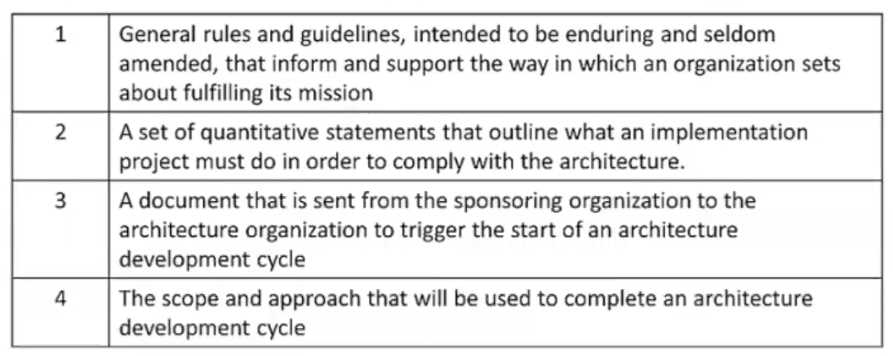
Consider the following descriptions of deliverables consumed and produced across the TOGAF ADM cycle. Open Group OGEA 101 question Which deliverables match these descriptions?
Options
11 comments in the community discussion
Why do they insist on asking this ADM sequence stuff? Probably D.
C/D? If it's strictly about creation order, C could edge it, but by ADM phase flow D is the textbook match.
Q: 15
What is presented as ”striking a balance between positive and negative outcomes resulting from the realization of either opportunities or threats?
Options
10 comments in the community discussion
1
C/D? Transition Management sounds tempting but positive vs negative outcomes is classic Risk Management language. Pretty sure it's D.
D , the balance of positive and negative outcomes is classic risk management speak. Saw a very similar one in a practice set, so pretty confident here.
Q: 16
What should be put in place through organization structures, roles, responsibilities, skills and processes to carry out architectural activity effectively?
Options
8 comments in the community discussion
1
C/D? The mention of frameworks can be a trap since roles and responsibilities are sometimes documented there too.
It's A for me, since EA Capability is all about the actual org structure, defined roles, and the day-to-day execution around architecture in TOGAF. Framework (C) gives you guidance but not the operational piece, so not quite what they're asking. Pretty sure on this but let me know if I'm missing something.
Q: 17
In which part of the ADM cycle do building block gaps become associated with work packages that will address the gaps?
Options
9 comments in the community discussion
5
This is where I'd pick D. Phase E is where you map all those building block gaps to actual work packages in TOGAF ADM. Earlier phases mostly focus on identifying the gaps, but E is about planning how to address them. Pretty sure this lines up with TOGAF guidance.
D
Q: 18
What are the four dimensions used to scope an architecture?
Options
10 comments in the community discussion
1
C vs B? I think it's probably C, that's what I've seen in TOGAF practice sets, but some folks mention B if it's not strictly TOGAF. Anyone else seen both pop up on similar questions in exam reports?
C is right, B looks tempting but those aren't the TOGAF scoping terms. If it's TOGAF, gotta be C.
Q: 19
Which of the following are interests important to the stakeholders in a system?
Options
18 comments in the community discussion
1
C , saw a similar question in an exam report and it matched the TOGAF use of "concerns" as stakeholder interests.
1
Makes sense, I'd pick C. TOGAF calls stakeholder interests "concerns" so this fits the question best for me.
Q: 20
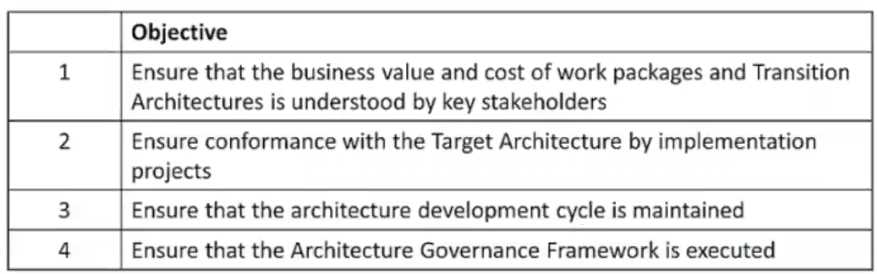
Consider the following ADM phases objectives. Open Group OGEA 101 question Which phase does each objective match?
Options
7 comments in the community discussion
1
B tbh, Phase H is all about ongoing architecture change management and that's what objective 1 describes. Then objectives 2 and 3 fit Migration Planning (Phase F), with Phase G best matching objective 4's focus on governance. Pretty sure this lines up, but open to other views if someone thinks otherwise.
B had something like this in a mock and option B lined up with the phase objectives.
Question 1 of 20

Premium Access Includes

  • Quiz Simulator
  • Exam Mode
  • Progress Tracking
  • Question Saving
  • Flash Cards
  • Drag & Drops
  • 3 Months Access
  • PDF Downloads
Get Premium Access
Scroll to Top