Free MuleSoft-Platform-Architect-I Practice Test Questions and Answers (2026)

Last Update Check

View Mode
Q: 1
A company uses a hybrid Anypoint Platform deployment model that combines the EU control plane with customer-hosted Mule runtimes. After successfully testing a Mule API implementation in the Staging environment, the Mule API implementation is set with environment-specific properties and must be promoted to the Production environment. What is a way that MuleSoft recommends to configure the Mule API implementation and automate its promotion to the Production environment?
Options
1 comment in the community discussion
Its D for me. I thought you could just use API policies to update properties between environments, so seems like doing it directly via API Manager would work. Anyone else think this could be right?
Q: 2
A large company wants to implement IT infrastructure in its own data center, based on the corporate IT policy requirements that data and metadata reside locally. Which combination of Mule control plane and Mule runtime plane(s) meets the requirements?
Options
1 comment in the community discussion
Is B an option here? Since Anypoint Runtime Fabric can run on-prem, wouldn't MuleSoft-hosted control plane be ok for managing it?
Q: 3
A company has created a successful enterprise data model (EDM). The company is committed to building an application network by adopting modern APIs as a core enabler of the company's IT operating model. At what API tiers (experience, process, system) should the company require reusing the EDM when designing modern API data models?
Options
1 comment in the community discussion
B tbh
Q: 4
Select the correct Owner-Layer combinations from below options
Options
Q: 5
A code-centric API documentation environment should allow API consumers to investigate and execute API client source code that demonstrates invoking one or more APIs as part of representative scenarios. What is the most effective way to provide this type of code-centric API documentation environment using Anypoint Platform?
Options
1 comment in the community discussion
CIf the question meant non-interactive docs instead of code execution, would B then make more sense as the answer?
Q: 6
4A developer for a transportation organization is implementing exactly one processing functionality in a Reservation Mule application to process and store passenger records. This Reservation application will be deployed to multiple CloudHub workers/replicas. It is possible that several external systems could send duplicate passenger records to the Reservation application. An appropriate storage mechanism must be selected to help the Reservation application process each passenger record exactly once as much as possible. The selected storage mechanism must be shared by all the CloudHub workers/replicas in order to synchronize the state information to assist attempting exactly once processing of each passenger record by the deployed Reservation Mule application. Which type of simple storage mechanism in Anypoint Platform allows the Reservation Mule application to update and share data between the CloudHub workers/replicas exactly once, with minimal development effort?
Options
1 comment in the community discussion
D imo, persistent object store fits since it's shared, but does the question specify CloudHub only? If not, B would make sense.
Q: 7
A retail company is using an Order API to accept new orders. The Order API uses a JMS queue to submit orders to a backend order management service. The normal load for orders is being handled using two (2) CloudHub workers, each configured with 0.2 vCore. The CPU load of each CloudHub worker normally runs well below 70%. However, several times during the year the Order API gets four times (4x) the average number of orders. This causes the CloudHub worker CPU load to exceed 90% and the order submission time to exceed 30 seconds. The cause, however, is NOT the backend order management service, which still responds fast enough to meet the response SLA for the Order API. What is the MOST resource-efficient way to configure the Mule application's CloudHub deployment to help the company cope with this performance challenge?
Options
1 comment in the community discussion
1
B I've seen similar questions in practice exams and the official guide. Might want to check autoscaling docs too.
Q: 8
An existing Quoting API is defined in RAML and used by REST clients for interacting with the quoting engine. Currently there is a resource defined in the RAML that allows the creation of quotes; however, a new requirement was just received to allow for the updating of existing quotes. Which two actions need to be taken to facilitate this change so it can be processed? Choose 2 answers
Options
Q: 9
An organization is deploying their new implementation of the OrderStatus System API to multiple workers in CloudHub. This API fronts the organization's on-premises Order Management System, which is accessed by the API implementation over an IPsec tunnel. What type of error typically does NOT result in a service outage of the OrderStatus System API?
Options
2 comments in the community discussion
Its D since if the backend is totally offline, the API can't answer requests even if workers are fine.
Q: 10
An API implementation is deployed to CloudHub. What conditions can be alerted on using the default Anypoint Platform functionality, where the alert conditions depend on the end-to-end request processing of the API implementation?
Options
2 comments in the community discussion
Had this exact question in my last MuleSoft exam, it's C.
Its D. Super clear wording on these options, similar to other Salesforce exam practice questions.
Q: 11
The application network is recomposable: it is built for change because it "bends but does not break"
Options
2 comments in the community discussion
1
False MuleSoft networks can still break if APIs aren’t managed well. Resilience isn’t always guaranteed just by design.
Probably True. Is this asking about the general principle or a specific feature in MuleSoft? If they meant "recomposable" as defined in API-led design, then it's True, but if they mean something like inherent redundancy, that might change it.
Q: 12
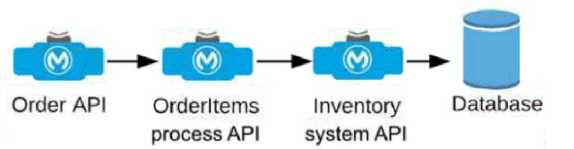
An Order API triggers a sequence of other API calls to look up details of an order's items in a back- end inventory database. The Order API calls the OrderItems process API, which calls the Inventory system API. The Inventory system API performs database operations in the back-end inventory database. The network connection between the Inventory system API and the database is known to be unreliable and hang at unpredictable times. Where should a two-second timeout be configured in the API processing sequence so that the Order API never waits more than two seconds for a response from the Orderltems process API? Salesforce MuleSoft Platform Architect I question
Options
1 comment in the community discussion
1
Does the question mean "best location" for the timeout or just where it would have any effect? If it asks for the best place, B is right, but if it's about any valid timeout, A could work too depending on the flow. Official guide sometimes words this differently.
Q: 13
What is the main change to the IT operating model that MuleSoft recommends to organizations to improve innovation and clock speed?
Options
1 comment in the community discussion
1
Had something like this in a mock, pretty sure it's D.
Q: 14
Question 10: Skipped An API implementation returns three X-RateLimit-* HTTP response headers to a requesting API client. What type of information do these response headers indicate to the API client?
Options
1 comment in the community discussion
C or D? If the question said "best header for response size info" I'd definitely go with C, but if it's about quota limits, then D makes sense.
Q: 15
What is true about API implementations when dealing with legal regulations that require all data processing to be performed within a certain jurisdiction (such as in the USA or the EU)?
Options
2 comments in the community discussion
1
Option D is tempting since encryption is important, but the real issue is about where data processing and management actually happen. If the control plane were outside the required jurisdiction, would that break compliance?
Q: 16
A company requires Mule applications deployed to CloudHub to be isolated between non-production and production environments. This is so Mule applications deployed to non-production environments can only access backend systems running in their customer-hosted non-production environment, and so Mule applications deployed to production environments can only access backend systems running in their customer-hosted production environment. How does MuleSoft recommend modifying Mule applications, configuring environments, or changing infrastructure to support this type of per-environment isolation between Mule applications and backend systems?
Options
1 comment in the community discussion
1
Would this change if all apps used the same VPC but with strict subnet segmentation?
Q: 17
A set of tests must be performed prior to deploying API implementations to a staging environment. Due to data security and access restrictions, untested APIs cannot be granted access to the backend systems, so instead mocked data must be used for these tests. The amount of available mocked data and its contents is sufficient to entirely test the API implementations with no active connections to the backend systems. What type of tests should be used to incorporate this mocked data?
Options
1 comment in the community discussion
1
Guessing D here. Mocking out the backend and testing API logic sounds like unit testing, since no real integration happens. I’m a little unsure since functional tests sometimes use mocks too but I think only unit tests are totally isolated like this. Anyone see it differently?
Q: 18
What do the API invocation metrics provided by Anypoint Platform provide?
Options
1 comment in the community discussion
4
Option C, since Anypoint Platform tracks past API invocations for usage patterns, not direct ROI or predictive policy issues. Rare edge case if you're using custom analytics pipelines, but that's outside the default metrics.
Q: 19
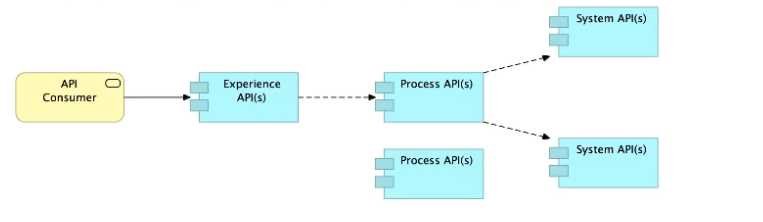
Refer to the exhibit. What is the best way to decompose one end-to-end business process into a collaboration of Experience, Process, and System APIs? A) Handle customizations for the end-user application at the Process API level rather than the Experience API level B) Allow System APIs to return data that is NOT currently required by the identified Process or Experience APIs C) Always use a tiered approach by creating exactly one API for each of the 3 layers (Experience, Process and System APIs) D) Use a Process API to orchestrate calls to multiple System APIs, but NOT to other Process APIs Salesforce MuleSoft Platform Architect I question
Options
1 comment in the community discussion
1
Probably B. System APIs should be reusable and expose more data than what's just needed right now. That way other consumers can use them later without rebuilding. Pretty sure that's what MuleSoft recommends for API-led architecture.
Q: 20
Which three tools automate the deployment of Mule applications? Choose 3 answers
Options
2 comments in the community discussion
1
Probably B, C, and E. The CLI and Platform APIs let you script deployments, and the Maven plugin is built for CI/CD automation. I remember a similar question in practice exams. Runtime Manager is more for manual work imo.
Option B. C, E. Had something almost identical on my actual exam and these three were the correct picks. CLI and Platform APIs can be automated in scripts or pipelines, Mule Maven plugin handles deployment via build tools. The others are more for manual operation or design.
Question 1 of 20

What's covered in this practice questions set

8: Delivering and Managing APIs · 7 questions

📖 About this Domain

This domain covers the operationalization of APIs within the Anypoint Platform, focusing on the post-development lifecycle stages. It details the processes for deploying, securing, and managing APIs using tools like API Manager and Runtime Manager. The core objective is ensuring API governance, reliability, and controlled consumption.

🎓 What You Will Learn

  • You will learn to apply and configure policies like rate limiting, throttling, and client ID enforcement for API governance.
  • You will learn the mechanics of deploying Mule applications and API proxies to various deployment targets including CloudHub and Runtime Fabric (RTF).
  • You will learn to establish and manage Service Level Access (SLA) tiers to control API access for different client applications.
  • You will learn the function of API autodiscovery for linking a deployed Mule application to its API Manager configuration for policy enforcement.

🛠️ Skills You Will Build

  • You will build the skill to architect a CI/CD pipeline for the automated build, test, and deployment of Mule applications.
  • You will build the ability to select and implement appropriate API policies to enforce security, quality of service, and compliance.
  • You will build proficiency in using Anypoint Monitoring and Visualizer to diagnose runtime issues and monitor API performance.
  • You will build the capability to manage the complete API lifecycle, including versioning, deprecation, and retirement strategies.

💡 Top Tips to Prepare

  • Master the distinction between API Manager for governance and Runtime Manager for deployment and operational control.
  • Understand the specific use cases for different deployment models and how they impact API management and scalability.
  • Focus on the key out-of-the-box policies and their primary functions, especially those related to security and traffic control.
  • Practice scenarios involving API autodiscovery to understand how a Mule runtime connects with API Manager for policy enforcement.

4: Governing APIs · 4 questions

📖 About this Domain

This domain covers the application of policies and controls to APIs to ensure security, quality, and consistency. It focuses on using Anypoint Platform's API Manager to enforce governance across the full API lifecycle. You will learn how to manage API access, consumption, and security through centralized policy management.

🎓 What You Will Learn

  • Learn to apply out-of-the-box policies like rate limiting, throttling, and client ID enforcement using API Manager.
  • Understand how to create and apply custom policies to meet specific non-functional requirements.
  • Discover the role of API gateways, including the Mule runtime and Flex Gateway, in policy enforcement.
  • Explore the use of API groups and Service Level Access (SLA) tiers to manage access for different API consumers.

🛠️ Skills You Will Build

  • You will build the skill to secure APIs by applying appropriate security policies like OAuth 2.0 or JWT validation.
  • You will be able to manage API traffic and consumption by implementing quality of service (QoS) policies.
  • You will develop the ability to design a governance strategy that aligns with organizational standards using API Manager.
  • You will gain proficiency in automating policy application and management across different environments.

💡 Top Tips to Prepare

  • Master the differences between out-of-the-box policies and the specific use cases that require a custom policy.
  • Understand the architecture of policy enforcement, including the role of the API proxy, autodiscovery, and the API gateway.
  • Practice configuring various SLA tiers and client access management within API Manager to control API consumption.
  • Review the policy development lifecycle, including creating a policy definition file (YAML) and its implementation template.

5: Architecting for Resiliency · 3 questions

📖 About this Domain

This domain focuses on designing MuleSoft solutions that maintain operational continuity despite component failures. It covers the principles and patterns for building fault-tolerant and highly available integration platforms. You will explore strategies for both runtime plane and control plane resiliency.

🎓 What You Will Learn

  • You will learn to design high availability (HA) clusters for customer-hosted Mule runtimes to eliminate single points of failure.
  • You will understand CloudHub's intrinsic resiliency features, including worker failover, zero-downtime updates, and persistent queues.
  • You will explore disaster recovery (DR) topologies, such as active-active and active-passive, to meet Recovery Time Objective (RTO) and Recovery Point Objective (RPO) goals.
  • You will learn the role of load balancers, both dedicated and shared, in distributing traffic and ensuring service availability across multiple nodes or workers.

🛠️ Skills You Will Build

  • You will build the skill to architect a resilient application network that can withstand infrastructure and application-level failures.
  • You will build the ability to evaluate and recommend appropriate HA and DR strategies based on specific non-functional requirements.
  • You will build competence in configuring Mule runtimes and CloudHub deployments for maximum uptime and fault tolerance.
  • You will build proficiency in designing stateful integrations using object stores and persistent VM queues to prevent data loss during outages.

💡 Top Tips to Prepare

  • Master the distinction between high availability for localized failures and disaster recovery for site-wide outages.
  • Deeply understand the mechanics of an on-premises Mule runtime cluster, including the shared memory grid and quorum requirements.
  • Focus on how CloudHub automatically provides resiliency through its multi-worker and multi-AZ architecture.
  • Review scenarios involving load balancers and persistent queues to understand how they contribute to a resilient system design.

2: Establishing Organizational and Platform Foundations · 2 questions

📖 About this Domain

This domain covers the establishment of a Center for Enablement (C4E) to drive API-led connectivity and platform adoption. It focuses on architecting the Anypoint Platform's organizational structure, including business groups, environments, and roles. You will learn to implement governance and operational models for scalable and secure platform usage.

🎓 What You Will Learn

  • Define a Center for Enablement (C4E) operating model to promote asset reuse and self-service development.
  • Structure Anypoint Platform with business groups, roles, and permissions for effective organizational governance.
  • Configure Anypoint Platform environments (Dev, Test, Prod) to support the API development lifecycle.
  • Integrate external identity providers (IdP) using protocols like SAML or OpenID Connect for centralized identity management.

🛠️ Skills You Will Build

  • Design a C4E charter and define key performance indicators (KPIs) to measure API program success.
  • Architect a multi-layered business group hierarchy that aligns with organizational structure and security requirements.
  • Establish environment promotion strategies and access control policies using platform roles and teams.
  • Configure single sign-on (SSO) for Anypoint Platform to streamline user access and enforce security policies.

💡 Top Tips to Prepare

  • Master the different C4E operating models, including centralized, decentralized, and federated, and their specific use cases.
  • Deeply understand the relationship between business groups, environments, roles, and permissions within Anypoint Platform.
  • Review official MuleSoft documentation on setting up Anypoint Platform for organizational governance and identity management.
  • Practice scenarios involving mapping complex company structures to Anypoint Platform business groups and environments.

6: Architecting for Reuse · 2 questions

📖 About this Domain

This domain covers strategies for creating and consuming reusable assets within Anypoint Platform to build an application network. It focuses on the role of a Center for Enablement (C4E) in governing and promoting the reuse of APIs, templates, and fragments to enable API-led connectivity.

🎓 What You Will Learn

  • Apply API-led connectivity principles to design a three-layered architecture that maximizes asset reuse.
  • Understand different Center for Enablement (C4E) operating models for governing and evangelizing reuse.
  • Learn the asset lifecycle for publishing, versioning, and managing APIs, fragments, and templates in Anypoint Exchange.
  • Identify key metrics and KPIs to measure the business value and adoption of reusable assets.

🛠️ Skills You Will Build

  • Design modular API specifications and fragments using RAML or OAS for broad reusability.
  • Define a C4E governance framework with clear roles, processes, and standards for asset management.
  • Utilize Anypoint Exchange effectively for asset discovery, consumption, and feedback loops.
  • Develop and apply API policies to enforce consistent security and quality of service on reusable APIs.

💡 Top Tips to Prepare

  • Master the distinct responsibilities of System, Process, and Experience APIs in an API-led architecture.
  • Study the various C4E models and their impact on organizational adoption of reuse.
  • Focus on Anypoint Exchange features like asset versioning, API groups, and custom asset types.
  • Know how to use Anypoint Platform to track reuse metrics and demonstrate the ROI of an application network.

3: Driving API-led Connectivity · 2 questions

📖 About this Domain

This domain covers the core principles of MuleSoft's API-led connectivity methodology. It emphasizes the three-layered architecture and its role in creating a composable enterprise through an application network.

🎓 What You Will Learn

  • Understand the distinct roles and responsibilities of Experience, Process, and System APIs in a layered architecture.
  • Learn to design an application network graph that promotes asset reuse and decouples systems.
  • Grasp how to articulate the business outcomes of API-led, such as increased organizational agility and self-service IT.
  • Identify how API-led connectivity facilitates a full API lifecycle management strategy within Anypoint Platform.

🛠️ Skills You Will Build

  • Architecting composable solutions by correctly layering APIs to meet specific business and technical requirements.
  • Developing a strategic vision for an application network that aligns with C4E (Center for Enablement) operating models.
  • Communicating the technical and business value proposition of an API-led approach to diverse stakeholders.
  • Defining governance strategies for API design, development, and consumption to ensure consistency and reusability.

💡 Top Tips to Prepare

  • Memorize the specific functions and boundaries of Experience, Process, and System API layers.
  • Focus on the C4E's role in evangelizing API-led connectivity and enabling decentralized development.
  • Practice mapping complex business requirements to a three-tiered API architecture diagram.
  • Thoroughly review the official MuleSoft documentation and whitepapers on building an application network.

7: Architecting for Security

📖 About this Domain

This domain covers architecting security for Mule applications and the Anypoint Platform. It focuses on a defense-in-depth strategy, securing the application network, and protecting data. You will design solutions for identity management, access control, and threat mitigation.

🎓 What You Will Learn

  • Integrate with external identity providers (IdPs) using OAuth 2.0, OpenID Connect, and SAML for identity federation.
  • Apply out-of-the-box policies like Rate Limiting, Throttling, and JSON/XML Threat Protection via API Manager.
  • Implement transport layer security (TLS) for data in transit and encryption for data at rest using secure properties.
  • Utilize Anypoint Platform security features including VPCs, dedicated load balancers, and role-based access control (RBAC).

🛠️ Skills You Will Build

  • Select and apply appropriate API policies to enforce security contracts and protect backend systems.
  • Architect Identity and Access Management (IAM) solutions for Mule applications, including SSO and client management.
  • Design secure network architectures for CloudHub deployments using VPCs, VPNs, and dedicated load balancers.
  • Leverage Anypoint Platform logging and auditing capabilities to monitor for security events and ensure compliance.

💡 Top Tips to Prepare

  • Master the different OAuth 2.0 grant types and their specific use cases for securing APIs.
  • Differentiate security layers: edge (DLB), API gateway (policies), and application implementation.
  • Practice scenarios involving CloudHub VPCs, firewalls, and dedicated load balancers to secure network traffic.
  • Know the purpose and configuration of key security policies like JWT validation and client ID enforcement.

Premium Access Includes

  • Quiz Simulator
  • Exam Mode
  • Progress Tracking
  • Question Saving
  • Flash Cards
  • Drag & Drops
  • 3 Months Access
  • PDF Downloads
Get Premium Access
Scroll to Top