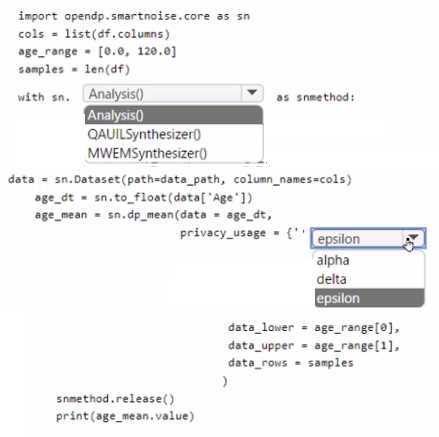
HOTSPOT You load data from a notebook in an Azure Machine Learning workspace into a pandas dataframe named df. The data contains 10.000 patient records. Each record includes the Age property for the corresponding patient. You must identify the mean age value from the differentially private data generated by SmartNoise SDK. You need to complete the Python code that will generate the mean age value from the differentially private data. Which code segments should you use? To answer, select the appropriate options in the answer area. NOTE: Each correct selection is worth one point.
Free DP-100 Practice Test Questions and Answers (2026)
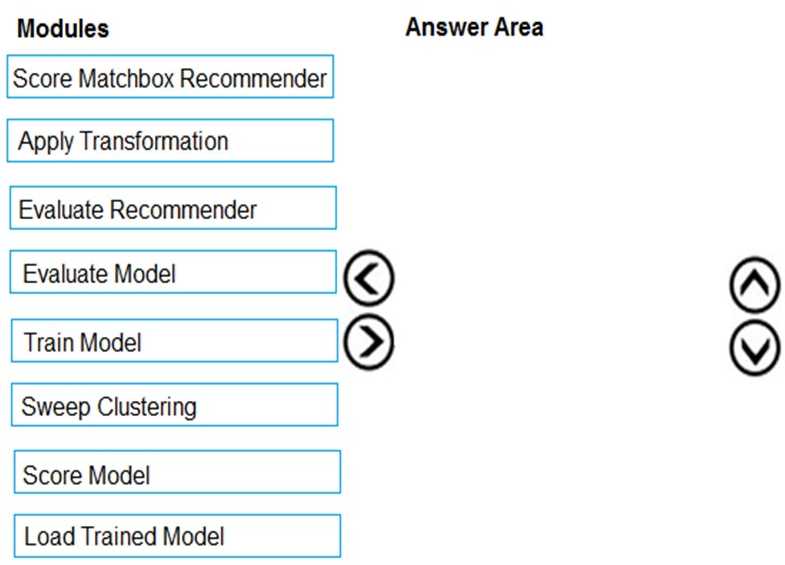
DRAG DROP You need to produce a visualization for the diagnostic test evaluation according to the data visualization requirements. Which three modules should you recommend be used in sequence? To answer, move the appropriate modules from the list of modules to the answer area and arrange them in the correct order.
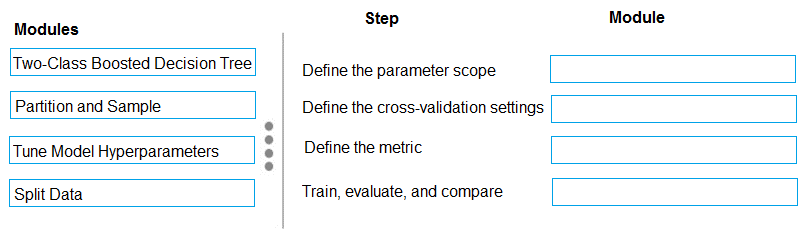
DRAG DROP You have a model with a large difference between the training and validation error values. You must create a new model and perform cross-validation. You need to identify a parameter set for the new model using Azure Machine Learning Studio. Which module you should use for each step? To answer, drag the appropriate modules to the correct steps. Each module may be used once or more than once, or not at all. You may need to drag the split bar between panes or scroll to view content. NOTE: Each correct selection is worth one point.

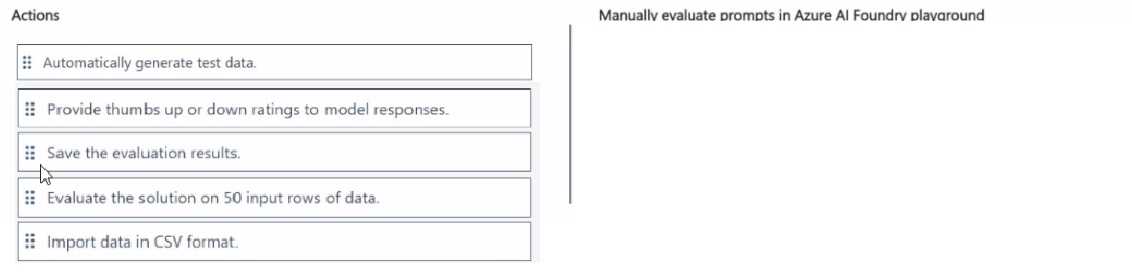
DRAG DROP You manage an Azure Al Foundry project. You deploy a large language model from the model catalog. You need to manually evaluate the model, collect the statistics, and be able to review the results later.
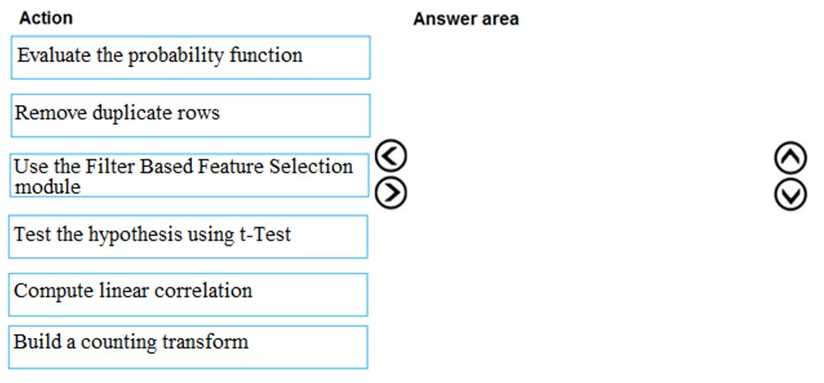
DRAG DROP You are producing a multiple linear regression model in Azure Machine Learning Studio. Several independent variables are highly correlated. You need to select appropriate methods for conducting effective feature engineering on all the data. Which three actions should you perform in sequence? To answer, move the appropriate actions from the list of actions to the answer area and arrange them in the correct order.
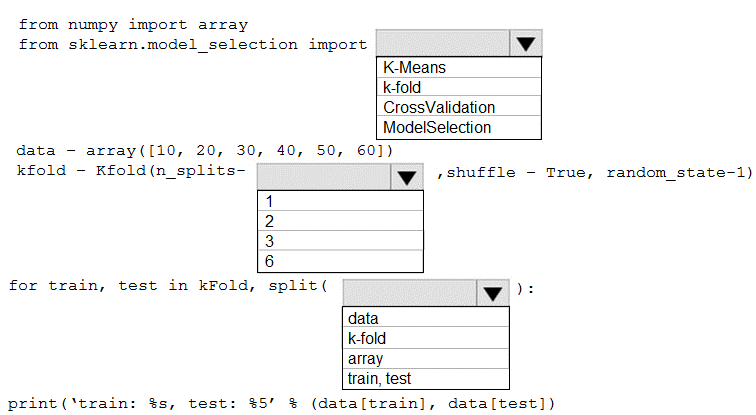
HOTSPOT You are evaluating a Python NumPy array that contains six data points defined as follows: data = [10, 20, 30, 40, 50, 60] You must generate the following output by using the k-fold algorithm implantation in the Python Scikit-learn machine learning library: train: [10 40 50 60], test: [20 30] train: [20 30 40 60], test: [10 50] train: [10 20 30 50], test: [40 60] You need to implement a cross-validation to generate the output. How should you complete the code segment? To answer, select the appropriate code segment in the dialog box in the answer area. NOTE: Each correct selection is worth one point.
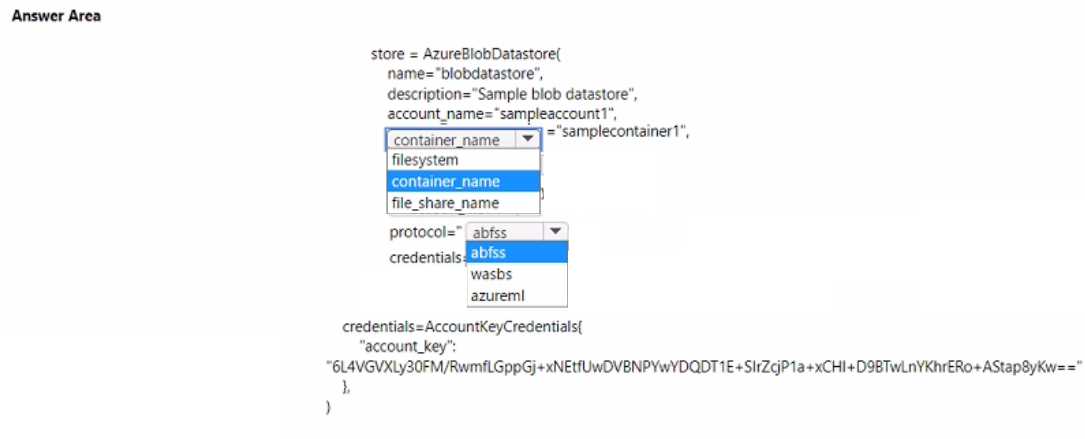
HOTSPOT You manage an Azure Machine Learning workspace named workspace1. You must register an Azure Blob storage datastore in workspace1 by using an access key. You develop Python SDK v2 code to import all modules required to register the datastore. You need to complete the Python SDK v2 code to define the datastore. How should you complete the code? To answer, select the appropriate options in the answer area. NOTE: Each correct selection is worth one point.
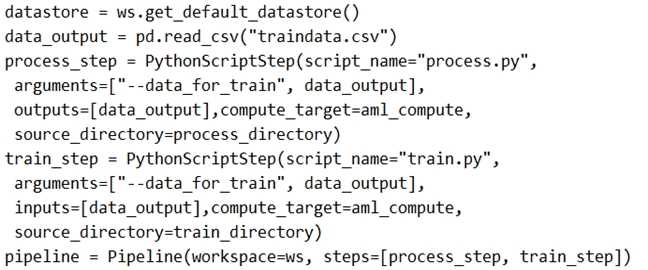
Note: This question is part of a series of questions that present the same scenario. Each question in the series contains a unique solution that might meet the stated goals. Some question sets might have more than one correct solution, while others might not have a correct solution. After you answer a question in this section, you will NOT be able to return to it. As a result, these questions will not appear in the review screen. You create a model to forecast weather conditions based on historical data. You need to create a pipeline that runs a processing script to load data from a datastore and pass the processed data to a machine learning model training script. Solution: Run the following code: 
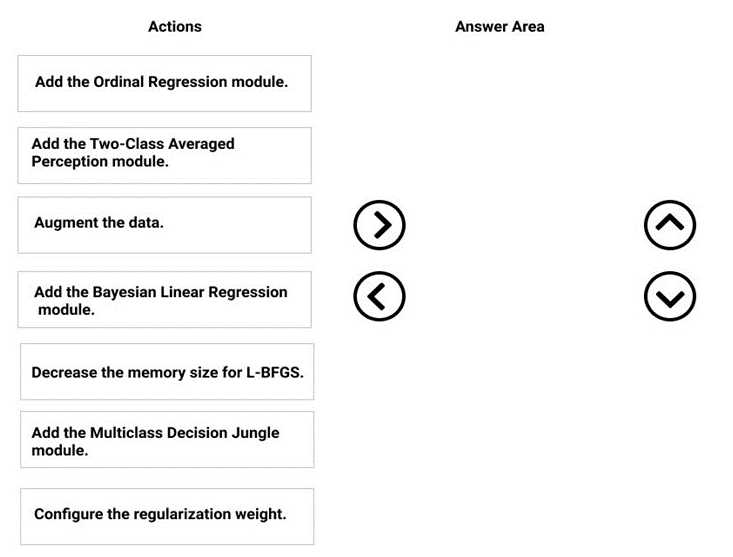
DRAG DROP You need to correct the model fit issue. Which three actions should you perform in sequence? To answer, move the appropriate actions from the list of actions to the answer area and arrange them in the correct order.
DRAG DROP You are managing an Azure Machine Learning workspace. You must tune a hyperparameter for a neural network model. The learning rate must be a continuous hyperparameter between 0.001 and 0.1. The batch size can be 32.64. or 128. You need to select the appropriate search space for each parameter. Which search space should you use? To answer, move the appropriate search spaces to the correct hyperparameters. You may use each search space option once, more than once, or not at all. You may need to move the split bar between panes or scroll to view content. NOTE: Each correct selection is worth one point.
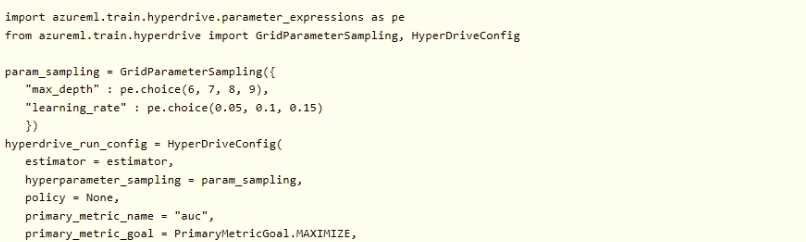
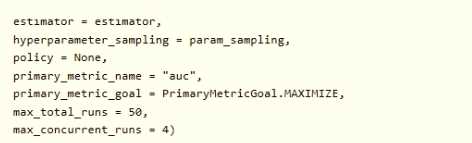
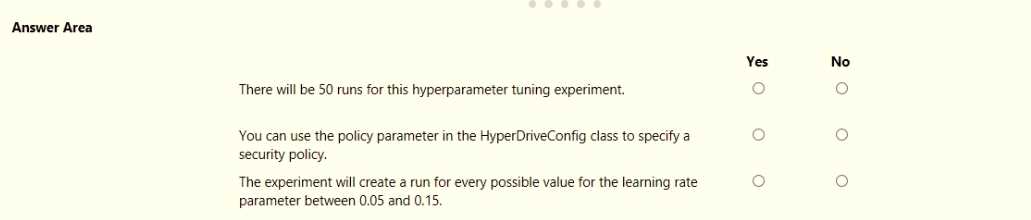
HOTSPOT You plan to use Hyperdrive to optimize the hyperparameters selected when training a model. You create the following code to define options for the hyperparameter experiment 

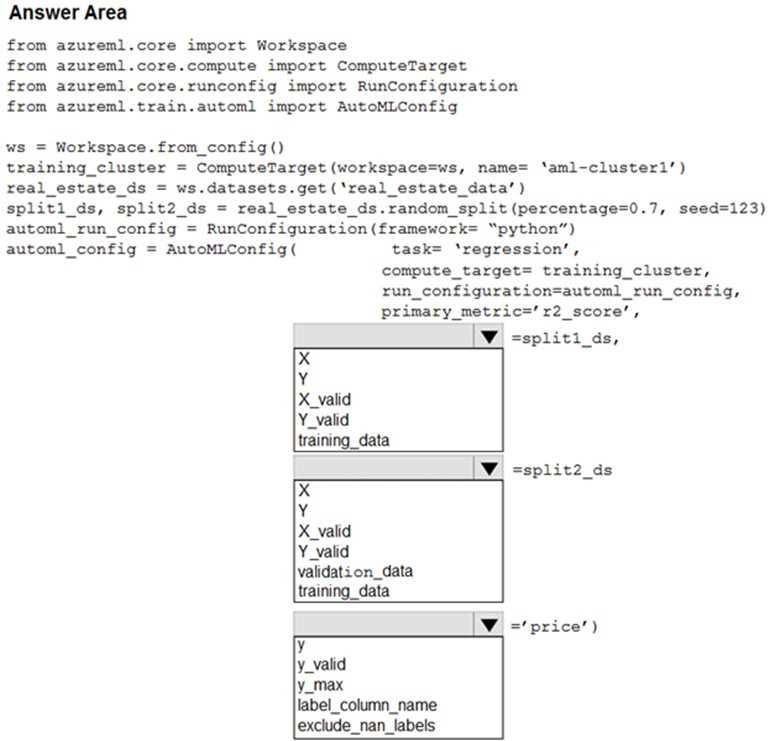
HOTSPOT Your Azure Machine Learning workspace has a dataset named real_estate_dat a. A sample of the data in the dataset follows. 
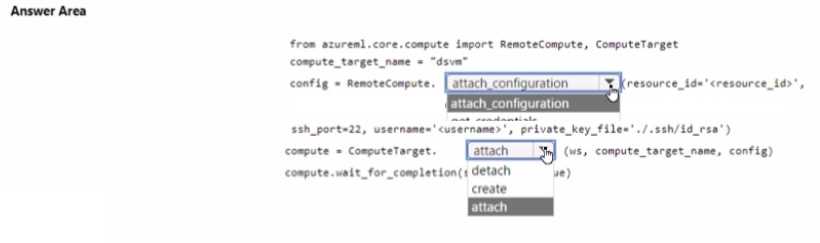
HOTSPOT You must use in Azure Data Science Virtual Machine (DSVM) as a compute target. You need to attach an existing DSVM to the workspace by using the Azure Machine Learning SDK for Python. How should you complete the following code segment? To answer, select the appropriate options in the answer area. NOTE: Each correct selection is worth one point.
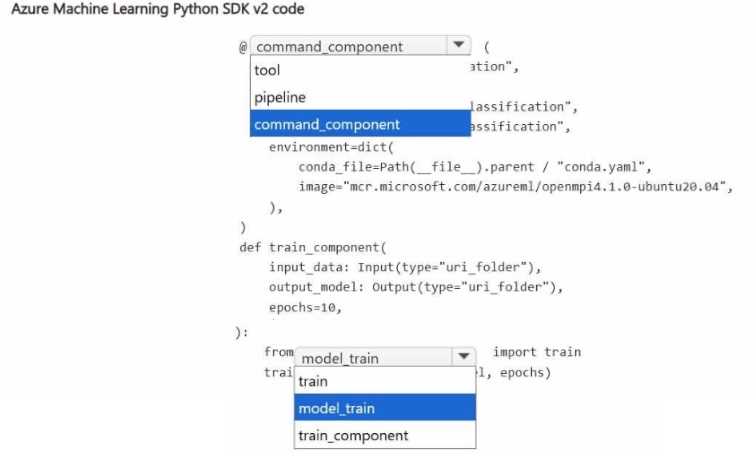
HOTSPOT You have an Azure Machine Learning workspace. You plan to use Azure Machine Learning Python SDK v2 to define a pipeline component that trains an image classification model. The execution logic of the component is contained in the train() function in the file named modeljrain.py. You write code to import all required libraries and store it as train_component.py in the same folder that contains model_train.py. You need to complete the remaining code in train_component.py. How should you complete the code? To answer, select the appropriate options in the answer area. NOTE: Each correct selection is worth one point.
What's covered in this practice questions set
2: Run experiments and train models · 15 questions
📖 About this Domain
This domain covers the execution of model training processes within the Azure Machine Learning workspace. It focuses on creating and running script-based experiments, logging metrics, and managing training jobs on various compute targets.
🎓 What You Will Learn
- You will learn to create and run script-based experiments using the Azure Machine Learning SDK and CLI v2.
- You will learn to consume data from datastores and data assets for model training jobs.
- You will learn to implement model training using frameworks like Scikit-learn and log metrics with MLflow for run tracking.
- You will learn to configure and use compute targets, such as compute clusters, for scalable training jobs.
🛠️ Skills You Will Build
- You will build the skill to write Python scripts that connect to an Azure ML workspace, access data, and train a machine learning model.
- You will build the skill to configure and submit command jobs using YAML definitions for reproducible and scalable training runs.
- You will build the skill to integrate MLflow for autologging or custom logging of parameters, metrics, and artifacts during an experiment run.
- You will build the skill to analyze experiment run history, compare metrics, and retrieve the best model from a completed job.
💡 Top Tips to Prepare
- Master the structure of YAML files for defining command jobs, including inputs, code, environment, and compute specifications.
- Practice using both the Azure ML SDK v2 and CLI v2 to submit and manage training jobs, as the exam covers both.
- Understand the different ways to log metrics, specifically the distinction between logging single values versus logging artifacts like charts.
- Focus on how to retrieve a registered model from a job run and understand the relationship between a job, its outputs, and the model registry.
3: Deploy and operationalize machine learning solutions · 3 questions
📖 About this Domain
This domain covers the operationalization of machine learning models using Azure Machine Learning. You will focus on deploying models as real-time and batch endpoints, and automating workflows with pipelines for continuous integration and delivery (CI/CD). It is the core of MLOps practices within the Azure ecosystem.
🎓 What You Will Learn
- Deploy trained models as real-time endpoints on compute targets like Azure Container Instance (ACI) or Azure Kubernetes Service (AKS) for immediate inference.
- Implement batch inference pipelines to process large volumes of data asynchronously using batch endpoints.
- Configure data drift and model performance monitoring to maintain model quality and detect degradation in production.
- Automate the end-to-end ML lifecycle by creating, publishing, and scheduling Azure Machine Learning pipelines using components.
🛠️ Skills You Will Build
- Ability to package models with scoring scripts and environment configurations for containerized deployment.
- Proficiency in creating, managing, and troubleshooting both real-time and batch inference endpoints via the SDK, CLI v2, and studio.
- Competence in building and parameterizing reusable ML pipelines for training and retraining workflows.
- Capability to set up data drift monitors on datasets and interpret results to trigger automated actions like retraining.
💡 Top Tips to Prepare
- Master the differences between ACI for dev/test deployments and AKS for production-scale, high-availability endpoints.
- Practice defining endpoints, deployments, and pipeline components using YAML configuration files for the CLI v2.
- Gain hands-on experience with the Azure CLI v2 for managing all MLOps assets, as it is a key focus of the exam.
- Understand the concepts of a baseline dataset versus a target dataset when configuring a data drift monitor.
4: Implement responsible machine learning · 1 questions
📖 About this Domain
This domain covers the operationalization of ethical AI principles using Azure Machine Learning. It focuses on implementing tools and techniques to ensure fairness, interpretability, and privacy in machine learning models. You will work with the Responsible AI dashboard to assess and mitigate potential harms.
🎓 What You Will Learn
- You will learn to use the Responsible AI dashboard to evaluate models for fairness and identify disparities across demographic groups.
- You will learn to implement model explainability techniques, such as SHAP, to interpret model predictions and understand feature importance.
- You will learn to analyze model errors and identify causal relationships to improve model reliability and robustness.
- You will learn the core concepts of differential privacy and how it can be applied to protect sensitive user data during the training process.
🛠️ Skills You Will Build
- You will build the skill to configure and interpret Responsible AI scorecards for a holistic assessment of model performance and fairness.
- You will build the skill to generate both global and local explanations for models to debug and validate their behavior.
- You will build the skill to apply fairness mitigation algorithms from the Fairlearn toolkit to retrain models and reduce bias.
- You will build the skill to identify data drift and other failure modes in production models to ensure ongoing reliability.
💡 Top Tips to Prepare
- Focus on the components of the Responsible AI dashboard, including error analysis, model explainability, and fairness assessment.
- Practice interpreting SHAP values and other explainer outputs to understand a model's decision-making process.
- Understand the different fairness metrics, such as demographic parity and equalized odds, and when to apply them.
- Review how to configure a pipeline job in Azure ML that includes a component for generating a Responsible AI dashboard.
1: Set up an Azure Machine Learning workspace · 1 questions
📖 About this Domain
This domain covers the provisioning and configuration of the Azure Machine Learning workspace, the foundational resource for machine learning operations. The workspace is the top-level resource that centralizes all ML artifacts and orchestrates dependent Azure resources.
🎓 What You Will Learn
- Provision an Azure Machine Learning workspace using the Azure portal, Azure CLI, and Python SDK.
- Identify the dependent Azure resources created with a workspace, including Storage Account, Key Vault, Application Insights, and Container Registry.
- Manage workspace access and permissions using Azure Role-Based Access Control (RBAC) for different user roles.
- Navigate the Azure Machine Learning studio to locate and manage workspace assets and properties.
🛠️ Skills You Will Build
- Deploying and configuring the core Azure Machine Learning environment required for any data science project.
- Implementing security controls by assigning built-in RBAC roles like Owner, Contributor, and Reader to users and service principals.
- Managing the lifecycle of a workspace, including understanding its properties and associated resource dependencies.
- Utilizing the Azure Machine Learning studio as the primary user interface for interacting with workspace assets.
💡 Top Tips to Prepare
- Practice creating a workspace using all three methods: Azure portal, Python SDK (Workspace.create), and Azure CLI (az ml workspace create).
- Memorize the four Azure resources automatically provisioned with a workspace and their specific functions.
- Understand the distinction between the Basic and Enterprise workspace editions and their feature differences.
- Know the specific permissions granted by the standard RBAC roles (Owner, Contributor, Reader) within the context of a workspace.