Free AZ-900 Practice Test Questions and Answers (2026)

View Mode
Q: 1

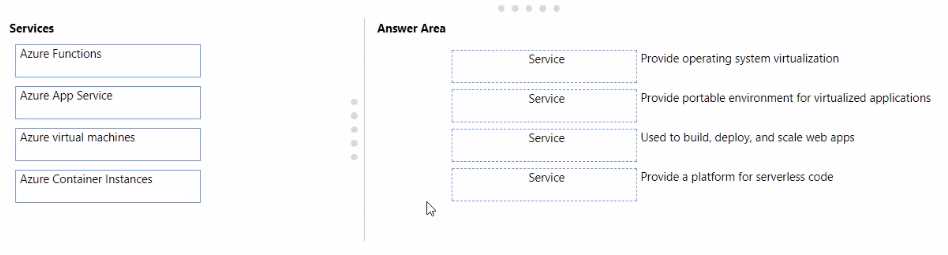
DRAG DROP Match the Azure service to the correct description. Instructions: To answer, drag the appropriate Azure service from the column on the left to its description on the right. Each service may be used once, more than once, or not at all NOTE: Each correct match is worth one point. Microsoft AZ 900 question

Drag & Drop
24 comments in the community discussion
9
Seen a similar mapping in practice sets. Virtual machines is traditional IaaS, container instances for quick containers, app service for web apps, and functions is serverless compute. Order is:Bucket 1: Azure virtual machinesBucket 2: Azure Container Instances.Bucket 3: Azure App ServiceBucke
6
Bucket 1: Azure virtual machines, Bucket 2: Azure Container Instances, Bucket 3: Azure App Service, Bucket 4: Azure Functions. Don’t fall for the trap where App Service and Functions are swapped-some practice questions word those really close. I’m pretty sure this is right unless the buckets mention serverless directly
Q: 2

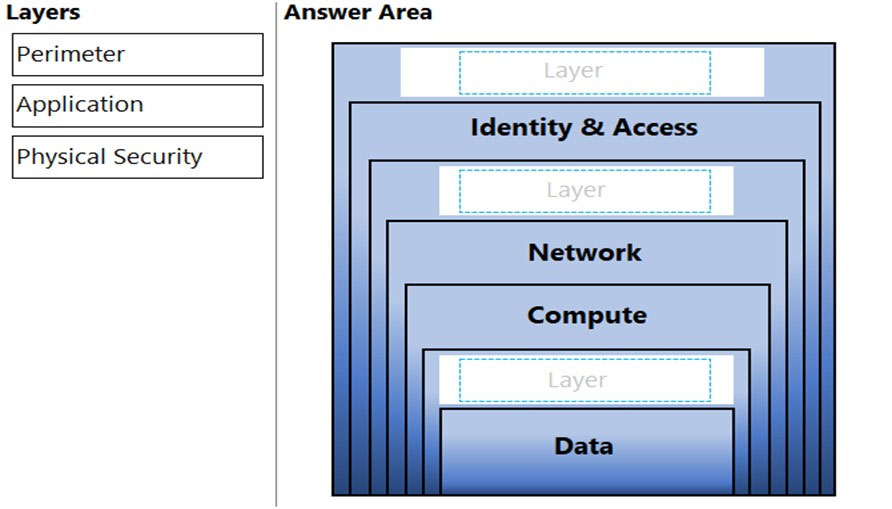
DRAG DROP You need to complete the defense-in-depth strategy used in a datacenter, What should you do? To answer, drag the appropriate layers to the correct positions in the model. Each layer may be used once, more than once, or not at all. NOTE: Each correct selection is worth one point.

Drag & Drop
38 comments in the community discussion
9
Physical Security, Perimeter, Application is the order that matched my exam exactly. Confident this is right.
5
Another one of those drag and drops where Microsoft loves to trip people up. Physical Security to Bucket 1, Perimeter to Bucket 2, Application to Bucket 3-seen the same mapping in practice tests. If anyone's gotten something else marked correct on an actual exam, post it.
Q: 3
Your company plans to move several servers to Azure. The company's compliance policy states that a server named FinServer must be on a separate network segment You are evaluating which Azure services can be used to meet the compliance policy requirements. Which Azure solution should you recommend?
Options
31 comments in the community discussion
5
B tbh. Only a separate VNet (option B) actually creates a distinct network segment for FinServer like the compliance policy asks. Resource groups (A or D) are more about management boundaries, not actual network segmentation, so they're a bit of a trap here. Pretty sure this is what AZ-900 wants, but happy to hear o
2
A or D, since resource groups seem like they give separation too, right?
Q: 4

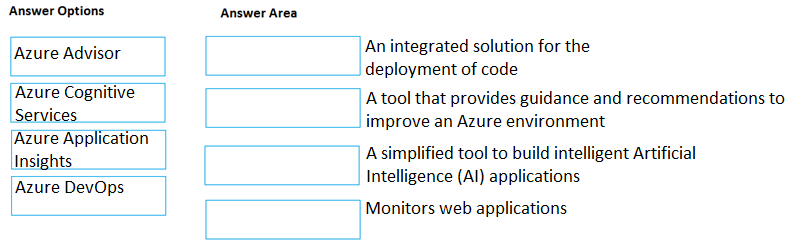
DRAG DROP Match the Azure service to the correct definition. Instructions: To answer, drag the appropriate Azure service from the column on the left to its description on the right. Each service may be used once, more than once, or not at all. NOTE: Each correct match is worth one point. Microsoft AZ 900 question

Drag & Drop
32 comments in the community discussion
6
Careful with this one, because in some practice sets if the description of monitoring shifts, Application Insights and Cognitive Services can flip. But here, the mapping should be: DevOps to Bucket 1, Advisor to 2, Cognitive Services to 3, App Insights to 4. Unless Microsoft tweaks their descriptions again!
6
Looks right to me: DevOps → Bucket 1, Advisor → 2, Cognitive Services → 3, Application Insights → 4. This matches what I remember from the official docs and past questions. Pretty sure this is the mapping unless they're emphasizing AI vs. monitoring in a different way. Anyone got a reason to swap
Q: 5

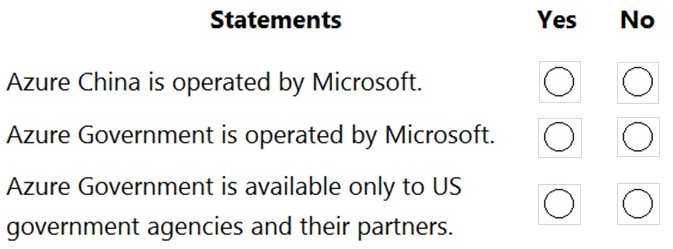
HOTSPOT For each of the following statements, select Yes if the statement is true. Otherwise, select No. NOTE: Each correct selection is worth one point. Microsoft AZ 900 question

Your Answer
34 comments in the community discussion
6
Yeah that's right, NO, YES, YES.
5
Totally agree NO, YES, YES is the way to go. Azure China isn't run directly by Microsoft (it's handled by 21Vianet), but Azure Government statements are both true since it's isolated and only available to US government/partners. Pretty sure about this, unless they've secretly changed the rules.
Q: 6
Your company plans to migrate all on-premises data to Azure. You need to identify whether Azure complies with the company’s regional requirements. What should you use?
Options
23 comments in the community discussion
2
D , Trust Center is where you get the official compliance info for Azure, including all regional requirements. The portal just manages resources, doesn't give that detail. Pretty sure that's what Microsoft recommends for these checks.
1
C won't give you compliance documentation, it's more for managing Azure resources. D (Trust Center) has all the detailed compliance info for different regions. I think D is right, unless they're asking about something super specific.
Q: 7

DRAG DROP Match the Azure storage services to the appropriate descriptions. To answer, drag the appropriate storage service from the column on the left to its description on the right. Each service may be used once, more than once, or not at all. NOTE: Each correct match is worth one point. Microsoft AZ 900 question

Drag & Drop
30 comments in the community discussion
6
That matches what I've seen: Queue Storage goes with Bucket 1, Files to Bucket 2, Blob storage to Bucket 3. Files is for SMB shares so Disk Storage isn’t right there. Pretty sure this maps to how Azure describes them, but let me know if anyone disagrees.
5
Queue Storage → Bucket 1, Files → Bucket 2, Blob Storage → Bucket 3. If it asked about VM-attached disks or persistent OS storage for Bucket 2 instead of SMB or file sharing, I'd swap in Disk Storage. Here, pretty confident this matches how they describe each service on the exam.
Q: 8
Note: This question is part of a series of questions that present the same scenario. Each question in the series contains a unique solution that might meet the stated goals. Some question sets might have more than one correct solution, while others might not have a correct solution. After you answer a question in this section, you will NOT be able to return to it. As a result, these questions will not appear in the review screen. Your company plans to migrate all its data and resources to Azure. The company’s migration plan states that only platform as a service (PaaS) solutions must be used in Azure. You need to deploy an Azure environment that supports the planned migration. Solution: You create an Azure App Service and Azure Storage accounts. Does this meet the goal?
Options
35 comments in the community discussion
4
Option B If all company data includes structured stuff, missing a PaaS database breaks the scenario.
2
Option B. because the company wants all data and resources migrated, not just web apps and files. App Service and Storage leave out managed PaaS databases like Azure SQL. I think B covers the full requirement, but open to other takes.
Q: 9

HOTSPOT How should you calculate the monthly uptime percentage? To answer, select the appropriate options in the answer area. NOTE: Each correct selection is worth one point. Microsoft AZ 900 question

Your Answer
37 comments in the community discussion
8
[(MAXIMUM AVAILABLE MINUTES - DOWNTIME IN MINUTES)] $\DIV$ [MAXIMUM AVAILABLE MINUTES] $\TIMES$ [100]Seen similar in official practice and study guides.
6
Isn’t this the trap where people mix up downtime with uptime? If you just divide downtime by max available minutes, you get the downtime percent, not uptime. Shouldn’t it be (Maximum Available Minutes minus Downtime) divided by Maximum Available Minutes, then times 100?
Q: 10

DRAG DROP Match the Azure governance feature to the correct description. Instructions: To answer, drag the appropriate feature from the column on the left to its description on the right. Each feature may be used once, more than once, or not at all. NOTE: Each correct match is worth one point. Microsoft AZ 900 question

Drag & Drop
31 comments in the community discussion
6
Yeah, same here. Policy to Bucket 1, Tags to Bucket 2, Blueprints to Bucket 3.
5
Not seeing resource locks as right for Bucket 2 here, since that's more about organization/billing. Trap is mixing up tags and locks. It's Policy to Bucket 1, Tags to Bucket 2, Blueprints to Bucket 3. I think that's how MS typically aligns them on exam questions.
Q: 11
Note: This question is part of a series of questions that present the same scenario. Each question in the series contains a unique solution that might meet the stated goals. Some question sets might have more than one correct solution, while others might not have a correct solution. After you answer a question in this section, you will NOT be able to return to it. As a result, these questions will not appear in the review screen. You plan to deploy several Azure virtual machines. You need to ensure that the services running on the virtual machines are available if a single data center fails. Solution: You deploy the virtual machines to two or more resource groups. Does this meet the goal?
Options
8 comments in the community discussion
1
Option B makes sense here since resource groups are really just for organizing resources, not making them resilient to datacenter failure. For real availability if one Azure datacenter goes offline, you'd want to use Availability Zones. I think B is the right call, but if anyone's seen situations where resource grou
I don’t think this works-just using multiple resource groups (B) doesn’t handle physical failures, that’s a common trap. Azure needs Availability Zones for true redundancy if a datacenter goes down. Anyone see it different on actual exams?
Q: 12

HOTSPOT To complete the sentence, select the appropriate option in the answer area. Microsoft AZ 900 question

Your Answer
4 comments in the community discussion
5
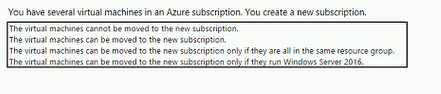
Are you sure VMs can't be moved? In Azure Resource Manager, moving VMs between subscriptions is supported as long as dependencies are also included. Maybe the question tried to catch people who assume resources are locked.
4
Classic Microsoft trick question, but you actually CAN move virtual machines to a new subscription.
Q: 13
You have an Azure subscription and 100 Windows 10 devices. You need to ensure that only users whose devices have the latest security patches installed can access Azure AD-integrated applications. What should you implement?
Options
8 comments in the community discussion
B tbh, had something like this in a mock and it's always conditional access for device compliance and app access.
Its B, conditional access policy does this by checking device compliance status before granting access. Seen similar on practice sets.
Q: 14

DRAG DROP Match the security components to the appropriate defense in depth layers. To answer, drag the appropriate service from the column on the left to its description on the right. Each service may be used once, more than once, or not at all. NOTE: Each correct match is worth one point

Drag & Drop
13 comments in the community discussion
2
I thought MFA fits under Physical security since it controls access, software updates/patches should be Identity, and surveillance camera could go with Compute because of monitoring digital assets. That was my guess, saw a chart somewhere that paired them this way. Not 100 percent sure though, open to challenge if s
2
Pretty straightforward if you know the layers. MFA always goes with identity, software updates to compute, surveillance cameras are all about physical security. Would the answer change if "firewall" or "encryption" was listed in any of these buckets?
Q: 15

HOTSPOT For each of the following statements, select Yes if the statement is true. Otherwise, select No. NOTE Each correct selection is worth one point. Microsoft AZ 900 question

Your Answer
8 comments in the community discussion
1
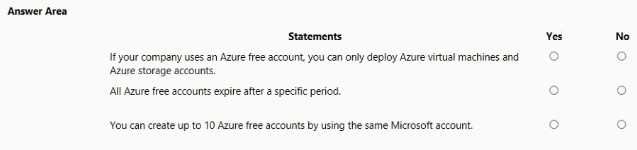
No, Yes, No. Azure only officially allows one free account per customer, so the last statement is a No. The credits and services do expire like the second says. Pretty sure that's what MS expects, but let me know if anyone disagrees.
Hmm, I'd pick No, Yes, Yes here. Was thinking the third one might be "Yes" since Microsoft's checks aren't super strict and I've seen people register with another email before. Maybe that's not what the exam wants though. If it's about intent, probably should've gone with No for the last one.
Q: 16

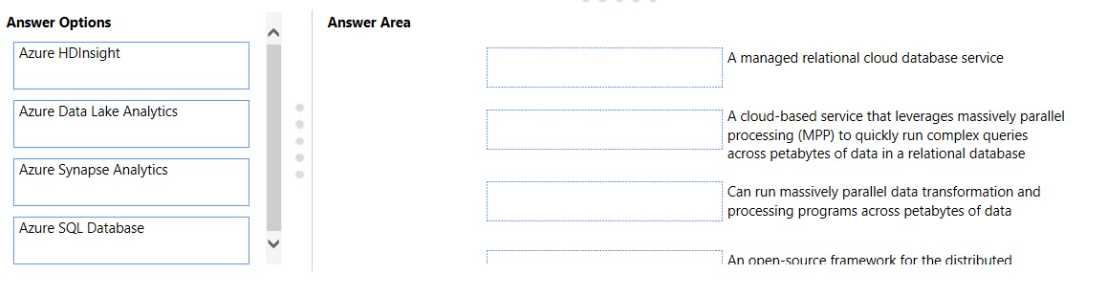
DRAG DROP Match the Azure service to the correct description. Instructions: To answer, drag the appropriate Azure service from the column on the left to its description on the right. Each service may be used once, more than once, or not at all NOTE: Each correct match is worth one point. Microsoft AZ 900 question

Drag & Drop
6 comments in the community discussion
4
SQL Database to Bucket 1, Synapse Analytics to Bucket 2, Data Lake Analytics to Bucket 3, HDInsight to Bucket 4.
3
SQL Database to Bucket 1, Synapse to Bucket 2, Data Lake Analytics to Bucket 3, HDInsight to Bucket 4. Makes sense because SQL DB is for managed relational storage, Synapse covers analytics/warehousing, Data Lake Analytics was for big data processing (with U-SQL), HDInsight is open-source Hadoop/Spark. Pretty sure t
Q: 17
You need to collect and automatically analyze security events from Azure Active Directory (Azure AD). What should you use?
Options
5 comments in the community discussion
2
A or C but pretty sure it's A since Azure Sentinel is the SIEM tool for grabbing and analyzing AD logs. Not 100 percent though, anyone else see this on practice tests?
C/A? I've seen similar questions and most guides point to Azure Sentinel for security event collection and analysis from AD. C (Synapse) is more for analytics/data warehousing. The official docs and practice exams focus on A here. Pretty confident but not 100%.
Q: 18
Note: This question is part of a series of questions that present the same scenario. Each question in the series contains a unique solution that might meet the stated goals. Some question sets might have more than one correct solution, while others might not have a correct solution. After you answer a question in this section, you will NOT be able to return to it. As a result, these questions will not appear in the review screen. An Azure administrator plans to run a PowerShell script that creates Azure resources. You need to recommend which computer configuration to use to run the script. Solution: Run the script from a computer that runs Linux and has the Azure CLI tools installed. Does this meet the goal?
Options
9 comments in the community discussion
3
Option B had something like this in a mock. Azure CLI alone won’t run PowerShell scripts, so this doesn’t meet the goal.
2
B pretty sure. Seen this in the official guide and practice tests, Azure CLI alone isn't enough for PowerShell scripts.
Q: 19

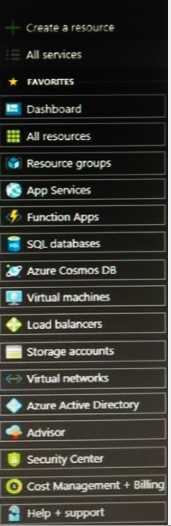
HOTSPOT You need to view a list of planned maintenance events that can affect the availability of an Azure subscription. Which blade should you use from the Azure portal? To answer, select the appropriate blade in the answer area. Microsoft AZ 900 question

Your Answer
11 comments in the community discussion
6
HELP + SUPPORT. Had exactly similar question in my exam, the Help + support blade is where you can track planned maintenance events or issues that could impact resources. Pretty sure this is what they're looking for here.
4
Is it really not Service Health directly? HELP + SUPPORT just felt like a support ticket thing, but maybe I'm missing something.
Q: 20

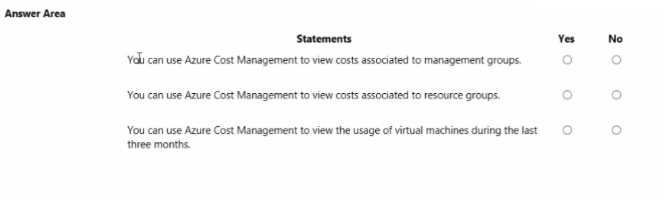
HOTSPOT For each of the following statements, select Yes if the statement is true. Otherwise, select No. NOTE: Each correct selection is worth one point. Microsoft AZ 900 question

Your Answer
9 comments in the community discussion
1
YES for all three. That's how Azure Cost Management handles cost and usage breakdowns as far as I know, but let me know if I'm missing something.
1
All YES. Official docs and labs both mention Cost Management gives that breakdown by management group, resource group, and usage.
Question 1 of 20

What's covered in this practice questions set

2: Describe Azure architecture and services · 13 questions

📖 About this Domain

This domain covers the core architectural components of the Azure cloud platform. You will explore the foundational services for compute, networking, and storage. It establishes the framework for deploying and managing resources in Azure.

🎓 What You Will Learn

  • Learn Azure's global infrastructure, including Regions, Availability Zones, and Resource Groups.
  • Explore core compute services like Azure Virtual Machines, Azure App Service, and Azure Kubernetes Service (AKS).
  • Understand Azure networking solutions such as Virtual Networks (VNet), VPN Gateway, and ExpressRoute.
  • Discover Azure storage services, including Blob Storage, Disk Storage, and Azure Files.

🛠️ Skills You Will Build

  • You will build the skill to differentiate between Azure architectural components for high availability and fault tolerance.
  • You will develop the ability to select appropriate Azure compute and storage services based on technical requirements.
  • You will gain the skill to describe how Azure resources are organized and managed using Subscriptions and Management Groups.
  • You will build the ability to explain core Azure networking and identity services like Azure AD and RBAC.

💡 Top Tips to Prepare

  • Memorize the differences between Regions, Availability Zones, and Resource Groups for architectural questions.
  • Focus on the primary use cases for IaaS, PaaS, and SaaS compute options like VMs versus App Services.
  • Understand the distinction between public and private endpoints for networking and storage services.
  • Use a free Azure account to practice creating and organizing resources within a resource group and subscription.

3: Describe Azure management and governance · 6 questions

📖 About this Domain

This domain covers the core features for managing and governing your Azure environment. You will explore tools for cost management, compliance enforcement, and resource deployment. Key components include Azure Policy, Azure Blueprints, Azure Arc, and monitoring services.

🎓 What You Will Learn

  • Describe cost management tools like the Pricing Calculator, TCO Calculator, and Azure Cost Management.
  • Understand governance features including Azure Policy, resource locks, and Azure Blueprints for compliance.
  • Identify tools for deploying and managing resources such as the Azure portal, Azure CLI, and Azure Arc.
  • Explain monitoring tools like Azure Advisor, Azure Service Health, and Azure Monitor for operational insights.

🛠️ Skills You Will Build

  • Applying cost optimization techniques using Azure's native cost management and pricing tools.
  • Implementing governance strategies with Azure Policy and resource locks to enforce organizational standards.
  • Managing Azure resources and subscriptions through programmatic interfaces like Azure CLI and PowerShell.
  • Monitoring cloud infrastructure health and performance using Azure Monitor and Azure Advisor recommendations.

💡 Top Tips to Prepare

  • Gain practical experience with the Azure Pricing and TCO calculators for cost estimation scenarios.
  • Familiarize yourself with the Azure portal interface for creating and managing policies and resource locks.
  • Understand the distinct purposes of management groups, subscriptions, and resource groups in the governance hierarchy.
  • Differentiate the functions of Azure Monitor, Azure Service Health, and Azure Advisor for monitoring scenarios.

1: Describe cloud concepts · 1 questions

📖 About this Domain

This domain introduces the fundamental principles of cloud computing. It establishes the core concepts, benefits, and terminology that underpin Microsoft Azure and cloud services in general.

🎓 What You Will Learn

  • Differentiate between public, private, and hybrid cloud deployment models.
  • Compare cloud service types including Infrastructure as a Service (IaaS), Platform as a Service (PaaS), and Software as a Service (SaaS).
  • Understand the economic shift from Capital Expenditure (CapEx) to Operational Expenditure (OpEx).
  • Define core cloud concepts like high availability, scalability, elasticity, agility, and disaster recovery.

🛠️ Skills You Will Build

  • Ability to articulate the value proposition of cloud computing using terms like fault tolerance and agility.
  • Skill to map business requirements to the correct cloud service model like IaaS, PaaS, or SaaS.
  • Competency in explaining the shared responsibility model across different cloud service types.
  • Proficiency in describing the consumption-based model and its impact on IT financial planning.

💡 Top Tips to Prepare

  • Memorize the precise definitions of scalability vs. elasticity and high availability vs. fault tolerance.
  • Use the shared responsibility model diagram to understand what you manage versus what Microsoft manages for IaaS, PaaS, and SaaS.
  • Practice applying CapEx and OpEx concepts to on-premises versus cloud infrastructure scenarios.
  • Complete the official Microsoft Learn modules for 'Describe cloud concepts' to reinforce knowledge with structured labs.

Premium Access Includes

  • Quiz Simulator
  • Exam Mode
  • Progress Tracking
  • Question Saving
  • Flash Cards
  • Drag & Drops
  • 3 Months Access
  • PDF Downloads
Get Premium Access
Scroll to Top

FLASH OFFER

Days
Hours
Minutes
Seconds

avail 10% DISCOUNT on YOUR PURCHASE