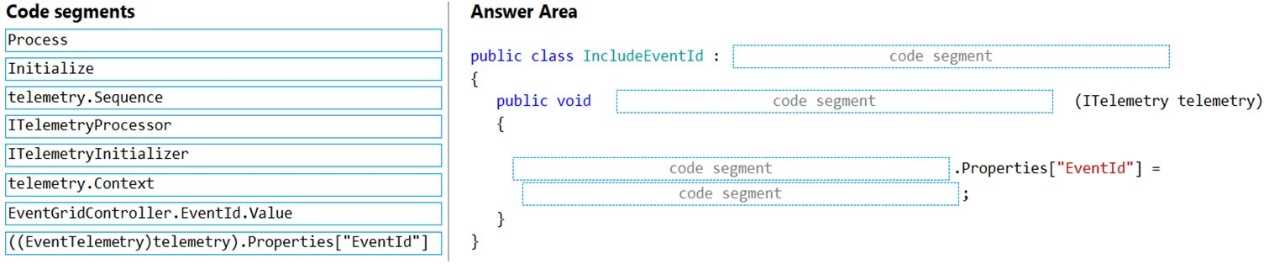
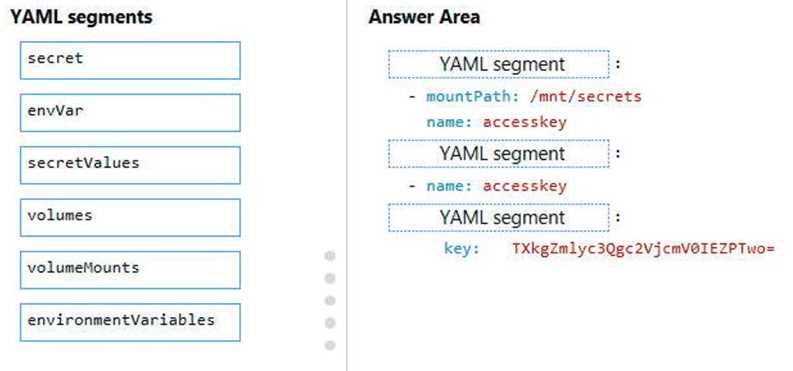
DRAG DROP You need to add YAML markup at line CS17 to ensure that the ContentUploadService can access Azure Storage access keys. How should you complete the YAML markup? To answer, drag the appropriate YAML segments to the correct locations. Each YAML segment may be used once, more than once, or not at all. You may need to drag the split bar between panes or scroll to view content. NOTE: Each correct selection is worth one point. 
Free AZ-204 Practice Test Questions and Answers (2026)
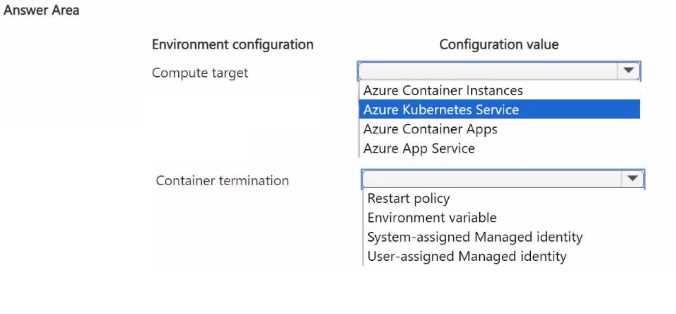
HOTSPOT You develop a Python application for image rendering. The application uses GPU resources to optimize rendering processes. You have the following requirements: • The application must be deployed to a Linux container. • The container must be stopped when the image rendering is complete.
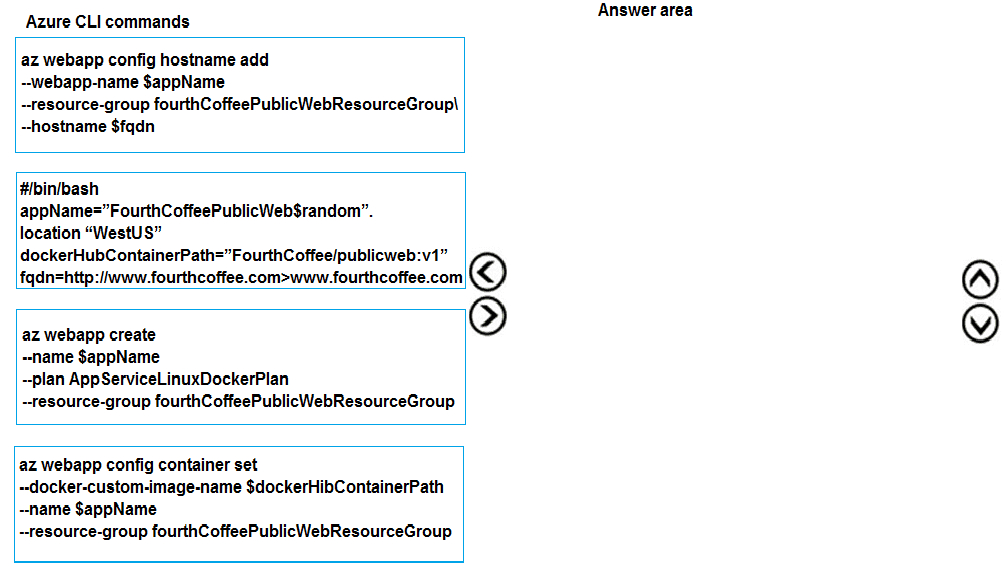
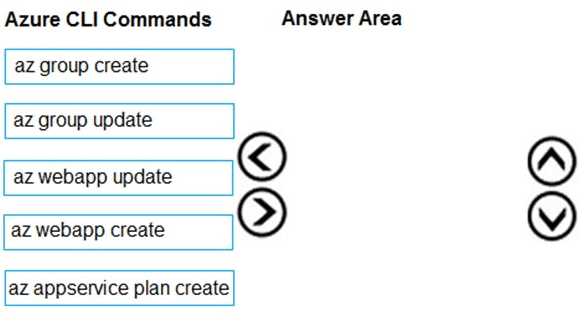
DRAG DROP Fourth Coffee has an ASP.NET Core web app that runs in Docker. The app is mapped to the www.fourthcoffee.com domain. Fourth Coffee is migrating this application to Azure. You need to provision an App Service Web App to host this docker image and map the custom domain to the App Service web app. A resource group named FourthCoffeePublicWebResourceGroup has been created in the WestUS region that contains an App Service Plan named AppServiceLinuxDockerPlan. Which order should the CLI commands be used to develop the solution? To answer, move all of the Azure CLI command from the list of commands to the answer area and arrange them in the correct order.
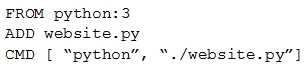
HOTSPOT You are preparing to deploy a Python website to an Azure Web App using a container. The solution will use multiple containers in the same container group. The Dockerfile that builds the container is as follows: 

HOTSPOT You are developing a microservices-based application that uses Azure Container Apps. The application consists of several containerized services that handle tasks, such as processing orders, managing inventory, and generating reports. You must secure the container apps All apps must reside in the same virtual network, share the same Dapr configuration, and share the same logging location. Apps must support the configuration of the amount of memory and compute resources available to containers. You need to configure the Azure Container App. How should you complete the CLI command' To answer, select the appropriate options in the answer area. NOTE: Each correct selection is worth one point.
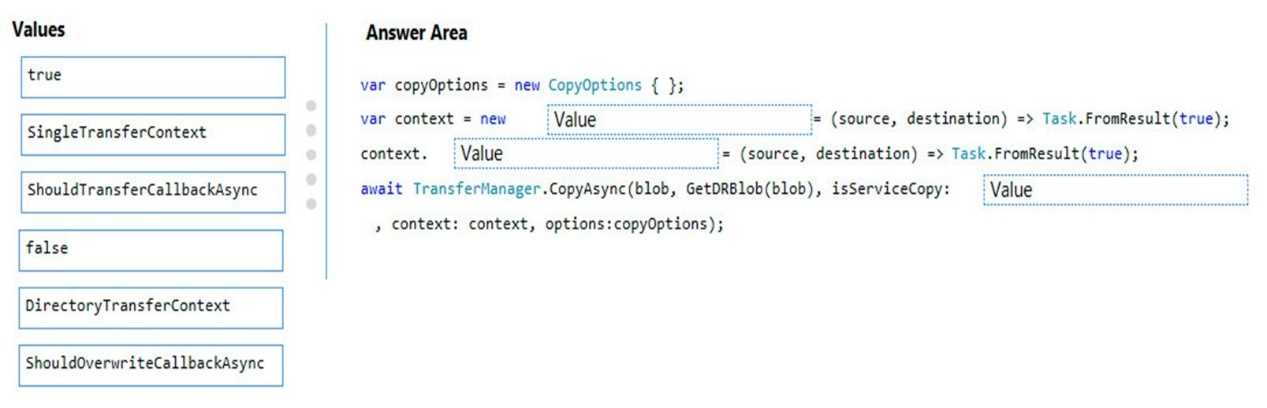
DRAG DROP You need to ensure disaster recovery requirements are met. What code should you add at line PC16? To answer, drag the appropriate code fragments to the correct locations. Each code fragment may be used once, more than once, or not at all. You may need to drag the split bar between panes or scroll to view content. NOTE: Each correct selection is worth one point.
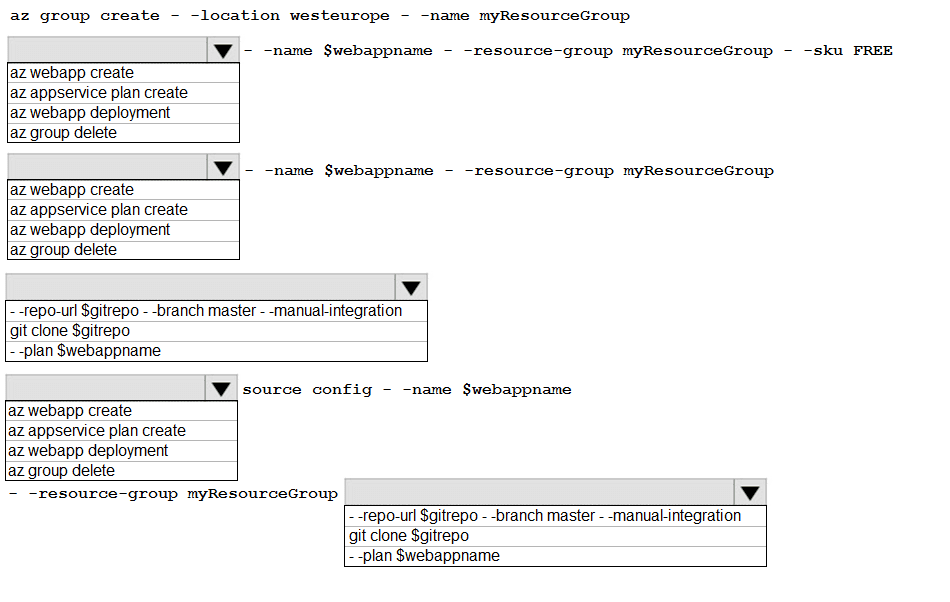
HOTSPOT You are creating a CLI script that creates an Azure web app related services in Azure App Service. The web app uses the following variables: 
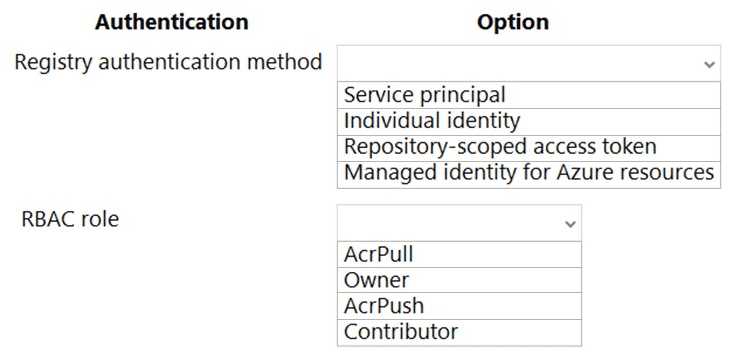
HOTSPOT You develop a containerized application. You plan to deploy the application to a new Azure Container instance by using a third-party continuous integration and continuous delivery (CI/CD) utility. The deployment must be unattended and include all application assets. The third-party utility must only be able to push and pull images from the registry. The authentication must be managed by Azure Active Directory (Azure AD). The solution must use the principle of least privilege. You need to ensure that the third-party utility can access the registry. Which authentication options should you use? To answer, select the appropriate options in the answer area. NOTE: Each correct selection is worth one point.
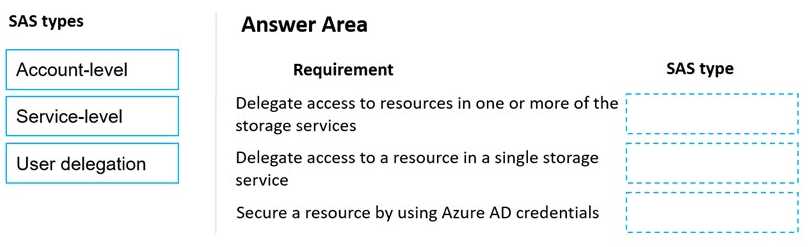
DRAG DROP An organization plans to deploy Azure storage services. You need to configure shared access signature (SAS) for granting access to Azure Storage. Which SAS types should you use? To answer, drag the appropriate SAS types to the correct requirements. Each SAS type may be used once, more than once, or not at all. You may need to drag the split bar between panes or scroll to view content. NOTE: Each correct selection is worth one point.
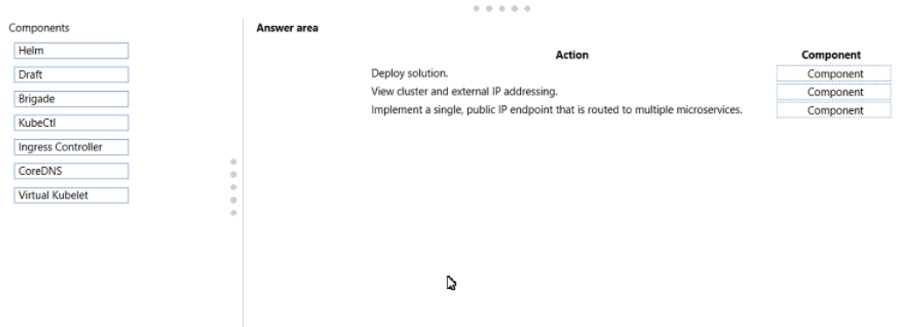
DRAG DROP You are developing a microservices solution. You plan to deploy the solution to a multinode Azure Kubernetes Service (AKS) cluster. You need to deploy a solution that includes the following features: reverse proxy capabilities configurable traffic routing TLS termination with a custom certificate Which components should you use? To answer, drag the appropriate components to the correct requirements. Each component may be used once, more than once, or not at all. You may need to drag the split bar between panes or scroll to view content. NOTE: Each correct selection is worth one point.
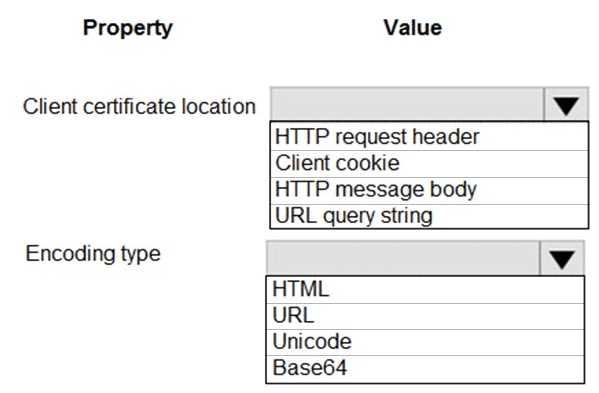
HOTSPOT You are developing an Azure Web App. You configure TLS mutual authentication for the web app. You need to validate the client certificate in the web app. To answer, select the appropriate options in the answer area. NOTE: Each correct selection is worth one point.
DRAG DROP You need to ensure that PolicyLib requirements are met. How should you complete the code segment? To answer, drag the appropriate code segments to the correct locations. Each code segment may be used once, more than once, or not at all. You may need to drag the split bar between panes or scroll to view content. NOTE: Each correct selection is worth one point.
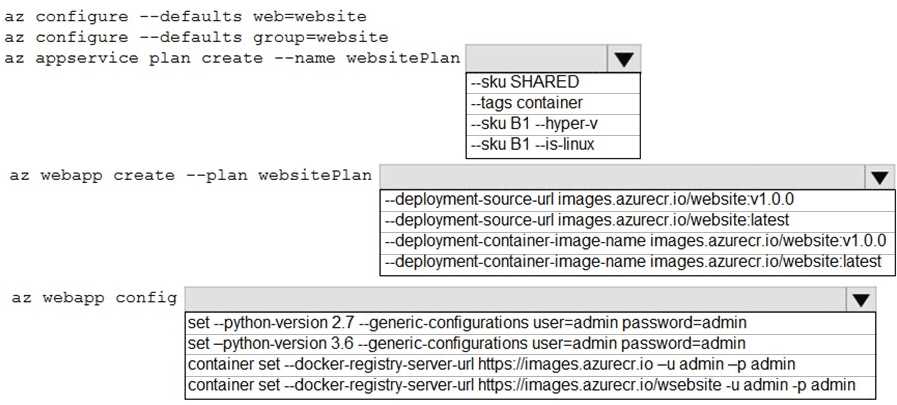
DRAG DROP You are developing a Docker/Go using Azure App Service Web App for Containers. You plan to run the container in an App Service on Linux. You identify a Docker container image to use. None of your current resource groups reside in a location that supports Linux. You must minimize the number of resource groups required. You need to create the application and perform an initial deployment. Which three Azure CLI commands should you use to develop the solution? To answer, move the appropriate commands from the list of commands to the answer area and arrange them in the correct order.
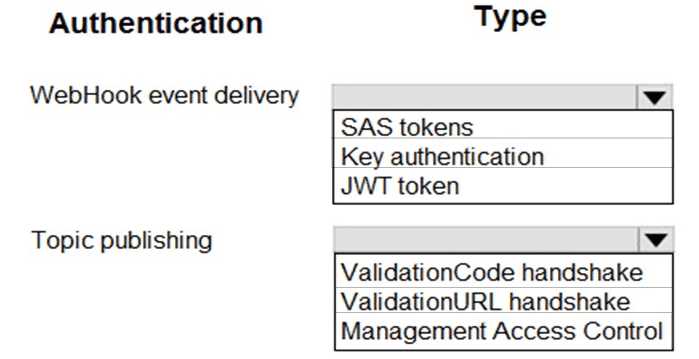
HOTSPOT You are creating an app that uses Event Grid to connect with other services. Your app's event data will be sent to a serverless function that checks compliance. This function is maintained by your company. You write a new event subscription at the scope of your resource. The event must be invalidated after a specific period of time. You need to configure Event Grid to ensure security. What should you implement? To answer, select the appropriate options in [he answer area. NOTE: Each correct selection is worth one point
What's covered in this practice questions set
3: Implement Azure security · 7 questions
📖 About this Domain
This domain focuses on securing Azure solutions. You will implement authentication and authorization using the Microsoft Identity Platform. It also covers securing application data with services like Azure Key Vault and Managed Identities.
🎓 What You Will Learn
- Implement user authentication and authorization using the Microsoft Identity Platform and Microsoft Authentication Library (MSAL).
- Implement secure access to Azure resources by using managed identities for Azure resources.
- Secure application configuration data by using Azure App Configuration and Azure Key Vault.
- Manage keys, secrets, and certificates using the Azure Key Vault SDK.
🛠️ Skills You Will Build
- Integrating applications with Azure Active Directory to enable secure user sign-in and API access.
- Configuring managed identities to provide Azure resources with an identity in Azure AD for authentication.
- Storing and retrieving application secrets programmatically from Azure Key Vault to avoid hardcoded credentials.
- Generating Shared Access Signatures (SAS) to provide delegated, secure access to Azure Storage resources.
💡 Top Tips to Prepare
- Practice authentication flows by building a sample application that uses MSAL to acquire tokens for Microsoft Graph.
- Understand the distinction between system-assigned and user-assigned managed identities and their specific use cases.
- Write code that utilizes the Azure Key Vault SDK to retrieve secrets, keys, and certificates.
- Focus on the programmatic creation and management of Shared Access Signatures (SAS) for Azure Storage.
1: Develop Azure compute solutions · 5 questions
📖 About this Domain
This domain focuses on implementing Azure compute solutions to host application workloads. You will provision, configure, and deploy code to IaaS and PaaS services. Key technologies include Azure Virtual Machines, App Service, Azure Functions, and container-based solutions.
🎓 What You Will Learn
- Implement IaaS solutions by provisioning and configuring Azure Virtual Machines using ARM templates and extensions.
- Create and configure Azure App Service Web Apps, including App Service plans, deployment slots, and scaling settings.
- Implement Azure Functions by creating function apps and implementing triggers and bindings for event-driven execution.
- Deploy containerized solutions by managing images in Azure Container Registry and running them on Azure Container Instances or Azure Kubernetes Service.
🛠️ Skills You Will Build
- Automating the deployment and configuration of virtual machines using declarative templates and command-line tools.
- Developing and deploying web applications and APIs to a managed PaaS environment with Azure App Service.
- Building serverless, event-driven architectures using Azure Functions to process data and integrate services.
- Containerizing applications with Docker and orchestrating their deployment and scaling on Azure's container platforms.
💡 Top Tips to Prepare
- Master the Azure CLI and PowerShell commands for creating and managing App Service, Functions, and VMs.
- Understand the specific use cases and limitations for each compute option: VMs, App Service, Functions, ACI, and AKS.
- Practice the complete container workflow from Dockerfile creation to pushing images to ACR and deploying to ACI.
- Focus on the configuration details of App Service plans and Azure Function hosting plans, including consumption versus dedicated tiers.
2: Develop for Azure storage · 5 questions
📖 About this Domain
This domain covers implementing solutions that use Azure Blob Storage and Azure Cosmos DB. It focuses on programmatic interaction with these storage services using their respective SDKs, including managing data lifecycle, security, and consistency levels.
🎓 What You Will Learn
- Interact with Azure Blob Storage using the .NET SDK to manage blobs, containers, and storage accounts.
- Utilize the Azure Cosmos DB SDK to perform database operations, manage containers, and configure consistency levels.
- Implement secure access to storage resources using Shared Access Signatures (SAS) and access policies.
- Configure blob properties, metadata, and data lifecycle management policies for storage optimization.
🛠️ Skills You Will Build
- Programmatically perform CRUD operations on Azure Blob Storage and Azure Cosmos DB via their respective SDKs.
- Implement data partitioning strategies in Cosmos DB and manage blob lifecycle policies.
- Generate and manage SAS tokens and stored access policies for secure, delegated access to storage.
- Select appropriate Cosmos DB consistency levels and Blob Storage tiers to optimize for cost and performance.
💡 Top Tips to Prepare
- Gain practical experience with the Azure.Storage.Blobs and Microsoft.Azure.Cosmos NuGet packages in a .NET project.
- Practice creating different types of SAS tokens, including user delegation SAS, and understand their scope and permissions.
- Understand the impact of partition keys on Request Unit (RU) consumption and query performance in Cosmos DB.
- Memorize the use cases for Hot, Cool, Cold, and Archive storage tiers and how to configure lifecycle management rules.
4: Monitor, troubleshoot, and optimize Azure solutions · 2 questions
📖 About this Domain
This domain covers application performance and reliability in Azure. It focuses on implementing caching with Azure Cache for Redis and Azure CDN. You will also instrument solutions with Application Insights and Azure Monitor for effective troubleshooting.
🎓 What You Will Learn
- You will learn to implement caching solutions using Azure Cache for Redis and configure Azure CDN for content delivery.
- You will learn to instrument an application with the Application Insights SDK to collect telemetry data.
- You will learn to analyze logs and metrics using Azure Monitor and Log Analytics to diagnose application issues.
- You will learn to configure alerts and web tests in Application Insights for proactive application health monitoring.
🛠️ Skills You Will Build
- You will build the skill to configure cache-aside patterns and expiration policies in Azure Cache for Redis.
- You will build the skill to add code-based instrumentation to an application for custom event and dependency tracking.
- You will build the skill to write Kusto Query Language (KQL) queries to investigate failures and performance bottlenecks.
- You will build the skill to implement alerting rules in Azure Monitor based on metrics and log data.
💡 Top Tips to Prepare
- Get hands-on experience configuring an Azure Cache for Redis instance and connecting a client application.
- Practice instrumenting a web application with the Application Insights SDK and exploring the telemetry in the Azure portal.
- Focus on learning basic Kusto Query Language (KQL) syntax for querying logs in Log Analytics.
- Create and trigger various Azure Monitor alerts, including metric alerts and log search alerts, to understand their configuration.
5: Connect to and consume Azure services and third-party services · 1 questions
📖 About this Domain
This domain covers the integration of disparate services into a cohesive application. You will implement solutions for API governance, event-driven architectures, and message-based communication. Key services include API Management, Event Grid, and Service Bus for building decoupled, scalable systems.
🎓 What You Will Learn
- Implement API Management: Learn to create an APIM instance, define APIs, and apply policies for transformation and security.
- Develop event-based solutions: Learn to implement solutions using Event Grid to handle events from Azure resources and custom topics.
- Develop message-based solutions: Learn to use Azure Queue Storage and Azure Service Bus queues and topics for reliable, asynchronous messaging.
🛠️ Skills You Will Build
- API Gateway Configuration: You will build skills to configure API Management as a facade, securing and managing backend APIs.
- Event-driven Programming: You will build the ability to implement handlers for Event Grid subscriptions to create reactive applications.
- Asynchronous Messaging Implementation: You will build proficiency in using SDKs to send and receive messages with Service Bus and Queue Storage.
💡 Top Tips to Prepare
- Practice API Management Policies: Focus on hands-on labs for applying policies like rate-limiting, caching, and JWT validation.
- Differentiate Azure Messaging Services: Know the specific use cases and differences between Queue Storage, Event Grid, Event Hubs, and Service Bus.
- Code with Azure SDKs: Implement producers and consumers for Service Bus and Queue Storage to solidify your understanding of the programming model.
- Understand Event Grid Schemas: Memorize the structure of Event Grid events and the CloudEvents schema to correctly parse incoming event data.