Free AZ-104 Practice Test Questions and Answers (2026)

View Mode
Q: 1

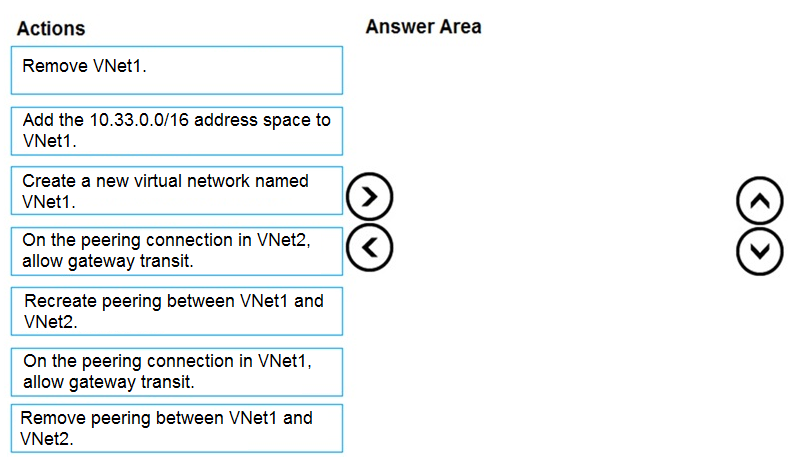
DRAG DROP - You have an Azure subscription that contains two virtual networks named VNet1 and VNet2. Virtual machines connect to the virtual networks. The virtual networks have the address spaces and the subnets configured as shown in the following table. AZ 104 Latest question You need to add the address space of 10.33.0.0/16 to VNet1. The solution must ensure that the hosts on VNet1 and VNet2 can communicate. Which three actions should you perform in sequence? To answer, move the appropriate actions from the list of actions to the answer area and arrange them in the correct order. Select and Place: AZ 104 Latest question

Drag & Drop
29 comments in the community discussion
10
Remove peering, add address space, then recreate peering. Had something like this in a mock, sequence matters here.
6
This order makes sense: Remove peering, add 10.33.0.0/16 to VNet1, then recreate the peering. Azure won’t automatically update routes for new address spaces on an active peering unless you remove and re-add it. I think that’s still how it works unless there’s a sync option (which isn’t here). Someone correct me if t
Q: 2
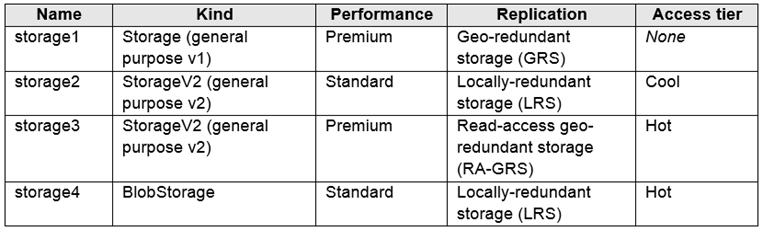
You have an Azure subscription that contains the storage accounts shown in the following table. AZ 104 Latest question You need to identify which storage account can be converted to zone-redundant storage (ZRS) replication by requesting a live migration from Azure support. What should you identify?

Options
25 comments in the community discussion
1
Yeah, the only one that matches the GPv2, Standard, GRS combo is B. Premium (D) can't be live-migrated to ZRS as of now, so storage2 is the pick. If Microsoft changes this in the future, maybe D, but not yet.
1
Live migration makes me think D could work if Premium accounts supported it, since storage4 has ZRS option. Wasn’t there talk about upgrades for Premium recently? Maybe I’m mixing things up, but for now I’m picking D. Open to being wrong if I missed that Standard-only detail.
Q: 3
You develop the following Azure Resource Manager (ARM) template to create a resource group and deploy an Azure Storage account to the resource group. AZ 104 Latest question Which cmdlet should you run to deploy the template?
Options
24 comments in the community discussion
5
D. template is subscription-scope so New-AzDeployment matches. If it was just inside a resource group would have been B. Agree?
1
Looks like it's D here since the schema in the template points to a subscription-level deployment. See this style in official practice tests a lot. If you want to double-check, check out the Microsoft docs or work through their lab environments-those make it clear too. Anyone see different guidance?
Q: 4
You have a Standard Azure App Service plan named Plan1. You need to ensure that Plan1 will scale automatically when the CPU usage of the web app exceeds 80 percent. What should you select for Plan1?
Options
32 comments in the community discussion
1
B , since you need a specific CPU threshold (80%), you have to use Rules Based. Saw a similar question in practice sets and it was always B for custom scaling like this. Correct me if I missed something.
1
Hmm, I get why everyone says B, but I still think A could work since "Automatic" sounds like it would autoscale based on CPU. Is there something I'm missing about how flexible that setting is?
Q: 5
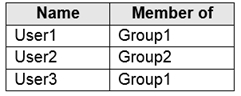
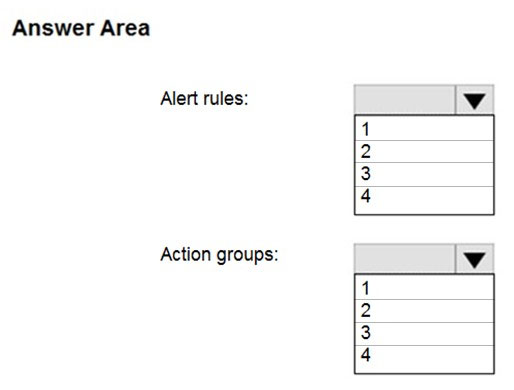
HOTSPOT - You have an Azure subscription that contains an Azure Storage account named storage1 and the users shown in the following table. AZ 104 Latest question You plan to monitor storage1 and to configure email notifications for the signals shown in the following table. AZ 104 Latest question You need to identify the minimum number of alert rules and action groups required for the planned monitoring. How many alert rules and action groups should you identify? To answer, select the appropriate options in the answer area. Hot Area: AZ 104 Latest question

Your Answer
43 comments in the community discussion
6
Saw a very similar question on a practice, minimum is 4 alert rules and 3 action groups.
6
Alert rules: 4Action groups: 3
Q: 6
HOTSPOT You need to configure a new Azure App Service app named WebApp1. The solution must meet the following requirements: WebApp1 must be able to verify a custom domain name of app.contoso.com. WebApp1 must be able to automatically scale up to eight instances. Costs and administrative effort must be minimized. Which pricing plan should you choose, and which type of record should you use to verify the domain? To answer, select the appropriate options in the answer area.
Your Answer
27 comments in the community discussion
6
Yeah, Standard with TXT record makes sense here. Only Standard plan supports scaling to 8 instances, and Azure always uses a TXT record for domain verification. Saw a similar question pop up in some exam reports. Correct me if I missed something!
6
Standard plan, TXT record
Q: 7
You plan to deploy several Azure virtual machines that will run Windows Server 2019 in a virtual machine scale set by using an Azure Resource Manager template. You need to ensure that NGINX is available on all the virtual machines after they are deployed. What should you use?
Options
28 comments in the community discussion
5
Option C
1
Not A, it should be C. Custom Script Extension actually handles script execution during deployment, so you can install NGINX right after provisioning. Publish-AzVMDscConfiguration is more for DSC configs, not quick software installs. Think this lines up with most Azure practice labs, but open to discussion.
Q: 8

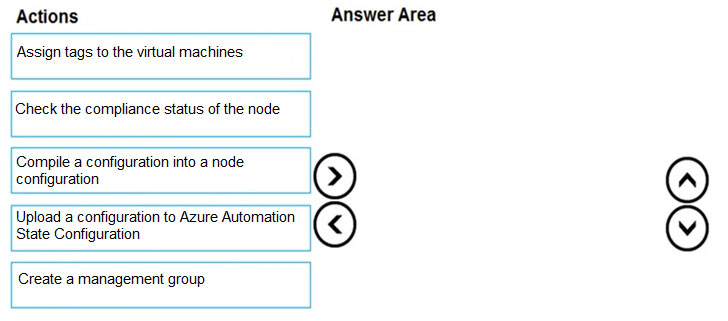
DRAG DROP - You onboard 10 Azure virtual machines to Azure Automation State Configuration. You need to use Azure Automation State Configuration to manage the ongoing consistency of the virtual machine configurations. Which three actions should you perform in sequence? To answer, move the appropriate actions from the list of actions to the answer area and arrange them in the correct order. NOTE: More than one order of answer choices is correct. You will receive credit for any of the correct orders you select. Select and Place: AZ 104 Latest question

Drag & Drop
26 comments in the community discussion
6
Upload configuration to State Configuration, then compile to node config, check compliance. Standard Azure flow here.
6
Upload configuration to Automation State Configuration → compile into node configuration → check compliance status. This matches the Azure workflow, since you can't compile before it's uploaded. Pretty sure that's how practice exams show it too, but let me know if official docs say otherwise!
Q: 9

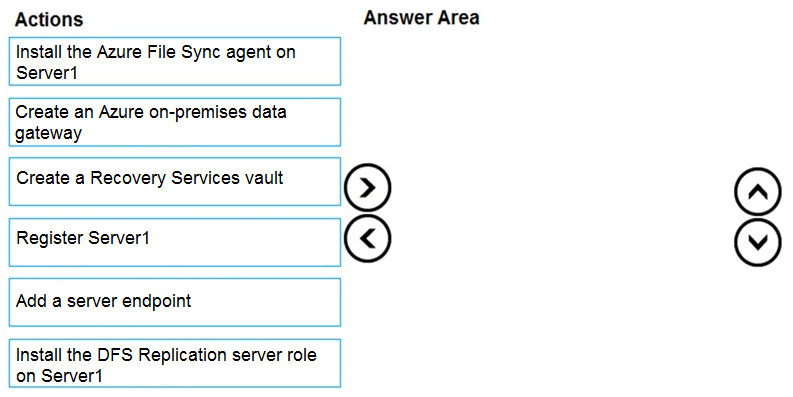
DRAG DROP - You have an on-premises file server named Server1 that runs Windows Server 2016. You have an Azure subscription that contains an Azure file share. You deploy an Azure File Sync Storage Sync Service, and you create a sync group. You need to synchronize files from Server1 to Azure. Which three actions should you perform in sequence? To answer, move the appropriate actions from the list of actions to the answer area and arrange them in the correct order. Select and Place:


Drag & Drop
31 comments in the community discussion
6
Seen this in a practice exam too. Sequence is: install Azure File Sync agent, then register Server1, then add the server endpoint.
4
Install the Azure File Sync agent on Server1, then register Server1, then add a server endpoint. That's the right flow.
Q: 10
HOTSPOT - You have an Azure subscription that contains an Azure Kubernetes Service (AKS) cluster named Cluster1. Cluster1 hosts a node pool named Pool1 that has four nodes. You need to perform a coordinated upgrade of Cluster1. The solution must meet the following requirements: - Deploy two new nodes to perform the upgrade. - Minimize costs. How should you complete the command? To answer, select the appropriate options in the answer area. NOTE: Each correct selection is worth one point. AZ 104 Latest question
Your Answer
28 comments in the community discussion
6
Hmm, I'd stick with updates and -max-surge 2 for this one.
5
Why not node-count in Box 2? I think -max-surge 2 is the better pick since it just adds the two nodes temporarily for the upgrade. Node-count would increase total pool size, which isn’t what they want here. Anyone disagree?
Q: 11

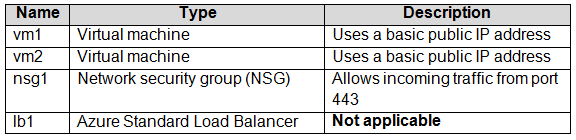
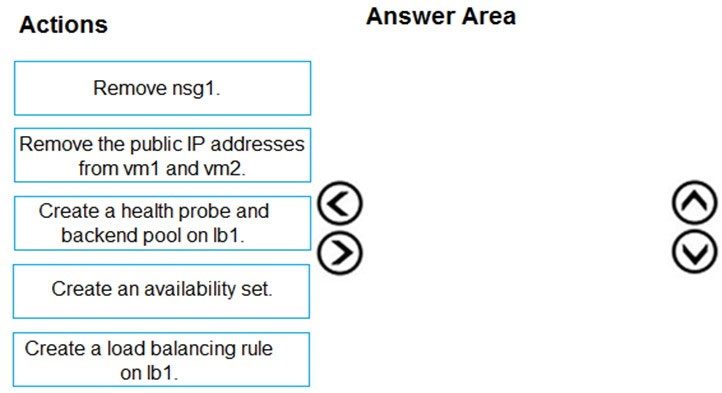
DRAG DROP - You have an Azure subscription that contains the resources shown in the following table. AZ 104 Latest question You need to load balance HTTPS connections to vm1 and vm2 by using lb1. Which three actions should you perform in sequence? To answer, move the appropriate actions from the list of actions to the answer area and arrange them in the correct order. Select and Place: AZ 104 Latest question
Drag & Drop
9 comments in the community discussion
8
Remove public IPs from vm1/vm2 → create health probe and backend pool on lb1 → create LB rule. Azure Standard Load Balancer can't backend machines with Basic public IPs, so you need to detach those first. Seen this combo in practice exams, should be right but correct me if not.
6
Looks like the right sequence is remove the public IPs from vm1 and vm2, create a health probe and backend pool on lb1, then add the load balancing rule. Standard LB can't work with VMs that have basic public IPs still attached. Saw a similar question on my last mock so I think that's correct but let me know if you
Q: 12
Your company's Azure solution makes use of Multi-Factor Authentication for when users are not in the office. The Per Authentication option has been configured as the usage model. After the acquisition of a smaller business and the addition of the new staff to Azure Active Directory (Azure AD) obtains a different company and adding the new employees to Azure Active Directory (Azure AD), you are informed that these employees should also make use of Multi-Factor Authentication. To achieve this, the Per Enabled User setting must be set for the usage model. Solution: You reconfigure the existing usage model via the Azure CLI. Does the solution meet the goal?
Options
12 comments in the community discussion
1
B tbh. Swapping to Per Enabled User in Azure CLI is just a billing change, not actual MFA enforcement. I get why A might look tempting if you miss that detail.
B , seen it in official guide and practice tests. CLI change only affects billing, not user MFA enforcement directly.
Q: 13

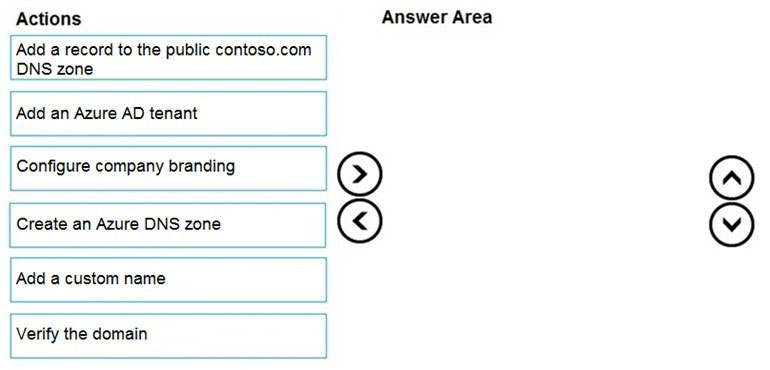
DRAG DROP - You have an Azure Active Directory (Azure AD) tenant that has the contoso.onmicrosoft.com domain name. You have a domain name of contoso.com registered at a third-party registrar. You need to ensure that you can create Azure AD users that have names containing a suffix of @contoso.com. Which three actions should you perform in sequence? To answer, move the appropriate actions from the list of actions to the answer area and arrange them in the correct order. Select and Place: AZ 104 Latest question
Drag & Drop
8 comments in the community discussion
4
Looks like the right order is add custom name, add DNS record to public zone, then verify the domain.
Add a custom name, then verify the domain, then add a record to the public contoso.com DNS zone. I’m pretty sure Azure wants you to verify before messing with DNS so it knows which record to check for. Saw similar in practice exams, but admit this always trips me up since some say DNS first. Open to someone correcti
Q: 14
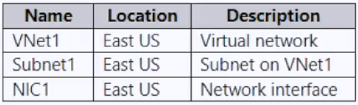
You have an Azure subscription that contains the resources shown in the following table. AZ 104 Latest question You create a route table named RT1 in the East US Azure region. To which resources can you associate RT1?
Options
7 comments in the community discussion
5
Option B
I don’t think it’s just Subnet1. D seems right because I thought route tables could also be linked to NICs if you're customizing routes, like with UDRs. Anyone else remember that from practice labs?
Q: 15
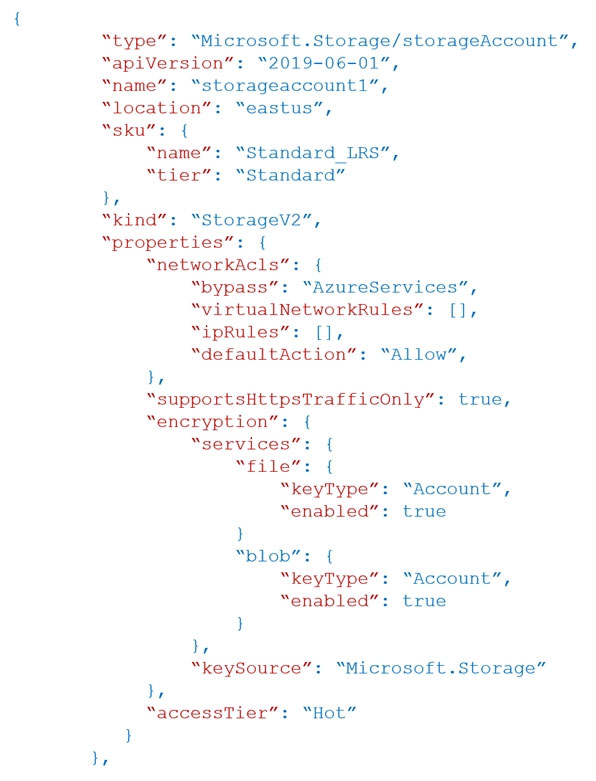
HOTSPOT - You have an Azure subscription that contains an Azure Storage account named storageaccount1. You export storageaccount1 as an Azure Resource Manager template. The template contains the following sections. AZ 104 Latest question For each of the following statements, select Yes if the statement is true. Otherwise, select No. Hot Area: AZ 104 Latest question
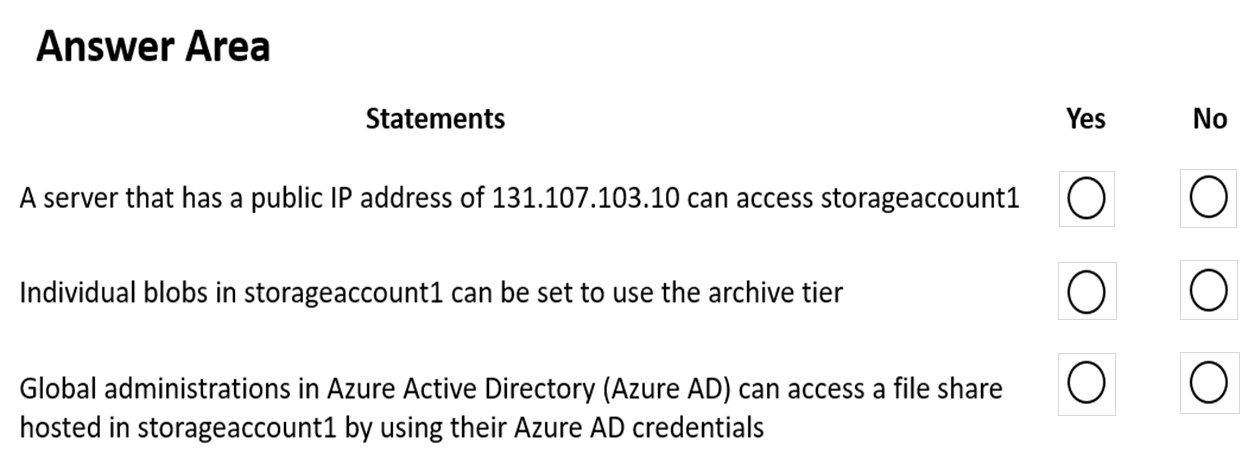
Your Answer
13 comments in the community discussion
5
Yes, Yes, NoSeen this type a lot in the official practice set. The defaultAction Allow on storage accounts is key for open network access, and StorageV2 supports blob tiering, but Azure AD admins don’t get file share access by default. Pretty sure that matches what Microsoft expects, but correct me if I’m off.
2
Nah, I think for the last statement it should be Yes, Yes, Yes.I was under the impression that Global Admins in Azure AD can access resources like file shares if they have sufficient privileges, so picked Yes for all. Could be a common trap about RBAC vs data-plane access, not 100% sure here so let me know if I
Q: 16
You have an Azure subscription named Subscription1 that contains two Azure virtual networks named VNet1 and VNet2. VNet1 contains a VPN gateway named VPNGW1 that uses static routing. There is a site-to-site VPN connection between your on-premises network and VNet1. On a computer named Client1 that runs Windows 10, you configure a point-to-site VPN connection to VNet1. You configure virtual network peering between VNet1 and VNet2. You verify that you can connect to VNet2 from the on-premises network. Client1 is unable to connect to VNet2. You need to ensure that you can connect Client1 to VNet2. What should you do?
Options
8 comments in the community discussion
2
Option C makes sense here. When you add new peering after setting up the P2S VPN, Client1 won't get routes to VNet2 unless you re-download the client package. A looks tempting but is more about gateway transit, not local routes. I think C fits best but open to feedback.
2
C tbh. Whenever you change peering or VNets, the P2S client config needs to be updated so Client1 gets the new routes. No need for BGP in this scenario. Someone correct me if I'm wrong.
Q: 17
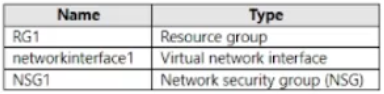
HOTSPOT - You have an Azure subscription that contains a user named User1 and the resources shown in the following table. AZ 104 Latest question NSG1 is associated to networkinterface1. User1 has role assignments for NSG1 as shown in the following table. AZ 104 Latest question For each of the following statements, select Yes if the statement is true. Otherwise, select No. AZ 104 Latest question
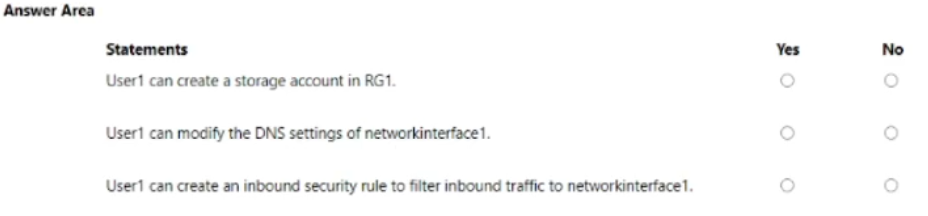
Your Answer
7 comments in the community discussion
8
1. Yes2. No3. YesI remember a similar question on a practice test. User1 has Storage Account Contributor on RG1, so they can create storage accounts there. For the network interface DNS setting, they only have Reader rights so that's a no. But with Contributor on NSG1, User1 can definitely add inbound
5
1. Yes, 2. No, 3. YesUser1 has Storage Account Contributor on RG1 so that's enough to deploy storage accounts there. Changing DNS on networkInterface1 needs write access at the NIC which they don't have (just Reader at subscription). Contributor role on NSG1 gives permission to add inbound rules though. Prett
Q: 18
You have an Azure subscription that contains a resource group named TestRG. You use TestRG to validate an Azure deployment. TestRG contains the following resources: AZ 104 Latest question You need to delete TestRG. What should you do first?
Options
8 comments in the community discussion
B imo, A tricks you with backup config but doesn't help if Vault1 still has data or VNET1 is locked.
Probably B. Resource group deletion fails if any resources have a delete lock like VNET1 does, plus Recovery Services vaults can't be deleted with backup items inside. Removing the lock and clearing Vault1's data lets you actually remove TestRG. Pretty sure that's what MS expects in this scenario, unless I'm missing so
Q: 19
You have an Azure App Service app named App1 that contains two running instances. You have an autoscale rule configured as shown in the following exhibit. AZ 104 Latest question For the Instance limits scale condition setting, you set Maximum to 5. During a 30-minute period, App1 uses 80 percent of the available memory. What is the maximum number of instances for App1 during the 30-minute period?
Options
7 comments in the community discussion
1
D, not B. The max instance limit is a common trap on these autoscale questions. Seen similar on past practice exams.
1
Option D Saw similar logic in official practice, max instance cap controls scaling behavior.
Q: 20
Your company has an Azure Active Directory (Azure AD) tenant named weyland.com that is configured for hybrid coexistence with the on-premises Active Directory domain. You have a server named DirSync1 that is configured as a DirSync server. You create a new user account in the on-premise Active Directory. You now need to replicate the user information to Azure AD immediately. Solution: You restart the NetLogon service on a domain controller. Does the solution meet the goal?
Options
5 comments in the community discussion
B. but I'd double check with the official guide or do a quick practice lab to be sure.
Its A
Question 1 of 20

What's covered in this practice questions set

3: Deploy and manage Azure compute resources · 6 questions

📖 About this Domain

This domain covers the implementation and management of Azure IaaS and PaaS compute solutions. You will handle the complete lifecycle of virtual machines, containers, and web applications. It is a core competency for the Azure Administrator role, focusing on resource deployment and configuration.

🎓 What You Will Learn

  • Deploy and configure virtual machines (VMs) using the Azure portal, ARM templates, and command-line interfaces.
  • Automate VM deployments and manage configurations using VM extensions and cloud-init.
  • Implement and manage containerized workloads using Azure Container Instances (ACI) and basic Azure Kubernetes Service (AKS) configurations.
  • Create and configure Azure App Service Plans and deploy web apps, including scaling and deployment slots.

🛠️ Skills You Will Build

  • Automating compute resource provisioning using Infrastructure as Code (IaC) with ARM templates and Bicep.
  • Configuring high availability and resilience for IaaS workloads using availability sets, availability zones, and scale sets.
  • Deploying and managing containerized applications on Azure's serverless container platform and orchestration service.
  • Managing PaaS web hosting environments, including autoscaling, custom domains, and backup configurations.

💡 Top Tips to Prepare

  • Master ARM template syntax for deploying VMs with dependent resources like NICs, NSGs, and public IPs.
  • Practice extensively with Azure CLI and Azure PowerShell commands for creating and modifying compute resources.
  • Clearly differentiate the use cases and SLAs for availability sets versus availability zones for VM fault tolerance.
  • Understand the specific scenarios for choosing between VMs, ACI, AKS, and App Service for application hosting.

4: Implement and manage virtual networking · 5 questions

📖 About this Domain

This domain covers the implementation and management of core Azure networking infrastructure. You will configure virtual networks, subnets, and IP addressing to establish a foundational network topology for Azure resources.

🎓 What You Will Learn

  • You will learn to create and configure VNets and subnets, including IP address space planning.
  • You will learn to filter network traffic using Network Security Groups (NSGs) and Azure Firewall rules.
  • You will learn to implement name resolution using Azure DNS private and public zones.
  • You will learn to configure VNet peering to connect virtual networks securely across regions.

🛠️ Skills You Will Build

  • You will build skills to deploy and manage Azure VNets, subnets, and IP addressing schemes.
  • You will build skills in securing network traffic using NSGs, Azure Firewall policies, and Azure Bastion.
  • You will build skills to configure Azure Load Balancer and Application Gateway for traffic distribution.
  • You will build skills using Network Watcher for network diagnostics and troubleshooting connectivity issues.

💡 Top Tips to Prepare

  • Get hands-on practice creating and peering VNets, both for local and global configurations.
  • Master the processing logic and priority numbers for NSG inbound and outbound security rules.
  • Understand the OSI layer differences between Azure Load Balancer (Layer 4) and Application Gateway (Layer 7).
  • Practice configuring Azure DNS, including private zones and auto-registration of VM records.

2: Implement and manage storage · 4 questions

📖 About this Domain

This domain covers the configuration and management of Azure Storage accounts. You will handle data solutions using Azure Blob Storage and Azure Files. Key tasks include securing storage access and managing data with tools like Storage Explorer.

🎓 What You Will Learn

  • Create and configure storage accounts, including network access and replication settings.
  • Manage Azure Blob Storage by configuring tiers, lifecycle management policies, and object replication.
  • Deploy and manage Azure file shares and configure Azure File Sync for hybrid scenarios.
  • Secure storage data by generating shared access signatures (SAS), managing access keys, and configuring Azure AD authentication.

🛠️ Skills You Will Build

  • You will build the ability to provision and manage storage accounts using the Azure portal, CLI, and PowerShell.
  • You will gain proficiency in securing storage endpoints and controlling data access with RBAC and access policies.
  • You will develop skills in performing data migration and management tasks using AzCopy and Storage Explorer.
  • You will be able to implement a hybrid file share solution by deploying and configuring Azure File Sync.

💡 Top Tips to Prepare

  • Get hands-on practice creating storage accounts with varied redundancy options like LRS, ZRS, GRS, and RA-GRS.
  • Use the Azure CLI to generate SAS tokens and understand the different permission levels and expiry settings.
  • Perform bulk data transfers with AzCopy to and from blob containers to master its command syntax.
  • Set up a complete Azure File Sync topology, including installing the agent and creating a sync group.

1: Manage Azure identities and governance · 4 questions

📖 About this Domain

This domain covers identity management using Microsoft Entra ID and Azure governance. You will manage users, groups, and role-based access control (RBAC). It also includes implementing compliance and cost management controls.

🎓 What You Will Learn

  • You will learn to manage Microsoft Entra ID objects like users, groups, and configure self-service password reset (SSPR).
  • You will learn to implement Azure role-based access control (RBAC) by assigning roles at various scopes like management groups and subscriptions.
  • You will learn to enforce resource governance using Azure Policy, resource locks, and tagging strategies.
  • You will learn to manage Azure subscriptions, configure cost management alerts, and organize resources with resource groups.

🛠️ Skills You Will Build

  • You will build skills to administer Microsoft Entra tenants, including bulk user operations and guest account management.
  • You will build skills to secure resource access by assigning built-in and custom RBAC roles effectively.
  • You will build skills to apply governance controls like Azure Policy for resource compliance and resource locks to prevent accidental changes.
  • You will build skills to analyze Azure costs and implement organizational structures using management groups and subscriptions.

💡 Top Tips to Prepare

  • Practice creating users and assigning them to groups using both the Azure portal and PowerShell commands.
  • Master the inheritance model of RBAC and understand how permissions are applied at different scopes.
  • Differentiate between the functions of Azure Policy for compliance and resource locks for operational protection.
  • Get hands-on experience with the Cost Management + Billing blade to set budgets and analyze spending patterns.

5: Monitor and maintain Azure resources · 1 questions

📖 About this Domain

This domain covers the operational management of Azure infrastructure. You will use Azure Monitor for performance tracking and Azure Backup for business continuity. It is critical for maintaining the health and availability of deployed resources.

🎓 What You Will Learn

  • Configure Azure Monitor to ingest metrics and logs from IaaS and PaaS resources.
  • Create alert rules, action groups, and alert processing rules for proactive notifications.
  • Utilize Log Analytics workspaces and Kusto Query Language (KQL) for log data analysis.
  • Implement backup and restore operations for Azure VMs using Recovery Services vaults.

🛠️ Skills You Will Build

  • Analyzing resource utilization and performance trends using Azure Monitor Metrics.
  • Troubleshooting operational issues by executing KQL queries against Log Analytics data.
  • Configuring and managing data protection strategies with Azure Backup policies.
  • Implementing disaster recovery plans by configuring Azure Site Recovery for VM replication.

💡 Top Tips to Prepare

  • Get hands-on practice creating alert rules with different signal types like metric and log.
  • Learn the core KQL commands like `where`, `project`, and `summarize` in the Log Analytics demo environment.
  • Understand the differences between a Recovery Services vault and a Backup vault.
  • Perform a full VM restore and a file-level restore in a lab to understand the process.

Premium Access Includes

  • Quiz Simulator
  • Exam Mode
  • Progress Tracking
  • Question Saving
  • Flash Cards
  • Drag & Drops
  • 3 Months Access
  • PDF Downloads
Get Premium Access
Scroll to Top

FLASH OFFER

Days
Hours
Minutes
Seconds

avail 10% DISCOUNT on YOUR PURCHASE