Free 1Z0-071 Practice Test Questions and Answers (2026)

Last Update Check
View Mode
Q: 1

Choose the best


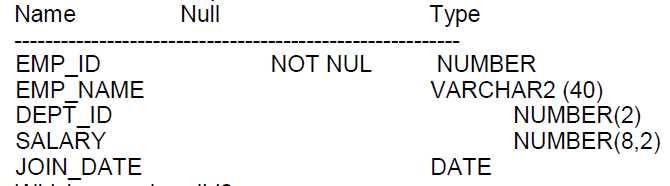
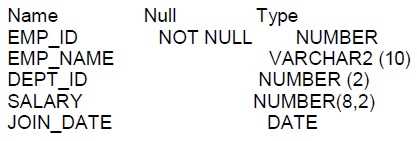
Examine the description of the EMPLOYEES table:

Answer

Which query is valid?


Options
15 comments in the community discussion
6
A
5
A. Had something like this in a mock before, and A matches what Oracle expects-SUM(salary) with both dept_id and join_date in GROUP BY. The others have typos or try to nest aggregates directly. Pretty sure A is right, but open to corrections.
Q: 2
Which two are true about the NVL, NVL2, and COALESCE functions?
Options
13 comments in the community discussion
1
You want D and E here. COALESCE goes until it finds a non-null, so D, and NVL does force types to match, so E. The others are distractors. Pretty sure this is right but always possible I'm missing a weird edge case.
1
Not D only, E matters too since NVL requires matching data types. C is a trap, COALESCE returns at the first non-null, not null.
Q: 3
You issued this command: DROP TABLE hr. employees; Which three statements are true?
Options
12 comments in the community discussion
2
Option A. B, E. Official guide covers DROP TABLE effects, worth a review if unsure.
1
My vote is it's A, B, E. Drop table takes out all constraints and indexes tied to the table, and unless you use PURGE, it goes to the recycle bin. Sequences and synonyms aren't affected directly. Open to pushback on this though.
Q: 4
Which two are true about granting privilege on objects?
Options
19 comments in the community discussion
1
I don't think B's right, since the WITH GRANT OPTION isn't restricted to just DBAs. A and C seem correct-owners always get all object privileges and need to grant REFERENCES for foreign keys. Pretty sure, but let me know if I missed a detail.
1
B tbh. WITH GRANT OPTION makes me think only DBAs can technically use that, since it's high privilege. Not sure I'm remembering this right though, maybe missing a detail about object owners granting too. Happy to be corrected if I'm off.
Q: 5
Which two statements are true about the rules of precedence for operators?
Options
17 comments in the community discussion
1
My pick: A and B. Arithmetic with the same precedence runs left to right, and parentheses always let you change order for operations. C and E are just common traps people fall for on SQL exams. If someone thinks D fits, let me know but pretty sure it's not.
1
A and B for me. Arithmetic ops with equal precedence go left to right, and you can stack parentheses as much as you want to force order. The traps in C and E come up a lot on Oracle questions. Anyone disagree?
Q: 6
Which two statements are true about date/time functions in a session where NLS_DATE_PORMAT is set to DD-MON-YYYY SH24:MI:SS
Options
12 comments in the community discussion
1
C and D tbh, matches up with what I saw in the official docs and practice exam questions.
C and D for me. CURRENT_DATE uses the session time zone, not just server OS, and SYSDATE gets its value straight from the database server's clock. Pretty sure that's what Oracle expects but happy to hear other takes.
Q: 7
Which three statements are true about Data Manipulation Language (DML)?
Options
14 comments in the community discussion
1
A B, E. No primary key needed for DML and Oracle doesn't autocommit inserts by default. Pretty sure that's correct here.
1
C/D? I get why most go for A, B, E since Oracle doesn't autocommit by default and primary key isn't required for DML. E seems solid with update subqueries, but C always makes me second guess because of different tool behaviors. Pretty sure it's A, B, E unless there's some weird context in play-let me know if you see
Q: 8
Which two statements are true about Oracle synonyms?
Options
19 comments in the community discussion
1
Option D had something really close to this in a practice set. Picked D and A since I thought you could make a synonym for stuff inside a package if it's public, but maybe that's not allowed for inside items. Pretty sure about D though, at least from that mock.
C/D? Not sure since the package vs object in package thing keeps coming up, but I think it's A and C still.
Q: 9
Which three are true about system and object privileges
Options
23 comments in the community discussion
2
I don't think it's C. A is a trap for system vs object, so A D F.
1
A D, F
Q: 10
Which two statements are true about selecting related rows from two tables based on entity relationship diagram (ERD)?
Options
23 comments in the community discussion
1
Not sure I buy A and D only. B seems legit since with a self join you often use inner join syntax, just different aliases on the same table. So I'd say B and D-self joins can still be written using INNER JOIN, right? I might be missing something subtle here though. Did others get tripped up by Oracle's phrasing?
1
A and D make sense here. Self join (A) is the standard for comparing/relating rows within a single table, usually using aliases. D also checks out since you often join more tables to bridge indirect relations, especially with normalization or many-to-many setups. I think these are the intended answers but let me know i
Q: 11
Which three statements are true about GLOBAL TEMPORARY TABLES?
Options
5 comments in the community discussion
2
Isn't C a bit of a trap here? Deletes on GTTs can be rolled back just like normal tables, so only B, D, and E line up with how Oracle handles temp tables. Anyone disagree?
1
Not F, E is correct. Rows in a GLOBAL TEMPORARY TABLE get wiped when the session ends.
Q: 12
Examine the description of the EMPLOYEES table: Oracle 1Z0-071 question NLS_DATE_FORMAT is set to DD-MON-YY. Which query requires explicit data type conversion?
Options
4 comments in the community discussion
1
Is there any scenario where Oracle wouldn't require an explicit TO_DATE conversion for a string like '10-02-2018' in D? The others seem to either be implicit or just not valid syntax, but maybe I'm missing something with B or C.
C vs D? Not sure, but leaning to D because the date in WHERE clause looks like a string. Anybody confirm this?
Q: 13
Which three statements are true about defining relations between tables in a relational database?
Options
7 comments in the community discussion
A E. Official Oracle docs and a few practice tests both confirm this.
It’s A and E, D is the common trap since it mixes up how PK and FK relate. Seen similar in practice sets.
Q: 14
The CUSTOMERS table has a CUST_LAST_NAME column of data type VARCHAR2. The table has two rows whose COST_LAST_MANE values are Anderson and Ausson. Which query produces output for CUST_LAST_SAME containing Oder for the first row and Aus for the second?
Options
6 comments in the community discussion
6
Actually, option A is the right pick here. The double REPLACE removes 'son' first and then swaps 'An' with 'O'. It's straightforward string manipulation, no need for TRIM or SUBSTR in this scenario. Correct me if I'm missing something.
1
C or D. I feel like using TRIM or SUBSTR should work here since we're just modifying the endings. Saw something close to this on a practice test, and substring usually solves these cases.
Q: 15
Which two true about a sql statement using SET operations such as UNION?
Options
4 comments in the community discussion
1
Yeah, just A and C. Names don't matter, it's all about the number of columns and implicit datatype conversion. Seen this come up in Oracle docs more than once. Anyone see D accepted anywhere?
A vs D, but pretty sure it's actually A and C here. Oracle just needs the number of columns to match and each column's data type to be implicitly convertible, not exactly the same or in the same group. D is a bit of a trick.
Q: 16
Examine this query: SELECT employee_id, first_name, salary FROM employees WHERE hiredate > 61* Which two methods should yours to prevent prompting for hire date value when this queries executed?
Options
6 comments in the community discussion
Probably B and F. C is a trap, only passing a value to a script doesn't always prevent prompts unless DEFINE is used. Seen similar logic on other practice exams.
C and E maybe?
Q: 17
Which two statements are true about a full outer join?
Options
6 comments in the community discussion
1
A and D
C , because a full outer join seems like it would include everything from both tables, so maybe that's like a Cartesian product? Not totally sure but feels close to what it's asking.
Q: 18

Which three statements are true about the Oracle join and ANSI Join syntax?

Options
3 comments in the community discussion
Maybe B, C, F but I always get tripped up with join syntax questions lol. From what I remember, both Oracle and ANSI styles can create Cartesian products and ANSI does support NATURAL JOIN. Is that right? Someone confirm?
Q: 19
You have the privileges to create any type of synonym. Which stalement will create a synonym called EMP for the HCM.EMPLOYEE_RECORDS table that is accesible to all users?
Options
2 comments in the community discussion
E imo, had something almost identical in a mock. That's the syntax for a public synonym so all users can access it.
Not sure but I think it's B. Syntax looks fine to me, unless I'm missing something?
Q: 20
Examine the data in the CUST NAME column of the CUSTOMERS table: CUST_NAME ------------------------------ Renske Ladwig Jason Mallin Samuel McCain Allan MCEwen Irene Mikkilineni Julia Nayer You want to display the CUST_NAME values where the last name starts with Mc or MC. Which two WHERE clauses give the required result?
Options
4 comments in the community discussion
1
It’s B and C. D is trying to do an OR but that’s not proper SQL syntax, it won’t work as written.
1
D imo, since the OR in D looks like it should match either 'Mc%' or 'MC%'. I saw a similar pattern in practice where both prefixes were checked like this. Not totally sure, but that's my pick here.
Question 1 of 20

Premium Access Includes

  • Quiz Simulator
  • Exam Mode
  • Progress Tracking
  • Question Saving
  • Flash Cards
  • Drag & Drops
  • 3 Months Access
  • PDF Downloads
Get Premium Access
Scroll to Top