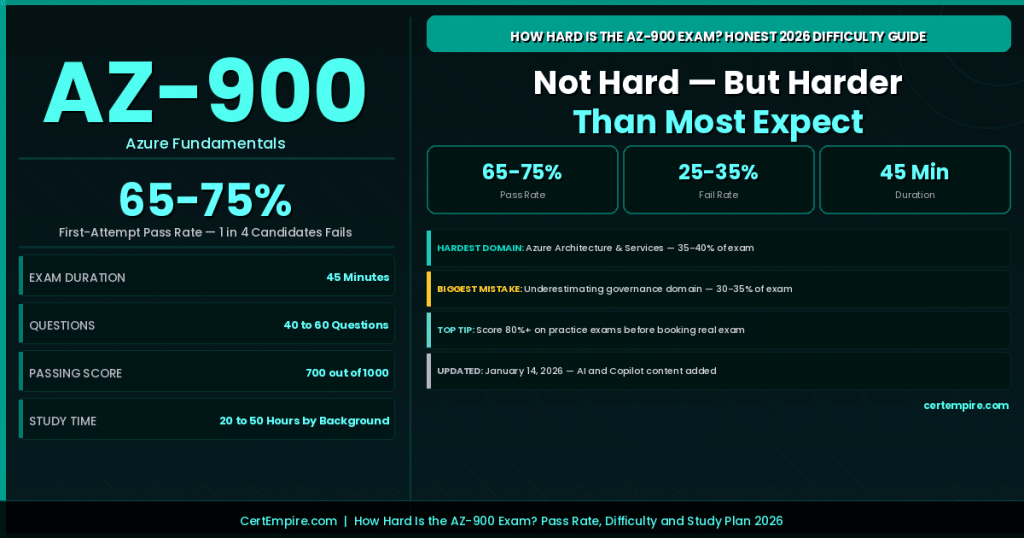
The AZ-900 exam is not hard — but it is harder than most candidates expect. The first-time pass rate is approximately 65 to 75 percent based on community data from Reddit, ExamTopics, and certification tracking platforms. That means roughly 1 in 4 candidates fails despite AZ-900 being Microsoft’s most beginner-friendly certification. The exam is genuinely accessible for candidates who prepare properly. It is a genuine obstacle for candidates who treat it as something they can skim through in a weekend.
To understand the difficulty clearly, candidates should first review the latest AZ-900 exam topics because the test is built around specific cloud concepts, Azure services, and governance areas. It also helps to know the official AZ-900 passing score so you understand what score is required and how Microsoft’s scaled scoring system works.
This is the honest difficulty guide. Not the reassuring one — the accurate one.
AZ-900 Difficulty: The Quick Answer
| Factor | Reality |
| Overall difficulty | Low to moderate — easiest Microsoft certification available |
| First-time pass rate | 65 to 75 percent — 1 in 4 candidates fails |
| Study time needed | 20 to 50 hours depending on background |
| Technical background required | None — conceptual only |
| Coding required | No |
| Hands-on lab required | No — but portal exploration helps |
| Passing score | 700 out of 1000 (70 percent) |
| Number of questions | 40 to 60 questions |
| Exam duration | 60 minutes |
| Hardest domain | Azure Architecture and Services (35 to 40 percent of exam) |
| Most common failure reason | Underestimating scenario-based questions |
What Makes AZ-900 Harder Than People Expect
Most candidates search “is AZ-900 hard” and find articles telling them it is easy. Then they sit the exam underprepared and fail. The 25 to 35 percent failure rate tells the real story.
Here is what actually makes AZ-900 harder than the “it’s just fundamentals” messaging suggests:
1. Questions Are Scenario-Based, Not Definition-Based
AZ-900 questions are not “what is Azure Blob Storage?” They are structured like this:
“A company needs to store millions of unstructured files with the lowest possible cost and no requirement for fast retrieval. Which Azure storage service and which access tier should they use?”
The answer changes based on one or two words in the scenario. “Lowest cost” gives a different answer than “fastest access.” “No retrieval requirement” versus “infrequent access” changes the storage tier. Candidates who memorized definitions without understanding service trade-offs consistently miss these AZ-900 exam topics.
2. Microsoft Uses Precise Language That Differs From Industry Standard
Microsoft defines terms slightly differently from how the broader industry uses them. “Scalability” versus “elasticity” is one example — they are related but distinct concepts and AZ-900 tests the difference. “High availability” versus “fault tolerance” versus “disaster recovery” are three separate concepts with specific Azure service relationships. Candidates who learn general cloud concepts from non-Microsoft sources sometimes arrive with subtly wrong definitions.
3. The Governance Domain Is Consistently the Weakest Area
Azure Policy, RBAC, Azure Blueprints, Cost Management, Microsoft Purview, and the Service Trust Portal are consistently the least-studied and most-tested topics in AZ-900. Most candidates spend their preparation time on compute, storage, and networking because those feel more concrete. The governance and compliance domain at 30 to 35 percent of the exam is where prepared candidates lose points they should not lose.
4. Time Pressure Is Real for Beginners
Sixty minutes for 40 to 60 scenario-based questions requires an average of 60 to 90 seconds per question. For candidates who are genuinely unfamiliar with Azure, reading each scenario carefully and reasoning through the answer takes longer than the time budget allows. Candidates who have done zero practice exams consistently report running out of time on their first attempt.
AZ-900 Pass Rate: The Real Numbers
Microsoft does not publish official AZ-900 pass rate data. The figures below are aggregated from community sources including Reddit’s r/AzureCertification, ExamTopics candidate reports, certification tracking platforms, and training provider data.
| Candidate Type | Estimated First-Attempt Pass Rate |
| IT professionals with cloud exposure | 85 to 90 percent |
| Non-technical professionals with 30 plus hours study | 75 to 85 percent |
| Complete beginners with 20 to 30 hours study | 60 to 70 percent |
| Candidates who studied less than 15 hours | 40 to 55 percent |
| All candidates combined | 65 to 75 percent |
The honest interpretation: AZ-900 has a higher pass rate than AWS Cloud Practitioner (CLF-C02) because Azure’s service naming is more intuitive and the content scope is slightly narrower. But it is not a certification you can pass by briefly skimming Microsoft Learn the night before your exam. The 1 in 4 failure rate is a real signal.
AZ-900 Difficulty by Domain: Where Candidates Lose Points
The AZ-900 exam covers three domains. Here is the honest difficulty assessment for each based on what the community consistently reports:
Domain 1: Cloud Concepts (25 to 30 percent of exam)
Difficulty: Easy for most candidates
| Topic | What It Tests | Difficulty |
| IaaS vs PaaS vs SaaS | Matching scenarios to service model | Easy once understood |
| Public vs private vs hybrid cloud | Identifying the right deployment model | Easy |
| CapEx vs OpEx | Financial model understanding | Easy |
| Consumption-based pricing | Cloud cost model | Easy |
| High availability vs scalability vs elasticity | Distinguishing related concepts | Moderate — definitions overlap |
| Shared responsibility model | What Microsoft manages vs customer manages | Moderate — commonly confused |
Where candidates lose points: Confusing scalability with elasticity. Getting the shared responsibility model wrong for different service types — the customer’s responsibility in IaaS is significantly larger than in SaaS.
Domain 2: Azure Architecture and Services (35 to 40 percent of exam)
Difficulty: Moderate — the hardest domain by volume and variety
| Topic | What It Tests | Difficulty |
| Azure regions and availability zones | Geographic redundancy concepts | Easy |
| Resource groups and subscriptions | Management hierarchy | Easy |
| Azure compute services | VM, App Service, Functions, ACI, AKS — which to use when | Moderate to hard |
| Azure storage services | Blob, Files, Queue, Table, Disk — differences and use cases | Moderate |
| Azure networking | VNet, VPN Gateway, ExpressRoute, CDN, Load Balancer | Moderate |
| Azure database services | SQL, Cosmos DB, MySQL, PostgreSQL, Synapse — which to use | Moderate to hard |
| Azure AI and analytics services | Cognitive Services, Azure ML, Synapse — conceptual overview | Easy to moderate |
Where candidates lose points: Service selection questions are the hardest. “Which Azure compute service should a company use for containerized microservices with automatic scaling?” requires knowing the specific distinctions between App Service, Azure Container Instances, and Azure Kubernetes Service — not just that they exist.
Domain 3: Azure Management and Governance (30 to 35 percent of exam)
Difficulty: Moderate — the most underestimated domain
| Topic | What It Tests | Difficulty |
| Azure Cost Management | Cost analysis, budgets, spending alerts | Easy |
| Azure Policy | Rule enforcement across subscriptions | Moderate |
| RBAC | Role-based access control, principle of least privilege | Moderate |
| Azure Blueprints | Repeatable environment deployment | Moderate |
| Resource locks | Preventing accidental deletion or modification | Easy |
| Microsoft Purview | Data governance and compliance | Moderate |
| Azure Monitor | Alerts, logs, diagnostics | Moderate |
| Service Trust Portal | Compliance documentation access | Easy |
Where candidates lose points: The difference between Azure Policy and RBAC confuses most candidates. Azure Policy controls what can be done with resources. RBAC controls who can do it. Questions often present scenarios requiring you to choose between them — the correct choice depends on whether the restriction is about resource type or user permission.
How Hard Is AZ-900 Compared to Other Microsoft Certifications?
| Certification | Difficulty vs AZ-900 | Pass Rate | Study Time |
| AZ-900 | Baseline | 65 to 75% | 20 to 50 hours |
| SC-900 | Comparable — narrower but more specific | Similar | 15 to 35 hours |
| AI-901 | Comparable | Similar | 15 to 35 hours |
| AZ-104 | Significantly harder | 60 to 70% | 80 to 120 hours |
| AZ-305 | Much harder | 55 to 65% | 100 to 150 hours |
| AZ-400 | Much harder | 55 to 65% | 100 to 160 hours |
AZ-900 is the easiest Microsoft certification. It is designed to be. The step from AZ-900 to AZ-104 is a genuine difficulty increase — not a small one. Candidates who breeze through AZ-900 often underestimate what AZ-104 requires. For the full comparison of AZ-900 and AZ-104 including what each exam actually tests, our AZ-104 vs AZ-900 guide covers every difference in detail.
How Hard Is AZ-900 for Non-Technical Professionals?
Easier than you think. AZ-900 is explicitly designed for non-technical candidates. The exam does not require you to configure anything in the Azure portal. It does not require coding knowledge. It does not require networking expertise.
What it does require is genuine understanding of concepts — not surface-level familiarity. Non-technical candidates who spend 30 to 40 focused hours on Microsoft Learn and then test themselves with realistic practice questions consistently pass on their first attempt.
The main challenge for non-technical candidates is not the technical depth. It is the volume of new vocabulary. Cloud computing has its own language and AZ-900 tests that language specifically. Candidates who invest time learning what each Azure service does and when it is used rather than just memorizing names perform significantly better on scenario questions.
How Hard Is AZ-900 for IT Professionals?
Easier than for non-technical candidates — with one important exception.
IT professionals typically find the compute, storage, and networking domains intuitive because the Azure concepts map to on-premises equivalents they already know. VMs, storage accounts, and networking concepts are familiar territory.
The exception is the governance domain. Many IT professionals have never worked with enterprise cloud governance tools like Azure Policy, RBAC at scale, or Microsoft Purview. These feel unfamiliar even to experienced IT administrators and this is exactly where experienced professionals lose points they expect to win.
If you have IT experience, do not skim the governance domain. It is the domain where confident preparation becomes complacent failure.
What Trips Candidates Up the Most: The 5 Most Common Failure Patterns
Based on community reports from Reddit’s r/AzureCertification and training provider feedback, these are the five failure patterns that appear most consistently:
1. Memorizing names without understanding use cases. Knowing that Azure Blob Storage exists is not enough. Knowing that Blob Storage is for unstructured data like images, videos, and log files and that Archive tier is for data that is rarely accessed is what the exam tests. Flashcards alone do not build this understanding.
2. Skipping the governance domain entirely. Azure Policy, RBAC, Cost Management, and Purview are in every exam. Candidates who rush through them to spend more time on compute and networking consistently report being surprised by how many governance questions appear.
3. Not taking practice exams before the real exam. The AZ-900 exam format is specific. Scenario-based questions, drag-and-drop matching, and multi-select questions all require familiarity with the format. Working through free AZ-900 practice questions with realistic exam formats can help candidates become comfortable with these question styles before the actual test. Candidates who take their first scenario-based question on exam day are operating at a disadvantage.
4. Using outdated study materials. Microsoft updated the AZ-900 exam objectives on January 14, 2026. Candidates using pre-2026 study materials are preparing for a slightly different exam. The changes are minor but the identity and security sections were updated. Always verify that your materials reflect the current exam blueprint.
5. Underestimating the exam time pressure. Sixty minutes for up to 60 questions requires pacing discipline. Candidates who spend five minutes on a difficult question early and then rush the rest consistently run out of time before finishing.
How Long Should You Study for AZ-900?
| Your Background | Recommended Study Time | Recommended Timeline |
| No IT experience whatsoever | 40 to 60 hours | 4 to 6 weeks part-time |
| Some general IT experience | 25 to 40 hours | 3 to 4 weeks part-time |
| IT professional with cloud exposure | 15 to 25 hours | 2 to 3 weeks part-time |
| Azure experience (any level) | 10 to 20 hours | 1 to 2 weeks part-time |
These ranges assume focused study — not background reading while doing other things. One hour of active study using Microsoft Learn with knowledge checks is worth three hours of passive video watching.
The Most Effective Study Plan for AZ-900 in 2026
Step 1: Complete the Microsoft Learn AZ-900 Path First
Microsoft Learn is free and covers every exam objective. Complete the entire official learning path before touching any other resource. This gives you the correct Microsoft-specific definitions that the exam tests.
Time required: 10 to 15 hours
Step 2: Take One Practice Exam Cold
After completing Microsoft Learn, take one full practice exam without reviewing anything. Do not aim to pass. Aim to identify your weakest domains. Score every missed question by domain and allocate your remaining study time proportionally to your gaps.
Time required: 1 to 2 hours
Step 3: Fill Your Domain Gaps
Return to Microsoft Learn for your weakest domains. If governance is your gap, spend extra time on Azure Policy, RBAC, and Cost Management specifically. If service selection is your gap, study the comparison between similar services — when to use Azure SQL versus Cosmos DB, when to use App Service versus Azure Functions.
Time required: 5 to 15 hours depending on gaps
Step 4: Practice with Updated 2026 Questions
Use practice questions that reflect the January 2026 exam update. Questions aligned to the current blueprint cover the updated identity, security, and governance content that pre-2026 materials miss. Score consistently above 80 percent on practice exams before booking your real exam.
CertEmpire’s AZ-900 exam preparation materials include 493 verified practice questions across all three AZ-900 domains, updated for the January 2026 exam blueprint, with complete explanations for every question. Candidates who score 80 percent or above consistently on CertEmpire practice exams pass the real AZ-900 on their first attempt at a significantly higher rate than the community average.
Step 5: Book Your Exam With a Deadline
Candidates with a specific exam date study more efficiently than those with no deadline. Once you are consistently scoring above 80 percent on practice exams, book your exam within one week. Waiting longer without a deadline leads to study fatigue without meaningful additional preparation.
AZ-900 Difficulty: Exam Day Logistics That Affect Your Score
These factors are not about content difficulty but they affect how you perform:
Online proctoring adds stress. Strict environment requirements — clear desk, no phone, specific lighting, webcam monitoring — create pressure that in-person testing centers eliminate. If you are prone to exam anxiety or have a difficult home environment, book a testing center.
The flag-and-return strategy works. AZ-900 allows you to flag questions and return to them. Use this. If a question is taking more than 90 seconds, flag it and move on. Returning to flagged questions with fresh eyes after completing the rest of the exam consistently produces better answers than grinding through a difficult question in the moment.
Do not second-guess questions you know. The most common post-exam regret from AZ-900 candidates is changing correct answers to incorrect ones during review. Unless you have a specific reason to change an answer, leave your first response.
AZ-900 Retake: What Happens If You Fail?
| Attempt | Wait Period | Cost |
| First retake | 24 hours after failing | $99 — full fee |
| Second retake | 14 days after second failure | $99 — full fee |
| Third and beyond | 14 days between each | $99 per attempt |
| Maximum attempts | 5 within any 12-month period | — |
Failing costs $99 plus the time spent retaking. The most efficient path is always thorough preparation before your first attempt rather than planning to retake.
FAQS
Is the AZ-900 exam hard?
No — but it is harder than most candidates expect. AZ-900 is Microsoft’s easiest certification, but the 65 to 75 percent first-attempt pass rate means 1 in 4 candidates fails. Candidates who prepare properly with 20 to 50 hours of focused study and quality practice exams consistently pass on their first attempt.
What is the AZ-900 pass rate?
Microsoft does not publish official pass rates. Community data from Reddit, ExamTopics, and training platforms consistently shows a first-attempt pass rate of 65 to 75 percent. IT professionals with cloud exposure pass at higher rates of 85 to 90 percent. Complete beginners studying less than 15 hours pass at rates as low as 40 to 55 percent.
What is the hardest part of AZ-900?
The Azure Architecture and Services domain at 35 to 40 percent is the hardest by volume. The governance domain at 30 to 35 percent is the most underestimated. Service selection scenario questions — choosing between similar Azure services based on specific requirements — are consistently what candidates report as the most difficult question type.
How long does it take to study for AZ-900?
Most candidates need 20 to 50 hours depending on their background. IT professionals with cloud exposure need 15 to 25 hours. Complete beginners with no IT background need 40 to 60 hours. One focused hour using Microsoft Learn with active knowledge checks is worth three hours of passive video watching.
Can you pass AZ-900 with no IT experience?
Yes. AZ-900 is explicitly designed for non-technical candidates. It requires no coding, no hands-on configuration, and no networking expertise. Non-technical candidates who spend 30 to 40 focused hours on Microsoft Learn and practice exams consistently pass on their first attempt.
What score do you need to pass AZ-900?
700 out of 1000 — which is 70 percent. The exam contains 40 to 60 questions. Microsoft does not disclose the exact number of questions per exam sitting.
How many times can you retake AZ-900?
You can attempt AZ-900 up to 5 times within any 12-month rolling period. After a first failure you must wait 24 hours. After subsequent failures you must wait 14 days between each attempt. Each retake costs the full $99 exam fee.
Is AZ-900 harder than SC-900?
Both are comparable in overall difficulty. AZ-900 covers more ground across cloud concepts, all core Azure services, and governance. SC-900 is narrower but more specific on security, compliance, and identity topics. Most candidates find whichever one aligns less with their background to be harder.
Can you fail AZ-900 by guessing?
Yes. While some candidates attempt to guess through AZ-900, scenario-based questions with specific service trade-offs are difficult to guess correctly. The 25 to 35 percent failure rate includes candidates who underestimated preparation requirements and essentially attempted to guess their way through.
What is the best way to prepare for AZ-900?
Complete the full Microsoft Learn AZ-900 path first. Then take one full practice exam to identify your weakest domains. Fill those gaps with targeted study. Then practice with updated 2026 questions until you consistently score above 80 percent. Do not book your real exam until you are consistently above 80 percent on practice tests.