
Q: 1
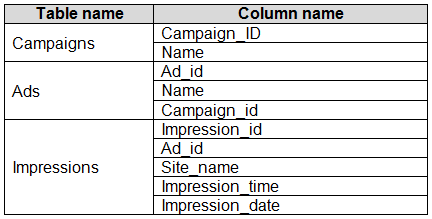
You have the tables shown in the following table.
 The Impressions table contains approximately 30 million records per month.
You need to create an ad analytics system to meet the following requirements:
Present ad impression counts for the day, campaign, and Site_name. The analytics for the last year
are required.
Minimize the data model size.
Which two actions should you perform? Each correct answer presents part of the solution.
NOTE: Each correct selection is worth one point.
The Impressions table contains approximately 30 million records per month.
You need to create an ad analytics system to meet the following requirements:
Present ad impression counts for the day, campaign, and Site_name. The analytics for the last year
are required.
Minimize the data model size.
Which two actions should you perform? Each correct answer presents part of the solution.
NOTE: Each correct selection is worth one point.
 The Impressions table contains approximately 30 million records per month.
You need to create an ad analytics system to meet the following requirements:
Present ad impression counts for the day, campaign, and Site_name. The analytics for the last year
are required.
Minimize the data model size.
Which two actions should you perform? Each correct answer presents part of the solution.
NOTE: Each correct selection is worth one point.
The Impressions table contains approximately 30 million records per month.
You need to create an ad analytics system to meet the following requirements:
Present ad impression counts for the day, campaign, and Site_name. The analytics for the last year
are required.
Minimize the data model size.
Which two actions should you perform? Each correct answer presents part of the solution.
NOTE: Each correct selection is worth one point.Options
Discussion
Option B and C for sure. Creating one-to-many relationships (B) keeps the data clean and you can count impressions with a lightweight measure (C), which won’t bulk up the model. No need for a calculated table here I think, unless I missed something. Agree?
B tbh, calculated tables like D would just make the data model bigger and aren't needed. Setting up one-to-many relationships (B) lets you slice and dice by ad, site, and date, and a measure using COUNTROWS (C) gives you counts without loading tons more data. Saw a similar question in practice sets. Anyone see a legit case where A makes sense here? Pretty sure B and C.
Guessing D here. If you create a calculated table with Ad_id, Site_name, and Impression_date, you can pre-aggregate the data which should make querying faster and keep things tidy. Not sure if it’s the smallest model though, but looks like an option.
Its B and C, model stays small with just a measure for counting rows and the relationships handle all the slicing by day or site/campaign. No need for another calculated table if you want to avoid a memory hit!
B tbh, relationships let you slice/filter across tables without copying tons of data. C is efficient for counting since measures barely add to model size. D looks tempting for pre-aggregating but actually bloats memory. I think B and C are made for the minimize size angle, not D. Disagree?
A classic Microsoft question where aggregate tables always feel safer.
I would go with A here.
Makes sense to me, B and C. Building the one-to-many relationships (B) keeps everything normalized, and a calculated measure (C) is way lighter than creating extra tables. Since they want minimal model size and last year's analytics, this combo fits. Anyone pick D here for any reason?
C vs D? Calculated measure (C) barely adds size, but a calculated table like D could bloat the model. If you just need counts and want to keep it lean, C makes more sense here I think. Let me know if that doesn't add up.
Option D
Be respectful. No spam.