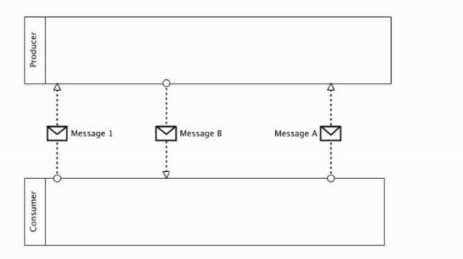
Analyzing the sequence flows within each pool determines the order of events.
1. The Consumer process starts and sends Message 1.
2. The Producer process, which was waiting, receives Message 1.
3. Following its sequence flow, the Producer then sends Message B.
4. The Consumer, waiting at an Event-Based Gateway, receives Message B.
Although the diagram is flawed (the Consumer process ends after receiving B, preventing it from ever sending A and causing the Producer to deadlock), option A correctly identifies the initial sequence of exchanges that the model dictates. It represents the most plausible intended interaction pattern (request-response-acknowledgment) despite the modeling error.