
Q: 9
See the following figure. All routers on the network run IS-IS and are in area 49.0001. By referring to the LSDB of R1, the Level-2 DIS is. (Enter the device name, for example, R1.) 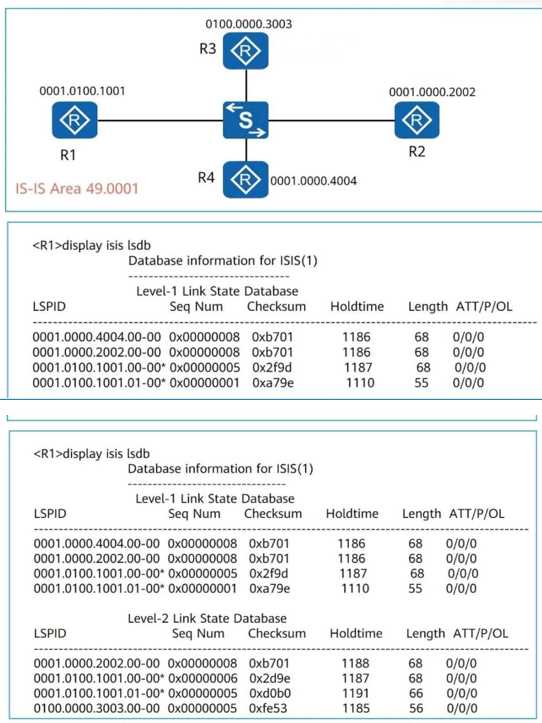
Your Answer
Discussion
R3 is the Level-2 DIS here. In IS-IS, the router that generates the pseudonode LSP in the LSDB is always the DIS for that level, and in R1’s Level-2 database you find a record with R3 as the source. Pretty sure that seals it, unless configs were non-standard or there’s something we’re not seeing in the image. Anyone see a case where another router would show up as L2 DIS in this scenario?
R3
Not R2 here, it's definitely R3. The pseudonode entry in R1's Level-2 LSDB is a classic DIS clue.
R3 is right here. In IS-IS the Level-2 DIS is whoever generates the L2 pseudonode LSP, and R1's LSDB shows that coming from R3. Priority doesn’t matter if the LSDB says otherwise, I think.
R3. Saw a similar question in the official guide, pay close attention to LSDB output for these IS-IS exam items.
Hmm, I'd say R2 for Level-2 DIS. If I read the LSDB right, R2 looked like it had the higher priority and was generating the right pseudonode entry. But maybe I'm missing a detail on which LSP in the database points to the actual DIS role. Anyone see where my logic goes off?
R2
I was thinking it's R2 because usually the router with the highest priority or MAC wins DIS, and some practice tests show R2 as Level-1 DIS. Maybe I'm missing something in how the LSDB is displayed here though. Official guide or lab would help double check this, but I think R2 is close. Agree?
I was thinking it's R2 because usually the router with the highest priority or MAC wins DIS, and some practice tests show R2 as Level-1 DIS. Maybe I'm missing something in how the LSDB is displayed here though. Official guide or lab would help double check this, but I think R2 is close. Agree?
R3
R3
R3
Be respectful. No spam.