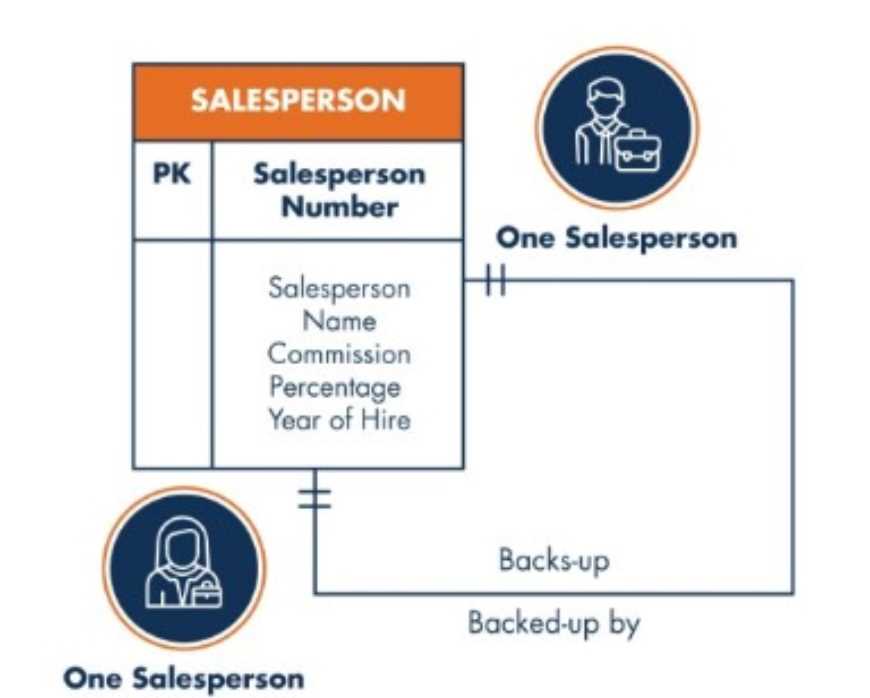
1. Elmasri, R., & Navathe, S. B. (2017). Fundamentals of Database Systems (7th ed.). Pearson. In Chapter 7, Section 7.2, "The Relational Data Model and Relational Database Constraints," the concept of a recursive (unary) relationship is explained using the example of an employee supervising other employees, which directly corresponds to the provided diagram.
2. Connolly, T., & Begg, C. (2015). Database Systems: A Practical Approach to Design, Implementation, and Management (6th ed.). Pearson. Chapter 16, "Conceptual Database Design Methodology," discusses relationship degrees, defining a unary (or recursive) relationship as one where an entity type is linked to itself. The "Staff manages Staff" example is used for illustration.
3. Ullman, J. D., & Widom, J. (2008). A First Course in Database Systems (3rd ed.). Prentice Hall. Chapter 4, "The Entity-Relationship Model," describes relationships that involve only one entity set, termed "recursive relationships," and provides examples such as a "married-to" relationship between people.