
Anthropic CCDV-F Exam Dumps [October 2026 Update]
Our Anthropic CCDV-F exam dumps provide the most recent and reliable practice material for the Claude Certified Developer – Foundations certification. Each dump includes verified answers, clear explanations, and useful references to support your study. With free sample questions and Cert Empire’s interactive exam simulator, you can prepare efficiently and approach your CCDV-F exam with confidence.
What Users Are Saying:
The Message Batches API is the most consistently surprising topic for developers who arrive at the CCDV-F exam having used the synchronous Messages API fluently. The Batch API offers a 50% cost reduction on API calls in exchange for up to 24-hour processing latency – and the exam tests the specific architectural decision this creates. Not just “the Batch API exists and costs less” but “given this described use case with this latency requirement, does the Batch API’s trade-off make sense?” Classifying 50,000 support tickets overnight where results are used in a morning report: Batch API. Responding to a user query in a chat interface: synchronous API. Generating personalized emails for a newsletter send scheduled in 6 hours: Batch API with margin to spare. Transcribing audio in real time: synchronous only. The exam presents use cases and tests whether the latency tolerance justifies the cost savings. Developers who know the Batch API exists but have only thought about it abstractly will miss the applied trade-off questions. The same pattern applies to deployment on Amazon Bedrock and Google Vertex AI – developers who deploy exclusively to Anthropic’s own infrastructure will encounter Bedrock and Vertex configuration questions and have no reference point for the differences in authentication, endpoint format, and capability surface area that the exam tests at the applied level.
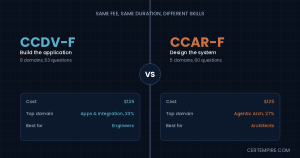
The Anthropic CCDV-F (Claude Certified Developer – Foundations) certifies technical professionals who build, integrate, and ship production-grade Claude applications, agents, and workflows. 53 questions, 120 minutes, 720/1000 to pass. Fee: $125. Eight domains weighted from 2.6% to 33.1%. The Applications and Integration domain alone covers one-third of the exam – API mechanics, streaming, tool use, vision, prompt caching, Batch API, and multi-cloud deployment.
Cert Empire’s CCDV-F exam questions are weighted to the official blueprint and built to the applied scenario depth the real exam uses – production decision questions, not API documentation recall.
Exam Snapshot
| Field | Details |
| Exam Code | CCDV-F |
| Exam Name | Claude Certified Developer – Foundations |
| Issuing Body | Anthropic |
| Launch | July 2026 (Exam Guide v1.0) |
| Fee | USD $125 per attempt |
| Questions | 53 |
| Duration | 120 minutes |
| Passing Score | 720 / 1000 |
| Delivery | Pearson VUE (online proctored) |
| Validity | 12 months; free on-time renewal |
| Target Audience | AI/ML engineers, senior software engineers, technical leads building production Claude applications |
Eight Domain Weights
| Domain | Weight |
| Applications and Integration | 33.1% |
| Model Selection and Optimization | 16.8% |
| Agents and Workflows | 14.7% |
| Prompt and Context Engineering | 11.0% |
| Tools and MCPs | 10.6% |
| Security and Safety | 8.1% |
| Claude Code | 3.1% |
| Eval, Testing, and Debugging | 2.6% |
Domain 1: Applications and Integration (33.1%) – One Third of the Exam
Messages API Core Mechanics
Request parameters and required fields: Every Messages API call requires three parameters: model (the Claude model string), max_tokens (the ceiling on output length – not a guarantee the response will be this long, just the maximum), and messages (the conversation array). The system prompt is a top-level parameter separate from the messages array, which affects its trust level – system prompt content is treated as more authoritative than user-turn content and is not visible to the Claude model as something a user submitted.
Content block types: The API accepts multiple content types within a single message: text blocks, image blocks (base64-encoded or URL), document blocks (PDF as base64), and tool result blocks. The exam tests which content type is required for which input scenario and what format each requires. A PDF analysis request differs from an image analysis request in how the document is passed to the API.
Response structure and stop_reason: Every response contains a stop_reason field that explains why generation stopped. The four possible values and their meanings: “end_turn” (Claude finished naturally), “max_tokens” (generation hit the token ceiling and may be incomplete – the response is truncated), “stop_sequence” (hit a configured stopping string), and “tool_use” (Claude is requesting a tool call and expects a tool_result in the next turn). The exam tests what each stop_reason means operationally – specifically that max_tokens indicates truncation and the caller must decide whether to continue with another request.
Multi-turn conversation construction: Maintaining conversation context means appending each response back into the messages array before the next turn. The exam tests the correct message structure for multi-turn conversations and what happens when message history grows beyond the context window limit – the developer must implement context management (summarization, pruning, or retrieval) rather than relying on the API to manage it automatically.
Streaming
The streaming event sequence: When stream=True, the API returns a series of server-sent events (SSEs) rather than a single response object. The events arrive in a defined sequence: message_start contains initial metadata including input token count, content_block_start signals a new content block opening, content_block_delta carries incremental text tokens, content_block_stop closes the current content block, message_delta carries the stop_reason and output usage, and message_stop signals the stream is fully complete.
The exam tests what each event contains and what the developer must do with content_block_delta events: concatenate them to build the full response text. A developer who processes only message_stop will miss all the streamed content.
When streaming is appropriate: The exam tests use case selection for streaming. Streaming improves perceived responsiveness when users see text appearing incrementally rather than waiting for the complete response. It is appropriate for: conversational interfaces, long-form generation where users benefit from seeing partial output, and any scenario where the time-to-first-token matters. Streaming is not appropriate for: structured extraction tasks where partial output is not useful, batch processing pipelines, and cases where the response must be complete before any downstream processing begins.
Prompt Caching
The cache_control mechanism: Cache checkpoints are created by adding {“cache_control”: {“type”: “ephemeral”}} to a content block. Once cached, that prefix costs approximately 10% of the full input price on subsequent requests. Cache checkpoints require a minimum number of tokens to activate – submitting short content for caching returns the full input price without the cache benefit.
When caching pays off: The exam tests the break-even analysis for prompt caching. The first request with a cache checkpoint costs slightly more than a regular request (cache write cost). Every subsequent request that hits the cache costs 10% of the normal input price. The break-even is typically two to three requests. The exam presents high-volume scenarios (10,000 requests per day with a shared 8,000-token system prompt) and tests whether caching is cost-positive.
Cache invalidation: Caches expire after five minutes of inactivity. Any change to the cached content – even a single character – creates a new cache entry rather than updating the existing one. The exam tests what causes cache misses: content changes, different model specified, or expiry.
Message Batches API
The Batch API workflow: Submitting a batch involves sending an array of request objects (each with a unique custom_id, a model, a max_tokens value, and a messages array) to the batch endpoint. The API returns a batch ID immediately. The caller polls the batch status using the batch ID – batches process asynchronously and complete within 24 hours. When status is ended, results are retrieved as a result file where each result is keyed by the custom_id from the original request.
The 24-hour / 50% cost trade-off: The exam tests this trade-off across multiple use case scenarios. The Batch API is appropriate when: the use case can tolerate up to 24 hours of latency, the volume is large enough for the 50% discount to produce meaningful savings, and the results are not needed in real time. It is not appropriate when: user-facing responses are required immediately, a downstream process needs the result within minutes, or the volume is small enough that the operational overhead of batch management exceeds the cost savings.
Bedrock and Vertex deployment: Claude is available through Amazon Bedrock and Google Cloud Vertex AI in addition to Anthropic’s own API. The differences the exam tests: authentication uses cloud provider credentials (IAM roles for Bedrock, service accounts for Vertex) rather than Anthropic API keys, model identifiers use cloud-provider-specific formats rather than Anthropic’s model strings, and certain API features may have availability differences between deployment targets. Developers who build exclusively for one environment must understand that their authentication and endpoint configuration will not transfer directly to another.
Domain 2: Model Selection and Optimization (16.8%)
Claude model tier selection by use case: The exam tests model selection as a cost-latency-quality triangle. Haiku is fastest and cheapest – appropriate for routing, classification, simple extraction, and high-volume tasks where cost per token dominates quality considerations. Sonnet balances intelligence and cost – the general-purpose production choice for most developer tasks including drafting, code generation, analysis, and RAG responses. Opus provides maximum intelligence – appropriate for the most complex multi-step reasoning, nuanced code review, and tasks where quality is the only metric that matters and cost/latency are secondary.
Multi-model pipelines: The exam tests a pattern where different model tiers handle different pipeline stages. A router or classifier (Haiku) evaluates incoming requests and routes them appropriately – only complex, high-stakes requests proceed to Sonnet or Opus, while simple or routine requests are handled by Haiku throughout. This pattern reduces cost significantly for high-volume applications without degrading quality on the requests that matter.
Token usage and cost estimation: The exam tests how to estimate request costs: input tokens multiplied by input price per million tokens, plus output tokens multiplied by output price per million tokens. Input tokens are cheaper than output tokens – this drives design decisions toward prompts that minimize unnecessary output verbosity (tight format instructions, stop sequences) rather than minimizing input.
Extended thinking: Extended thinking allows Claude to reason through complex problems before producing a final response. The exam tests when extended thinking improves output quality (mathematical reasoning, multi-step logical deduction, complex code architecture decisions) versus when it adds latency without benefit (simple factual queries, structured data extraction from short documents, tasks where the answer is immediately obvious).
Domain 3: Agents and Workflows (14.7%)
Workflow versus agent architecture: The exam tests this distinction explicitly – it maps directly to the core architectural decision in Claude-powered systems. A workflow has a predetermined execution sequence defined by code: step 1 happens, then step 2, then step 3. The code decides the path, not Claude. An agent uses Claude to determine its own execution path through available tools: Claude receives a goal, decides which tool to call, receives the result, decides what to do next, and continues until the goal is achieved or it determines it cannot proceed.
Workflows are preferable when: the task can be fully specified in advance, predictability and auditability are priorities, cost must be tightly controlled, and there is no need for dynamic adaptation. Agents are preferable when: the steps required to achieve a goal cannot be determined upfront, the task requires dynamic decision-making based on intermediate results, or multiple distinct approaches might be needed depending on what the agent discovers.
The agentic loop and tool_use handling: When Claude needs to call a tool, the response contains a content block of type tool_use rather than just text. The caller must: extract the tool name and input parameters from the tool_use block, execute the tool, and return the result as a tool_result content block in the next user turn. The stop_reason will be tool_use, not end_turn, when Claude expects this continuation. The exam tests every step of this loop and what happens when a tool execution fails – the developer must decide whether to return an error result (allowing Claude to adapt) or handle the error externally.
Domain 4: Prompt and Context Engineering (11%)
Structured output and format control: The exam tests techniques for producing structured, parseable output: specifying the output format in the system prompt (JSON with a defined schema), using a closing prefix in the assistant turn to prime the output format, and combining format instructions with validation and retry logic. Claude does not guarantee perfectly formatted JSON without explicit format instructions and error handling.
Context window management: The exam tests practical approaches to contexts that grow beyond the available window: conversation pruning (removing older turns), summarization (replacing older history with a summary), and retrieval (using external memory to retrieve relevant prior context just-in-time rather than maintaining full history). The exam also tests the “lost in the middle” phenomenon – Claude’s attention is less precise for content positioned in the middle of very long contexts, which affects how retrieved chunks should be ordered.
System versus user turn trust: Content in the system prompt is treated as more authoritative than content in user turns. This affects prompt injection defense: trusted instructions should be in the system prompt, not the user turn, so that user-provided content (or content from external sources that Claude processes) cannot override the core instructions. The exam tests this trust hierarchy and its security implications.
Domain 5: Tools and MCPs (10.6%)
Tool definition and description quality: Tool descriptions are what Claude uses to decide when and how to call each tool. Vague descriptions produce poor tool-calling behavior – Claude either calls tools unnecessarily or fails to call them when it should. The exam tests effective tool description principles: what the tool does, when it should be called (and when it should not), what each parameter means, and what the expected return format looks like.
MCP server design: MCP (Model Context Protocol) servers expose tools, resources, and prompts. The exam tests the basic MCP server structure: tools are executable functions with defined input schemas, resources are readable data sources, and prompts are reusable templates. Building a custom MCP server is appropriate when the organization has internal systems the model needs to access and no existing MCP integration exists.
Tool use error handling: When a tool call fails, the developer must decide how to handle it. Options include: returning an error message in the tool_result (allowing Claude to adapt its approach), retrying the tool call with modified parameters, or escalating to a fallback behavior. The exam tests which approach is appropriate for which failure type (transient failures versus permanent tool unavailability).
Domains 6-8 (Security 8.1%, Claude Code 3.1%, Eval 2.6%)
Prompt injection defense: The exam tests the primary classes of prompt injection: direct injection (malicious instructions in user input) and indirect injection (malicious instructions embedded in external content Claude reads – documents, web pages, tool results). Defensive patterns include: clear separation between trusted system instructions and untrusted external content, structured output formats that reduce attack surface, validating tool call parameters before execution, and monitoring for anomalous tool-calling patterns.
Claude Code configuration: CLAUDE.md files provide Claude Code with persistent instructions about the project’s conventions, coding standards, and constraints. The exam tests CLAUDE.md hierarchy (project-level vs. directory-level files) and what types of instructions belong in CLAUDE.md versus what should be provided as inline context during a session.
Evaluation framework design: The exam tests evaluation at the functional level rather than the statistical level: what makes a good eval (tests the actual behavior that matters in production, has clear ground truth, is reproducible), what types of assertions apply to different task types (exact match for structured extraction, rubric-based for open-ended generation, functional testing for tool-using agents), and how to detect quality degradation before users report it.
5 Study Tips for Anthropic CCDV-F
- Tip 1: Study the Batch API as a specific architectural decision, not just a feature. Practice applying the 24-hour/50% trade-off to described use cases: tolerate latency for cost savings on offline processing, use synchronous API for user-facing responses. The exam presents scenarios and tests the decision.
- Tip 2: Study Bedrock and Vertex deployment differences even if you only deploy to Anthropic directly. The exam tests authentication method differences (cloud provider credentials versus Anthropic API keys) and model identifier format differences between deployment targets.
- Tip 3: Memorize the streaming SSE event sequence: message_start → content_block_start → content_block_delta → content_block_stop → message_delta → message_stop. Know what each carries and what the developer does with each event type.
- Tip 4: Practice the agentic loop end-to-end: request → stop_reason tool_use → extract tool parameters → execute tool → return tool_result in next turn → continue until stop_reason end_turn. Know what happens when a tool returns an error.
- Tip 5: Practice with Cert Empire’s CCDV-F exam questions domain-weighted to the official blueprint – 33.1% Applications and Integration, 16.8% Model Selection, and so on – built as production decision scenarios rather than API documentation recall.
Best Study Resources
- Cert Empire CCDV-F exam questions PDF and practice simulator (July 2026 blueprint-aligned edition).
- Anthropic API documentation: Messages API, streaming, prompt caching, Message Batches API.
- Official CCDV-F Exam Guide v1.0 (available through Anthropic Partner Academy).
- claudecertificationguide.com/ccdv-f – free domain breakdown and study resources.
- O’Reilly “Claude Certified Developer – Foundations Exam Prep” live course.
Why Candidates Choose Cert Empire for CCDV-F Preparation
✔ Batch API architectural decision questions. Our questions test the 24-hour/50% trade-off across described use cases – applied latency tolerance judgment, not feature awareness.
✔ Bedrock and Vertex deployment configuration questions. We test authentication differences, model identifier format differences, and when multi-cloud deployment considerations apply.
✔ Streaming SSE event sequence questions. Our questions test the complete event sequence and what the developer does with each event type, at the implementation precision the real exam requires.
✔ Domain-weighted question distribution. 33.1% of our question bank covers Applications and Integration – matching the official blueprint rather than distributing evenly across eight domains.
✔ Backed by a full money-back guarantee. If our exam questions do not help you pass, we refund your purchase.
FAQ’s
What is the Anthropic CCDV-F certification?
CCDV-F is the Claude Certified Developer – Foundations credential from Anthropic, launched July 2026. It certifies technical professionals who build, integrate, and ship production-grade Claude applications, agents, and workflows using the Claude API, Agent SDK, Claude Code, and MCP.
How many questions are on the CCDV-F exam?
53 questions in 120 minutes. A scaled score of 720 out of 1000 is required to pass. The exam costs $125. The credential is valid for 12 months with a free on-time renewal assessment available through the Anthropic Partner Academy.
What are the eight CCDV-F domains and their weights?
Applications and Integration (33.1%), Model Selection and Optimization (16.8%), Agents and Workflows (14.7%), Prompt and Context Engineering (11.0%), Tools and MCPs (10.6%), Security and Safety (8.1%), Claude Code (3.1%), and Eval, Testing, and Debugging (2.6%).
What is the Message Batches API and when should it be used?
The Message Batches API processes large volumes of API requests asynchronously with up to 24-hour processing time in exchange for a 50% cost reduction versus synchronous API calls. It is appropriate for use cases where results are not needed in real time – overnight classification tasks, batch content generation, large-scale extraction – and not appropriate for user-facing interactive applications requiring immediate responses.
What is the difference between deploying Claude on Anthropic’s API versus Amazon Bedrock or Google Vertex AI?
Anthropic’s API uses Anthropic API keys and Anthropic model strings. Bedrock deployment uses AWS IAM credentials and Bedrock-specific model identifiers. Vertex AI deployment uses Google Cloud service account credentials and Vertex-specific endpoint formats. Authentication and model identifier configuration differ between deployment targets; the Anthropic API key cannot be reused in a Bedrock or Vertex deployment.
What is the stop_reason field in a Claude API response?
The stop_reason field explains why Claude stopped generating. Four values: “end_turn” (natural completion), “max_tokens” (response was truncated at the token limit), “stop_sequence” (hit a configured stopping string), and “tool_use” (Claude is requesting a tool call and expects a tool_result in the next turn).
What is the difference between a workflow and an agent in Claude-powered systems?
A workflow has a predetermined execution sequence defined by code – the developer decides the steps, and Claude executes within each step. An agent uses Claude to dynamically determine its own execution path through available tools, deciding what to do next based on intermediate results. Workflows are preferable for predictable, auditable tasks; agents are preferable for tasks where required steps cannot be determined in advance.
Do I need prior Claude experience to take the CCDV-F exam?
No mandatory prerequisites exist, but Anthropic recommends roughly one to five years of engineering experience and at least six months of hands-on work with Claude or a comparable LLM platform. Familiarity with REST APIs, Python or TypeScript, and CLI tools is also recommended.
Related Certifications Worth Exploring
CCDV-F certified developers advancing to the architecture level will find our Anthropic CCAR-F (Claude Certified Architect – Foundations) exam questions page covers the Foundations-level architect credential that builds on CCDV-F’s API and agent knowledge with system design, retrieval architecture, evaluation frameworks, and governance scope. For developers who also want to credential their non-technical Claude productivity usage alongside their developer expertise, our Anthropic CCAO-F (Claude Certified Associate – Foundations) exam questions page covers the business professional credential that validates output evaluation, workflow integration, and responsible use skills that complement the technical CCDV-F.
Related Posts
-

-
-
-
-
-



Reviews
There are no reviews yet.