
Anthropic CCAO-F Exam Dumps by Cert Empire [October 2026 Update]
Our Anthropic Authentic CCAO-F exam dumps bring you the latest and most reliable practice material for the Claude Certified Associate – Foundations certification. Each dump includes verified answers, detailed explanations, and helpful references to support your preparation. With free sample questions and our interactive exam simulator, Cert Empire makes your CCAO-F exam preparation easier, faster, and more effective.
What Users Are Saying:
The CCAO-F is Anthropic’s certification for professionals who use Claude in their work – not the certification for engineers who build with Claude. No code. No API. No system prompts. What makes this exam genuinely challenging is not the prompting knowledge it tests; it is the output judgment it demands. Output Evaluation and Validation is the single largest domain at 21%, and it tests a skill that most Claude users have never formally developed: looking at what Claude produced and determining whether it is accurate, complete, sufficiently verified, appropriately hedged for uncertainty, free from subtle bias, and safe to use without additional review. Claude can produce a confident, well-structured answer that is wrong. Claude can produce a useful research summary that quietly misattributes a fact. Claude can generate a recommendation that is consistent with its reasoning but inconsistent with a current external reality its training does not reflect. The CCAO-F exam tests whether you know the difference between a Claude output that can be used and one that requires fact-checking before it can be trusted – and that is a professional judgment skill, not a prompting skill.
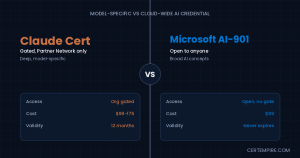
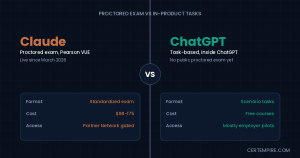
The Anthropic CCAO-F (Claude Certified Associate – Foundations) launched as part of Anthropic’s expanded Claude Certification Program on July 13, 2026. It is Anthropic’s entry-level credential designed for business professionals who use Claude as a day-to-day productivity tool: operations, marketing, project management, education, communications, and general knowledge work. No software development or API experience is required. The exam has 60 questions (multiple-choice and multiple-response) in 120 minutes, with a passing score of 720 on a 100-1000 scale. The exam fee is $99. Registration requires a Claude Partner Network company email (free Registered tier available to any company).
Cert Empire’s CCAO-F exam questions are built at the business professional application depth the real exam uses: output evaluation judgment scenarios, workflow integration decisions, governance and responsible use scenarios, and Claude product and model selection for realistic professional tasks.
Exam Snapshot
| Field | Details |
| Exam Code | CCAO-F |
| Exam Name | Claude Certified Associate – Foundations |
| Issuing Body | Anthropic |
| Launch Date | July 13, 2026 |
| Fee | USD $99 per attempt |
| Questions | 60 (Multiple-Choice + Multiple-Response) |
| Duration | 120 minutes |
| Passing Score | 720 / 1000 (scaled) |
| Delivery | Pearson VUE (online proctored or test center) |
| Access | Requires Claude Partner Network company email (free Registered tier available) |
| Retakes | 14 / 30 / 90-day waits, max 4 per rolling 12 months |
| Validity | 12 months; free on-time renewal (non-proctored assessment) |
| Prerequisites | None (no coding or API experience required) |
| Target Audience | Business professionals using Claude for productivity – operations, marketing, project management, education, communications, knowledge work |
The CCAO-F Within the Claude Certification Family
| Exam | Code | For | Fee | Questions |
| Claude Certified Associate – Foundations | CCAO-F | Business professionals, no coding | $99 | 60 |
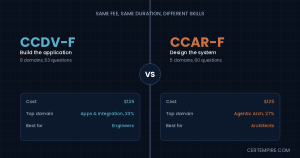
| Claude Certified Developer – Foundations | CCDV-F | Developers building on Claude API | $125 | — |
| Claude Certified Architect – Foundations | CCAR-F | Architects designing Claude systems | $125 | 60 |
| Claude Certified Architect – Professional | CCAR-P | Senior architects, production ownership | $175 | 63 |
CCAO-F is the only Claude certification that requires no technical background. It exists specifically to credential the business users who work with Claude daily but are not building applications.
The Seven CCAO-F Domains
| Domain | Weight |
| Output Evaluation and Validation | 21% |
| Workflow Integration and Solution Design | 16% |
| Governance, Risk, and Responsible Use | 15% |
| Prompting and Task Execution | 14% |
| Product and Model Selection | 12% |
| Configuration and Knowledge Management | 12% |
| Troubleshooting and Optimization | 10% |
Output Evaluation is the largest domain. Output Evaluation plus Workflow Integration and Governance together account for over half the exam. Candidates who focus preparation primarily on prompting techniques are studying the fourth-largest domain (14%) while underinvesting in the first, second, and third.
Domain 1: Output Evaluation and Validation (21%) – Largest Domain
This domain tests whether you can critically evaluate what Claude produces – the professional judgment skill that determines whether Claude’s output is usable, needs revision, or requires additional verification before it can be relied upon.
Identifying Hallucinations
What hallucinations are: Claude, like all large language models, can generate information that sounds accurate and well-reasoned but is factually incorrect. This can manifest as: invented citations that do not exist (specific paper titles, journal names, page numbers that Claude generates plausibly but that are not real), incorrect facts stated confidently without hedging, outdated information presented as current, and fabricated statistics or data that appear precise.
Hallucination indicators the exam tests: Outputs are higher-risk for hallucination when: they include very specific facts (specific dates, specific statistics, specific names) without a source, they discuss events after Claude’s training data cutoff, they involve niche technical or legal domains, or they involve combining multiple facts in ways that might be slightly altered.
Validation approach: The exam tests appropriate validation strategies: cross-referencing specific claims with authoritative sources, using Claude to generate a list of sources and then verifying those sources exist and actually say what Claude claims, recognizing when a task is too high-stakes for unverified AI output, and building verification steps into workflows that produce business-critical content.
Bias Detection in Claude Outputs
Representation bias: Claude’s training data reflects historical patterns, which may include biases about gender, race, geography, culture, and other attributes. When Claude generates descriptions, recommendations, or analyses involving people, the exam tests awareness that outputs may reflect training biases rather than objective analysis.
Framing bias: How a question is asked to Claude influences the framing of the output. The exam tests how to prompt for balanced perspectives and how to evaluate whether an output reflects only one framing of a complex issue.
Recognizing when human review is required: For decisions that significantly affect individuals (hiring, performance evaluation, loan assessment, medical guidance), the exam tests that Claude outputs must be reviewed by a qualified human professional rather than acted upon directly.
Output Adaptation and Format Selection
Adapting outputs for different audiences: A Claude-generated technical analysis must be adapted before presenting to a non-technical executive. The exam tests how to identify appropriate output formats (executive summary, detailed technical report, bullet points, narrative prose) for different audiences and how to prompt Claude to produce each format directly.
Artifacts versus inline responses: Claude can produce outputs as Artifacts (longer structured documents, code, tables) or as inline responses. The exam tests when each format is appropriate and how to work with Artifacts for document workflows.
Domain 2: Workflow Integration and Solution Design (16%)
Using Claude for requirements analysis and research: Claude can help structure ambiguous problem statements into clear requirements, research topics to inform decisions, and synthesize information from provided documents. The exam tests how to design Claude-assisted workflows for research, planning, and requirements gathering tasks.
Integrating Claude into existing workflows: Most business workflows use Claude to augment existing processes rather than replace them. The exam tests how to identify which steps in an existing workflow benefit from Claude assistance (drafting, research, summarization, analysis) versus which steps should remain human-only (final decision, sensitive client interaction, regulatory attestation).
Claude Projects: Claude Projects allow users to give Claude persistent instructions, documents, and context that apply across all conversations within the project. The exam tests how Projects are used to maintain consistent Claude behavior for recurring workflows without re-entering context each time.
Communicating Claude’s capabilities and limitations to stakeholders: Business professionals using Claude must be able to accurately represent what Claude can and cannot do to colleagues, managers, and clients. The exam tests how to accurately describe Claude’s knowledge cutoff, context limitations, potential for error, and appropriate use cases to non-technical audiences.
Domain 3: Governance, Risk, and Responsible Use (15%)
Identifying appropriate and inappropriate use cases: Not all tasks are appropriate for Claude. The exam tests categories of inappropriate use: tasks requiring professional licensure and human accountability (legal advice, medical diagnosis, financial advice for specific situations), tasks involving personal data that violates privacy requirements, tasks where AI output could cause harm if wrong and cannot be adequately verified, and tasks prohibited by organizational AI policy.
Data sensitivity and privacy: The exam tests how to assess whether sharing data with Claude creates privacy or security risks: personally identifiable information (PII), confidential business information (unreleased financials, proprietary formulas, M&A strategy), customer data subject to data processing agreements, and regulated health information (PHI). The appropriate response is to either anonymize data before using Claude or to use Claude only within an enterprise deployment with appropriate data handling agreements.
Organizational AI policies: Many organizations have AI usage policies that govern which data can be processed by external AI tools, what types of tasks AI can be used for, and what approval processes are required for AI-assisted content in external communications. The exam tests applying organizational AI governance standards rather than treating Claude as an unrestricted personal productivity tool.
Ethical implications of AI usage: The exam tests awareness of AI ethical principles: transparency (disclosing AI assistance where appropriate), fairness (avoiding using AI in ways that discriminate), accountability (humans remaining responsible for AI-assisted outputs), and privacy (respecting data subjects’ rights when processing their information through AI tools).
Domain 4: Prompting and Task Execution (14%)
Prompt structure for different task types: The exam tests how prompt structure varies by task category:
- Analysis tasks: Provide the data or text, specify what analytical lens to apply, specify output format.
- Research tasks: Specify the question, scope, desired depth, and how to handle areas where Claude has limited or uncertain knowledge.
- Drafting tasks: Provide the context, audience, tone, format, length, and any specific requirements or constraints.
- Brainstorming tasks: Provide the problem, constraints, and ask for multiple distinct options rather than one recommendation.
Task decomposition: Complex tasks are better handled in stages than as a single large prompt. The exam tests how to decompose a multi-step task into a sequence of Claude interactions where each step builds on the previous. Example: instead of “analyze this report and create an executive briefing and draft follow-up emails,” decompose into: (1) analyze report and summarize key findings, (2) identify the three most significant findings for executive audience, (3) draft executive briefing, (4) draft follow-up emails for each identified action item.
Iterative prompting: When an initial response is not what was needed, the exam tests effective iteration strategies: clarifying what is missing or wrong, specifying the desired change explicitly, providing an example of what a better output would look like, or starting fresh with a more detailed prompt if the initial direction is fundamentally wrong.
Domain 5: Product and Model Selection (12%)
Claude model tiers (Haiku, Sonnet, Opus): Claude comes in multiple variants:
- Haiku: Fastest and lowest cost. Best for simple, high-volume tasks where speed and cost efficiency matter more than maximum intelligence (classification, simple extraction, repetitive formatting tasks).
- Sonnet: Balanced intelligence and speed. The general-purpose choice for most business tasks. Best for drafting, analysis, research, and complex reasoning that does not require the maximum intelligence level.
- Opus: Most intelligent and most capable. Best for the most complex reasoning, nuanced analysis, and tasks where quality is paramount and cost/speed are secondary.
The exam tests selecting the appropriate model tier based on task complexity, quality requirements, volume, and cost considerations.
Claude product features: The exam tests familiarity with Claude’s built-in features relevant to business users: Research mode (extended, multi-step research tasks), web search integration (accessing current information beyond training data cutoff), Artifacts (producing structured documents, code, tables), and Projects (persistent context across conversations).
Domain 6: Configuration and Knowledge Management (12%)
Claude Projects and project instructions: Projects allow users to configure Claude’s behavior for a specific workflow by providing: persistent instructions (how Claude should approach tasks, what tone to use, what to avoid), relevant background documents (company style guides, product descriptions, policy documents), and context that applies to all conversations within the project.
Context limitations and memory: Claude does not retain memory between separate conversations unless they are within the same Project or unless context is explicitly provided. The exam tests how to manage context limitations: when to start a new conversation (context window too full or topic has shifted significantly), when to summarize earlier conversation history and provide the summary at the start of a new session, and how Projects provide persistent context without re-entering it every session.
Domain 7: Troubleshooting and Optimization (10%)
Diagnosing poor outputs: When Claude produces an unsatisfactory response, the exam tests diagnosing why: insufficient context provided (Claude did not have enough information to give a good answer), ambiguous prompt (Claude interpreted the request differently from what was intended), the task is at the edge of Claude’s capability for the selected model tier, or the task requires information after Claude’s training cutoff.
Workflow efficiency improvement: The exam tests how to identify inefficiencies in Claude-assisted workflows (tasks that require extensive iteration could be addressed with better initial prompts or Project instructions) and how to systematically improve prompt quality based on outcome patterns.
5 Study Tips for Anthropic CCAO-F
- Tip 1: Study Output Evaluation and Validation as your primary focus area. At 21%, it is the largest domain and the one least served by general AI literacy content. Practice identifying hallucination risk factors, appropriate validation strategies, and when human review is required.
- Tip 2: Use Claude actively for your own work while preparing. The CCAO-F tests applied professional judgment – “business judgment about deploying Claude in workflows” (as one early exam-taker described it) – that comes from actually using Claude for real tasks and critically evaluating the results.
- Tip 3: Study the governance domain with organizational context in mind. The exam tests applying data sensitivity principles and organizational AI policy standards, not just abstract ethics principles.
- Tip 4: Know the three Claude model tiers and when each is appropriate. Model selection questions appear across multiple domains (Product and Model Selection explicitly, but also in Workflow Integration and Troubleshooting contexts).
- Tip 5: Practice with Cert Empire’s CCAO-F exam questions in the business scenario format the real exam uses – workplace situations where you assess Claude’s output, design a workflow, or evaluate an appropriate use case.
Best Study Resources
- Cert Empire CCAO-F exam questions PDF and practice simulator (July 2026 blueprint-aligned edition).
- Anthropic Academy (anthropic.skilljar.com) – official free courses covering all seven CCAO-F domains.
- Official CCAO-F Exam Guide v1.0 (effective July 2026) – available through the Anthropic Partner Academy portal.
- Claude documentation: claude.ai Help Center for product features.
- claudearchitectcertification.com/exam-guide/ccao-f – free domain breakdown and mock exam.
- theCRUX.com Claude Certified Associate Guide – free domain study modules.
Career Opportunities After CCAO-F
- AI-Enabled Operations Specialist
- AI Productivity Lead
- Knowledge Management Analyst (AI-Assisted)
- Marketing Manager (AI Workflow Focus)
- Project Manager (AI Tool Integration)
- Digital Transformation Consultant
CCAO-F is the first Claude certification for non-technical roles. It positions holders as capable, credentialed Claude users in organizations that are scaling AI adoption across non-technical functions. As organizations demand AI literacy across all roles, CCAO-F provides the formal credential that distinguishes professional-grade Claude users from casual ones.
Why Candidates Choose Cert Empire for CCAO-F Preparation
✔ Output evaluation judgment scenario questions. Our CCAO-F questions present Claude outputs and test whether candidates can correctly identify hallucination risk, detect biases, determine when human review is required, and validate factual claims – the skills the largest domain (21%) demands.
✔ Governance and responsible use scenario questions. We test data sensitivity classification decisions, appropriate versus inappropriate use case identification, and organizational AI policy application in realistic workplace contexts.
✔ Model selection and product feature questions. Our questions test Haiku/Sonnet/Opus selection decisions based on task complexity and cost-quality requirements, and how to use Claude Projects, Research mode, and Artifacts for professional workflows.
✔ Business professional framing throughout. Every CCAO-F question is framed as a business professional scenario – no API calls, no code, no system prompts. The scenarios reflect operations, marketing, project management, and knowledge work contexts.
✔ Practice under real exam conditions with the Cert Empire Exam Simulator. Our CCAO-F simulator runs 60 questions in 120 minutes with domain-level tracking across all seven CCAO-F domains.
✔ Instant access, 90-day free updates, and 24/7 support. As Anthropic updates CCAO-F exam content, your materials update automatically. Our support team is available around the clock.
✔ Backed by a full money-back guarantee. If our exam questions do not help you pass, we refund your purchase with no conditions.
Readiness Check
- A marketing manager uses Claude to draft a competitive analysis comparing their company’s product to three named competitors. Claude produces a detailed, well-structured analysis with specific market share figures, customer satisfaction scores, and pricing data attributed to specific reports. The manager is about to send this analysis to the CMO. Identify the specific validation steps the manager must take before using this analysis, explain what type of AI error is most likely given the specificity of the data cited, and describe what the correct output evaluation process looks like for competitive analysis content.
- An HR operations specialist wants to use Claude to help score job applications by analyzing each candidate’s resume text and rating their qualification level on a scale of 1-10. The specialist believes this will save significant time and provide more consistent evaluations. Evaluate whether this is an appropriate Claude use case by identifying the governance considerations, the specific risks to candidates, and what the organizational and ethical obligations are before deploying an AI system for hiring-adjacent decisions.
- A project manager has a Claude Project configured with persistent instructions for generating project status reports. They add a new team member’s confidential performance review document to the Project as “context” so Claude can reference it when asked about team capacity. Identify what data sensitivity issue this creates, what the correct approach would be for incorporating relevant team capacity information without the privacy concern, and what data handling question should be answered before putting any confidential HR documents into a Claude Project.
- A business analyst needs to produce three deliverables: (a) a quick classification of 500 customer support tickets by category (billing, technical, account), (b) an in-depth analysis of emerging customer pain points from 50 representative tickets, and (c) a comprehensive strategic recommendation for product improvements based on the analysis. For each deliverable, identify the most appropriate Claude model tier (Haiku, Sonnet, or Opus) and justify the selection based on the task complexity, quality requirements, and cost considerations.
- A communications specialist drafts a press release with Claude’s help about a new company initiative. When reviewing the draft, they notice that Claude described the initiative as having “received endorsement from industry analysts” – a claim that was not in any documents they provided and that is not accurate. Identify what this represents in terms of output evaluation, what validation step the specialist failed to perform that would have caught this before review, and what prompt change for future similar tasks would reduce the likelihood of this type of fabrication occurring.
FAQ’s
What is the Anthropic CCAO-F certification?
CCAO-F is the Claude Certified Associate – Foundations certification from Anthropic, launched July 13, 2026. It validates that business professionals can use Claude effectively and responsibly for productivity, research, drafting, and workflow tasks without requiring coding or API experience.
Do I need technical skills to take CCAO-F?
No. CCAO-F is specifically designed for non-technical professionals. No coding, API knowledge, or system prompt experience is required. It is the only Claude certification that does not assume a development background.
What is the largest domain on CCAO-F?
Output Evaluation and Validation at 21%. This domain tests whether candidates can critically evaluate Claude’s outputs – identify hallucinations, detect biases, determine when human review is required, and adapt outputs for different audiences.
What are the seven CCAO-F domains?
Output Evaluation and Validation (21%), Workflow Integration and Solution Design (16%), Governance, Risk, and Responsible Use (15%), Prompting and Task Execution (14%), Product and Model Selection (12%), Configuration and Knowledge Management (12%), Troubleshooting and Optimization (10%).
How do I register for CCAO-F?
Registration goes through the Anthropic Partner Academy (anthropic.skilljar.com). Your employer must have a Claude Partner Network account (free Registered tier available). Scheduling is through Pearson VUE once registered.
How long is the CCAO-F credential valid?
12 months. Free on-time renewal is available through a non-proctored assessment on the Anthropic Partner Academy before the credential expires.
Related Certifications Worth Exploring
CCAO-F certified professionals expanding into technical Claude roles will find our Anthropic CCAR-F (Claude Certified Architect Foundations) exam questions page covers the architect-level credential for professionals who design and implement Claude-based systems – the technical counterpart to the business-focused CCAO-F. For those combining Claude expertise with broader AI governance knowledge, our ISACA AI Fundamentals exam questions page covers the governance-oriented AI foundational credential that complements CCAO-F’s practical Claude application focus.
Related Posts
-

-
-
-
-
-



Reviews
There are no reviews yet.