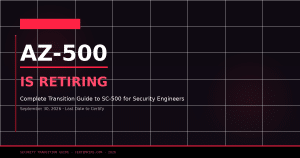
If you have been working toward your Microsoft Azure Security Engineer Associate (AZ-500) certification — or if you already hold it — September 30, 2026 is a date you need to mark on your calendar. That is the day Microsoft officially retires AZ-500, ending the ability to earn or renew one of the most respected cloud security certifications in enterprise IT.
But retirement does not mean the end of the road for security engineers. It means the beginning of a new one.
Microsoft is replacing AZ-500 with SC-500 (Microsoft Cloud and AI Security Engineer) — a certification that carries forward the core Azure security competencies that made AZ-500 valuable while adding an entirely new dimension: securing artificial intelligence systems, AI pipelines, and generative AI deployments in enterprise environments.
This guide is not just about what is changing. It is a complete transition plan. Whether you are currently studying for AZ-500, already certified, planning your renewal, or starting fresh in cloud security, this guide tells you exactly what to do and when to do it so you do not lose ground during Microsoft’s 2026 certification transition.
Why Microsoft Is Retiring AZ-500
Understanding why AZ-500 is retiring helps you appreciate what SC-500 is trying to accomplish and why the transition matters for your career.
AZ-500 was designed for a cloud security landscape that existed before AI became a mainstream enterprise technology. When AZ-500 launched, the primary security concerns for Azure environments were identity and access management, network perimeter security, compute and data protection, and security operations using Sentinel and Defender for Cloud. These remain important — but they are no longer the complete picture.
In 2026 enterprise security teams are increasingly responsible for protecting AI systems alongside traditional cloud infrastructure. Organizations running Microsoft Copilot, Azure OpenAI Service, AI agents, and generative AI-powered applications have introduced an entirely new attack surface that AZ-500’s framework was never designed to address.
Prompt injection attacks, data exfiltration through AI model responses, misconfigured AI access permissions, model abuse, and AI-assisted social engineering are real threats that security engineers encounter in modern enterprise environments. AZ-500 does not cover any of them because they barely existed when the exam was designed.
SC-500 exists because Microsoft recognizes that the definition of cloud security engineering has fundamentally expanded. Security engineers in 2026 and beyond need to protect both the cloud infrastructure they have always managed and the AI systems that are now running on top of it. SC-500 validates both dimensions in a single certification.
What Changes and What Stays the Same
One of the most important things to understand about the AZ-500 to SC-500 transition is that Microsoft is not throwing away what made AZ-500 valuable. It is building on it.
What Carries Forward From AZ-500 to SC-500
The foundational Azure security competencies that AZ-500 validates are expected to remain core requirements in SC-500. Security engineers will still need to demonstrate mastery of:
Identity and access management — Microsoft Entra ID, conditional access policies, Privileged Identity Management, identity protection, managed identities, and service principal security remain fundamental to cloud security regardless of AI workloads.
Network security — Azure Firewall, network security groups, Azure DDoS Protection, private endpoints, and network monitoring are still essential for securing cloud environments. AI systems run on the same network infrastructure as traditional applications.
Compute and data security — Securing virtual machines, containers, Azure Kubernetes Service, storage accounts, and databases remains a core security engineer responsibility. AI models and training data live in these same environments.
Security operations — Microsoft Sentinel for SIEM and SOAR capabilities, Microsoft Defender for Cloud for posture management and threat protection, and incident response workflows are foundational security operations skills that SC-500 will build upon rather than replace.
What Is New in SC-500
The genuinely new territory in SC-500 represents the expansion of the security engineer role into AI security. Based on Microsoft’s announced direction, this includes:
Securing AI model environments — Understanding how to protect AI model deployments, manage model access controls, implement data loss prevention for AI outputs, and prevent unauthorized model access or abuse.
AI governance and compliance — Implementing governance frameworks for AI deployments, managing AI usage policies, ensuring compliance with responsible AI requirements, and auditing AI system behavior for security and ethical concerns.
Protecting against AI-specific attack vectors — Understanding prompt injection attacks, jailbreaking attempts, data poisoning risks, model inversion attacks, and other AI-specific threats that have no equivalent in traditional cloud security frameworks.
Securing Microsoft Copilot deployments — Managing permissions for Microsoft 365 Copilot, controlling what data AI agents can access, implementing oversharing prevention controls, and securing the integration points between Copilot and enterprise data sources.
AI access controls and data protection — Ensuring that AI systems only access the data they are authorized to use, implementing information barriers for AI, and preventing sensitive data from being included in AI model training or responses.
The Official Retirement Timeline You Need to Know
Getting the dates right is critical for planning your certification strategy. Here is the complete timeline:
Now through September 29, 2026
AZ-500 is fully active. You can register for, take, and pass the exam. You can also renew existing AZ-500 certifications. This is your window to earn or renew AZ-500 if you choose to do so.
September 30, 2026
AZ-500 officially retires. After this date you cannot take the AZ-500 exam for the first time. You cannot renew your existing AZ-500 certification after it expires. The exam is removed from the active certification offerings.
After September 30, 2026
Your existing AZ-500 credential remains on your Microsoft Learn transcript in the Active Certifications section until it reaches its natural expiration date. Once it expires it moves to Historical Certifications. It does not disappear from your profile but it can no longer be renewed.
July 2026 (expected)
SC-500 training materials become available. This is when candidates who plan to go directly to SC-500 can begin structured preparation using official Microsoft Learn resources.
Late 2026 (expected)
SC-500 exam becomes generally available. Candidates can register and sit the exam through the standard Pearson VUE testing process.
What Happens to Your Existing AZ-500 Certification
This is the question most currently certified professionals ask first. Here is the complete answer.
Your certification does not disappear. If you earned AZ-500 before it retires, it stays on your Microsoft Learn transcript in the Active Certifications section until its expiration date. You keep the credential and the professional recognition that comes with it for the remainder of its validity period.
You cannot renew it after it retires. Microsoft role-based certifications like AZ-500 require annual renewal to stay active. If your AZ-500 expires after September 30, 2026, you will not be able to complete a renewal assessment because the renewal path is retired along with the certification. This means you need to plan your renewal strategy carefully if your AZ-500 is approaching its expiration date.
It does not convert to SC-500. Your AZ-500 credential does not automatically become SC-500 or count toward SC-500 in any way. SC-500 is a separate certification that must be earned independently by passing the SC-500 exam. As we covered in our AZ-500 vs SC-500 comparison guide, there is no transition exam or automatic conversion path.
Your transcript tells the full story. After AZ-500 expires post-retirement, it moves to the Historical Certifications section of your Microsoft Learn profile. It remains visible as evidence of your certification history even after it is no longer active.
Your Transition Plan Based on Where You Are Right Now
The right transition strategy depends entirely on your current situation. Here is a detailed plan for each scenario.
Situation 1: You Are Currently Studying for AZ-500
Your goal: Finish AZ-500 before September 30, 2026.
The most important thing you can do right now is assess your preparation level honestly and set a concrete exam date. Do not leave your exam unboooked — having a specific date creates accountability and helps you structure your remaining study time.
If you are 60 percent or more prepared, you have enough foundation to push through to completion. Intensify your study schedule, focus on your weakest domains, and schedule your exam as soon as you have a realistic shot at passing.
If you are less than 60 percent prepared, evaluate whether you can realistically reach exam readiness before September 30, 2026. Given that AZ-500 requires 60 to 100 hours of focused preparation, you have more runway than candidates chasing June 30 deadlines. But do not take the extra time for granted — make a study schedule and stick to it.
Either way, use our AZ-500 exam preparation materials to benchmark your current readiness before committing to an exam date. Knowing where your gaps are now is far better than discovering them on exam day.
Situation 2: You Already Hold AZ-500 and It Expires Before September 30, 2026
Your goal: Renew AZ-500 before it expires, or before September 30, 2026, whichever comes first.
Microsoft role-based certifications have a renewal window that opens six months before the expiration date. If your AZ-500 is due to expire before September 30, 2026, complete the free renewal assessment on Microsoft Learn as soon as your renewal window opens.
Do not wait until the last minute. If your AZ-500 expires on, say, August 15, 2026, your renewal window opened in February 2026. If you miss the renewal window and your certification expires before September 30, 2026, you can no longer renew it because the renewal assessment itself retires with the certification.
After renewing AZ-500 before retirement, your certification will remain active until its new expiration date — which may extend beyond September 30, 2026. The certification continues to count on your transcript until that extended expiration date even though the exam itself is retired.
Situation 3: You Already Hold AZ-500 and It Expires After September 30, 2026
Your goal: Let your AZ-500 run its natural course, then plan your SC-500 transition.
If your AZ-500 was recently renewed and will not expire until late 2026 or 2027, you do not need to take urgent action on the retirement timeline. Your certification remains active and valid until its expiration date regardless of when AZ-500 retires as an exam.
Your transition planning question is simply: when your AZ-500 expires, do you want SC-500 on your transcript as its successor? For most security professionals the answer is yes. Start familiarizing yourself with SC-500’s expected content now so that when SC-500 preparation materials become fully available in mid-to-late 2026, you can move efficiently through the certification process.
Situation 4: You Have Not Started Yet and Want to Earn a Microsoft Cloud Security Certification
Your goal: Choose the right path from the beginning.
If you are starting from zero in cloud security certification, you have a genuine choice between starting AZ-500 now or waiting for SC-500. Our AZ-500 vs SC-500 comparison covers this decision in full detail.
The short version: if you can commit to intensive preparation and testing before September 30, 2026, AZ-500 is still a legitimate and valuable starting point. If you cannot commit to that timeline or if you are starting in mid-2026, going directly to SC-500 is the cleaner path.
Situation 5: You Are a Team Lead or Learning Manager Planning Team Certifications
Your goal: Plan your team’s certification roadmap across the transition period.
For organizations planning team-wide security certifications, the transition creates a sequencing challenge. Team members at different preparation stages need different guidance.
The general recommendation for teams is: anyone who can realistically certify before September 30, 2026 should pursue AZ-500. Anyone who cannot should be planned for SC-500 once training materials are available in July 2026. Mixed cohorts — some earning AZ-500, some pursuing SC-500 — is a perfectly reasonable outcome during the transition period.
How to Prepare for SC-500: A Proactive Study Plan
Even though SC-500 training materials are not fully available until around July 2026, there is meaningful preparation you can do right now to get ahead.
Phase 1: Build or Reinforce AZ-500 Level Knowledge (Now)
Whether you earn AZ-500 before it retires or jump straight to SC-500, the foundational Azure security knowledge that AZ-500 covers is the bedrock that SC-500 builds on. If you do not have strong hands-on experience with Microsoft Entra identity management, Azure network security, Defender for Cloud, and Microsoft Sentinel, start building that foundation now.
The Microsoft Learn AZ-500 learning path is free and comprehensive. Work through it systematically even if you are not planning to sit the AZ-500 exam. This investment pays dividends directly in SC-500 preparation.
Phase 2: Study AI Security Concepts Proactively (Now Through Mid-2026)
Microsoft has published substantial documentation on AI security topics that will form the new content areas of SC-500. You do not need to wait for official SC-500 materials to start learning. Study the following areas now:
Azure OpenAI Service security — Microsoft’s documentation on securing Azure OpenAI deployments covers network isolation, private endpoints, managed identity authentication, content filtering, and usage monitoring. This is directly relevant to SC-500’s expected AI security content.
Microsoft Purview for AI governance — Microsoft Purview has been extended to cover AI governance including data classification for AI, sensitivity labels in Copilot experiences, and audit capabilities for AI interactions. Understanding how Purview applies to AI environments is expected to be part of SC-500.
Microsoft Copilot security architecture — Microsoft has published security documentation for Microsoft 365 Copilot covering data residency, access controls, oversharing prevention, and admin controls. Study this documentation to understand how AI assistant security differs from traditional application security.
Responsible AI and content safety — Azure AI Content Safety is a service designed to detect and filter harmful content in AI inputs and outputs. Understanding how to implement content safety controls in AI deployments is part of modern AI security engineering.
Phase 3: Follow Official SC-500 Materials When Available (July 2026 Onward)
When Microsoft publishes the official SC-500 learning path, exam blueprint, and practice assessment on Microsoft Learn, make those your primary preparation resources. Third-party materials will follow but official Microsoft content should always be your foundation.
Pay particular attention to the official skills breakdown when it is published. The percentage weightings for each domain will tell you where to focus your study time. Based on current direction, AI security is likely to carry significant weight in SC-500 — do not underestimate the new content relative to the familiar carry-forward domains.
The Career Impact of the AZ-500 to SC-500 Transition
For security professionals who have invested in AZ-500, the natural concern is whether that investment loses value as the certification retires. The honest answer is nuanced.
AZ-500 retains its career value in the short term. Employers who have been hiring AZ-500 holders for years do not suddenly stop recognizing it the moment Microsoft retires the exam. The skills it validates — Azure identity security, network security, Defender for Cloud, Sentinel — remain directly relevant to enterprise security operations regardless of what Microsoft does with its certification program. Your AZ-500 remains a meaningful credential on your resume until it expires.
SC-500 will create a new hiring signal. As SC-500 becomes established over the next 12 to 18 months, employers hiring cloud security engineers will increasingly look for it on resumes. Security professionals who earn SC-500 early will have a first-mover advantage in a hiring market where the majority of candidates are still transitioning from AZ-500.
AI security skills are already in demand. The demand for security professionals who understand AI risks, AI governance, and AI-specific threat detection is growing faster than the supply. SC-500 will be one of the clearest certifications signals that a candidate has validated AI security competency. Earning it in 2026 or early 2027 positions you well ahead of the majority of the security workforce.
The combination of AZ-500 history and SC-500 certification is powerful. For mid-career security professionals, having AZ-500 on your historical transcript and SC-500 as your current active certification tells a compelling story: you have deep traditional cloud security roots and you have evolved to meet the new AI security reality. That narrative is genuinely valuable in senior security hiring conversations.
Common Mistakes to Avoid During the Transition
Mistake 1: Assuming you have plenty of time and not acting September 30, 2026 feels distant in early 2026, but preparation timelines are longer than most candidates expect. AZ-500 requires 60 to 100 hours of serious preparation. If you have not started or are mid-preparation, do not treat the September deadline as a comfort — treat it as a deadline that requires active planning.
Mistake 2: Letting your existing AZ-500 expire without renewing If you currently hold AZ-500 and it expires before September 30, 2026, missing your renewal window means losing an active credential you cannot recover. Check your expiration date today and set a calendar reminder to complete your renewal assessment as soon as the renewal window opens.
Mistake 3: Expecting SC-500 to be available immediately Some candidates assume they can simply switch to SC-500 right now. SC-500 training is not expected until July 2026 and the exam follows after that. Planning your certification timeline around SC-500 being available today will leave you without a path forward in the near term.
Mistake 4: Treating SC-500 as just a harder AZ-500 SC-500 is not simply AZ-500 with more content added. It represents a meaningfully different framing of what cloud security engineering means in an AI-powered enterprise. Candidates who approach SC-500 preparation as if it is just an extension of AZ-500 will underestimate the new AI security content and risk being underprepared for those domains.
Mistake 5: Ignoring the transition because your organization has not adopted AI yet Many security professionals think AI security is not relevant to them because their organization is not yet running significant AI workloads. This is a shortsighted view. AI adoption in enterprise environments is accelerating rapidly. The security engineers who invest in AI security knowledge now will be the ones organizations turn to when their AI adoption accelerates — which for most enterprises will happen within the next 12 to 24 months.
AZ-500 Retirement in the Context of Microsoft’s Broader 2026 Changes
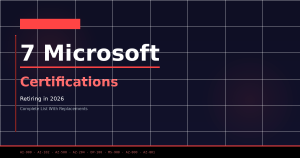
The AZ-500 retirement is one part of a larger pattern of change across Microsoft’s entire certification portfolio in 2026. As we covered in detail in our complete guide to Microsoft certifications retiring in 2026, Microsoft is retiring seven major certifications this year and replacing them with AI-focused credentials across every technical track.
The consistent theme is clear: Microsoft is embedding AI competency directly into every role-based certification rather than treating AI knowledge as a separate specialization. Security engineers are expected to understand AI security. Developers are expected to build AI applications. Data scientists are expected to work with modern MLOps and GenAIOps patterns. Infrastructure administrators are expected to manage AI-inclusive hybrid environments.
For security professionals this context matters because it means SC-500 is not an isolated change. It is part of a coordinated shift that will affect your entire organization’s technical workforce. The developers on your team are navigating the AZ-204 to AI-200 transition. The AI engineers are deciding between AI-102 and AI-103. The data scientists are evaluating DP-100 vs DP-750. Everyone is being asked to grow their AI competency alongside their existing domain expertise.
Understanding this broader context helps you see SC-500 not as an inconvenient disruption to your certification plans but as Microsoft’s investment in making certified professionals genuinely equipped for the AI-powered enterprise environments they will be securing in 2027 and beyond.
Final Recommendations: Your AZ-500 to SC-500 Action Plan
Here is your clear action plan based on your specific situation:
If you are currently studying for AZ-500: Set an exam date before September 30, 2026 today. Intensify your preparation using the official Microsoft Learn path and practice materials. Earn AZ-500 before retirement. Then plan your SC-500 journey for 2027.
If you already hold AZ-500 expiring before September 30, 2026: Complete your renewal assessment immediately within your renewal window. Do not let your certification expire before the retirement date — after that you cannot renew it.
If you already hold AZ-500 expiring after September 30, 2026: No urgent action needed. Your certification remains valid until expiration. Begin familiarizing yourself with SC-500 content now so you are ready to pursue it when your AZ-500 expires.
If you have not started yet: If you can commit to intensive preparation and testing before September 30, 2026, AZ-500 is still worth pursuing. If you cannot make that commitment, wait for SC-500 materials in July 2026 and start fresh on the new path.
Regardless of your situation: Start building AI security knowledge now. Study Azure OpenAI security documentation, Microsoft Purview for AI governance, Copilot security architecture, and responsible AI principles. This investment pays off whether you earn AZ-500, SC-500, or both.
FAQs
When exactly does AZ-500 retire?
AZ-500 retires on September 30, 2026. After this date you cannot take the exam for the first time or renew an existing certification once it expires.
What happens to my AZ-500 after it retires?
Your earned AZ-500 certification remains on your Microsoft Learn transcript in Active Certifications until it naturally expires. After expiration it moves to Historical Certifications. You cannot renew it after September 30, 2026.
Is SC-500 available now?
No. SC-500 training is expected around July 2026 with the exam following in the months after. It is not available for registration as of early 2026.
Do I have to start SC-500 from scratch if I already have AZ-500?
Yes. SC-500 is a separate certification that must be earned independently. Your AZ-500 does not transfer to or count toward SC-500 in any way.
How different is SC-500 from AZ-500?
SC-500 carries forward the core Azure security domains from AZ-500 — identity, networking, compute security, and security operations — and adds a significant new domain covering AI security, AI governance, and protecting AI-powered deployments. Candidates with strong AZ-500 knowledge will have a meaningful foundation for SC-500 but will need to invest seriously in the new AI security content.
Should I rush to get AZ-500 before it retires?
If you are already prepared or close to prepared, yes — finish it before September 30, 2026. If you are starting from scratch and cannot commit to intensive preparation, going directly to SC-500 when it becomes available is a cleaner path.
Will SC-500 be harder than AZ-500?
Based on announced scope, SC-500 covers everything AZ-500 covers plus AI security additions. Candidates with strong AZ-500 preparation should find SC-500 manageable with focused study of the new content areas. The exam is likely to be similar in overall difficulty to AZ-500 for well-prepared candidates.
Where can I find AZ-500 study materials right now?
Microsoft Learn has a complete free learning path for AZ-500. You can also use our AZ-500 exam preparation materials to assess your readiness before your exam date.
How does AZ-500 retirement fit into Microsoft’s broader 2026 changes?
AZ-500 is one of seven major Microsoft certifications retiring in 2026. Our complete Microsoft certifications retiring in 2026 guide covers all retirements, replacement exams, and transition strategies across every affected track.