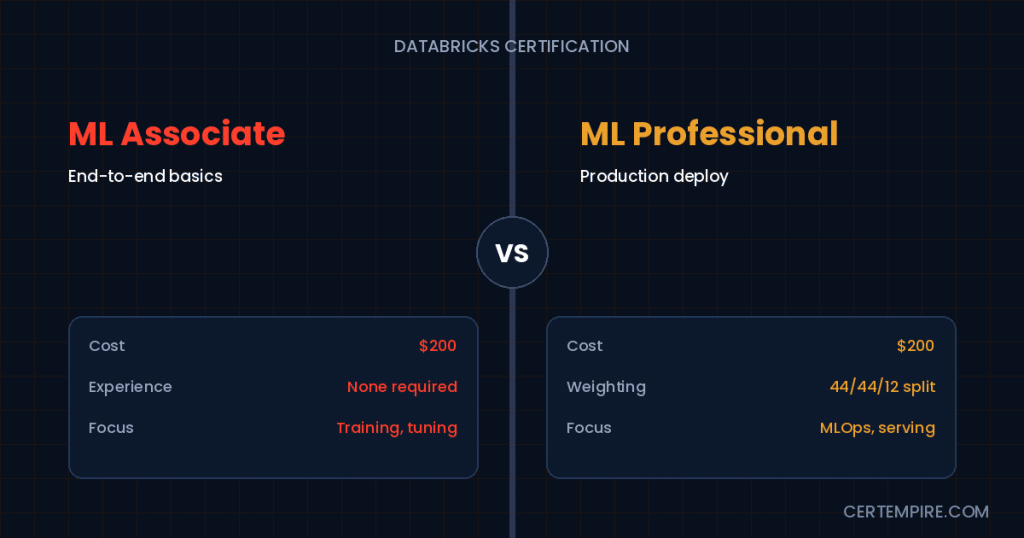
Machine Learning Associate and Machine Learning Professional both cost $200 and share the same 70 percent passing score, but Professional’s domain weighting reveals something the price tag doesn’t: it splits almost evenly between Model Development and ML Ops, at 44 percent each, with Model Deployment carrying the remaining 12 percent, a genuinely different shape than Associate’s broader, more introductory coverage. Official exam guides live on Databricks’ certification page.
The direct answer: Take Machine Learning Associate if you’re new to ML on Databricks or your work is running basic end-to-end ML projects, exploring data, engineering features, training and tuning models with AutoML and MLflow. Take Machine Learning Professional once you have roughly a year of hands-on experience and your responsibilities include production-grade model deployment, custom model serving, and controlled rollout strategies specifically. Multiple 2026 study guides describe Professional as the hardest exam in Databricks’ entire catalog, so treat the jump seriously.
At a Glance
| Detail | Machine Learning Associate | Machine Learning Professional |
| Cost | $200 | $200 |
| Question count | 45 | 59 to 60 |
| Duration | 90 minutes | 120 minutes |
| Passing score | 70 percent | 70 percent |
| Core focus | End-to-end basic ML projects | Advanced model development, MLOps, controlled deployment |
| Key tools | AutoML, Feature Store, MLflow, Spark ML | Custom model serving, deployment strategies, advanced MLOps |
| Experience assumed | None formally required | Roughly 1 year of hands-on experience |
| Reputation | Approachable entry point | Widely cited as the hardest of the 7 Databricks exams |
Professional’s Domain Weighting Tells You What to Expect
| Domain | Weight |
| Model Development | 44 percent |
| ML Ops | 44 percent |
| Model Deployment | 12 percent |
Key point: This near-even split between Model Development and ML Ops is unusual. Most certification exams weight one domain more heavily than the rest, but Professional treats building the model and operationalizing it as equally important, which reflects a real shift in what senior ML roles actually expect. A candidate who’s strong at model development but has never owned an ML Ops pipeline in production will lose a genuinely large share of the exam, not just a peripheral section. Model Deployment’s smaller 12 percent weighting is deceptive too, it covers custom model serving infrastructure and controlled rollout strategies that assume you’ve actually shipped a model change to production and managed the risk of that rollout, not just theoretical familiarity with the concept.
What Machine Learning Associate Actually Covers
Associate proves you can run a basic ML project start to finish inside Databricks: understanding the platform, exploring data, engineering features, training, tuning, and evaluating models, then deploying something functional. It leans on Databricks-native tooling at an introductory level, AutoML for automated model selection, Feature Store for reusable features, and MLflow for tracking experiments and managing the model registry, without assuming deep production operations experience. The exam tests your ability to apply these tools correctly to a described scenario rather than testing deep statistical theory behind the models themselves.
What Machine Learning Professional Actually Covers
Professional’s Model Development domain goes well beyond Associate’s introductory feature engineering and training, covering advanced techniques for improving model performance, handling more complex data scenarios, and making defensible modeling decisions under ambiguity. The ML Ops domain, carrying equal weight, tests your ability to build and maintain the operational infrastructure around a model: monitoring for model drift, managing retraining pipelines, and maintaining reliability once a model is live and being used by real downstream systems. Model Deployment closes the loop with custom serving architecture and rollout strategy specifically, the kind of decision-making that determines whether a model update ships safely or causes an incident.
Note: Because ML Ops and Model Development are weighted identically, candidates can’t rely on being strong in one area to compensate for weakness in the other the way they sometimes can on exams with a single dominant domain. This is a meaningful part of why Professional has a reputation as Databricks’ hardest certification.
The Real Gap Between Them
Associate assumes you can build a working model. Professional assumes you can be trusted to deploy that model into a live environment where custom serving infrastructure, rollout strategy, and ongoing operational monitoring actually matter, and where a mistake affects real users or real business decisions, not a notebook exercise.
| If Your Work Involves | Take |
| Learning Databricks ML tooling, running your first end-to-end projects | Associate |
| Basic AutoML and MLflow experiment tracking | Associate |
| Custom model serving and deployment strategy | Professional |
| Production-grade ML Ops and monitoring | Professional |
| Diagnosing model drift and managing retraining pipelines | Professional |
| Controlled rollouts and rollback strategy for live models | Professional |
Who Should Take Each Certification
Data scientists and junior ML engineers building their first production models. Associate matches this stage directly, validating the core AutoML-to-MLflow workflow without assuming you’ve already owned a live model’s operational lifecycle.
Senior ML engineers responsible for models already running in production. Professional’s even split between development and operations matches this role’s actual daily reality, where building a good model is only half the job and keeping it healthy in production is the other half.
Candidates considering Professional primarily because it’s the more prestigious credential. Given its reputation as the hardest exam in the catalog, this isn’t the certification to pursue for resume optics alone. The scenario-based ML Ops content specifically assumes real operational scars, and candidates without that experience typically need meaningfully more preparation time than the hours estimate suggests.
Team leads planning certification paths for ML staff. Treat Associate as a reasonable general expectation for anyone building models on Databricks, and reserve Professional specifically for engineers who own production model reliability, rather than a universal target for the whole team.
Preparation Time and Difficulty
| Exam | Typical Prep Time | Background |
| Machine Learning Associate | 4 to 8 weeks | New to ML on Databricks, or with general data science background |
| Machine Learning Professional | 60 to 100 hours, often more given its difficulty reputation | Candidates with roughly a year of hands-on production ML experience |
Multiple 2026 study guides specifically flag Machine Learning Professional as the hardest exam across all 7 Databricks certifications, harder in candidate reports than Data Engineer Professional despite sharing the same format and passing score. The reason consistently cited is the even domain weighting: there’s no single dominant area to focus study time on, and genuine weakness in either Model Development or ML Ops costs nearly half the available points.
What This Difference Means for Pay
Databricks doesn’t publish a salary split specifically between Machine Learning Associate and Professional holders, but the pattern from the Data Engineer track likely applies here too: Professional-level certification aligns with senior-tier responsibilities, production deployment ownership and ML Ops specifically, that command higher pay industry-wide regardless of the specific certifying body. Databricks’ broader claim that certified professionals earn 15 to 30 percent more than non-certified peers is vendor-reported rather than independently verified, useful as a directional signal rather than a precise promise for your specific role or region.
Where This Fits, and What to Look at Next
If you’re deciding between the traditional ML track and Databricks’ newer generative AI credential, see our Machine Learning Associate vs Generative AI Engineer Associate comparison for that fork. The same Associate-to-Professional pattern exists on the data engineering side too, covered in our Data Engineer Associate vs Professional guide. For the complete 7-exam catalog, see our Databricks Certification Path guide.
Common Mistakes When Choosing Between These Two
Assuming Professional is just a harder set of Associate-style questions. The near-even Model Development and ML Ops split means it’s testing 2 genuinely different skill areas with equal weight, not one deeper skill.
Attempting Professional without real production deployment experience. Custom model serving and rollout strategy aren’t things you can fully learn from documentation alone, and this exam’s difficulty reputation specifically stems from how much it assumes real operational exposure.
Underestimating the ML Ops half of Professional because Model Development sounds like the “main” topic. Both domains carry identical 44 percent weight, and neglecting either one costs you nearly half the exam.
Treating the 12 percent Model Deployment domain as a minor afterthought worth skipping in preparation. It specifically tests custom serving architecture and rollout risk management, content that doesn’t overlap heavily with either of the 2 larger domains.
Underestimating total prep time for Professional based purely on the 60 to 100 hour estimate. Given its consistent reputation as the hardest Databricks exam, candidates without substantial hands-on ML Ops experience should budget meaningfully more time than that range suggests.
FAQS
What’s unusual about Machine Learning Professional’s domain weighting?
Model Development and ML Ops each carry 44 percent of the exam, an unusually even split that reflects how much production ML roles now expect equal competence in both building and operating models.
Is Machine Learning Professional really the hardest Databricks certification?
Multiple 2026 study guides describe it that way, citing the even domain split between Model Development and ML Ops as the specific reason, since there’s no single dominant area to concentrate study time on.
Do I need a Machine Learning Associate before Professional?
Not formally required, but Professional’s content assumes the foundational ML workflow knowledge Associate covers, and most successful candidates hold Associate first.
How much hands-on experience does Professional assume?
Roughly a year of production ML work, particularly around model deployment and operational monitoring, though given its difficulty reputation, more experience is genuinely helpful.
Is Machine Learning Associate enough for most data science roles?
For roles focused on model development and experimentation, yes. Professional becomes relevant once you’re responsible for production deployment and ongoing operations specifically.
How long should I study for Machine Learning Professional?
Typically 60 to 100 hours if you already have close to a year of hands-on production experience with model deployment and ML Ops, though candidates without that background should expect meaningfully more given the exam’s difficulty reputation.
What does the Model Deployment domain actually test?
Custom model serving architecture and controlled rollout strategies, the kind of decisions that determine whether a production model update ships safely.
How many questions are on Machine Learning Professional, and how long do I have?
59 to 60 questions in 120 minutes, consistent with every Professional-level Databricks certification.