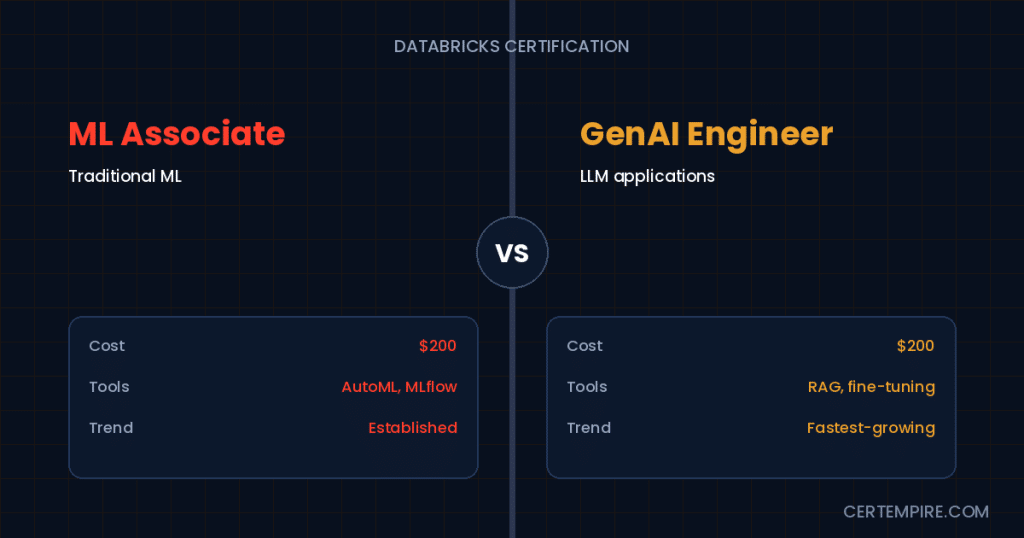
Machine Learning Associate and Generative AI Engineer Associate both cost $200, both run 45 questions in 90 minutes, and both sit at the same Associate tier, but they validate genuinely different work, traditional end-to-end ML workflows using AutoML and MLflow versus building GenAI applications with RAG pipelines and LLM fine-tuning, and Generative AI Engineer Associate is currently the fastest-growing certification in Databricks’ entire catalog. Official exam guides live on Databricks’ certification page.
The direct answer: Take Machine Learning Associate if your work is training, tuning, and deploying traditional ML models, classification, regression, forecasting, using Databricks’ ML tooling. Take Generative AI Engineer Associate if you’re building applications on top of large language models specifically, RAG pipelines, AI agents, and LLM-powered features. The 2 aren’t sequential, they’re parallel specializations, and plenty of practitioners now need both as GenAI work increasingly sits alongside traditional ML in the same organization.
At a Glance
| Detail | Machine Learning Associate | Generative AI Engineer Associate |
| Cost | $200 | $200 |
| Question count | 45 | 45 |
| Duration | 90 minutes | 90 minutes |
| Passing score | 70 percent | 70 percent |
| Core focus | End-to-end traditional ML workflows | Building and deploying GenAI applications |
| Key tools | AutoML, Feature Store, MLflow, Spark ML | RAG, Vector Search, Foundation Model APIs, LangChain, Agent Framework |
| Launched | Established, part of the original certification catalog | 2025, the newest exam in the current lineup |
| Growth trend | Established, steady | Fastest-growing certification in the Databricks catalog |
Domain Weighting for Generative AI Engineer Associate
| Domain | Weight |
| Application Development | 30 percent |
| Assembling and Deploying Applications | 22 percent |
| Design | 14 percent |
| Data Preparation | 14 percent |
| Evaluation and Monitoring | 12 percent |
| Governance | 8 percent |
Important: More than half the exam sits in Application Development and Assembling/Deploying Applications combined. This is a build-and-ship exam, not a theory exam, and candidates who’ve only read about RAG architecture without actually assembling one consistently underperform on this specific weighting. Beyond the domain percentages, the exam specifically tests practical knowledge of RAG pipeline construction, Vector Search implementation, working with Foundation Model APIs, using LangChain for orchestration, Databricks’ Agent Framework, evaluation methodology for LLM outputs, and guardrails for responsible deployment.
What Machine Learning Associate Actually Tests
Machine Learning Associate validates that you can run a complete ML project inside Databricks: exploring data, engineering features, training and tuning models, evaluating results, and deploying something that works. It leans on Databricks-native tooling, AutoML for automated model selection, Feature Store for reusable feature pipelines, and MLflow for experiment tracking and model registry, at an introductory level appropriate for someone new to production ML work on the platform. The exam assumes you understand traditional supervised learning concepts, classification and regression specifically, and tests your ability to apply them using Databricks’ specific toolchain rather than testing statistical theory in the abstract.
Note: MLflow appears across multiple domains within this exam rather than being confined to one section, since it functions as the tracking and registry layer underneath nearly every other ML task Databricks tests. Candidates who treat MLflow as a minor tool rather than core infrastructure tend to underprepare for how frequently it appears.
The Real Difference: Predicting Outcomes vs Building on Language Models
Machine Learning Associate is about traditional supervised and unsupervised learning, models that predict a number, a category, or a cluster from structured data. Generative AI Engineer Associate is about a completely different technical stack, working with pre-trained large language models, designing prompts and retrieval systems, and building applications where the “model” is something you integrate and orchestrate rather than train from scratch. A data scientist with years of traditional ML experience can still find GenAI Engineer Associate’s content genuinely unfamiliar, since RAG pipeline design and LLM evaluation aren’t extensions of classical ML skills, they’re a different discipline that happens to share the word “AI.”
| Your Work Involves | Better Fit |
| Training classification, regression, or forecasting models | Machine Learning Associate |
| Feature engineering and traditional model evaluation | Machine Learning Associate |
| Using AutoML and MLflow for experiment tracking | Machine Learning Associate |
| Building chatbots, RAG systems, or LLM-powered features | Generative AI Engineer Associate |
| Fine-tuning or integrating large language models | Generative AI Engineer Associate |
| Working with Vector Search or LangChain-based orchestration | Generative AI Engineer Associate |
| Both, as your organization expands into GenAI alongside existing ML work | Consider both, they’re complementary rather than competing |
Who Should Take Each Certification
Data scientists and ML engineers running traditional predictive modeling projects. Machine Learning Associate directly validates the AutoML, Feature Store, and MLflow-centered workflow this role uses daily, without requiring any LLM-specific knowledge that wouldn’t apply to your actual work.
Developers and engineers building chatbots, internal AI assistants, or LLM-powered product features. Generative AI Engineer Associate is built specifically for this work, and its heavy weighting toward application development and deployment matches the hands-on, build-focused nature of GenAI engineering roles.
Teams whose organizations are actively investing in GenAI products right now. Given that GenAI-skilled data professionals are consistently ranked among the most in-demand technical hires globally in 2026, prioritizing Generative AI Engineer Associate ahead of or alongside Machine Learning Associate is a reasonable response to where hiring demand is actually concentrated.
Experienced ML practitioners who haven’t yet worked hands-on with LLM application development. Don’t assume your existing ML background shortens GenAI Engineer Associate prep significantly. RAG architecture, vector search, and prompt-based application design are genuinely new material, not an extension of classical ML skill.
Why Generative AI Engineer Associate Is Growing So Fast
Organizations are racing to build production GenAI applications on lakehouse architectures, and GenAI-skilled data professionals are consistently ranked among the most in-demand technical hires globally right now. This isn’t a niche specialization anymore, it’s becoming a standard expectation alongside traditional ML skill for data teams at organizations investing seriously in AI products. The exam’s 2025 launch date makes it the newest credential in Databricks’ current lineup, and its rapid adoption reflects genuine market demand rather than novelty alone.
Preparation Time
| Exam | Typical Prep Time | Notes |
| Machine Learning Associate | 4 to 8 weeks | Faster with existing data science or statistics background |
| Generative AI Engineer Associate | 4 to 8 weeks | Faster with hands-on LangChain or RAG pipeline experience specifically, not general ML background |
What This Difference Means for Pay
Databricks doesn’t publish certification-specific salary splits for either credential, but the broader market signal is clear directionally: GenAI-skilled data professionals are consistently ranked among the most in-demand technical hires globally in 2026, per multiple industry analyses, which typically translates into a premium over traditional ML roles at organizations actively competing for that talent. Treat this as a demand signal rather than a precise number, since neither Databricks nor independent salary surveys have published a clean Associate-level breakdown specific to these 2 certifications yet.
Choosing Your Path, and What Comes Next
If you’re on the traditional ML track and wondering how far to take it, see our Machine Learning Associate vs Professional comparison for that decision. For the complete 7-exam Databricks catalog these 2 certifications sit inside, see our Databricks Certification Path guide. If you’re comparing this GenAI-specific credential against a model vendor’s own developer certification, our Claude Certification Path guide covers Anthropic’s equivalent Developer-track exam.
Common Mistakes When Choosing Between These Two
Assuming traditional ML experience transfers directly to Generative AI Engineer Associate. The underlying skills, prompt design, RAG architecture, LLM evaluation, are genuinely different from classical model training and evaluation.
Treating these as sequential rather than parallel specializations. Neither is a prerequisite for the other, and choosing between them should be based on which type of work you actually do, not which sounds more advanced.
Underestimating how build-heavy Generative AI Engineer Associate is. With more than half the exam concentrated in application development and deployment domains, reading about GenAI concepts without hands-on RAG pipeline experience leaves real gaps.
Treating MLflow as a peripheral tool when studying for Machine Learning Associate. It underpins tracking and registry functions across nearly every domain in the exam, not just one isolated section.
Chasing Generative AI Engineer Associate purely because it’s the fastest-growing certification, without confirming your actual role involves LLM application development. Popularity in the market doesn’t override fit with your daily work.
FAQS
What’s the difference between Machine Learning Associate and Generative AI Engineer Associate?
Machine Learning Associate tests traditional ML workflows, training and deploying models that predict outcomes from structured data. Generative AI Engineer Associate tests building applications on top of large language models, RAG pipelines, LLM fine-tuning, and AI agents.
Do I need a Machine Learning Associate before Generative AI Engineer Associate?
No, they’re parallel specializations rather than sequential tiers, and neither is a formal prerequisite for the other.
Which certification is more in demand right now?
Generative AI Engineer Associate is currently the fastest-growing certification in Databricks’ entire catalog, reflecting rapid organizational investment in production GenAI applications.
Can traditional ML experience help with the GenAI exam?
Some general data and platform familiarity transfers, but the core skills, prompt engineering, RAG design, LLM evaluation, are a genuinely different discipline from classical model training.
Should I get both certifications?
If your organization is expanding into GenAI work alongside existing ML responsibilities, both are increasingly complementary rather than redundant.
What specific tools does Generative AI Engineer Associate test?
RAG pipeline construction, Vector Search, Foundation Model APIs, LangChain-based orchestration, Databricks’ Agent Framework, output evaluation methodology, and guardrails for responsible AI deployment.
How many questions are on each exam, and how long do I have?
Both run 45 questions in 90 minutes, consistent with every Associate-level Databricks certification.
When did Generative AI Engineer Associate launch?
2025, making it the newest certification in Databricks’ current 7-exam lineup.