
Real Anthropic CCAR-P Exam Questions [October 2026 Update] - Cert Empire
Our Anthropic Valid CCAR-P exam questions deliver accurate and up-to-date content for the Claude Certified Architect – Professional certification. Each question is reviewed by AI certification professionals and includes verified answers with clear explanations. With free demo access and Cert Empire’s online exam simulator, you can practice effectively and prepare for the CCAR-P exam with confidence.
What Users Are Saying:
Integration is 19% of the CCAR-P exam – the single largest domain – and it is the domain where the most technically competent candidates lose points. Not because they lack architectural skill. Because they over-study Developer Enablement (7%), the domain they recognize most easily: Claude Code, team enablement, developer tooling. Those topics are familiar to senior engineers. Integration is where Anthropic-specific knowledge matters most and where general architecture experience does not transfer. Anthropic’s retrieval stack – how to chunk documents for RAG, when to use hybrid search versus vector search alone, what Contextual Retrieval adds and when it justifies the additional cost, how MCP servers are designed for secure multi-tenant tool access, how the Messages API handles document inputs versus text – these are patterns specific to the Claude platform. A senior solutions architect with five years of cloud experience and general LLM knowledge who has not specifically studied how Claude handles retrieval, tool integration, and multi-modal inputs will not perform well on a domain that is nearly a fifth of the exam. And that is exactly the domain that the exam’s architecture weighting places the most emphasis on.
The Anthropic CCAR-P (Claude Certified Architect – Professional) is Anthropic’s Expert-tier certification for senior architects who own production Claude solutions end-to-end: from translating business requirements into system designs through integration, evaluation, governance, stakeholder communication, and team enablement. It launched in July 2026 as the terminal credential in Anthropic’s Claude Certification Program. The exam has 63 questions (MCQ + multiple-response) in 120 minutes, with a passing score of 720 on a 100-1000 scale. The fee is $175 per attempt. Recommended experience: 3+ years of systems architecture or platform engineering, plus 6+ months of hands-on Claude experience.
Cert Empire’s CCAR-P exam questions are built at the production architecture decision depth the exam requires: retrieval stack design with Anthropic-specific techniques, MCP server design for enterprise tool access, evaluation metric selection, governance framework application, and the architectural trade-off reasoning that the Professional-level exam specifically demands.
Exam Snapshot
| Field | Details |
| Exam Code | CCAR-P |
| Exam Name | Claude Certified Architect – Professional |
| Issuing Body | Anthropic |
| Launch | July 2026 (Exam Guide v1.0, effective July 2026) |
| Fee | USD $175 per attempt |
| Questions | 63 (Multiple-Choice + Multiple-Response) |
| Duration | 120 minutes |
| Passing Score | 720 / 1000 (scaled) |
| Delivery | Pearson VUE (online proctored or test center) |
| Retakes | 14 / 30 / 90-day waits, max 4 per rolling 12 months |
| Validity | 12 months; free on-time renewal |
| Recommended Experience | 3+ years systems architecture / platform engineering + 6+ months hands-on Claude |
| Prerequisites | None mandatory (CCAR-F strongly recommended as preparation) |
| Target Audience | Mid-senior solution architects, AI/ML engineers, technical leads who own production Claude architecture decisions |
CCAR-P vs. CCAR-F: Where the Professional Exam Goes Further
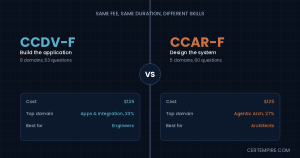
The CCAR-F (Architect Foundations) tests five domains covering the fundamentals of building and operating Claude systems. The CCAR-P tests the full ownership loop – seven domains that extend beyond implementation into evaluation, governance, stakeholder accountability, and team leadership.
| CCAR-F Tests | CCAR-P Goes Further |
| Agentic loop mechanics | Multi-system architectural trade-offs at scale |
| Tool design and MCP introduction | MCP design for enterprise security, multi-tenancy, and governance |
| Prompt engineering basics | Evaluation framework design across multiple model families |
| Basic deployment | Full production lifecycle including monitoring, cost governance, and incident response |
| Safety fundamentals | Regulatory compliance mapping (GDPR, HIPAA, EU AI Act risk tiers) |
| Claude Code configuration | Developer enablement at organizational scale |
The Seven CCAR-P Domains
| Domain | Weight |
| Integration | 19% |
| Evaluation and Optimization | 16% |
| Solution Design and Architecture | 15% |
| Governance, Safety, and Risk | 14% |
| Model and Context Strategy | 13% |
| Stakeholder Communication and Lifecycle | 13% |
| Developer Enablement | 7% |
Domain 1: Integration (19%) – Largest Domain
RAG Architecture: Anthropic-Specific Patterns
Chunking strategy selection: Document chunking determines what context Claude receives when answering a query. The exam tests chunking trade-offs:
- Fixed-size chunking: Simple, predictable. Pros: consistent embedding vector size. Cons: cuts across sentence and paragraph boundaries, reducing semantic coherence.
- Semantic chunking: Groups content by meaning (splitting at topic changes). Pros: more coherent chunks for retrieval. Cons: variable chunk sizes complicate index management.
- Hierarchical chunking: Multiple granularity levels (paragraph, section, document) indexed separately with parent-child relationships. Enables both specific retrieval and broader context.
The exam tests which strategy is appropriate for different document types (contracts vs. technical documentation vs. conversational transcripts) and query patterns (specific fact retrieval vs. broad topic queries).
Contextual Retrieval (Anthropic-specific): Contextual Retrieval is Anthropic’s technique for improving retrieval quality by prepending chunk-level context to each chunk before embedding. Instead of embedding a chunk that says “The maximum limit is 1,000 requests per day,” you first have Claude generate a sentence explaining what document and section this comes from, then embed “This section of the API rate limits documentation describes the standard tier maximum request limit. The maximum limit is 1,000 requests per day.” This additional context dramatically improves retrieval accuracy for ambiguous chunks. The exam tests when Contextual Retrieval justifies its additional processing cost (large document collections with context-poor chunks) versus when it is unnecessary overhead.
Hybrid search: Combining dense vector search (semantic similarity using embeddings) with sparse retrieval (BM25/keyword matching) and merging results. Dense search finds semantically related content even when exact keywords differ. Sparse search finds exact keyword matches that dense search might miss for rare proper nouns, acronyms, and technical terms. The exam tests when hybrid search is worth the architectural complexity over pure vector search: environments with high technical terminology, regulatory documents with precise language requirements, or code repositories where function names matter exactly.
Embedding model selection: Embeddings convert text to vectors. The exam tests how embedding model choice affects retrieval quality: domain-specific models may outperform general models for technical content; multilingual models are needed for cross-language retrieval; embedding dimensionality affects storage cost and query latency.
Reranking: After initial retrieval returns the top-N candidate chunks, a reranker applies a more computationally expensive relevance score to reorder the candidates before presenting them to Claude. The exam tests the reranking architectural pattern: retrieve broadly (top 50 chunks), rerank (select top 10 by relevance), present to Claude. This two-stage approach provides better precision than retrieval alone.
MCP Integration Design
MCP server architecture for enterprise: When designing MCP servers for enterprise production environments, the exam tests security design patterns:
- Per-user authentication: MCP servers must validate which user is making each tool call rather than operating in a shared, unauthenticated mode. Enterprise MCP servers should integrate with the organization’s identity provider.
- Rate limiting per client/user: Preventing individual users or malfunctioning clients from exhausting shared MCP server resources.
- Audit logging: Every tool call through an MCP server should be logged for security, debugging, and compliance purposes.
- Sandboxing for dangerous tools: Tools that can execute code, modify files, or access external systems should operate in sandboxed environments with clearly defined permission scopes.
When to build a custom MCP server versus use existing integrations: Building a custom MCP server is appropriate when: the target system has no existing MCP integration, the organization has unique data access patterns or security requirements, or the tool needs to operate within the organization’s security perimeter. Using existing MCP servers (from approved third-party providers) is appropriate when: the integration is for a standard SaaS platform with maintained server implementations.
MCP resource design: MCP resources (static or dynamic data exposed for reading) versus tools (executable functions). The exam tests when to implement something as a resource (read-only, frequently accessed reference data) versus a tool (actions that have side effects or require computation).
Messages API Integration Patterns
System prompt design for production: Production system prompts must be: specific enough to prevent off-topic responses, flexible enough to handle the range of user inputs the application will receive, and structured to separate instructions from user-controllable parameters. The exam tests how to structure system prompts for maintainability and how to use the {{variable}} pattern for dynamic system prompt elements.
Multi-modal input handling: Claude 3+ models can accept images, documents (PDFs), and text. The exam tests the architectural decision of when to use multi-modal input versus pre-processing content to text: documents with complex formatting (tables, charts) may be better analyzed via the PDF document type than converted to markdown; screenshots of UI states may be more efficiently described than extracted to text.
Streaming responses: The Messages API supports streaming response delivery, where tokens are returned as they are generated rather than waiting for completion. The exam tests when streaming improves user experience (conversational, long-form generation tasks where users benefit from seeing partial output) versus when batch delivery is preferable (structured extraction tasks where partial results are not useful).
Domain 2: Evaluation and Optimization (16%)
Building Evaluation Frameworks
Why evaluation matters at the architect level: An architect who deploys a Claude system without a rigorous evaluation framework cannot know whether the system is performing correctly, whether performance is degrading over time, or whether changes improve or worsen quality. Evaluation is not optional post-deployment audit; it is a core architectural concern from the start.
Evaluation metric selection by task type:
- Structured extraction tasks: Precision (are the extracted fields correct?) and recall (are all required fields extracted?). The ground truth is a labeled dataset of correct extractions.
- RAG retrieval quality: Retrieval precision (are returned chunks relevant?) and retrieval recall (are all relevant chunks returned?). Measured by checking retrieved chunks against expected contexts.
- RAG generation quality: Faithfulness (does the answer contain only information from the retrieved context, without hallucination?), answer relevance (does the answer address the query?), and context relevance (is the retrieved context actually relevant?). RAGAS is a common framework for RAG evaluation.
- Agentic task completion: Task success rate (did the agent complete the assigned goal?), step efficiency (how many tool calls and reasoning steps were required?), and error recovery rate (when the agent encountered an obstacle, did it recover?).
LLM-as-judge evaluation: Using a separate Claude model to evaluate the outputs of the production Claude model. The judge model assesses outputs against criteria (accuracy, helpfulness, safety, format compliance) and produces structured scores. The exam tests how to design judge prompts, calibrate judge scores against human evaluation, and where LLM-as-judge is reliable versus where human review is required.
Benchmarking across model updates: When Anthropic releases new Claude model versions, the exam tests how to run systematic before/after evaluation across the evaluation suite to confirm that upgrading produces expected improvements without regressions.
Prompt Caching for Optimization
Prompt caching (Anthropic-specific): Prompt caching allows caching of repeated prompt prefixes (system prompts, document context, reference materials) so that cached tokens cost significantly less per request. The exam tests when caching is appropriate: high-volume applications where the same system prompt and reference documents appear in many requests. The architectural design consideration: cached content must appear before non-cached content in the message structure for caching to activate.
Cost management at scale: The exam tests cost architecture: how to estimate token consumption per request, how to size caching to control costs, how to right-size model tier (using Haiku for classification/routing before sending to Sonnet/Opus only when needed), and how to implement token budget monitoring and alerting.
Domain 3: Solution Design and Architecture (15%)
Translating Business Requirements to Claude Architecture
Requirement-to-architecture mapping: The exam tests how an architect translates vague business objectives into Claude system specifications. Given: “We want AI to help our customer service team handle tier-1 queries faster.” Required outputs: what data the AI needs access to (knowledge base, customer records, product documentation), what it can and cannot decide autonomously (can answer factual questions, cannot issue refunds), what escalation to human agents looks like, and how performance is measured.
Workflow versus agentic architecture selection: The exam tests when a deterministic workflow (predefined steps, predictable execution, easier to audit) is preferable to an agentic architecture (dynamic planning, handles novel situations, more autonomy, harder to audit). For regulated industries, workflow architectures with human approval checkpoints are often required even when agentic systems would be more capable.
Multi-Claude system design patterns: The exam tests when and how to use multiple Claude model invocations in a system: routing models (cheap/fast) that classify queries before directing to specialized handlers, extraction models that process unstructured inputs before reasoning models handle them, verification models that double-check high-stakes outputs from generation models.
Non-Functional Requirements
Latency, throughput, and reliability: The exam tests how to design Claude systems to meet non-functional requirements: streaming for latency-sensitive applications, retry logic with exponential backoff for API reliability, circuit breakers for dependent service failures, and caching strategies for throughput at scale.
Production incident response: The exam tests how to design Claude systems with operational runbooks: what to do when response quality degrades unexpectedly (model version change, prompt injection, context contamination), what monitoring detects degradation before users report it, and how to roll back to a known-good configuration.
Domain 4: Governance, Safety, and Risk (14%)
Regulatory Compliance for AI Systems
EU AI Act risk classification: The EU AI Act classifies AI systems into risk tiers: Unacceptable (prohibited), High Risk (extensive documentation, human oversight, technical documentation, registration required), Limited Risk (transparency obligations), and Minimal Risk (no specific obligations). The exam tests classifying Claude-powered applications by EU AI Act tier and what obligations apply to each.
GDPR and data protection: When Claude processes personal data, GDPR applies. The exam tests: the legal basis required for processing personal data through AI systems, data subject rights (access, deletion, objection to automated decision-making), and what constitutes automated decision-making with significant effects requiring human review under GDPR Article 22.
HIPAA for healthcare Claude applications: When Claude processes Protected Health Information (PHI), HIPAA applies. The exam tests: whether Anthropic can serve as a Business Associate (requiring a Business Associate Agreement), what data residency and audit requirements HIPAA imposes, and what safeguards must be in place for Claude deployments that handle clinical data.
Guardrails and Safety Design
Input and output guardrails: Production Claude systems should have layered safety controls: input validation (filtering or flagging problematic user inputs before they reach Claude), system prompt safety instructions (instructing Claude what to refuse or how to handle sensitive topics), output validation (checking Claude’s response for policy violations or factual claims that require verification before display).
Prompt injection defense at the architect level: The exam tests architectural defenses: structuring system prompts to clearly delineate trusted instructions from untrusted user input, using structured output formats that reduce injection attack surface, implementing programmatic validation of tool call parameters before execution, and monitoring for anomalous tool call patterns that may indicate injection.
Domain 5: Model and Context Strategy (13%)
Model selection across the Claude 3 family: At the architect level, model selection is a system-wide decision with cost, latency, and quality implications. The exam tests model selection trade-offs: Haiku for high-volume, speed-sensitive tasks; Sonnet for balanced intelligence and cost; Opus for the most complex reasoning tasks where quality is critical and cost is secondary. In a multi-step pipeline, different steps may appropriately use different models.
Context window strategy: Production systems must manage context deliberately. The exam tests long-context architectural patterns: when to use extended context windows (complex multi-document analysis where all context should be in-scope simultaneously) versus RAG (when the relevant context can be identified and retrieved, avoiding loading everything). The “lost in the middle” problem (Claude’s attention is weaker for content positioned in the middle of very long contexts) is an architectural consideration for how retrieved chunks are ordered.
Extended thinking for complex reasoning: Extended thinking allows Claude to reason through complex problems before generating a final response. The exam tests when extended thinking improves output quality (complex multi-step reasoning, mathematical proof, code architecture decisions) versus when it adds latency without benefit (simple factual queries, structured extraction from short documents).
Domain 6: Stakeholder Communication and Lifecycle (13%)
Communicating AI system limitations to non-technical stakeholders: Executives, legal teams, and product managers need to understand AI system limitations without requiring technical expertise. The exam tests how to communicate: model confidence and uncertainty (what “Claude might be wrong” means in practice), knowledge cutoff limitations (why Claude cannot answer questions about events after its training), context limitations (why very long documents may need to be chunked), and when human review is required.
AI system lifecycle management: The exam tests the complete production lifecycle: initial deployment with limited scope and monitoring, expanding scope as confidence in quality grows, updating system prompts and configuration when requirements change, responding to production incidents, and planning for model version transitions when Anthropic releases updated Claude versions.
Success metrics and reporting: The exam tests how to define and report AI system success metrics to stakeholders: task completion rate, user satisfaction, cost per task, latency at P50/P95, quality score from evaluation framework. Business-level metrics (cases resolved per day, first-contact resolution rate) must be connected to AI system metrics.
Domain 7: Developer Enablement (7%) – Smallest Domain, Most Over-Studied
Claude Code for team enablement: Claude Code is a command-line tool that enables developers to work with AI assistance in their local development environment. The exam tests Claude Code at the team enablement level: how to configure CLAUDE.md files with team coding standards, how to evaluate Claude Code’s fit for different developer workflows, and how to measure Claude Code adoption and effectiveness.
Developer education and best practices documentation: The exam tests how to create and maintain documentation that helps development teams use Claude effectively: prompt libraries for common internal use cases, example patterns for the organization’s most frequent Claude integrations, and guidelines for when to use Claude in the development workflow versus when human judgment is required.
Note: This domain is 7% of the exam. Candidates who are familiar with Claude Code and CCAR-F content already have most of what is needed here. Spending study time on this domain beyond review is the most common CCAR-P study error – time that is better invested in Integration (19%) and Evaluation (16%).
5 Study Tips for Anthropic CCAR-P
- Tip 1: Invest 19% of your preparation in Integration – retrieval stack design, MCP architecture, and Messages API patterns. Contextual Retrieval, hybrid search, and reranking are Anthropic-specific topics that general LLM architecture knowledge does not cover.
- Tip 2: Build and run a real RAG pipeline before sitting the exam. The Integration domain tests architectural decisions that are best understood by having encountered the trade-offs in practice: why chunking strategy matters, what hybrid search adds, where retrieval fails and why.
- Tip 3: Study the Evaluation domain as an architectural discipline. Design evaluation suites for at least two task types before the exam. Know RAGAS for RAG evaluation, LLM-as-judge design, and how to detect quality degradation in production.
- Tip 4: Study the EU AI Act risk tiers and GDPR/HIPAA implications for Claude systems. Governance at 14% is the fourth-largest domain and requires specific regulatory knowledge, not just general AI ethics awareness.
- Tip 5: Practice with Cert Empire’s CCAR-P exam questions weighted to the Integration domain, with RAG design scenarios, MCP architecture questions, and production evaluation framework design scenarios.
Best Study Resources
- Cert Empire CCAR-P exam questions PDF and practice simulator (July 2026 blueprint edition).
- Official CCAR-P Exam Guide v1.0 (effective July 2026) – available through Anthropic Partner Academy.
- Anthropic documentation: Messages API, Claude models, prompt caching, Contextual Retrieval, MCP.
- findskill.ai Claude Certified Architect Professional Prep course (39 lessons, first 2 free).
- tutorialsdojo.com CCAR-P study guide.
- claudearchitectcertification.com/certifications/ccar-p – free domain breakdown and prep resources.
Career Opportunities After CCAR-P
- Claude AI Solutions Architect (Senior)
- AI Platform Architect
- Enterprise AI Delivery Lead
- AI Product Architect
- Principal AI Engineer
The CCAR-P is Anthropic’s highest-level credential and positions holders as senior practitioners who can own the complete lifecycle of production Claude solutions. Senior architects with CCAR-P are in demand at major consulting firms and technology companies deploying Claude at scale.
Why Candidates Choose Cert Empire for CCAR-P Preparation
✔ Integration domain questions at Anthropic-specific retrieval depth. Our CCAR-P questions test Contextual Retrieval design decisions, hybrid search architecture trade-offs, MCP server security patterns, and reranking pipeline design – the Anthropic-specific knowledge the largest domain requires.
✔ Evaluation framework design questions. We test RAGAS metric selection, LLM-as-judge design, evaluation suite construction for different task types, and production monitoring metric selection at the architect design level.
✔ Regulatory compliance mapping questions. Our questions test EU AI Act risk classification for real Claude system scenarios, GDPR automated decision-making applicability, and HIPAA Business Associate implications for healthcare Claude deployments.
✔ Domain-weighted question distribution aligned to the CCAR-P blueprint. Integration receives 19% of our question bank, Evaluation 16%, Solution Design 15%, Governance 14% – matching the exam’s actual blueprint rather than distributing evenly.
✔ Practice under real exam conditions with the Cert Empire Exam Simulator. Our CCAR-P simulator runs 63 questions in 120 minutes with domain-level tracking across all seven Professional domains and multiple-response item support.
✔ Instant access, 90-day free updates, and 24/7 support. As Anthropic updates CCAR-P exam content, your materials update automatically. Our support team is available around the clock.
✔ Backed by a full money-back guarantee. If our exam questions do not help you pass, we refund your purchase with no conditions.
Readiness Check
- An architect is designing a RAG system for a large law firm. The corpus consists of 200,000 legal documents ranging from 2 to 800 pages each. Many chunks from longer documents lack sufficient context to be interpretable in isolation – a chunk might say “This clause is superseded by Section 14(b)” without indicating which document or section this refers to. Which Anthropic-specific retrieval technique directly addresses this context-poor chunk problem, describe how it works and what additional cost it imposes, and explain when this technique’s benefit justifies its cost.
- An enterprise architect is designing MCP server access for a company’s internal document management system. Multiple teams will use Claude-powered applications that all need to query the document system. Security requirements state that employees should only see documents they have access to under the organization’s existing role-based access control, and all document queries must be auditable. Describe three specific security design decisions that the MCP server must implement to meet these requirements, and explain how each requirement is satisfied by each design decision.
- A production Claude customer support system has been running for 3 months and the product team reports that response quality has “felt worse recently” without being able to quantify the degradation. The architect must design a monitoring approach that would have detected this degradation before user reports. Describe three specific evaluation metrics that should have been tracked from day 1, what data each metric requires to measure, and what threshold conditions would have triggered an alert before the degradation was noticeable to end users.
- A healthcare company wants to deploy Claude to help clinicians search and summarize patient records from their EHR system. The solution architect must assess the regulatory implications. Identify whether HIPAA applies to this deployment and what specific obligation triggers the HIPAA analysis, what the Business Associate Agreement obligation means for the Anthropic relationship, and what technical safeguard is required for patient data processed through Claude.
- An e-commerce company’s marketing team wants to use Claude to automatically generate personalized product recommendation emails for customers in the EU. The recommendations would be generated based on each customer’s purchase history without human review before sending. Identify what EU AI Act risk tier this application may fall under, what GDPR article is potentially triggered by fully automated personalization without human review, and what architectural change would address both the EU AI Act and GDPR considerations while still allowing AI-assisted personalization.
FAQ’s
What is the Anthropic CCAR-P certification?
CCAR-P is the Claude Certified Architect – Professional certification from Anthropic, the Expert-tier credential validating that an architect can design, implement, evaluate, govern, and communicate production-grade Claude solutions end-to-end.
How does CCAR-P differ from CCAR-F?
CCAR-F (Architect Foundations) tests five domains covering Claude system implementation fundamentals: agentic architecture, tool design, MCP, Claude Code, and responsible AI at the foundational level. CCAR-P adds four Professional-exclusive domains (Evaluation, Governance/Safety/Risk, Model/Context Strategy, Stakeholder Communication) and goes deeper on all shared topics, particularly Integration (19%) with Anthropic-specific retrieval patterns.
What is the largest CCAR-P domain?
Integration at 19%, covering RAG architecture, MCP integration design, and Messages API patterns. Anthropic-specific techniques like Contextual Retrieval, hybrid search architecture, and reranking are tested at architectural decision depth.
What is the most common CCAR-P study mistake?
Over-studying Developer Enablement (7% – the smallest domain) because it is the most familiar domain for senior engineers, while under-studying Integration (19%) and Evaluation (16%), which are the largest domains and require Anthropic-specific knowledge.
Do I need CCAR-F before taking CCAR-P?
No mandatory prerequisite exists, but CCAR-F is strongly recommended as preparation. The CCAR-P assumes foundational knowledge that CCAR-F covers. Attempting CCAR-P without CCAR-F foundation is possible but significantly increases the preparation burden.
Related Certifications Worth Exploring
CCAR-P certified architects who also want to credential their foundational Anthropic knowledge will find our CCAR-F (Claude Certified Architect Foundations) exam questions page covers the Foundations-level credential that provides the architecture implementation foundation the Professional exam builds on. For those expanding their AI governance expertise alongside the CCAR-P, our ISACA AI Fundamentals exam questions page covers the AI governance certificate that complements the CCAR-P’s Governance, Safety, and Risk domain.
Related Posts
-

-
-
-
-
-



Reviews
There are no reviews yet.