Free HPE6-A85 Practice Test Questions and Answers (2026)

View Mode
Q: 1
The noise floor measures 000000001 milliwatts, and the receiver's signal strength is -65dBm. What is the Signal to Noise Ratio?
Options
27 comments in the community discussion
6
Option D. Seen this in a few practice sets and SNR is just the difference between signal and noise dBm. Pretty sure that's the logic here.
2
Option D The trick here is not falling for B, SNR is signal minus noise in dBm.
Q: 2
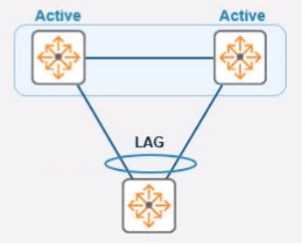
Refer to the exhibit. HP HPE6 A85 question In the given topology, a pair of Aruba CX 8325 switches are in a VSX stack using the active gateway What is the nature and behavior of the Virtual IP for the VSX pair if clients are connected to the access switch using VSX as the default gateway?
Options
33 comments in the community discussion
5
Had something like this in a mock. in other practice sets and option B fits since the Virtual IP is meant to float between the VSX switches if one fails. That's the whole point of active gateway in this Aruba setup: seamless failover for clients. I think this matches what the exam wants, but let me know if you see a
1
Maybe C. Since both switches participate in VSX active gateway, I'd expect the Virtual IP to be usable through both devices in steady state. Feels like a common trap, though, since failover is also important. Not totally convinced but C seemed closest at first glance. Anyone see it this way?
Q: 3
What are the main characteristics of the 6 GHz band?
Options
36 comments in the community discussion
2
Option B. pretty sure that's what the official guide stresses. Check the exam blueprint or practice tests if in doubt.
2
Option D. seen similar on practice tests and some guides. Official docs and Aruba config labs are good for this topic.
Q: 4
What is the correct command to add a static route to a class-c-network 10.2.10.0 via a gateway of 172.16.1.1?
Options
38 comments in the community discussion
2
Looks like D. The format looks fine to me for static route setup, especially if they want explicit masks. Not 100 percent though.
2
A not B. The 'ip-route' with CIDR is what ArubaOS expects, while option B looks like Cisco syntax and adds extra with the description. C and D are wrong format for Aruba, pretty sure about A but someone correct if you've seen a different syntax.
Q: 5
Which feature can network administrators use to centralized RF planning and optimization service when using an Aruba mobility master architecture?
Options
39 comments in the community discussion
5
Option C
2
C/D? Depends if they're talking about cluster-wide RF planning. If so, pretty sure it's C.
Q: 6
Which commands are used to set a default route to 10.4.5.1 on an Aruba CX switch when ln-band management using an SVl is being used?
Options
29 comments in the community discussion
6
I’m going with C here, regular static route syntax is what you need for in-band via SVI. The VRF mgmt one (option B) is only used for out-of-band management. Pretty sure that's how it works on Aruba CX, but let me know if I missed something.
5
Option C not B. This is in-band SVI, so standard static route syntax applies, B's VRF mgmt is a trap.
Q: 7
You have been asked to onboard a new Aruba 6300M in a customer deployment You are working remotely rather than on-site You have a colleague installing the switch The colleague has provided you with a remote console session to configure the edge switch You have been asked to configure a link aggregation going back to the cores using interfaces 1/1/51 and 1/1/52 The Senior Engineer of the project has asked you to configure the switch and 1Q uplink with these guidelines 1. Add VLAN 20 to the local VLAN database with name Mgmt 2. Add L3 SVl on VLAN 20 for Management using address 10 in the 10.1.1 0/24 subnet 3. Add LAG 1 using LACP mode active for the uplink 4 use vlan 20 as the native vlan on the LAG 5. Make sure the interfaces are all ON. Which configuration script will achieve the task?
Options
40 comments in the community discussion
1
I don’t think it’s B, gotta go with C. B misses 'no routing' before LACP and doesn't clearly link the interfaces to the LAG in proper Aruba style. C actually gets the sequence right: VLAN 20 with name, SVI on VLAN 20, lag config with native VLAN set, LACP active mode, and all ports enabled. Pretty sure that's what A
1
Probably C. The trap is B, since it configures a trunk but skips 'no routing' in the right place and order matters for LACP and VLAN native assignment. C checks off every guideline exactly, even if B could work in real life. Pretty sure this is what Aruba expects for onboarding configs, but let me know if you see somet
Q: 8
A network technician is using Aruba Central to troubleshoot network issues Which dashboard can be used to view and acknowledge issues when beginning the troubleshooting process?
Options
39 comments in the community discussion
5
Option A is correct here. The Alerts and Events dashboard is what you use when you want to review and acknowledge issues in Aruba Central before taking further action. Tools dashboard is more for hands-on diagnostics, so not quite what the question asks. I think A matches the intent best, but happy to see other view
1
Option A. Official guide and lab practice both mention Alerts and Events for this.
Q: 9
What are two advantages of a UXl? (Select two.)
Options
48 comments in the community discussion
2
Agree with C and E here. UXI's main advantages are acting like a client (C) and checking real app performance like HTTP or Office 365 (E). D is more for dedicated coverage tools, not what UXI usually does. Pretty confident but open if I've missed anything.
2
C vs D, but pretty sure it's C and E. UXI is designed to act like a user client and test apps from the user's perspective, not just check coverage. Unless they specifically mean coverage mapping, I'd stick with C and E for this one.
Q: 10
What does WPA3-Personal use as the source to generate a different Pairwise Master Key (PMK) each time a station connects to the wireless network?
Options
35 comments in the community discussion
7
Option C SAE is what WPA3-Personal relies on for unique PMKs each connection. Pretty sure this is correct.
2
C or A, but I'm leaning C. The source of PMK generation in WPA3-Personal is the SAE handshake (option C), since that's the protocol that does it each time a client connects-session data like MACs and nonces are just inputs to that exchange. If they were asking about what info is used, A would be right, but they're aski
Q: 11
Where are wireless client roaming decisions made?
Options
12 comments in the community discussion
1
Always confused me at first too. It's A for this one.
1
C/D? I always thought the APs talk to each other and sort out roaming, especially with newer Aruba gear. Central seems like it could be involved with decision making too. Not totally convinced it's just the client deciding here, so maybe C or D.
Q: 12
When would you bond multiple 20MHz wide 802.11 channels?
Options
17 comments in the community discussion
1
Bonding multiple 20MHz channels is really just for more throughput between AP and client, not antenna gain or redundancy. B fits. Pretty sure about this but open if someone has a different take on how antennas tie in.
1
B tbh, saw a similar question in some exam reports. Channel bonding boosts throughput by making more bandwidth available between client and AP. Pretty sure that's what they're getting at here.
Q: 13
Which authentication does Aruba's Captive Portal use?
Options
19 comments in the community discussion
3
A. Had something like this in a mock, Aruba captive portal does Layer 3 authentication since it intercepts HTTP after association. Not Layer 2 like MAC auth and not 802.1x. Pretty standard for captive portals.
1
Its D here, since the user actually connects before hitting the portal so I was thinking Layer 2. But maybe that's a trap, I'm not completely sure.
Q: 14

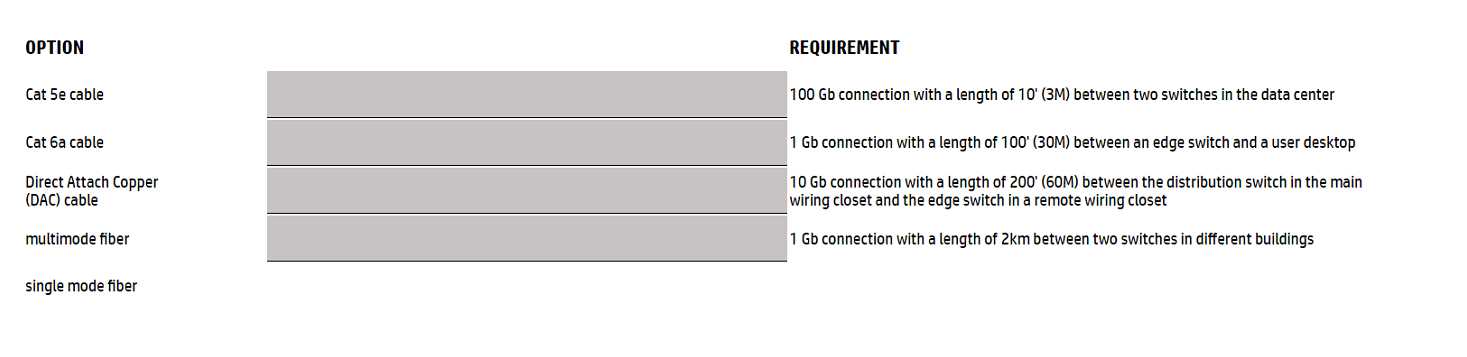
DRAG DROP Match the most cost-effective option for cabling each requirement. (All lengths indicate total cable length including patch cable(s), service loops, etc. where used.) HP HPE6 A85 question

Drag & Drop
18 comments in the community discussion
6
100Gb 3M = single mode fiber, 1Gb 100' = Cat 6a, 10Gb 200' = DAC, 1Gb 2km = multimode fiber. I don’t think DAC is valid for the longer run since that’s way past its limit, and single mode at short range is often cheaper at high speeds than multi or fancy copper in enterprise gear. Trap here is thinking DAC for the s
5
100Gb 3M = single mode fiber, 1Gb 100' = Cat 6a, 10Gb 200' = DAC, 1Gb 2km = multimode fiber
Q: 15

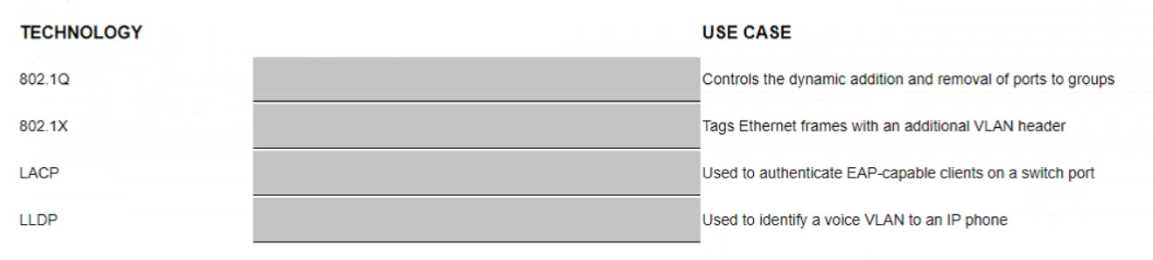
DRAG DROP Match the switching technology with the appropriate use case. HP HPE6 A85 question

Drag & Drop
12 comments in the community discussion
9
Controls the dynamic addition and removal of ports to groups: LACP, Tags Ethernet frames with an additional VLAN header: 802.1Q, Used to authenticate EAP-capable clients on a switch port: 802.1X, Used to identify a voice VLAN to an IP phone: LLDP.These acronyms get tossed around so much but on actual config, it
5
LACP -> dynamic port group, 802.1Q -> VLAN tag, 802.1X -> EAP auth, LLDP -> voice VLAN. I don’t think 802.1Q fits for the phone piece, that’s the trap in practice sets.
Q: 16

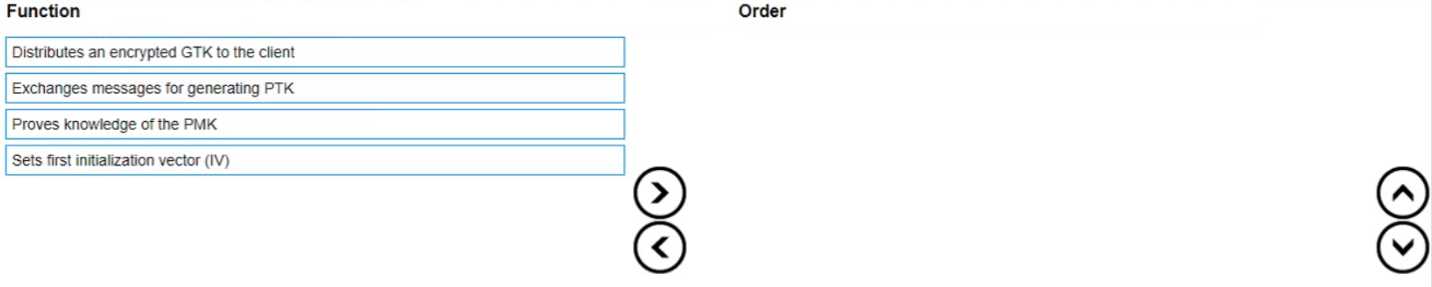
DRAG DROP List the WPA 4-Way Handshake functions in the correct order. HP HPE6 A85 question

Drag & Drop
16 comments in the community discussion
5
Proves knowledge of the PMK → Exchanges messages for PTK → Distributes encrypted GTK → Sets IV. That's the typical WPA 4-way handshake flow from Aruba guides and CWNP material. Some mix up PTK exchange before proving PMK due to how Message 1/2 are labeled, but proving PMK actually kicks everything off. I think this
5
Yeah this matches what I've mostly seen in study guides. The correct order should be: Proves knowledge of the PMK, Exchanges messages for generating PTK, Distributes encrypted GTK to the client, then Sets first initialization vector (IV). Pretty sure that's how the WPA handshake logic flows. If anyone has seen a var
Q: 17

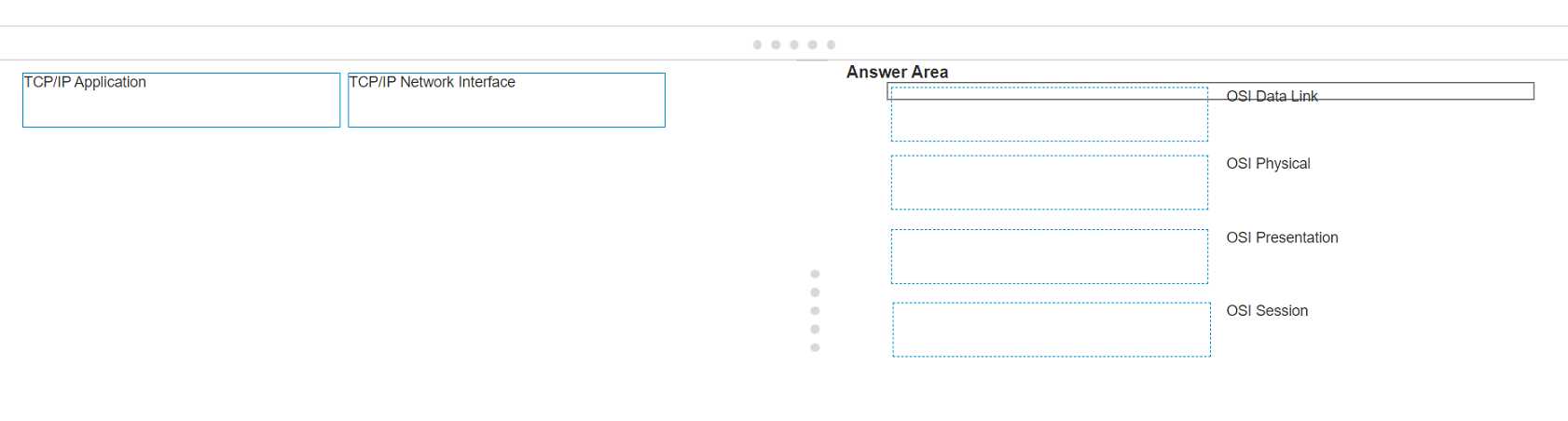
DRAG DROP Match the Open Systems Interconnection (OSI) layer with its comparable member of the TCP/IP stack. (Options may be used more than once.) HP HPE6 A85 question

Drag & Drop
13 comments in the community discussion
8
OSI Data Link and Physical map to TCP/IP Network Interface, Presentation and Session go with TCP/IP Application. That's the standard mapping.
6
Always see Data Link and Physical paired with Network Interface, while Presentation and Session map to Application layer. That's the classic comparison-no Transport in this question. Open for corrections if anyone sees it differently.
Q: 18

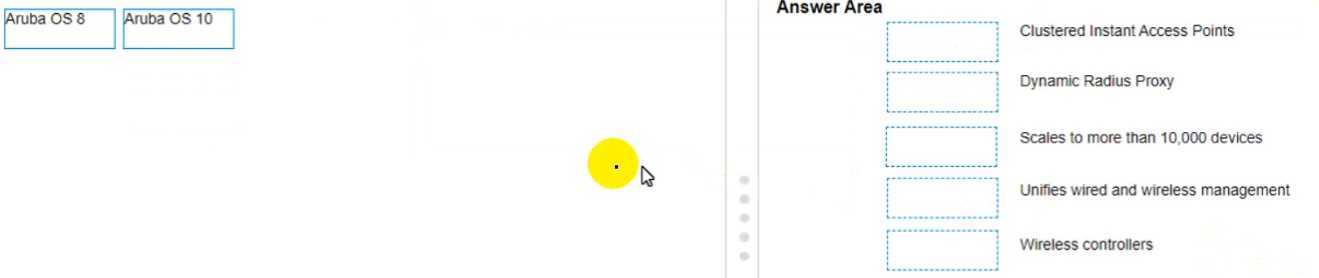
DRAG DROP Match the feature to the Aruba OS version (Matches may be used more than once.) HP HPE6 A85 question

Drag & Drop
11 comments in the community discussion
9
Looks like only "Scales to more than 10,000 devices" goes under Aruba OS 10, rest (Clustered Instant APs, Dynamic Radius Proxy, Unifies wired and wireless management, Wireless controllers) are with Aruba OS 8. Saw a similar question and this mapping flips if you count unified management in both versions but the image s
5
Clustered Instant APs, Dynamic Radius Proxy, Unifies wired and wireless management, Wireless controllers map to OS 8, only Scales to more than 10,000 devices goes with OS 10. Saw a similar question in another practice set-trap is thinking unified mgmt means OS 10 by default. I think this mapping is correct but open to
Q: 19

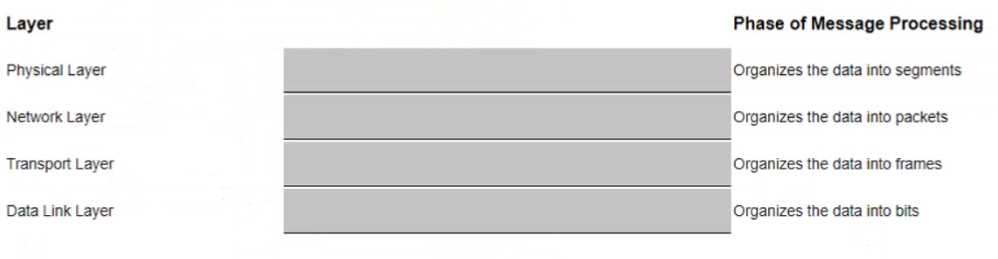
DRAG DROP Match the phase of message processing with the Open Systems interconnection (OSl) layer. HP HPE6 A85 question

Drag & Drop
14 comments in the community discussion
5
That lines up with how I learned it. Segments go with Transport Layer, packets map to Network, frames to Data Link, bits to Physical. Pretty standard OSI model logic here honestly, unless Aruba changed something up in their docs.Segments -> Transport LayerPackets -> Network LayerF
4
Yep, the usual order applies here. Transport Layer is segments, Network Layer is packets, Data Link Layer is frames, Physical Layer is bits. That's the typical OSI breakdown when talking about message processing phases. Pretty sure that's what Aruba expects too, but happy to hear if anyone has seen otherwise in othe
Q: 20

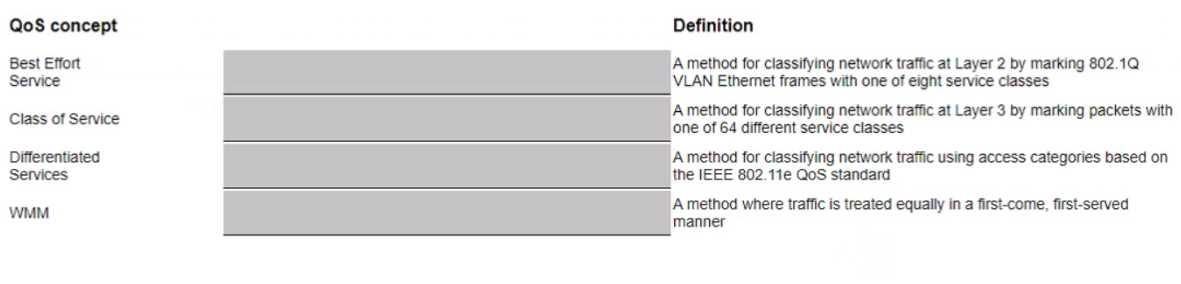
DRAG DROP Match the appropriate QoS concept with its definition. HP HPE6 A85 question

Drag & Drop
10 comments in the community discussion
2
Best Effort Service = first-come, first-served; Class of Service = Layer 2, 802.1Q marking; Differentiated Services = Layer 3, DSCP; WMM = IEEE 802.11e wireless categories. Matches make sense based on where each operates.
1
I don't think mapping Differentiated Services to Layer 2 (802.1Q VLAN) is right, since DSCP is Layer 3. Trap is confusing CoS and DSCP. Should be: Class of Service for Layer 2 VLAN tags, Differentiated Services for Layer 3 DSCP, WMM for 802.11e Wi-Fi, Best Effort for equal treatment. Correct me if I'm missing someth
Question 1 of 20

Premium Access Includes

  • ✓Quiz Simulator
  • ✓Exam Mode
  • ✓Progress Tracking
  • ✓Question Saving
  • ✓Flash Cards
  • ✓Drag & Drops
  • ✓3 Months Access
  • ✓PDF Downloads
Get Premium Access
Scroll to Top

FLASH OFFER

Days
Hours
Minutes
Seconds

avail 10% DISCOUNT on YOUR PURCHASE