Free OGEA-103 Practice Test Questions and Answers (2026)

View Mode
Q: 1
What are the following activities part of? . Risk classification . Risk identification . Initial risk assessment
Options
39 comments in the community discussion
6
Option D
6
Option D here. Had something like this in a mock, and those three activities always came up under risk management, not a specific ADM phase. Pretty confident but let me know if you see it differently.
Q: 2
Consider the following statement. According to the TOGAF standard, a governed approach of a particular deliverable will ensure adherence to the principles, standards, and requirements of the existing or developing architectures. Which deliverable does this refer to?
Options
41 comments in the community discussion
5
C . The contract is what TOGAF calls the governed deliverable, D is tricky but not governance-focused.
5
C . D is tempting but only the contract is explicitly defined as governed in TOGAF wording, not the definition doc.
Q: 3
You are working as an Enterprise Architect within an Enterprise Architecture (EA) team at a large government agency with multiple divisions. The agency has a well-established EA practice and follows the TOGAF standard as its method for architecture development. The government has mandated that the agency prepare for an "AI-first" world. The agency wants to determine the impact and role of AI in its future services. The CIO has approved a Request for Architecture Work to explore the use of AI in services. Some leaders are concerned about reliance on AI, security, and employees’ need to acquire new skills. The EA team leader seeks suggestions on managing the risks associated with a new architecture for the AI-first project. Based on the TOGAF standard, which of the following is the best answer?
Options
42 comments in the community discussion
6
A. since B’s Communication Plan isn’t where TOGAF tracks risks. Pretty sure A is what the exam wants, agree?
3
A. That's the usual TOGAF step, risks in Vision and Requirements. Not 100 percent sure, but it's what I've always seen.
Q: 4
Complete the sentence. When considering agile development, Architecture to Support Portfolio will identify what products the Enterprise needs, the boundary of the products, and what constraints a product owner has; this defines the Enterprise's
Options
32 comments in the community discussion
5
Option C is the fit here. D is tempting since operating model sounds 'big picture', but agile talk about product boundaries and constraints usually means backlog. Pretty sure C, but if I missed a subtlety let me know.
2
Makes sense to pick C here, backlog lines up with agile product owner constraints.
Q: 5
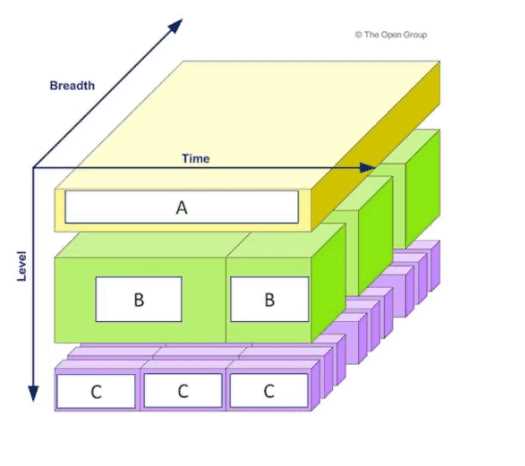
Consider the diagram showing a classification model for Architecture Landscapes. The Open Group OGEA 103 question What are the items labelled A, B and C?
Options
31 comments in the community discussion
2
D fits best here. The TOGAF architecture landscape model labels those levels as Strategic, Segment, and Capability Architecture, not capability itself. Option C is a common mix-up since capabilities sound similar, but I’m pretty sure it stays with architecture for the official framework. Feel free to disagree if you’ve
2
Option D matches the TOGAF landscape model-enterprise strategic, segment, and capability architecture layers. C sounds logical at first since it covers capabilities but the question asks about architecture specifically. Pretty sure D is right, unless I'm missing some diagram nuance. Agree?
Q: 6
What does the TOGAF ADM recommend for use in developing an Architecture Vision document?
Options
41 comments in the community discussion
4
Option D here. Business scenarios are specifically mentioned in ADM Phase A for crafting the Architecture Vision. Principles (B) steer things overall, but TOGAF calls out D when you're actually developing the doc. Pretty sure that's what the exam wants, but open to counter points.
1
D imo. Business scenarios are actually called out in Phase A of the ADM for building the Architecture Vision doc. Principles (B) come up, but they're more about guidance, not direct development. Pretty sure TOGAF expects D here, but if anyone disagrees let me know.
Q: 7
Consider the following statements 1 A whole corporation or a division of a corporation 2 A government agency or a single government department 3 Partnerships and alliances of businesses working together such as a consortium or supply chain What are those examples of according to the TOGAF Standard?
Options
38 comments in the community discussion
6
A. That's what TOGAF defines as enterprises, covers all those scenarios. Organization is broader in plain English but not per the standard.
4
Option A fits since TOGAF uses "enterprise" for all those scopes, not just normal organizations. The standard treats divisions, agencies, and even business consortia as types of enterprises under its architecture lens. C is tempting but doesn't capture the broader scope that TOGAF defines. Pretty sure it's A, but op
Q: 8
Consider the following chart: Which important concept for Enterprise Architecture Practitioners does it illustrate?
Options
37 comments in the community discussion
4
C. not D. Saw a similar chart on official practice, all ADM phases sequenced. Official guide explains this well.
3
Option C Had something like this in a mock, ADM phases are meant to be sequenced not all run together.
Q: 9
Exhibit Consider the illustration showing an architecture development cycle Which description matches the phase of the ADM labeled as item 2?
Options
41 comments in the community discussion
6
Option D lines up with what I remember from exam reports, since Implementation Governance in ADM is about overseeing implementation and making sure it sticks to the architecture. Not 100% but that's the phase described here. Others agree?
4
D . Implementation Governance is where the architecture team provides oversight while the solution gets built, which lines up with what's described for item 2. Not totally sure if the diagram matches every ADM version, but D feels right.
Q: 10
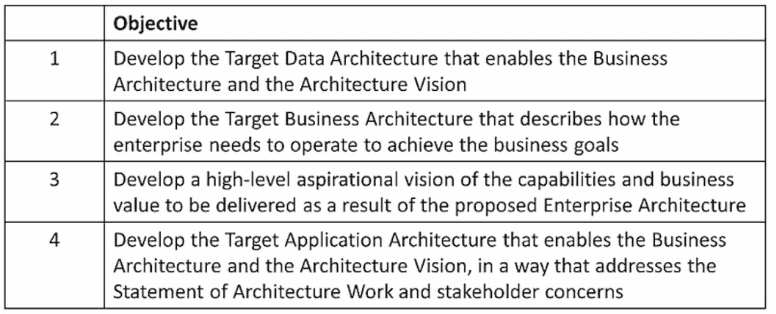
Consider the following ADM phases objectives. The Open Group OGEA 103 question Which phase does each objective match?
Options
44 comments in the community discussion
1
Its A. Both Data and Application Architecture are under Phase C in ADM, not D like some think. Could be wrong but I've always seen it that way in TOGAF materials.
1
A tbh, I've seen similar logic in official guides and practice tests.
Q: 11
Which of the following statements about architecture partitioning is correct?
Options
17 comments in the community discussion
3
Option A looks right since partitioning is all about breaking down the enterprise architecture to keep it manageable. The other options mix up partitions with levels or org structure, which isn't the case. Pretty sure A is what TOGAF wants here.
1
B not A. Partitions aren't the same as architecture levels, so A makes sense here.
Q: 12
Please read this scenario prior to answering the question You are working as an Enterprise Architect at a large supermarket. The company runs many retail stores, as well as an online grocery shop. Many of the stores used to remain open 24/7, but the number has decreased in recent years. Instead, they now focus on fulfilling online orders during the night. The company has a mature Enterprise Architecture (EA) practice and uses the TOGAF standard for its architecture development method. The EA practice is involved in all aspects of the business, with oversight provided by an Architecture Board with representatives from different parts of the business. The EA program is sponsored by the Chief Information Officer (CIO). Each store uses a standard method to track sales and inventory. This involves sending accurate timely sales data to a central Al-based inventory management system that can predict demand, adjust stock levels and automate reordering. The central inventory management system is housed at the company's central data center. The company has bought a major rival. The Chief Executive Officer believes that a merger will enable growth through combined offerings and cost savings. The decision has been taken to fully integrate the two organizations, including merging retail operations and systems. This means that duplicated systems will be replaced with one standard retail management system. Also, the company will reduce the number of applications that are used. The CIO expects significant savings will be achieved by implementing these changes across the newly merged company. One improvement that the rival has successfully implemented is the use of hand-held devices within stores, for both customers and staff. This has increased both customer and staff employee satisfaction due to the time savings this has brought. The CIO has given the go-ahead to roll out the devices in all stores but has stated that training on how to use the hand-held devices should be brief because there are a lot of employees, many of whom are part-time. The Request for Architecture Work to oversee the merger has been approved. The project has been scoped and you have been assigned to work on it. Your role includes managing the architecture for the retail stores. Refer to the scenario You have been asked to confirm the most relevant architecture principles for the transformation. Based on the TOGAF Standard, which of the following is the best answer? [Note: The sequence of the principles listed in each answer does not matter. You should assume the company follows the set of principles that are provided in the TOGAF Standard, ADM Techniques, Architecture Principles chapter. You may need to refer to section 2.6 located in ADM Techniques within the reference text to answer this question.]
Options
16 comments in the community discussion
1
I see why some would pick D because of "Ease of Use" for the handhelds, but considering this is a full enterprise transformation from the merger, A makes more sense. It covers maximizing value and standardizing apps, which TOGAF usually pushes for big integration work. Not 100% sure though, maybe there's a case for
1
Its A. D is tempting because of "ease of use," but that's a trap since the merger and consolidation focus leans on maximizing benefit and common use apps. Disagree if you read section 2.6 differently.
Q: 13
Which statement about Requirements Management is most correct?
Options
12 comments in the community discussion
5
Option D This matches TOGAF guidance, centralizing both requirements and stakeholders in ADM.
2
Not convinced C is right, since Requirements Management isn't actually a phase step itself. Why not D here?
Q: 14
In which phase of the ADM cycle do building blocks become implementation-specific?
Options
15 comments in the community discussion
5
Option D, since Phase E is where the architecture gets linked to actual solutions and products. The official guide covers this ADM step pretty clearly. Pretty sure that's what the exam expects-see the TOGAF docs if you want extra confirmation.
5
D . In Phase E (Opportunities and Solutions), that's when you actually map building blocks to real-world products and technologies. Earlier phases keep things abstract or logical, but Phase E is where specifics get nailed down. Pretty sure about this, unless I'm mixing up the ADM flow.
Q: 15
Which of the following best summarizes the purpose of Enterprise Architecture?
Options
15 comments in the community discussion
1
C makes sense to me because enterprise architecture often means putting controls around big changes, like major IT transformations or reorganizations. I saw a similar question in practice tests that pushed for C as the main role. Not 100% sure, open to corrections if I'm missing something.
1
Official study guides and The Open Group sample questions both stick with B.
Q: 16
Scenario You are working as an Enterprise Architect within an Enterprise Architecture (EA) team at a global company that sells consumer products. The company produces many products that buyers use and enjoy. The company has announced a major change to its products that will occur over a four-year period. This change includes the introduction of digital products and services. An architecture to support this strategy has been finished, along with a roadmap for a set of projects to implement this significant change. This will be a cross-functional effort between the product design and software teams. It is planned to be developed in phases. The company faces a challenge in presenting and providing access to different services through its products and digital platforms while ensuring compliance with data privacy laws. In some countries and regions, the data residency requirements mean that the company has to store certain data within the region where it is collected. As a result, the company’s application portfolio and infrastructure must connect with various cloud services and data repositories in different countries. The EA team has inherited the architecture used by the current products, some of which can be carried over to the new products. The EA team has started to define which parts of the architecture to carry forward. Enough of the Business Architecture has been defined so that work can commence on the Information Systems and Technology Architectures. Those architectures need to be defined to support the key digital services that the company plans to provide. The company uses the TOGAF Standard as the foundation for its Enterprise Architecture framework, and architecture development follows the purpose-based EA Capability model outlined in the TOGAF Series Guide: A Practitioner’s Approach to Developing Enterprise Architecture Following the TOGAF ADM. The EA team reports to the Chief Information Officer (CIO), who oversees the program. You have been asked how to decide and organize the work to deliver the requested architectures. Based on the TOGAF standard, which of the following is the best answer?
Options
18 comments in the community discussion
4
Option A If the Vision and Business Architecture are set, you don't go back to Phase A or start researching from scratch. Pretty sure TOGAF puts next steps on block analysis and feasibility.
4
A. That matches the TOGAF flow after Biz Architecture is set, since it's about reviewing dependencies and analyzing candidate building blocks.
Q: 17
Exhibit Consider the illustration showing an architecture development cycle Which description matches the phase of the ADM labeled as item 1?
Options
10 comments in the community discussion
6
C . In TOGAF ADM diagrams, item 1 usually points at that central cycle which is continuous requirements management. The other answers (like D) are more about change control or governance steps that happen later in the process. Pretty sure C matches the intent but open if someone interprets the diagram differently.
1
C . Item 1 is always the tricky one in ADM diagrams since it isn't a "phase" but the ongoing Requirements Management process. The other options talk about implementation and change, which are handled in later phases. Saw similar question in practice sets.
Q: 18
Please read this scenario prior to answering the question Your role is that of a consultant to the Lead Enterprise Architect in a multinational automotive manufacturer. The company has a corporate strategy that focuses on electrification of its portfolio, and it has invested heavily in a new shared car platform to use across all its brands. The company has four manufacturing facilities, one in North America, two in Europe, and one in Asia. A challenge that the company is facing is to scale up the number of vehicles coming off the production line to meet customer demand, while maintaining quality. There are significant supply chain shortages for electronic components, which are impacting production. In response to this the company has taken on new suppliers and has also taken design and production of the battery pack in-house. The company has a mature Enterprise Architecture practice. The TOGAF standard is used for developing the process and systems used to design, manufacture, and test the battery pack. The Chief Information Officer and the Chief Operating Officer co-sponsor the Enterprise Architecture program. As part of putting the new battery pack into production, adjustments to the assembly processes need to be made. A pilot project has been completed at a single location. The Chief Engineer, sponsor of the activity, and the Architecture Board have approved the plan for implementation and migration at each plant. Draft Architecture Contracts have been developed that detail the work needed to implement and deploy the new processes for each location. The company mixes internal teams with a few third- party contractors at the locations. The Chief Engineer has expressed concern that the deployment will not be consistent and of acceptable quality. Refer to the scenario The Lead Enterprise Architect has asked you to review the draft Architecture Contracts and recommend the best approach to address the Chief Engineer's concern. Based on the TOGAF Standard, which of the following is the best answer?
Options
19 comments in the community discussion
1
Probably C. It's the only one that includes compliance reviews and legally binding contracts for third parties. Fits TOGAF pretty well here.
1
C makes the most sense since it adds compliance reviews and covers objectives, plus legal enforceability for third parties. That aligns well with TOGAF's governance focus. Pretty sure that's what they're after here, but let me know if you see it differently.
Q: 19
Complete the sentence The TOGAF standard covers the development of four architecture domains. Business. Data, Technology and__________________.
Options
14 comments in the community discussion
1
D , Application is what the classic TOGAF architecture domains list. Capability is part of capability-based planning, but it's not one of the main four in the standard. Could be wrong if they're using some new extension though.
1
I don’t think Application fits here. C, Capability, since TOGAF has been focusing more on capability-based planning. If they’re asking about recent extensions, Capability might be what they want-depends how up to date the question is.
Q: 20
Complete the following sentence. In the ADM documents which are under development and have not undergone any formal review and approval process are_______________.
Options
15 comments in the community discussion
1
A makes sense here, since "draft" is the standard TOGAF term for in-progress docs that haven't hit a formal review yet. "Version 0.1" or other numbering usually comes after it's more official I think. Anyone see it work differently?
1
A tbh. ADM calls them 'draft' until they're reviewed. I've seen similar wording in the official guide and some practice questions.
Question 1 of 20

Premium Access Includes

  • Quiz Simulator
  • Exam Mode
  • Progress Tracking
  • Question Saving
  • Flash Cards
  • Drag & Drops
  • 3 Months Access
  • PDF Downloads
Get Premium Access
Scroll to Top

FLASH OFFER

Days
Hours
Minutes
Seconds

avail $6 DISCOUNT on YOUR PURCHASE