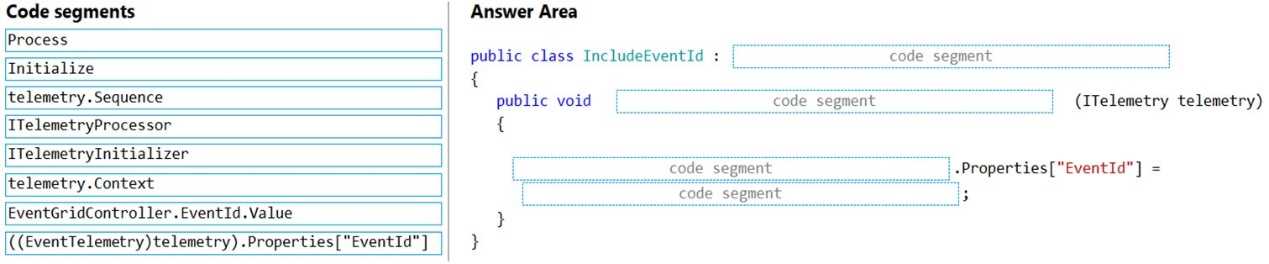
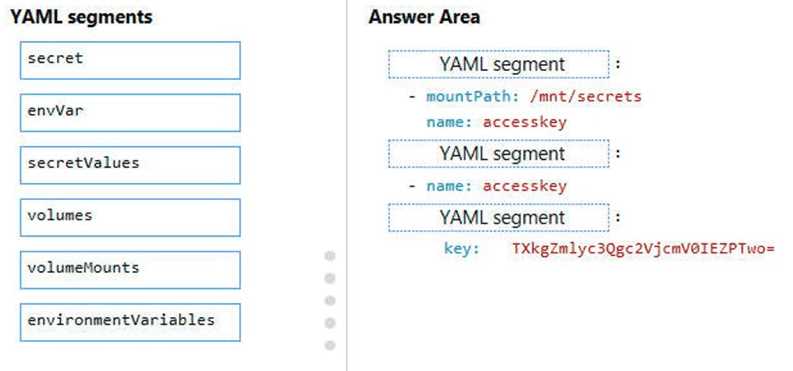
DRAG DROP You need to add YAML markup at line CS17 to ensure that the ContentUploadService can access Azure Storage access keys. How should you complete the YAML markup? To answer, drag the appropriate YAML segments to the correct locations. Each YAML segment may be used once, more than once, or not at all. You may need to drag the split bar between panes or scroll to view content. NOTE: Each correct selection is worth one point.
Free AZ-204 Practice Test Questions and Answers (2026)
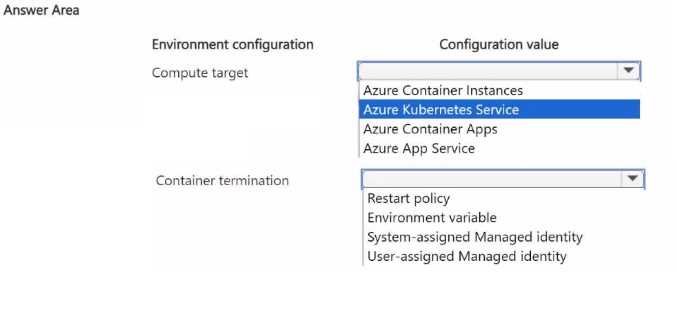
HOTSPOT You develop a Python application for image rendering. The application uses GPU resources to optimize rendering processes. You have the following requirements: • The application must be deployed to a Linux container. • The container must be stopped when the image rendering is complete.
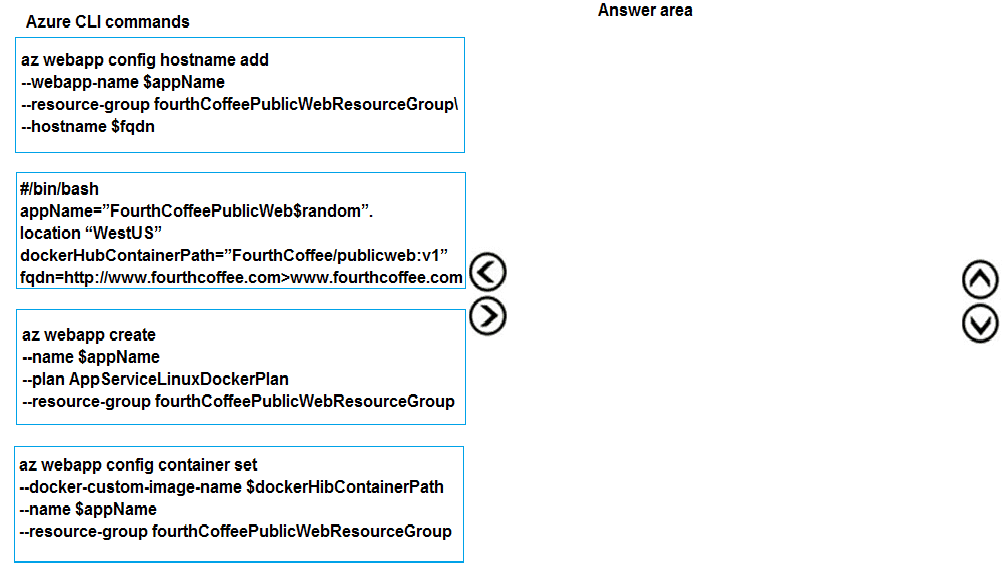
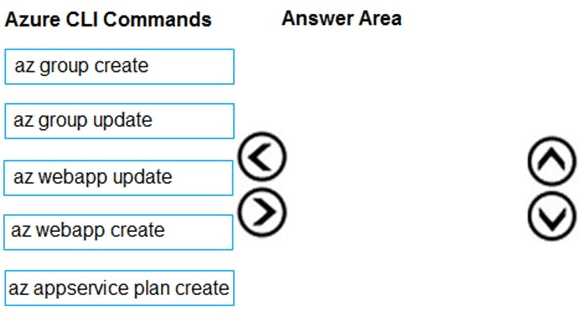
DRAG DROP Fourth Coffee has an ASP.NET Core web app that runs in Docker. The app is mapped to the www.fourthcoffee.com domain. Fourth Coffee is migrating this application to Azure. You need to provision an App Service Web App to host this docker image and map the custom domain to the App Service web app. A resource group named FourthCoffeePublicWebResourceGroup has been created in the WestUS region that contains an App Service Plan named AppServiceLinuxDockerPlan. Which order should the CLI commands be used to develop the solution? To answer, move all of the Azure CLI command from the list of commands to the answer area and arrange them in the correct order.
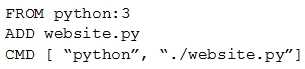
HOTSPOT You are preparing to deploy a Python website to an Azure Web App using a container. The solution will use multiple containers in the same container group. The Dockerfile that builds the container is as follows: 

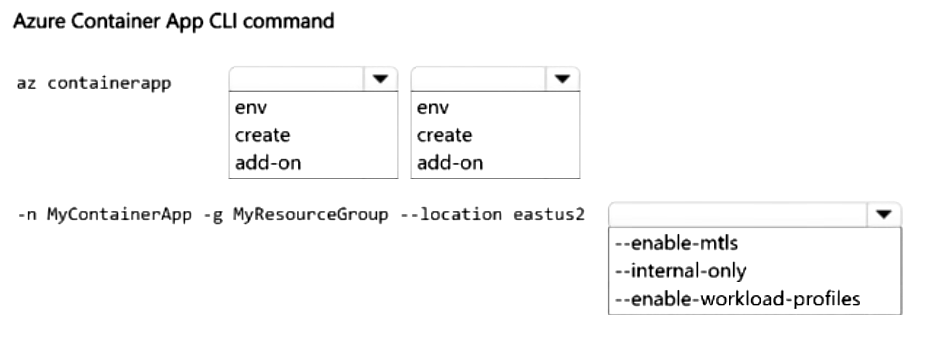
HOTSPOT You are developing a microservices-based application that uses Azure Container Apps. The application consists of several containerized services that handle tasks, such as processing orders, managing inventory, and generating reports. You must secure the container apps All apps must reside in the same virtual network, share the same Dapr configuration, and share the same logging location. Apps must support the configuration of the amount of memory and compute resources available to containers. You need to configure the Azure Container App. How should you complete the CLI command' To answer, select the appropriate options in the answer area. NOTE: Each correct selection is worth one point.
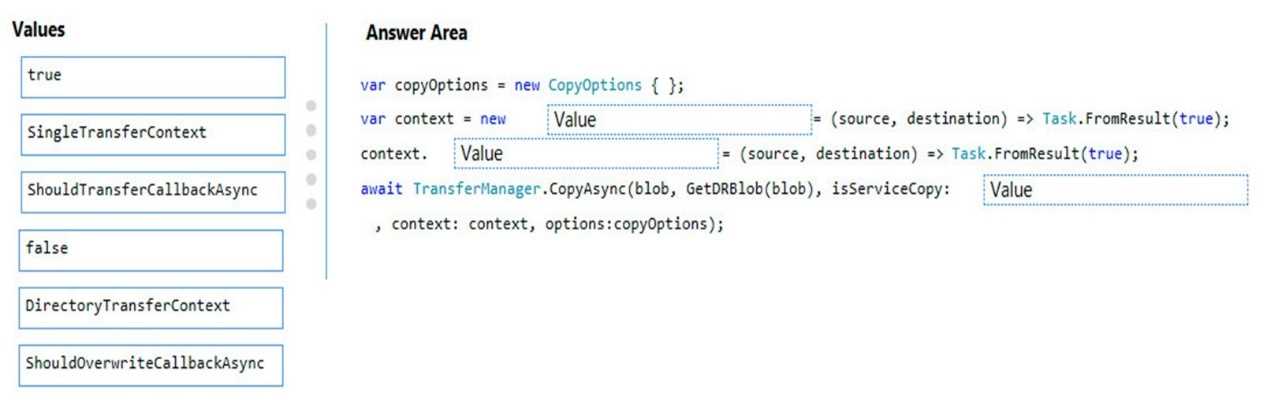
DRAG DROP You need to ensure disaster recovery requirements are met. What code should you add at line PC16? To answer, drag the appropriate code fragments to the correct locations. Each code fragment may be used once, more than once, or not at all. You may need to drag the split bar between panes or scroll to view content. NOTE: Each correct selection is worth one point.
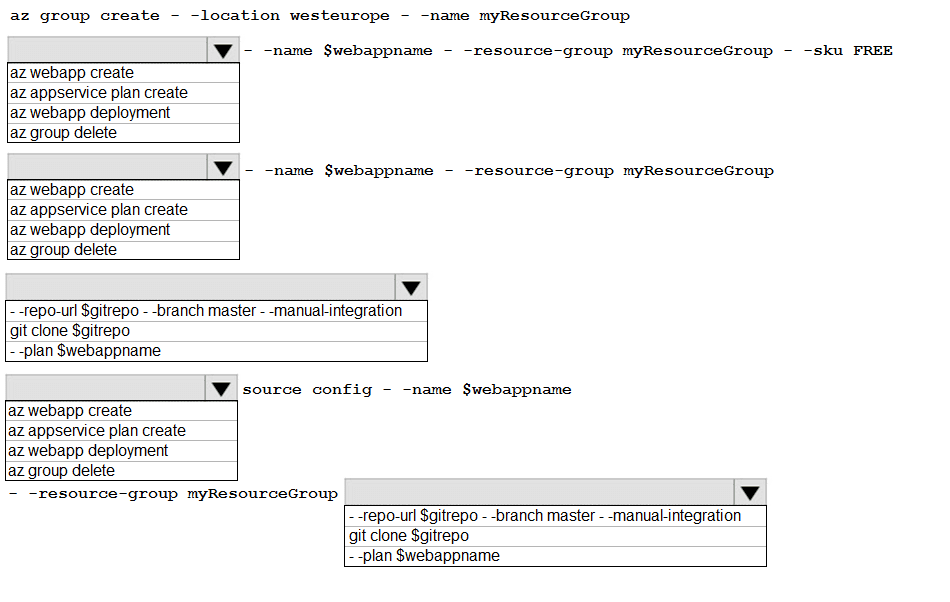
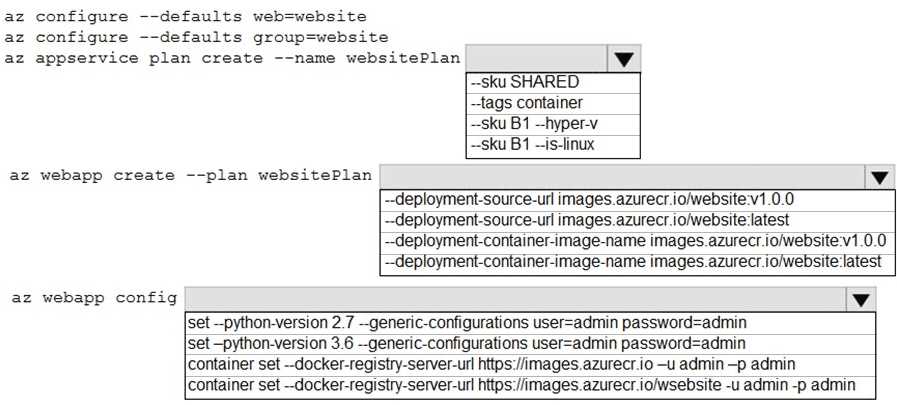
HOTSPOT You are creating a CLI script that creates an Azure web app related services in Azure App Service. The web app uses the following variables: 
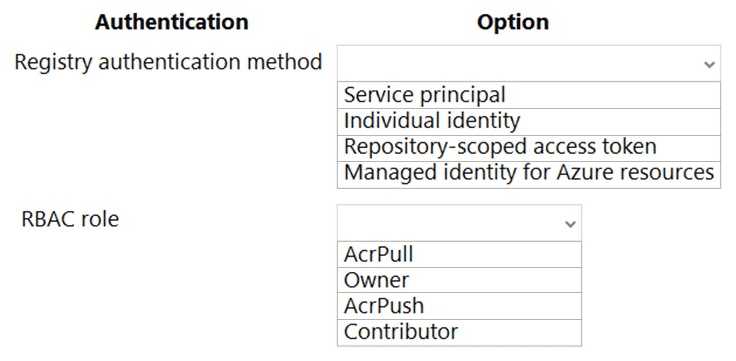
HOTSPOT You develop a containerized application. You plan to deploy the application to a new Azure Container instance by using a third-party continuous integration and continuous delivery (CI/CD) utility. The deployment must be unattended and include all application assets. The third-party utility must only be able to push and pull images from the registry. The authentication must be managed by Azure Active Directory (Azure AD). The solution must use the principle of least privilege. You need to ensure that the third-party utility can access the registry. Which authentication options should you use? To answer, select the appropriate options in the answer area. NOTE: Each correct selection is worth one point.
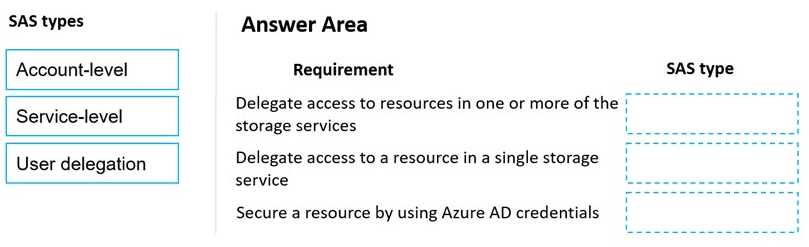
DRAG DROP An organization plans to deploy Azure storage services. You need to configure shared access signature (SAS) for granting access to Azure Storage. Which SAS types should you use? To answer, drag the appropriate SAS types to the correct requirements. Each SAS type may be used once, more than once, or not at all. You may need to drag the split bar between panes or scroll to view content. NOTE: Each correct selection is worth one point.
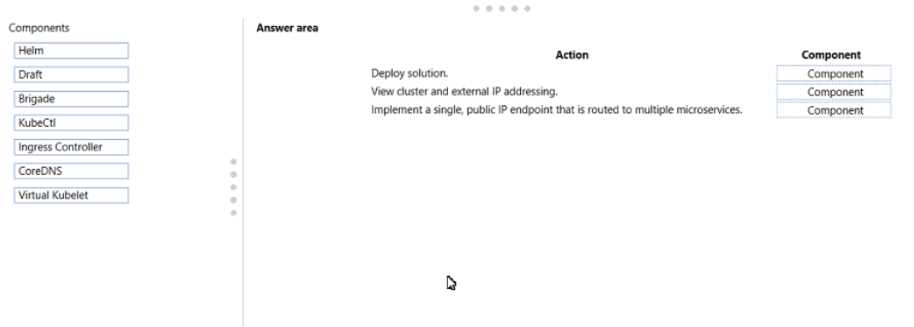
DRAG DROP You are developing a microservices solution. You plan to deploy the solution to a multinode Azure Kubernetes Service (AKS) cluster. You need to deploy a solution that includes the following features: reverse proxy capabilities configurable traffic routing TLS termination with a custom certificate Which components should you use? To answer, drag the appropriate components to the correct requirements. Each component may be used once, more than once, or not at all. You may need to drag the split bar between panes or scroll to view content. NOTE: Each correct selection is worth one point.
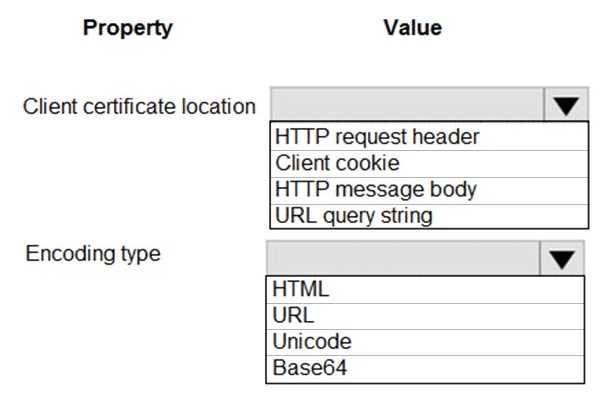
HOTSPOT You are developing an Azure Web App. You configure TLS mutual authentication for the web app. You need to validate the client certificate in the web app. To answer, select the appropriate options in the answer area. NOTE: Each correct selection is worth one point.
DRAG DROP You need to ensure that PolicyLib requirements are met. How should you complete the code segment? To answer, drag the appropriate code segments to the correct locations. Each code segment may be used once, more than once, or not at all. You may need to drag the split bar between panes or scroll to view content. NOTE: Each correct selection is worth one point.

DRAG DROP You are developing a Docker/Go using Azure App Service Web App for Containers. You plan to run the container in an App Service on Linux. You identify a Docker container image to use. None of your current resource groups reside in a location that supports Linux. You must minimize the number of resource groups required. You need to create the application and perform an initial deployment. Which three Azure CLI commands should you use to develop the solution? To answer, move the appropriate commands from the list of commands to the answer area and arrange them in the correct order.
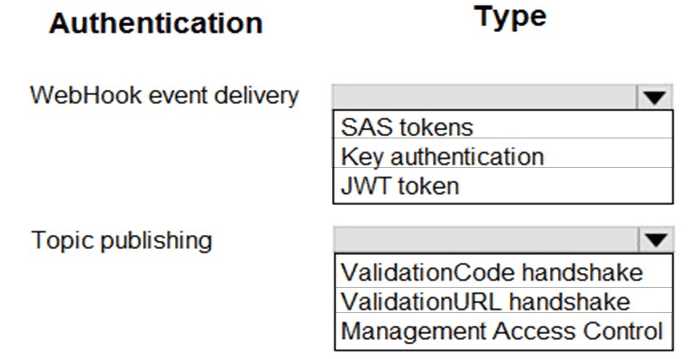
HOTSPOT You are creating an app that uses Event Grid to connect with other services. Your app's event data will be sent to a serverless function that checks compliance. This function is maintained by your company. You write a new event subscription at the scope of your resource. The event must be invalidated after a specific period of time. You need to configure Event Grid to ensure security. What should you implement? To answer, select the appropriate options in [he answer area. NOTE: Each correct selection is worth one point
What's covered in this practice questions set
1: Develop Azure compute solutions · 9 questions
📖 About this Domain
This domain, 'Develop Azure compute solutions', is the most heavily weighted section of the AZ-204 exam, accounting for 25-30% of the questions. It focuses on your ability to implement and deploy various compute options, which are the fundamental building blocks for applications in Azure. You will be tested on your practical skills in creating, configuring, and deploying solutions using services like Azure App Service, Azure Functions, and containerized solutions. This domain reflects the real-world tasks of an Azure developer, who must choose the appropriate compute service for a given workload and then implement it effectively.
🎓 What You Will Learn
- How to implement containerized solutions by creating and managing container images for solutions, publishing them to Azure Container Registry, and running them using Azure Container Instances and Azure Container Apps.
- The process of creating and configuring Azure App Service Web Apps, including enabling diagnostics logging, deploying code, and managing settings like Transport Layer Security (TLS) and API configurations.
- Techniques for implementing autoscaling rules for App Service Web Apps, based on both schedules and operational or system metrics, to ensure your application can handle varying loads efficiently.
- The fundamentals of implementing Azure Functions, which are a key component of serverless computing on Azure, allowing you to run small pieces of code in response to triggers.
- How to implement input and output bindings for Azure Functions to seamlessly connect your functions to other Azure services without writing extensive boilerplate code.
- The different types of function triggers, such as those based on data operations, timers, and webhooks, and how to implement them to execute your function code.
- The concepts and implementation of Azure Durable Functions, which allow you to write stateful functions in a serverless compute environment for orchestrating complex, long-running workflows.
🛠️ Skills You Will Build
- The ability to provision and configure virtual machines (VMs), which are a foundational Infrastructure-as-a-Service (IaaS) offering, giving you full control over the operating system and hardware.
- Proficiency in creating Azure Resource Manager (ARM) templates to define and deploy your infrastructure as code, ensuring consistent and repeatable deployments of your Azure resources.
- The skill to create container images for your solutions using tools like Docker and publish those images to a private repository in Azure Container Registry for secure storage and management.
- The capability to run containers on-demand in a serverless environment using Azure Container Instances, which is ideal for simple applications, task automation, and build jobs.
- The ability to create and manage Azure App Service Web Apps, a platform for building and deploying scalable web applications and APIs without managing the underlying infrastructure.
- Expertise in configuring deployment slots for Azure App Service Web Apps, enabling you to stage and test new versions of your application before swapping them into production with zero downtime.
- The skill to develop and implement Azure Functions with various triggers and bindings, enabling you to build event-driven, serverless applications that respond to a wide range of events across Azure.
💡 Top Tips to Prepare
- Focus a significant portion of your study time on this domain as it carries the most weight in the exam.
- Gain hands-on experience with deploying and managing containerized applications using Azure Container Instances and Azure Container Apps.
- Master the configuration of Azure App Service, including deployment slots, custom domains, and autoscaling rules.
- Understand the different types of Azure Function triggers and bindings and when to use each one in your serverless applications.
3: Implement Azure security · 7 questions
📖 About this Domain
The 'Implement Azure security' domain accounts for 15-20% of the AZ-204 exam and is a crucial topic for any cloud developer. This section focuses on your ability to implement secure cloud solutions by leveraging Azure's identity and access management features. You will be tested on your knowledge of user and application authentication and authorization, as well as how to securely store and access application secrets. The exam will present you with scenarios where you need to choose the appropriate security mechanism to protect your applications and data.
🎓 What You Will Learn
- How to implement user authentication and authorization in your applications using the Microsoft identity platform, including Azure Active Directory (Azure AD).
- The fundamentals of modern authentication protocols like OAuth 2.0 and OpenID Connect and how to use them to secure access to your applications and APIs.
- How to implement Managed Identities for Azure resources, which provide a secure way for your applications to access other Azure services without needing to manage credentials in your code.
- The importance of securing application secrets, keys, and certificates, and how to use Azure Key Vault to store and manage them securely.
- How to develop code that can securely retrieve secrets, keys, and certificates from Azure Key Vault at runtime.
- The process of creating and implementing shared access signatures (SAS) to provide delegated access to resources in your Azure Storage accounts.
- Best practices for using shared access signatures, including how to create them with the appropriate permissions and expiration times to minimize security risks.
🛠️ Skills You Will Build
- The ability to integrate your applications with Azure Active Directory for user authentication and authorization, enabling single sign-on and secure access control.
- Proficiency in using the Microsoft Authentication Library (MSAL) to acquire tokens from the Microsoft identity platform to call protected APIs.
- The skill to configure and use both system-assigned and user-assigned managed identities for your Azure resources to eliminate the need for storing credentials in your application's configuration.
- The capability to securely store and retrieve application secrets, such as connection strings and API keys, from Azure Key Vault in your application code.
- Expertise in managing access to Azure Key Vault using access policies to control which users, groups, and applications can perform operations on your secrets.
- The ability to generate shared access signatures for your Azure Storage resources with the principle of least privilege, granting only the necessary permissions for a specific task.
- The skill to implement secure data solutions by using encryption and key management features available in Azure, such as Azure Disk Encryption and Azure Storage Service Encryption.
💡 Top Tips to Prepare
- Understand the difference between authentication and authorization and how they are implemented in Azure.
- Master the concept of Managed Identities and be able to explain the benefits of using them over storing credentials in your application.
- Gain hands-on experience with Azure Key Vault, including how to create a vault, add secrets, and access them from an application.
- Be familiar with the different types of shared access signatures and when to use each one.
2: Develop for Azure storage · 2 questions
📖 About this Domain
The 'Develop for Azure storage' domain constitutes 15-20% of the AZ-204 exam and is a critical area for any Azure developer. This section assesses your ability to write code that interacts with Azure's primary storage services, focusing on Azure Blob Storage and Azure Cosmos DB. It moves beyond theoretical knowledge, requiring you to demonstrate practical skills in using the Azure SDKs to perform data operations. You will be tested on your ability to select appropriate APIs, implement partitioning schemes, and manage data consistency in your applications.
🎓 What You Will Learn
- How to develop solutions that use Azure Cosmos DB, a globally distributed, multi-model database service, and how to select the appropriate API for your specific solution's needs.
- The importance of partitioning in Azure Cosmos DB and how to implement effective partitioning schemes to ensure scalability and performance for your applications.
- How to interact with data in Azure Cosmos DB using the appropriate SDK, including performing create, read, update, and delete (CRUD) operations on containers and items.
- The different consistency levels available in Azure Cosmos DB and how to set the appropriate level for your operations to balance performance, availability, and data consistency.
- The process of creating and managing containers within Azure Cosmos DB, which are the units of scalability and throughput for your data.
- How to develop solutions that use Azure Blob Storage for storing large amounts of unstructured data, such as text or binary data.
- Techniques for setting and retrieving properties and metadata for blobs, as well as performing operations on data using the appropriate SDK for Azure Blob Storage.
🛠️ Skills You Will Build
- The ability to select the right API for your Azure Cosmos DB solution, such as the SQL API, MongoDB API, or Gremlin API, based on your data model and application requirements.
- Proficiency in designing and implementing partitioning strategies for Azure Cosmos DB to optimize performance and avoid common pitfalls like hot partitions.
- The skill to write code that efficiently interacts with Azure Cosmos DB using the .NET SDK or other supported SDKs to manage data at scale.
- The capability to configure the appropriate consistency level for your Azure Cosmos DB operations, making informed trade-offs between data consistency and latency.
- Expertise in creating and managing Azure Cosmos DB containers, including setting throughput and indexing policies to meet your application's needs.
- The ability to develop applications that leverage Azure Blob Storage for a variety of use cases, from storing user-generated content to hosting static website assets.
- The skill to implement storage policies and data lifecycle management for Azure Blob Storage to automatically transition data between different access tiers and manage its retention.
💡 Top Tips to Prepare
- Gain practical experience with the Azure Cosmos DB SDK, as the exam will likely test your knowledge of specific methods and classes.
- Thoroughly understand the different consistency levels in Azure Cosmos DB and the scenarios in which each is appropriate.
- Practice implementing data lifecycle management policies for Azure Blob Storage to optimize storage costs.
- Be prepared for scenario-based questions that require you to choose the correct storage solution and configuration based on a set of requirements.
5: Connect to and consume Azure services and third-party services · 1 questions
📖 About this Domain
The 'Connect to and consume Azure services and third-party services' domain accounts for 20-25% of the AZ-204 exam, making it a significant portion of the test. This section focuses on your ability to integrate your applications with other services, both within and outside of Azure. You will be tested on your knowledge of API Management, event-based solutions, and message-based solutions. This domain reflects the modern, distributed nature of cloud applications, where services often need to communicate with each other to perform their functions.
🎓 What You Will Learn
- How to use Azure API Management to publish, secure, and manage your APIs, providing a centralized gateway for your backend services.
- The process of creating and documenting APIs in API Management, making them easy for other developers to discover and consume.
- Techniques for configuring access to your APIs in API Management, including using policies to enforce security and usage quotas.
- How to develop event-based solutions using Azure Event Grid and Azure Event Hubs, enabling you to build reactive, event-driven architectures.
- The fundamentals of Azure Event Grid, a fully managed event routing service that allows you to connect event sources to event handlers.
- The concepts and implementation of Azure Event Hubs, a big data streaming platform and event ingestion service that can receive and process millions of events per second.
- How to develop message-based solutions using Azure Service Bus, a fully managed enterprise integration message broker that enables you to build decoupled and reliable applications.
🛠️ Skills You Will Build
- The ability to create an Azure API Management instance and import your existing APIs to be managed through the gateway.
- Proficiency in defining and applying policies in API Management to transform and protect your APIs, such as rate limiting, authentication, and authorization policies.
- The skill to create and manage products and subscriptions in API Management to control access to your APIs and monetize them.
- The capability to build applications that publish and subscribe to events using Azure Event Grid, enabling you to create loosely coupled and scalable systems.
- Expertise in developing applications that can send and receive events from Azure Event Hubs, allowing you to process high-volume event streams in real-time.
- The ability to use Azure Service Bus queues and topics to build reliable and asynchronous communication between your application components.
- The skill to implement message-based communication patterns, such as publish-subscribe and competing consumers, using Azure Service Bus to create resilient and scalable applications.
💡 Top Tips to Prepare
- Understand the key differences between Azure Event Grid, Event Hubs, and Service Bus, and the scenarios in which each service is most appropriate.
- Gain hands-on experience with Azure API Management, including creating APIs, defining policies, and managing access.
- Practice building a simple event-driven application using Azure Functions and Event Grid to solidify your understanding of the concepts.
- Be prepared for questions that require you to design a solution that integrates multiple Azure services to meet a specific set of requirements.
4: Monitor, troubleshoot, and optimize Azure solutions · 1 questions
📖 About this Domain
The 'Monitor, troubleshoot, and optimize Azure solutions' domain makes up 5-10% of the AZ-204 exam. While it is the smallest domain by weight, it covers essential skills for maintaining the health and performance of your applications in production. This section assesses your ability to use Azure's monitoring and diagnostics tools to identify and resolve issues, as well as to optimize your solutions for performance and cost. You will be tested on your practical knowledge of Application Insights, Azure Monitor, and caching strategies.
🎓 What You Will Learn
- How to use Application Insights to monitor the performance and usage of your live applications, including tracking requests, exceptions, and dependencies.
- The process of instrumenting your application code to send custom telemetry to Application Insights, providing deeper insights into your application's behavior.
- How to use Azure Monitor to collect and analyze metrics and logs from your Azure resources, giving you a unified view of the health of your entire solution.
- Techniques for troubleshooting application issues by analyzing diagnostic logs and metrics in Azure Monitor and Application Insights.
- How to implement caching in your applications to improve performance and reduce latency, including using services like Azure Cache for Redis.
- The fundamentals of content delivery networks (CDNs) and how to use Azure CDN to cache static assets closer to your users to improve load times.
- How to configure and implement autoscaling for your Azure resources to automatically adjust capacity based on demand, ensuring both performance and cost-effectiveness.
🛠️ Skills You Will Build
- The ability to integrate Application Insights into your web applications and services to gain real-time insights into their performance and usage.
- Proficiency in using the Application Insights portal to analyze telemetry data, identify performance bottlenecks, and diagnose exceptions.
- The skill to write Kusto Query Language (KQL) queries to analyze logs in Azure Monitor Log Analytics, enabling you to perform advanced troubleshooting and analysis.
- The capability to set up alerts in Azure Monitor to be notified of important events and performance issues in your applications and infrastructure.
- Expertise in implementing caching strategies in your application code, such as using an in-memory cache or a distributed cache like Azure Cache for Redis.
- The ability to configure Azure CDN to cache your application's static content and improve its global performance and availability.
- The skill to define and configure autoscaling rules for your Azure App Services and other compute resources to ensure they can handle fluctuating traffic loads efficiently.
💡 Top Tips to Prepare
- Do not underestimate this domain due to its lower weight; every question counts towards your final score.
- Gain hands-on experience with Application Insights by instrumenting a sample application and exploring the collected telemetry.
- Learn the basics of Kusto Query Language (KQL) as it is a powerful tool for analyzing logs in Azure Monitor.
- Understand the different caching options available in Azure and when to use each one to optimize your application's performance.