Free JN0-363 Practice Test Questions and Answers (2026)

View Mode
Q: 1
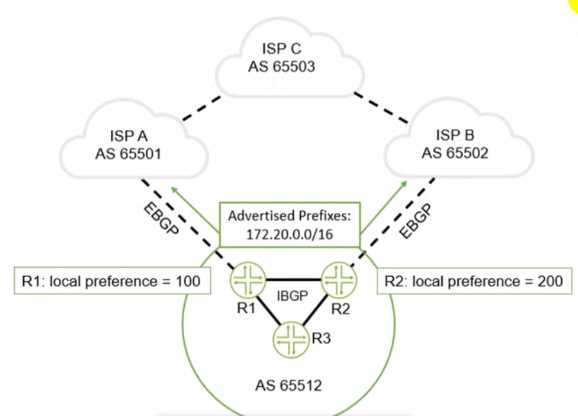
Exhibit Juniper JN0 363 question You are advertising a summary route that represents your local network (172.20.0.0716) to both ISP A and ISPB. You want to influence all traffic sent to you from ISP C to go through R2. How would you accomplish this task?
Options
43 comments in the community discussion
6
Had something just like this on my exam. The trick is to use AS path prepending from R2 so ISP C sees a longer path if coming via R1, making traffic favor the R2 route. Option C lines up with that. Anyone see it differently?
2
I thought B might work since changing the local preference to 250 on R1 would prioritize that path, but I realize now that's only effective inside your own AS. If you want ISP C to pick R2, local preference on R1 won't actually influence their decision. Still, I assumed increasing it would somehow help influence ups
Q: 2
You are implementing traffic engineering in your MPLS network. You must ensure that the MPLS routes are used to traverse your network. Your solution should not affect IGP routes in your route tables. In this scenario, which traffic engineering setting will accomplish this behavior?
Options
41 comments in the community discussion
6
Option B
3
B. Keeps MPLS in play and leaves IGP untouched, which matches the requirement.
Q: 3
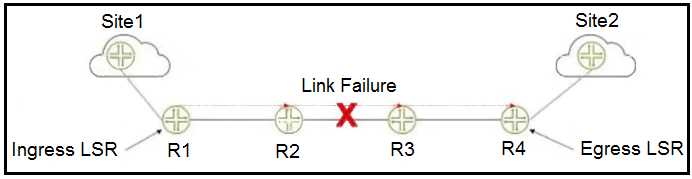
Click the Exhibit button. Juniper JN0 363 question Referring to the exhibit, you have an established RSVP LSP between R1 and R4 when you experience a link failure between R2 and R3. Which two statements are correct? (Choose two.)
Options
34 comments in the community discussion
2
Makes sense to me, C.
Kinda tricky one, but I'd say C. From what I remember, PathTear can go upstream from R2 to R1 when the link fails, signaling to clean up the LSP state. Not 100 percent sure, someone correct me if that's off.
Q: 4
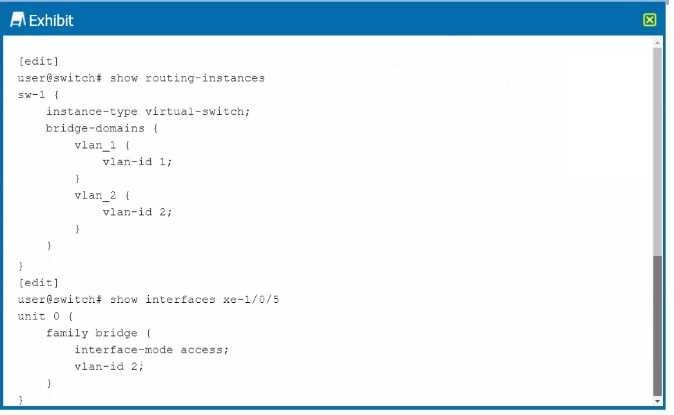
Exhibit Juniper JN0 363 question You are asked to assign interface xe-1/0/5 to a virtual switch. What must be accomplished to complete the configuration?
Options
40 comments in the community discussion
3
Option A
1
I'm pretty sure it's D here. Lots of folks pick A, but IRB config is usually required to complete VLAN-to-switch assignments.
Q: 5
Which BGP message type is used to re-advertise routes that have already been sent to a peer and acknowledged using TCP?
Options
42 comments in the community discussion
3
Option A
2
A . Only UPDATE (A) actually carries the route info, even for re-advertisements. "Refresh" is a capability not a direct message type. If they're strict about message types, it's gotta be A. Let me know if someone thinks otherwise.
Q: 6
Which BGP attribute Is used to detect touting loops?
Options
39 comments in the community discussion
5
Option A is right here. BGP uses AS path to spot loops by checking if its own AS shows up in the list when receiving a route, pretty standard for loop avoidance in inter-AS environments. If anyone's seen it handled differently, let me know.
1
Option A is correct. AS path is the main BGP attribute used to check for routing loops, as routers look for their own ASN in the path. Official guides and some practice tests cover this a lot. Pretty sure, but anyone seen different behavior on lab gear?
Q: 7
Exhibit S Exhibit LSI1 A AS 65501 ISPB AS 65502 Advertised Prefixes: 172.20.0.0/24 172.20.20.0/24 172.20.21.0/24 \ N Advertised Prefixes: 172.20.0.0/24 172.20.1.0/24 Juniper JN0 363 question Referring to the exhibit, which two statements are correct? (Choose two.)
Options
45 comments in the community discussion
1
Maybe C and D, had something like this in a mock where BGP local pref made me pick those two.
1
These Juniper questions always twist BGP basics. It's A and B.
Q: 8
What are three types of MPLS routers? (Choose three.)
Options
34 comments in the community discussion
2
ACE tbh, had something like this in a mock and those are the MPLS router types Junos expects.
1
Option ACE
Q: 9
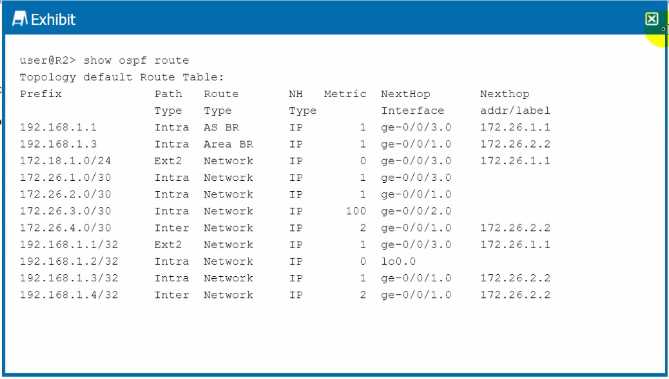
Exhibit Juniper JN0 363 question Which prefix in the output shown in the exhibit is an external prefix injected by an OSPF router?
Options
43 comments in the community discussion
3
B. I'm sticking with that. It's labeled Ext2 so matches OSPF external prefix. Pretty sure that's what matters here. Agree?
1
Seen exactly similar question in my exam, B is the external prefix flagged as Ext2. Confident that's the right pick.
Q: 10
Which OSPF database packet determines which router is in charge of the database synchronization and the transferring of LSA headers between the two systems?
Options
48 comments in the community discussion
2
D tbh, since link-state update is what actually sends LSAs so kinda close, but probably a trap in this context.
2
Its B. Database description packets set the master/slave roles for OSPF sync. Link-state request is just for missing LSAs, not control.
Q: 11
Which statement is correct about the FE80;:/10 prefix?
Options
33 comments in the community discussion
3
A . FE80::/10 is always used for link-local addressing in IPv6, not loopback or multicast. Seen this in labs before, so pretty confident unless I'm missing some weird Juniper context.
1
Call it it's A, FE80::/10 is always link-local in IPv6.
Q: 12
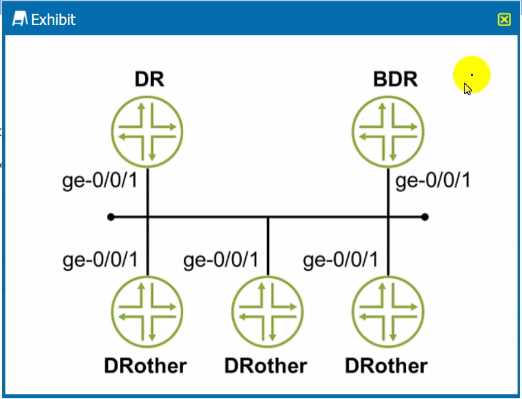
Exhibit Juniper JN0 363 question You are asked to configure the OSPF environment to prevent the DRother routers from participating in DR/BDR election. Referring to the exhibit, which command will accomplish this task?
Options
39 comments in the community discussion
3
Option B
1
B over D here. Setting the OSPF priority to 0 (option B) on a specific interface means that router won't participate in DR/BDR elections, but others still can. D changes the whole interface type to p2p, which avoids any election entirely, not just for DRothers. I think B matches what they're asking for, but I get wh
Q: 13
Which two statements are correct about the way that BGP propagates routes by default? (Choose two.)
Options
44 comments in the community discussion
1
C/D tbh. I always mix up the IBGP split-horizon with regular EBGP ads. For C, I remembered a question that said EBGP to IBGP doesn't just happen unless configured, but maybe that's a trap option here. Could be wrong, anyone else think D makes sense if route reflectors are default?
1
C/D? I could see C being a trap since people mix up IBGP and EBGP propagation defaults, but D is tempting if you miss the split-horizon part. I've seen similar practice questions trip folks up here.
Q: 14
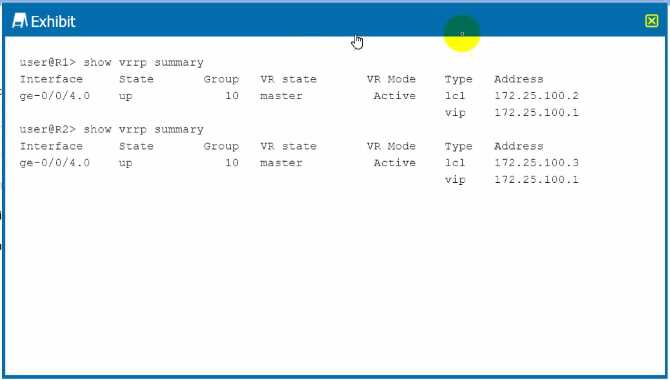
Exhibit Juniper JN0 363 question Referring to the exhibit, which statement is true about VRRP?
Options
45 comments in the community discussion
6
C. Both routers master means VRRP is running active/active as designed. No signs of a config issue from the exhibit, so C fits here.
5
Option C If you enable active-active on both routers, master state for each is expected, not a config issue.
Q: 15
Which statement is correct about IS-IS?
Options
35 comments in the community discussion
5
Option C for sure. IS-IS runs as a link-state protocol-just like OSPF, it builds a complete topology map, not just next hops. It isn't distance vector or path vector, and classful/classless doesn't really apply since IS-IS doesn't carry IP subnet info in the same way RIP or EIGRP might. Pretty confident but correct
5
C . IS-IS is always considered link-state, never distance or path vector. Juniper materials are clear about that. Disagree?
Question 1 of 20

Premium Access Includes

  • ✓Quiz Simulator
  • ✓Exam Mode
  • ✓Progress Tracking
  • ✓Question Saving
  • ✓Flash Cards
  • ✓Drag & Drops
  • ✓3 Months Access
  • ✓PDF Downloads
Get Premium Access
Scroll to Top

FLASH OFFER

Days
Hours
Minutes
Seconds

avail 10% DISCOUNT on YOUR PURCHASE