Free H12-831_V1.0 Practice Test Questions and Answers (2026)

Last Update Check

View Mode
Q: 1

As shown in the figure, R1, R2, R3, and R4 are in the same PLs domain, and LDP is used to distribute IPLS labels between devices. R4 is the Egress LSR of the FEC 4.4.4.0/24. If you want to achieve R1 access 4.4.4.0/24, R4 does not need to query the label table but can know the forwarding priority of the data, then the outgoing label of R3 for the FEC should be: . (Please fill in the Arabic numerals directly, without symbols) H12 831 V1 question

Your Answer
Q: 2

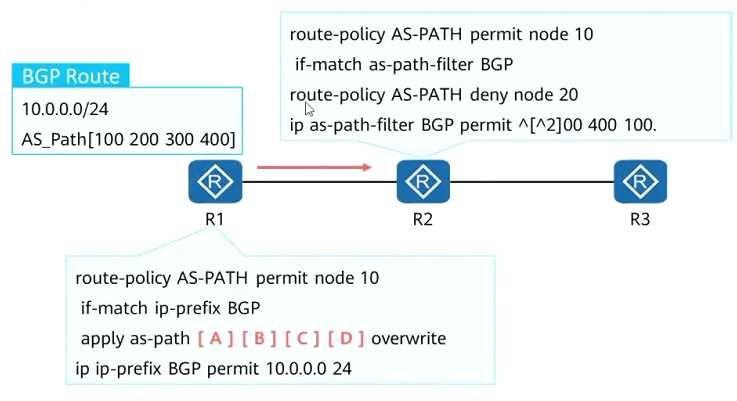
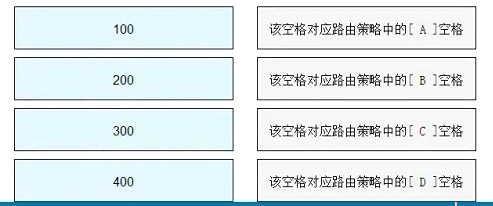
The configuration shown is performed on R2 to filter all incoming routes. Suppose there is a BGP route with the AS_Path attribute of [100200300400] on R1 that needs to be sent to R2. Please help the network administrator to adjust the AS order in the AS_Path attribute of the route on R1 to ensure that the route entry will not be filtered by the routing policy of R2 , , , . H12 831 V1 question H12 831 V1 question 100 This space corresponds to the [A] space in the routing policy 200 This space corresponds to the [B] space in the routing policy 300 This space corresponds to the [C] space in the routing policy 400 This space corresponds to the [D] space in the routing policy
Your Answer
Q: 3
display interface GEO/O/O once, and found that the Total Eror count (the total number of error packets at the physical layer of the interface) is not correct. . At this time, it can be concluded that the current time and fall has not disappeared.
Options
Q: 4
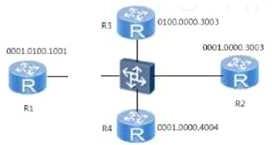
All routers in a network run IS-IS, and all are in Area 49.0001, where the L SDB of R1 is shown in the figure According to this, it is judged that the DIS of Level-2 is. (Please fill in the device name, such as R1) H12 831 V1 question | displayisisisdb DatabaseinformationforISIS (1) Level-1Link State Database LSPIDO Seq Num ChecksumbHoldtime Length ATT/P/OL 0001.0000.4004.00-00 0x00000008 0xb701 1186 68 0/0/0 0001.0000.2002.00-00Ox 0000008 0xb701 1186680/0/0 0001.0100.1001.00-00*0x00000050x2f9d1187 680/0/0 0001.0100.1001.01-00*0x00000001 0xa79e1110550/0/0 Level-2 Link State Database LSPIDAN> Seq Num Checksum., Holdtime Length ATT/P/OL 0001.00002002.00-00 0000000080xb7011188 6S0/0/0 0001.0100.1001.00-00* 0x00000060x2d9e 1187 680/0/0 0001.0100.1001.01-00* 0x00000005OxdObO 1191 660/0/0 0100.0000.3003.00-00 000000005 0xfe53 1185 560/0/0 0
Your Answer
Q: 5

In OSPFv3, an LSA whose propagation range is one area has kind. (Fill in Arabic numerals only)

Your Answer
Q: 6
by executing The command can completely isolate the second and third layer users of different ports on the same LAN and cannot communicate. (Please use English and lowercase letters to complete the command, and the command cannot be abbreviated)
Your Answer
Q: 7
Which of the following are static information coke analysis?
Options
Q: 8

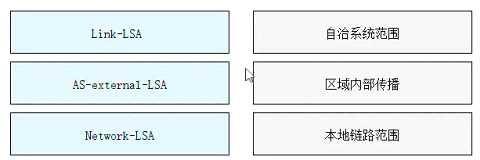
Please match 0SPFv3LSA with its transmission range. H12 831 V1 question

Drag & Drop
Q: 9

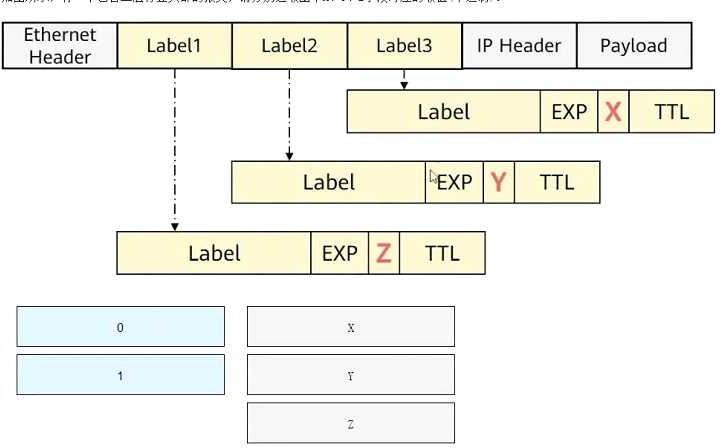
As shown in the figure, there is a packet containing a three-layer label header. Please select the values (decimal) corresponding to the x, and Z fields in the figure. H12 831 V1 question

Your Answer
Q: 10
During the daily troubleshooting process, engineers may need to view some alarm information of the device. Run the terminal command to enable the terminal to display the debugging/log/alarm information sent by the information center.
Your Answer
Q: 11

IGP converges faster than BGP, which may cause network traffic loss. By enabling the OSPF and BGP linkage feature of the device, the device can keep the OSPF and BGP linkage during the set linkage time. The router makes the link metric value in the LSA advertised to be the maximum value, so as to inform other OSPF devices not to use this router to forward data, so as to avoid traffic loss. (Note: If English letters are involved, all uppercase)

Your Answer
Q: 12

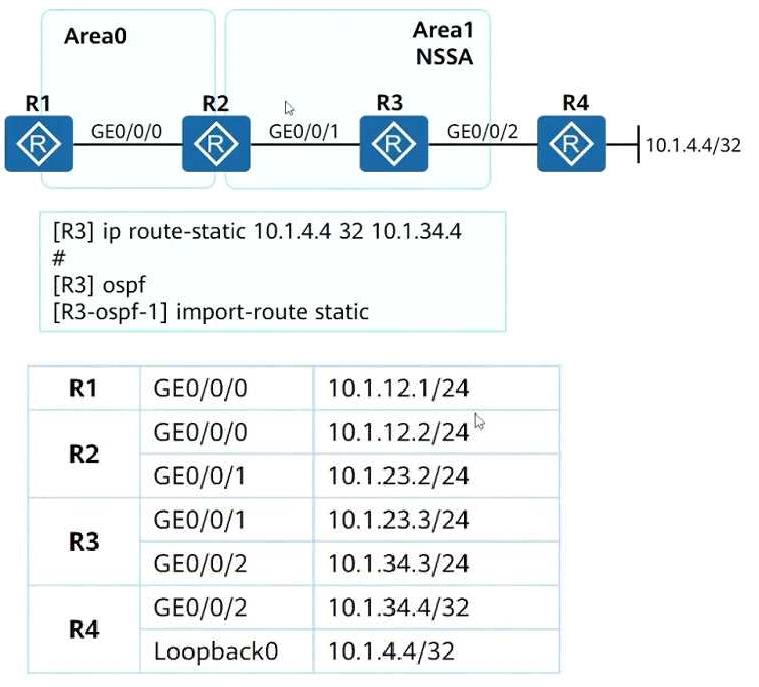
OSPF is deployed in a campus to achieve network interworking, and OSPF is also enabled on the GEO/0/2 interface of R3. Area1 is deployed as an NSSA area, and the device addresses are shown in the figure. An engineer configures a static route on R3 to access the loopback interface address of R4, and imports the static route in the 0SPF process. At this point, in the Type5 LSA received by R1, the forwarding address (FA) is . (Note: Please fill in the IP address without mask) H12 831 V1 question

Your Answer
Q: 13
Which of the following is included in the routine collection of basic equipment information?
Options
Q: 14
Which of the following statements about MPLS header TTL is correct?
Options
Q: 15
Regarding multi-instance CE (Mlulti-VPN-Instance CE, MCE), which of the following descriptions is wrong?
Options
Q: 16
BGP authentication can prevent illegal routers from establishing neighbors with BGP routers. BGP authentication can be divided into ID5 authentication and Keychain authentication. Which of the followingBGP packets will carryBGPKeychain authentication information?
Options
Q: 17
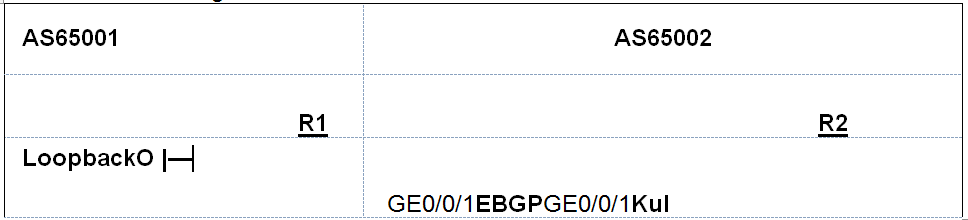
An engineer uses two routers to test IPv6 services, and simulates the interconnection between the headquarters and branches by running BGP4+. The logical topology of the network is shown in the figure. Regarding the transmission of IPv6 routes between the two devices, which of the following Is a statement wrong? H12 831 V1 question
Options
Q: 18
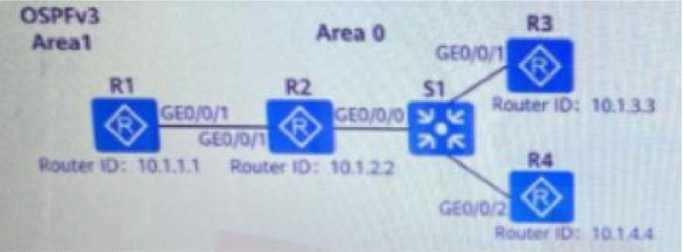
A campus has deployed IPv6 for service testing. There are 4 routers in the network, running 0SPFV3. Interconnection of IPv6 networks. As shown in the figure, an engineer checked the LSDB of R2 and intercepted one of them Link-LSAs. Which of the following statements is true about the description of this LSA? H12 831 V1 question
Options
Q: 19
In intra-domain MPLS VPN networks, data packets will be encapsulated with two layers of MPLS when they enter the public network and are forwarded. label, the description of the two-layer label in the following options is wrong
Options
Q: 20
The RR rules for advertising routes violate the IBGP split horizon rules, which may cause loops in the AS. Which routing attributes does RR use to prevent loops?
Options
Question 1 of 20

What's covered in this practice questions set

2: BGP Advanced · 6 questions

📖 About this Domain

This domain details advanced Border Gateway Protocol (BGP) features for large-scale networks. It covers complex route selection, policy-based control, and inter-AS solutions like Route Reflectors and Confederations.

🎓 What You Will Learn

  • Understand the BGP best-path selection algorithm and the function of attributes like MED, Local_Pref, and AS_Path.
  • Implement BGP route control using route-policy, AS_Path filters, and community attributes for traffic engineering.
  • Configure BGP Route Reflectors (RR) and Confederations to solve IBGP full-mesh scalability issues.
  • Deploy BGP security mechanisms such as GTSM and reliability features like BFD for BGP.

🛠️ Skills You Will Build

  • Ability to manipulate BGP attributes to engineer inbound and outbound traffic paths across autonomous systems.
  • Competency in designing and implementing scalable IBGP topologies using Route Reflectors and Confederations.
  • Proficiency in applying complex routing policies with community attributes and various filter tools.
  • Skill in troubleshooting BGP peering sessions, route propagation failures, and policy application errors.

💡 Top Tips to Prepare

  • Memorize the BGP 13-step route selection process and the default behavior of each path attribute.
  • Perform hands-on labs for Route Reflector client/non-client peering and inter-confederation EBGP sessions.
  • Practice extensive use of `display bgp` commands to verify path attributes and policy enforcement.
  • Focus on the configuration syntax for route-policy, ip-prefix lists, and AS-path-filters to manipulate BGP updates.

1: IGP Advanced (OSPF, IS-IS) · 5 questions

📖 About this Domain

This domain covers advanced principles and configurations for Interior Gateway Protocols, specifically OSPF and IS-IS. It focuses on hierarchical network design, route control, and optimization techniques required for large-scale enterprise and service provider networks.

🎓 What You Will Learn

  • You will learn OSPF multi-area design, including the function of ABRs, ASBRs, and special area types like Stub, NSSA, and Totally Stubby areas.
  • You will understand IS-IS multi-level architecture, including Level-1/Level-2 routing, DIS election, and route leaking between levels.
  • You will grasp advanced route control techniques such as route filtering using route-policies and summarization to manage routing table size.
  • You will learn troubleshooting methodologies for complex IGP issues involving adjacency formation, LSA/LSP database synchronization, and path calculation.

🛠️ Skills You Will Build

  • You will build the skill to design and implement scalable, multi-area OSPF networks with efficient route summarization.
  • You will gain proficiency in configuring and verifying IS-IS Level-1 and Level-2 domains, including inter-level route exchange.
  • You will develop the ability to manipulate routing updates and control traffic paths using advanced IGP attributes and route-policies.
  • You will acquire the competence to diagnose and resolve complex IGP faults by analyzing protocol states, LSDB/LSDB, and routing tables.

💡 Top Tips to Prepare

  • Master the packet types and LSA/LSP structures for both OSPF and IS-IS, as they are critical for troubleshooting.
  • Utilize Huawei's eNSP simulator to build and break complex multi-area OSPF and multi-level IS-IS topologies.
  • Focus on the logic of inter-area and external route calculation, including the role of the A-bit in NSSA and the P-bit in IS-IS.
  • Practice interpreting the output of `display` commands for peer states, LSDB/LSPDB details, and routing protocol tables.

4: MPLS Basics · 4 questions

📖 About this Domain

This domain introduces the fundamentals of Multiprotocol Label Switching (MPLS), a high-performance packet forwarding technology. It explains how MPLS uses short, fixed-length labels to direct data, decoupling forwarding from traditional IP routing lookups. This mechanism enhances forwarding speed and enables large-scale service deployment.

🎓 What You Will Learn

  • You will learn the basic MPLS architecture, including concepts like Forwarding Equivalence Class (FEC), Label Switched Path (LSP), and Label Switching Router (LSR).
  • You will understand the working principles of the Label Distribution Protocol (LDP) for establishing LSPs and distributing labels.
  • You will grasp the MPLS data forwarding process, including the label operations of push, swap, and pop.
  • You will learn the basic command-line configuration for enabling MPLS and LDP on Huawei VRP-based devices.

🛠️ Skills You Will Build

  • You will build the skill to configure a basic MPLS backbone network using LDP.
  • You will be able to verify the establishment of LDP sessions and the creation of LSPs.
  • You will learn to analyze the MPLS forwarding table (LFIB) to trace the path of labeled packets.
  • You will develop the ability to perform basic troubleshooting on LDP peer relationships and label distribution.

💡 Top Tips to Prepare

  • Focus on understanding the MPLS label stack and the structure of the 32-bit label header.
  • Use the eNSP simulator to practice MPLS and LDP configuration and verification commands extensively.
  • Clearly differentiate the roles of the control plane (LDP) and the forwarding plane (LFIB) in an MPLS network.
  • Memorize the different LDP label advertisement modes (DU/DoD) and distribution control modes (Independent/Ordered).

5: Network O&M · 3 questions

📖 About this Domain

This domain covers network operations and maintenance, focusing on ensuring network stability and high availability. It introduces technologies for network monitoring, fault diagnosis, and service quality assurance using Huawei VRP.

🎓 What You Will Learn

  • Understand network management protocols like SNMPv1/v2c/v3 and their MIB/OID structures.
  • Learn fault diagnosis principles and utilize tools like ping, tracert, and display commands for troubleshooting.
  • Master the implementation of Network Quality Analyzer (NQA) for real-time network performance monitoring.
  • Grasp the fundamentals of network automation using Python, NETCONF, and YANG models for efficient O&M.

🛠️ Skills You Will Build

  • Configure SNMP agents on VRP devices for centralized network monitoring and management.
  • Deploy NQA test instances to proactively detect network faults and measure service quality metrics.
  • Apply systematic troubleshooting methodologies to locate and resolve common Layer 2 and Layer 3 network issues.
  • Utilize basic automation scripts to perform routine device configuration and information gathering.

💡 Top Tips to Prepare

  • Memorize the functions and outputs of key `display` commands for rapid fault information collection.
  • Practice configuring various NQA test types like ICMP-echo, TCP, and UDP-jitter in eNSP labs.
  • Differentiate the security mechanisms and operational modes of SNMPv1, SNMPv2c, and SNMPv3.
  • Focus on the interaction between NQA, static routes, and BFD for dynamic link failover scenarios.

6: Network Features · 2 questions

📖 About this Domain

This domain covers key network services and high-availability technologies. It focuses on DHCP for IP address management, VRRP for gateway redundancy, and BFD for rapid fault detection. These features are critical for building robust and manageable enterprise networks.

🎓 What You Will Learn

  • DHCP Principles and Configuration: Learn DHCP relay, DHCP snooping, and DHCP server operations for IP address management.
  • VRRP Principles and Configuration: Understand Virtual Router Redundancy Protocol for implementing gateway high availability and load balancing.
  • BFD Principles and Configuration: Master Bidirectional Forwarding Detection for sub-second link failure detection with routing protocols.
  • Network Management Protocols: Grasp the fundamentals of SNMP for network device monitoring and management.

🛠️ Skills You Will Build

  • Implement DHCP services including DHCP relay and snooping on Huawei VRP devices.
  • Configure VRRP master and backup groups to ensure default gateway redundancy.
  • Integrate BFD with static routes, OSPF, and IS-IS to accelerate network convergence.
  • Deploy SNMPv1/v2c/v3 for basic network monitoring and fault reporting.

💡 Top Tips to Prepare

  • Practice DHCP relay and snooping configurations in a lab environment like eNSP.
  • Memorize the VRRP state machine and the function of preemption delay timers.
  • Understand how BFD session parameters directly impact fault detection time.
  • Focus on the command-line configuration for linking BFD sessions to specific routing protocols.

3: Routing Control

📖 About this Domain

This domain covers the tools and techniques used to influence routing decisions and control the flow of routing information within a network. It focuses on implementing policies to filter routes and modify their attributes for traffic engineering and enforcing network policies. Key components include route-policy, IP-prefix lists, and policy-based routing (PBR).

🎓 What You Will Learn

  • You will learn to filter routes using tools like ACLs, IP-prefix lists, and filter-policies to control routing table content.
  • You will learn to modify route attributes such as preference, MED, and community using route-policy to influence path selection.
  • You will learn the principles and configuration of Policy-Based Routing (PBR) to forward traffic based on policies rather than destination IP alone.
  • You will learn the matching rules and application logic of route-policy nodes, including the function of if-match and apply clauses.

🛠️ Skills You Will Build

  • You will build the skill to configure and apply route-policies on Huawei VRP devices to manage BGP and OSPF route advertisements.
  • You will build the skill to implement granular route control using IP-prefix lists for efficient prefix matching.
  • You will build the skill to deploy PBR to direct specific traffic flows through alternate paths for load sharing or policy enforcement.
  • You will build the skill to troubleshoot routing issues caused by misconfigured route-policies or filter-policies.

💡 Top Tips to Prepare

  • Focus on the specific differences between using an ACL and an IP-prefix list for route filtering.
  • Practice lab scenarios involving route-policy to modify BGP path attributes like local preference and MED.
  • Understand the processing order of route-policy nodes and the permit/deny logic within each node.
  • Memorize the command syntax for applying policies to routing protocols and interfaces on the VRP platform.

Premium Access Includes

  • ✓Quiz Simulator
  • ✓Exam Mode
  • ✓Progress Tracking
  • ✓Question Saving
  • ✓Flash Cards
  • ✓Drag & Drops
  • ✓3 Months Access
  • ✓PDF Downloads
Scroll to Top