
Q: 1
Refer to the exhibit.
 Refer to the exhibit.
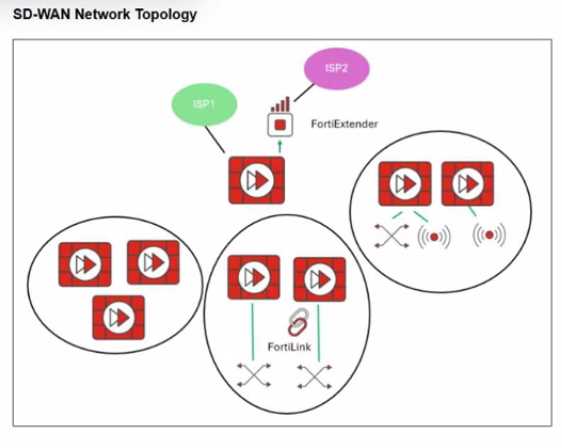
You want to configure SD-WAN on a network as shown in the exhibit.
The network contains many FortiGate devices. Some are used as NGFW, and some are installed with
extensions such as FortiSwitch. FortiAP. or Forti Ex tender.
What should you consider when planning your deployment?
Refer to the exhibit.
You want to configure SD-WAN on a network as shown in the exhibit.
The network contains many FortiGate devices. Some are used as NGFW, and some are installed with
extensions such as FortiSwitch. FortiAP. or Forti Ex tender.
What should you consider when planning your deployment?
 Refer to the exhibit.
You want to configure SD-WAN on a network as shown in the exhibit.
The network contains many FortiGate devices. Some are used as NGFW, and some are installed with
extensions such as FortiSwitch. FortiAP. or Forti Ex tender.
What should you consider when planning your deployment?
Refer to the exhibit.
You want to configure SD-WAN on a network as shown in the exhibit.
The network contains many FortiGate devices. Some are used as NGFW, and some are installed with
extensions such as FortiSwitch. FortiAP. or Forti Ex tender.
What should you consider when planning your deployment?Options
Discussion
No comments yet. Be the first to comment.
Be respectful. No spam.
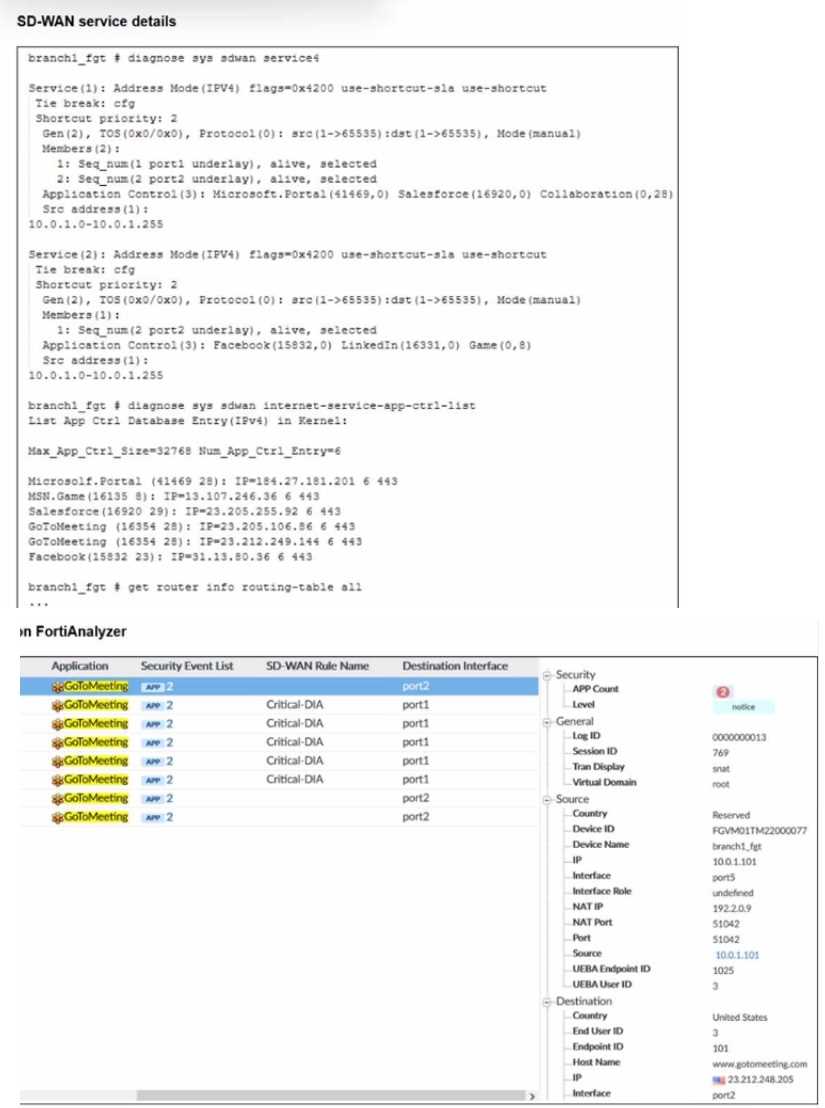 An administrator is testing application steering in SD-WAN. Before generating test traffic, the
administrator collected the information shown in the first exhibit. After generating GoToMeeting test
traffic, the administrator examined the corresponding traffic log on FortiAnalyzer, which is shown in
the second exhibit.
The administrator noticed that the traffic matched the implicit SD-WAN rule, but they expected the
traffic to match rule ID 1.
Which two reasons explain why some log messages show that the traffic matched the implicit SD-
WAN rule? (Choose two.)
An administrator is testing application steering in SD-WAN. Before generating test traffic, the
administrator collected the information shown in the first exhibit. After generating GoToMeeting test
traffic, the administrator examined the corresponding traffic log on FortiAnalyzer, which is shown in
the second exhibit.
The administrator noticed that the traffic matched the implicit SD-WAN rule, but they expected the
traffic to match rule ID 1.
Which two reasons explain why some log messages show that the traffic matched the implicit SD-
WAN rule? (Choose two.)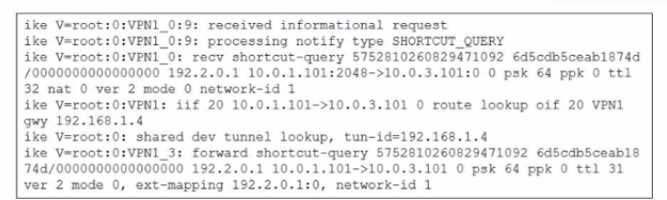 Which statement best describe the role of the ADVPN device in handling traffic?
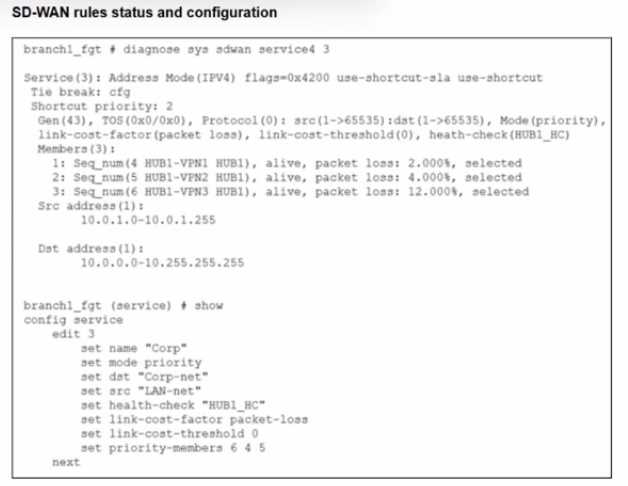 Refer to the exhibit, which shows the SD-WAN rule status and configuration.
Based on the exhibit, which change in the measured packet loss will make HUB1-VPN3 the new
preferred member?
Refer to the exhibit, which shows the SD-WAN rule status and configuration.
Based on the exhibit, which change in the measured packet loss will make HUB1-VPN3 the new
preferred member?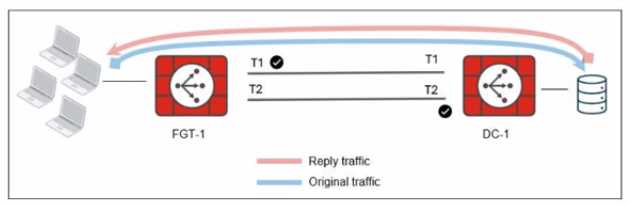 The administrator analyzed the traffic between a branch FortiGate and the server located in the data
center, and noticed the behavior shown in the diagram.
When the LAN clients located behind FGT1 establish a session to a server behind DC-1, the
administrator observes that, on DC-1, the reply traffic is routed overT2. even though T1 is the
preferred member in
the matching SD-WAN rule.
What can the administrator do to instruct DC-1 to route the reply traffic through the member with
the best performance?
The administrator analyzed the traffic between a branch FortiGate and the server located in the data
center, and noticed the behavior shown in the diagram.
When the LAN clients located behind FGT1 establish a session to a server behind DC-1, the
administrator observes that, on DC-1, the reply traffic is routed overT2. even though T1 is the
preferred member in
the matching SD-WAN rule.
What can the administrator do to instruct DC-1 to route the reply traffic through the member with
the best performance?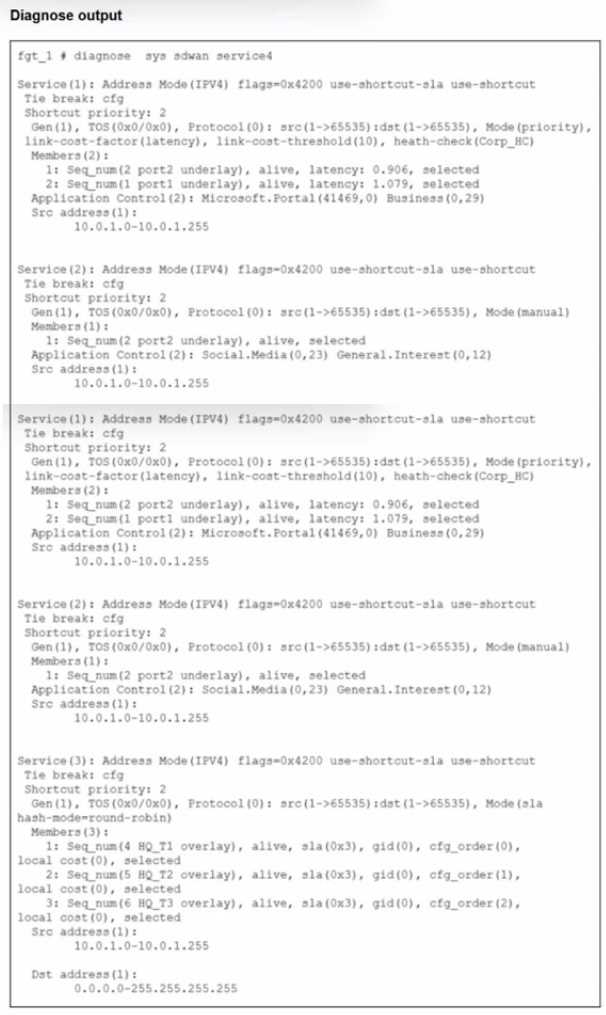 The exhibit shows output of the command diagnose sys adwan aervice4 collected on a FortiGate
device.
The administrator wants to know through which interface FortiGate will steer traffic from local users
on subnet 10.0.1.0/255.255.255.192 and with a destination of the social media application Facebook.
Based on the exhibits, which two statements are correct? (Choose two.)
The exhibit shows output of the command diagnose sys adwan aervice4 collected on a FortiGate
device.
The administrator wants to know through which interface FortiGate will steer traffic from local users
on subnet 10.0.1.0/255.255.255.192 and with a destination of the social media application Facebook.
Based on the exhibits, which two statements are correct? (Choose two.)