Free AZ-800 Practice Test Questions and Answers (2026)

Last Update Check
View Mode
Q: 1
You need to implement the planned changes for Microsoft Entra users to sign in to Server1. Which PowerShell cmdlet should you run?
Options
30 comments in the community discussion
1
I don’t think it’s C. I’d actually pick B, since Set-AzVM is used for VM settings and it seems like a logical fit if you’re managing how users access the VM. Maybe I’m off but that’s my take here.
1
Probably A, but does it specify if these servers use FSRM or just standard shares? That info could flip it between A and B.
Q: 2

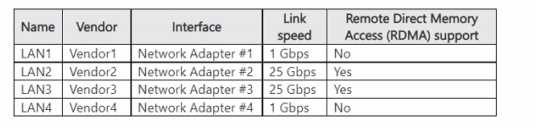
You have a server that runs Windows Server 2022 and has the network adapters shown in the following table. Microsoft AZ 800 question You need to configure NIC learning for LAN2 and LAN3. The solution must support Dynamic Virtual Machine Multi-Queue (d.VMMQ). What should you use?
Options
19 comments in the community discussion
1
B is correct for this one. SET is the only teaming option that works with d.VMMQ on Server 2022, since LBFO and traditional teaming methods don't support it. Pretty sure Microsoft specifically calls this out in the docs. If anyone has seen d.VMMQ working with LBFO, let me know!
1
A
Q: 3
You have an Active Directory Domain Services (AD DS) domain. The domain contains three servers named Server 1, Server2, and Server3 that run Windows Server. You sign in to Server1 by using a domain account and start a remote PowerShell session to Server2. From the remote PowerShell session, you attempt to access a resource on Server3. but access to the resource is denied. You need to ensure that your credentials are passed from Server1 to Server3. The solution must minimize administrative effort. What should you do?
Options
23 comments in the community discussion
6
Option A makes sense here since it's the double-hop issue with PowerShell remoting. Kerberos constrained delegation lets Server2 pass your credentials on to Server3 securely. I think that's the least work for admins too, but open if anyone sees a catch.
5
I don’t think it’s D. 6516 is used if you pick a custom port, but here the question says default install. A makes sense since Windows Admin Center listens on 443 out of the box for HTTPS. Some might confuse it with RDP (3389) but that's not needed for WAC. Pretty sure A is right, unless I missed something.
Q: 4

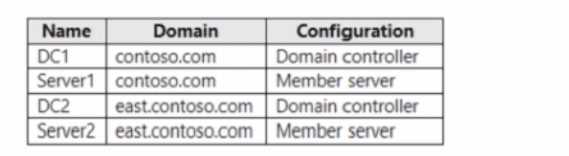
Your network contains an Active Directory forest. The forest contains two domains named contoso.com and east.contoso.com and the servers shown in the following table. Microsoft AZ 800 question Contoso.com contains a user named User1. You add User1 to the built-in Backup Operators group in contoso.com. Which servers can User1 back up?
Options
26 comments in the community discussion
4
C. only D fits since E's a DB and F's not supported. Pretty sure about this.
4
C. saw a similar question in an exam report, only D qualified that time. Anyone get different info?
Q: 5

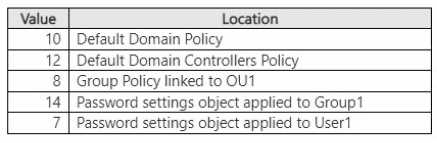
Your network contains an Active Directory Domain Services (AD DS) domain. The domain contains a user named User1. User1 is a member of a group named Group1 and is in an organizational unit (OL)} named OU1. The domain has minimum password lengths configured as shown in the following table. Microsoft AZ 800 question What is the minimum password length that User1 should use when changing to a new password?

Options
32 comments in the community discussion
3
Option A makes sense here. JIT VM access is all about reducing attack surface by only opening admin ports when needed, which lines up with most exam wording around security requirements. Pretty sure that's the expected answer unless the question says you can't add a Defender agent. Could see someone picking D for Basti
1
Doesn't the PSO with lowest precedence always override the domain policy if it's linked via Group1? Unless User1 has another direct PSO or a higher-precedence one applies somehow, looks like 7 chars is enforced. Someone correct me if I'm missing a nuance with OU-level policies here.
Q: 6
Your on-premises network has an IP address range of 10.0.0.0/23. You have an Azure virtual network named VNet1 that contains a virtual machine named VM1 VNet1 has an IP address range of 10.0.1.0/24. You need to deploy a Site-to-Site (S2S) VPN to connect the on-premises network to VNet1. What should you do first?
Options
32 comments in the community discussion
3
Option C makes sense because Azure requires non-overlapping address ranges for S2S VPN, so reconfiguring VNet1 to 10.0.2.0/24 should be step one. The official docs and practice tests highlight this overlap issue a lot, but let me know if you see it differently!
2
B or D. New-ADServiceAccount on DC1 (B) makes sense since that's where you create the gMSA, but I've seen practice tests mention Install-ADServiceAccount on the DC (D) too, and it's easy to mix up. Official guide goes into this but I'm not 100% sure here.
Q: 7
You have an on-premises Active Directory Domain Services (AD DS) domain that syncs with an Azure Active Directory (Azure AD) tenant The on-premises network is connected to Azure by using a Site-to- Site VPN. You have the DNS zones shown in the following table. Microsoft AZ 800 question You need to ensure that names from fabrikam.com can be resolved from the on-premises network Which two actions should you perform? Each correct answer presents part of the solution, NOTE: Each correct selection Is worth one point
Options
23 comments in the community discussion
2
A/E. I don’t think B works here since stub zones don’t forward requests, they just hold info about authoritative servers.
1
Ugh, this double-hop AD question again. A imo, Kerberos constrained delegation is specifically designed for this scenario with PowerShell remoting. Lets creds go from Server1 to Server3 through Server2 without opening security risks to everything. Anyone disagree?
Q: 8

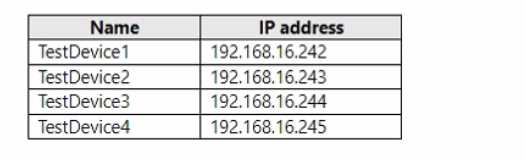
You have four testing devices that are configured with static IP addresses as shown in the following table. Microsoft AZ 800 question The test devices are turned on once a month. You need to prevent Server1 from assigning the IP addresses allocated to the test devices to other devices when the test devices are offline. The solution must minimize administrative effort. What should you do?
Options
32 comments in the community discussion
6
Yeah, this one just needs a conditional forwarder for contoso.com to DC1.
5
Configure a conditional forwarder for contoso.com to DC1, not a standard forwarder. Trick is in the wording.
Q: 9
You are planning the implementation Azure Arc to support the planned changes. You need to configure the environment to support configuration management policies. What should you do?
Options
19 comments in the community discussion
7
Makes sense to start with the vnet, then create Azure AD DS, then update vnet DNS settings.
6
Official guide and lab walkthroughs show: Create virtual network, create Azure AD DS, then modify vnet DNS.
Q: 10
Note: This question is part of a series of questions that present the same scenario. Each question in the series contains a unique solution that might meet the stated goals. Some question sets might have more than one correct solution, while others might not have a correct solution. After you answer a question in this section, you will NOT be able to return to it. As a result, these questions will not appear in the review screen. Your network contains an Active Directory Domain Services (AD DS) domain named contoso.com. You need to identify which server is the PDC emulator for the domain. Solution: From Active Directory Domains and Trusts, you right-click Active Directory Domains and Trusts in the console tree, and then select Operations Master. Does this meet the goal?
Options
26 comments in the community discussion
6
Why do you think Server3 needs a secondary zone if the contoso.com replication scope is just domain-wide?
6
All Yes. I've seen a similar setup in practice exams, the replication scopes match so nothing unexpected here.
Q: 11
You have an on-premises Active Directory Domain Services (AD DS) domain that syncs with an Azure Active Directory (Azure AD) tenant. You plan deploy 100 new Azure virtual machines that will run Windows Server. You need to ensure that each new virtual machine is joined to the AD DS domain. What should you use?
Options
8 comments in the community discussion
2
D . Enabling enhanced session mode lets you use things like clipboard copy/paste, audio, even USB devices from your host in the VM. The other options either secure the VM or deal with credentials, but they don't improve user experience for connecting to the VM directly. Pretty sure this matches what you'd want for tech
1
D imo, because if the requirement was about local device redirection or clipboard, only enhanced session mode does that for VMConnect.
Q: 12
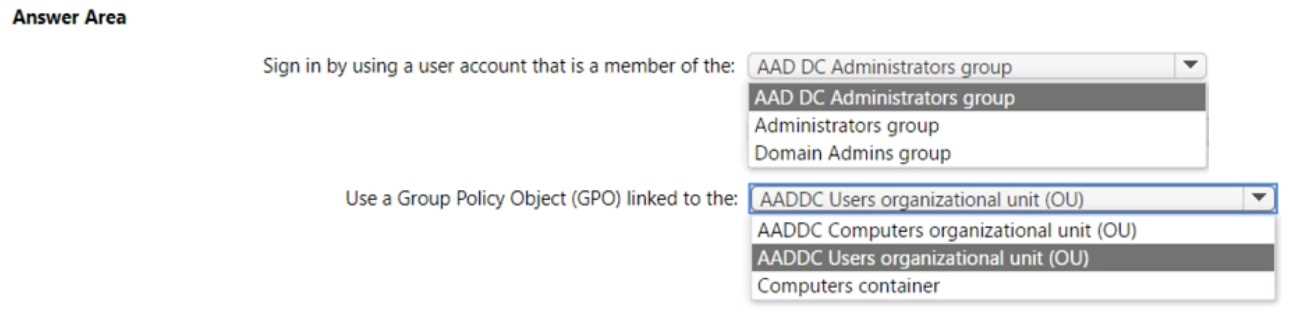
You have an Azure Active Directory Domain Services (Azure AD DS) domain named contoso.com. You need to provide an administrator with the ability to manage Group Policy Objects (GPOs). The solution must use the principle of least privilege. To which group should you add the administrator?
Options
9 comments in the community discussion
5
Add-KdsRootKey is the one you need for setting up gMSA support in the domain. Without running that PowerShell cmdlet, AD can't generate the required keys for gMSAs. Pretty sure that's all they're looking for here, unless they want immediate use (then you'd tweak -EffectiveTime). Agree?
4
Add-KdsRootKey
Q: 13

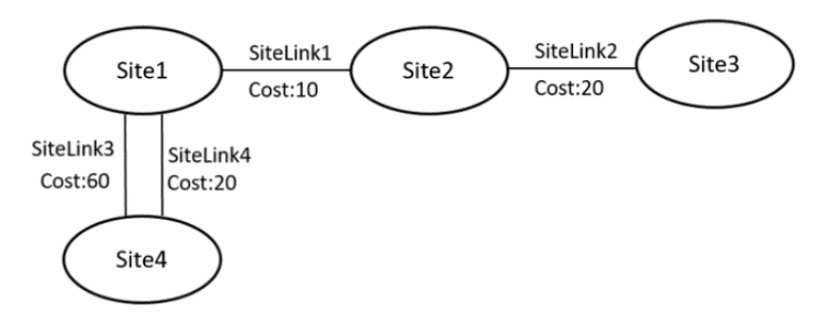
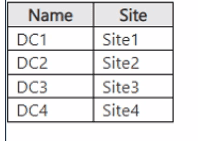
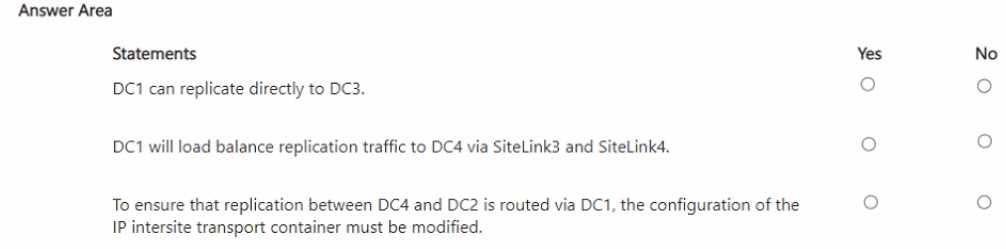
HOTSPOT Your network contains an Active Directory Domain Services (AD DS) forest. The forest contains the sites and site links shown in the following exhibit. Microsoft AZ 800 question The sites contain the bridgehead domain controllers shown in the following table. Microsoft AZ 800 question The IP intersite transport container is configured as shown in the following exhibit. For each of the following statements, select Yes if the statement is true. Otherwise, select No. NOTE: Each correct selection is worth one point. Microsoft AZ 800 question
Your Answer
8 comments in the community discussion
9
Seen this on a practice test. You have to get the new cert first, grab its thumbprint, then run WAC setup and pick Change so you can update it with the new cert. Order is:Obtain and install a new certificate → Copy the certificate thumbprint → Run Windows Admin Center Setup and select Change.I thin
2
Obtain and install a new certificate, copy the thumbprint, then run setup and select Repair. Official guide or lab walkthrough should help verify this order.
Q: 14

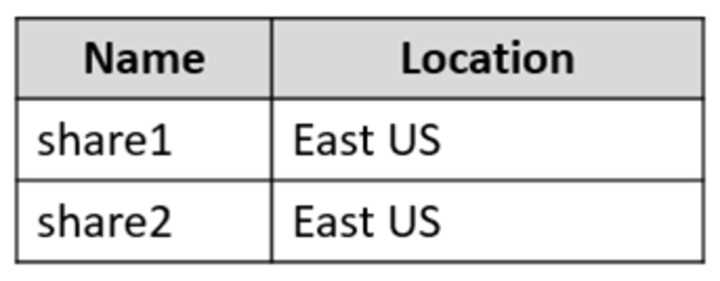
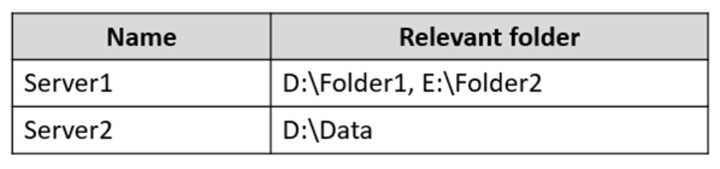
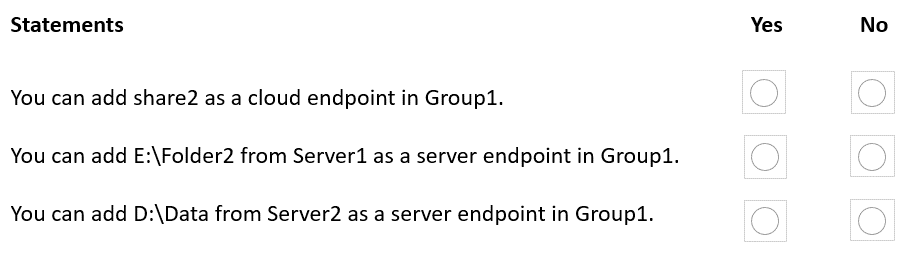
HOTSPOT You have on-premises file servers that run Windows Server as shown in the following table. Microsoft AZ 800 question You have the Azure file shares shown in the following table. Microsoft AZ 800 question You add a Storage Sync Service named Sync1 and an Azure File Sync sync group named Group1. Group1 uses share1 as a cloud endpoint. You register Server1 and Server2 with Sync1. You add D:\Folder1 from Server1 as a server endpoint in Group1. For each of the following statements, select Yes if the statement is true. Otherwise, select No. NOTE: Each correct selection is worth one point. Microsoft AZ 800 question
Your Answer
8 comments in the community discussion
4
Ugh, I always forget how picky Azure File Sync is here. 1: No (can only have one cloud endpoint per group). 2: No, same server can only do one server endpoint per sync group. 3: Yes, syncing between different servers in the same group is exactly what it's for. Anyone else tripped up by those sync group limits on the
2
Add-KdsRootKey - New-ADServiceAccount - Add-ADComputerServiceAccountPretty sure it should finish with Add-ADComputerServiceAccount for linking the gMSA, not Install-ADServiceAccount. Unless the question says these hosts are running Server 2012 or later, which lets you use Install-ADS
Q: 15

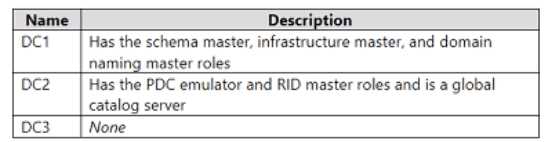
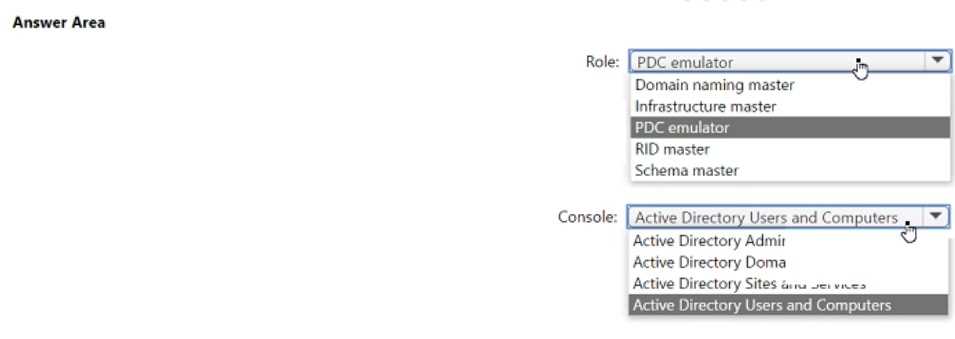
HOTSPOT Your network contains an Active Directory Domain Services (AD DS) domain. The domain contains the domain controllers shown in the following table. Microsoft AZ 800 question You need to configure DC3 to be the authoritative time server for the domain. Which operations master role should you transfer to DC3, and which console should you use? To answer, select the appropriate options in the answer area. NOTE: Each correct selection is worth one point. Microsoft AZ 800 question

Your Answer
10 comments in the community discussion
4
Makes sense to pick B here. JIT in Defender for Cloud is meant for access requests like this, NSG on its own can't handle the approval part. Pretty sure that's what they're going for, but let me know if you think otherwise.
Pretty sure it's B. Defender for Cloud gives the JIT access feature where admins submit a request and get temporary RDP access. Not something NSG alone can handle. Agree?
Q: 16

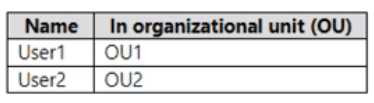
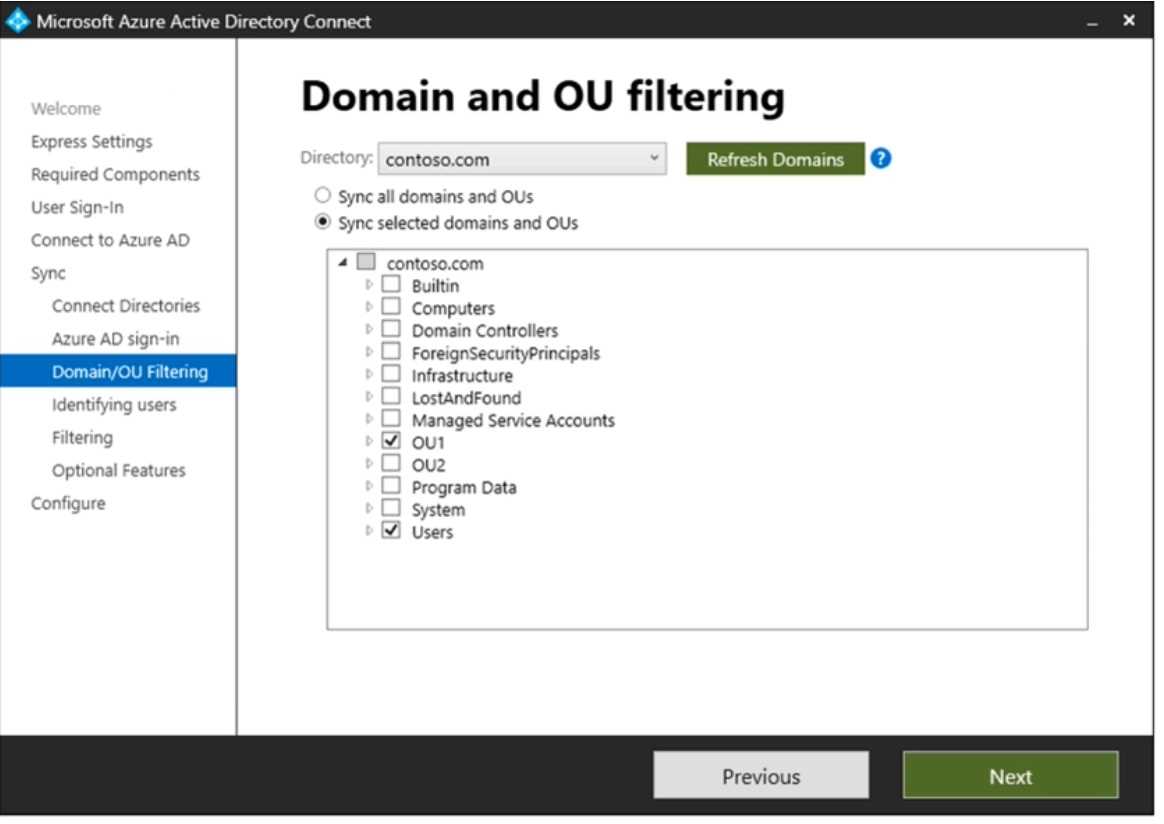
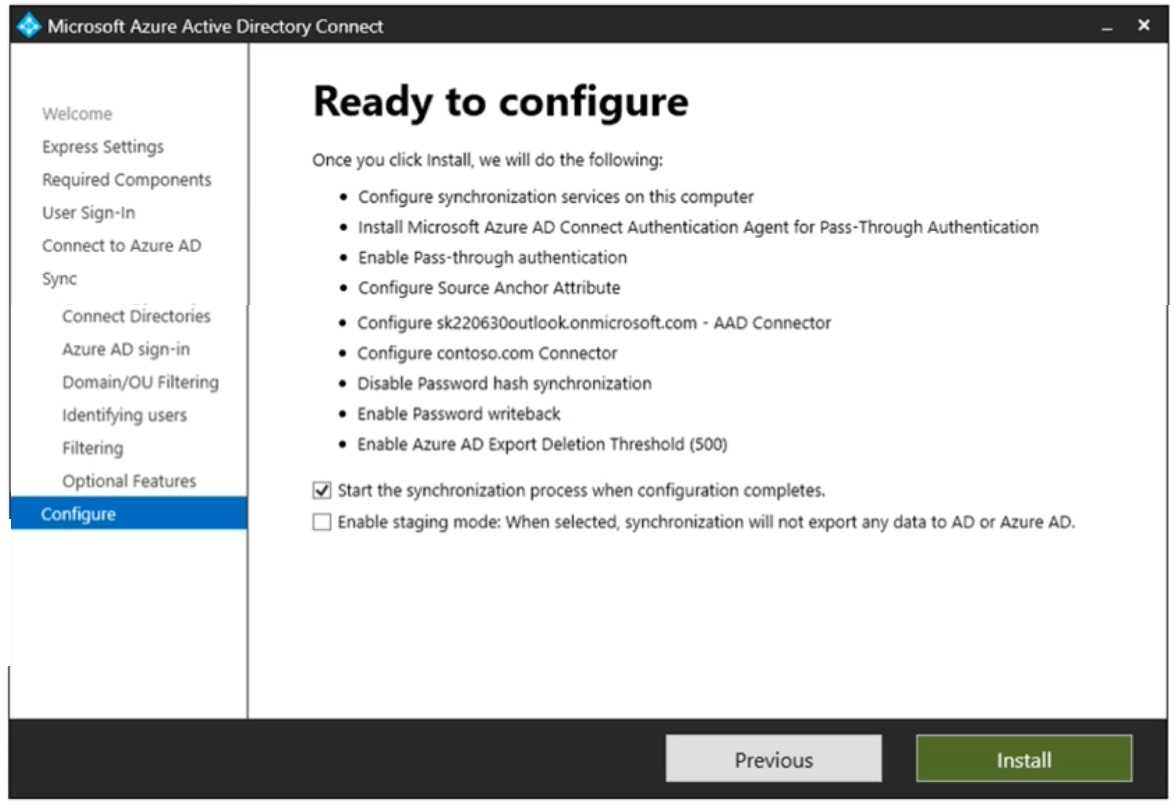
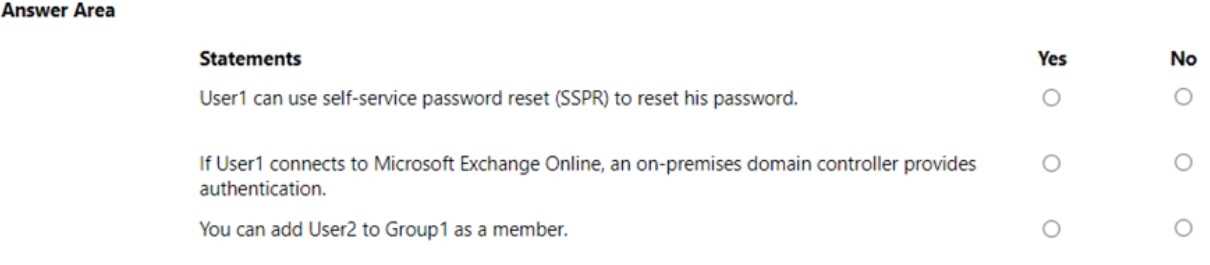
HOTSPOT Your network contains an on-premises Active Directory Domain Services (AD DS) domain named contoso.com that syncs with an Azure AD tenant. The tenant contains a group named Group1 and the users shown in the following table. Microsoft AZ 800 question Domain/OU filtering in Azure AD Connect is configured as shown in the Filtering exhibit. (Click the Filtering tab.) Microsoft AZ 800 question You review the Azure AD Connect configurations as shown in the Configure exhibit. (Click the Configure tab.) Microsoft AZ 800 question For each of the following statements, select Yes if the statement is true. Otherwise, select No. NOTE: Each correct selection is worth one point. Microsoft AZ 800 question
Your Answer
4 comments in the community discussion
1
Its D, User1, User3 and User4. Official doc and labs cover these group permissions pretty well if you want to check deeper.
B for me
Q: 17

HOTSPOT Your network contains an Azure AD Domain Services domain named contoso.com. You need to configure a password policy for the local user accounts on the Azure virtual machines joined to contoso.com. What should you do? To answer, select the appropriate options in the answer area. NOTE: Each correct selection is worth one point. Microsoft AZ 800 question

Your Answer
3 comments in the community discussion
Looks like the correct order is: Create and attach a new data disk, then Initialize the disk, then Create a new simple volume. That's usually how you set up persistent storage on an Azure VM from scratch. Not 100% if step 2 and 3 ever swap but pretty sure this is it.
Q: 18

HOTSPOT You have an Active Directory Domain Services (AD DS) domain that contains a group named Group1. You need to create a group managed service account (gMSA) named Account1. The solution must ensure that Group1 can use Account1. How should you complete the script? To answer, select the appropriate options in the answer area, NOTE: Each correct selection is worth one point. Microsoft AZ 800 question

Your Answer
8 comments in the community discussion
6
\\CONTOSO.COM and \FILES\FOLDER1. Saw a similar question in the official practice test, the format always sticks to the domain-based namespace path, not the server or share directly. Using the UNC path with domain ensures users stay on DFS for resiliency and central management.
5
\\CONTOSO.COM and \FILES\FOLDER1. Some might pick the server name here but that's for standalone namespaces, not domain-based. Anyone disagree?
Q: 19

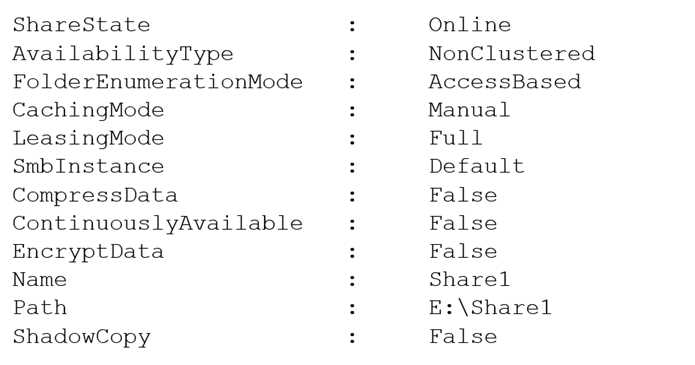
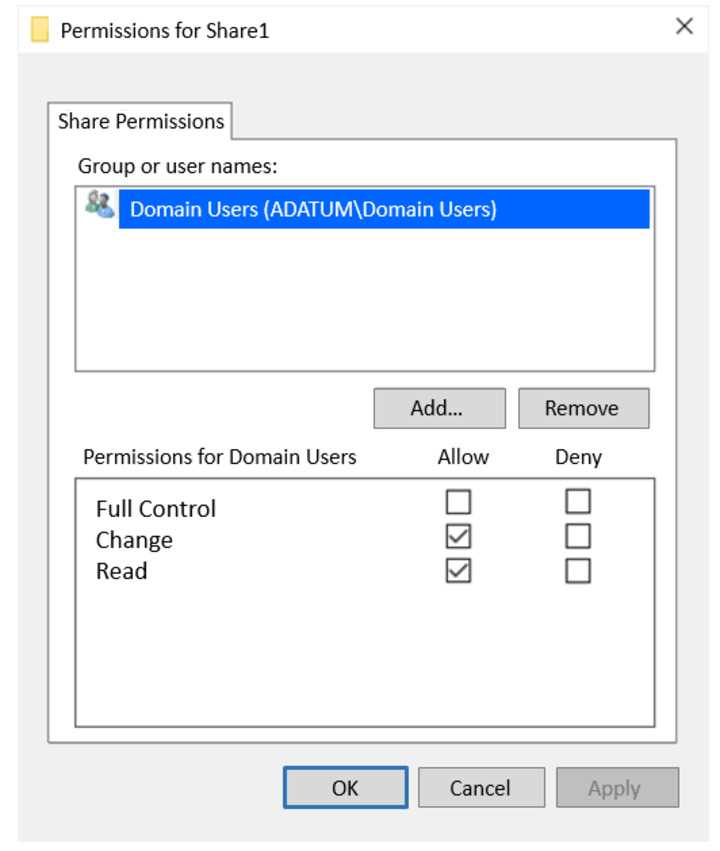
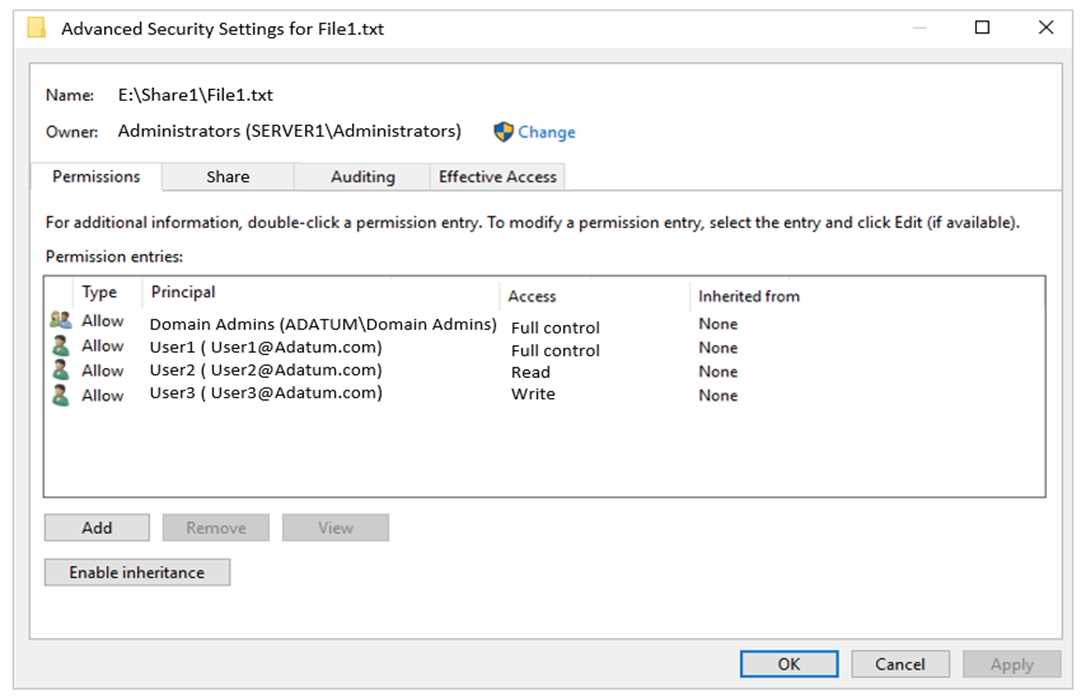
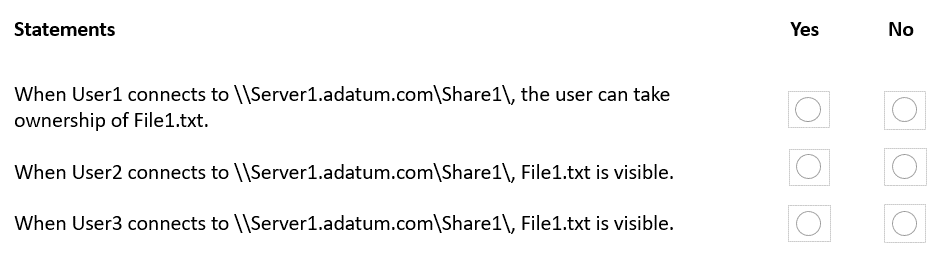
HOTSPOT Your network contains an Active Directory Domain Services (AD DS) domain named adatum.com. The domain contains a file server named Server1 and three users named User1, User2, and User3. Server1 contains a shared folder named Share1 that has the following configurations: Microsoft AZ 800 question The share permissions for Share1 are configured as shown in the Share Permissions exhibit. Microsoft AZ 800 question Share1 contains a file named File1.bxt. The share settings for File1.txt are configured as shown in the File Permissions exhibit. Microsoft AZ 800 question For each of the following statements, select Yes if the statement is true. Otherwise, select No. NOTE: Each correct selection is worth one point. Microsoft AZ 800 question
Your Answer
3 comments in the community discussion
8
Install BranchCache for network files on Server1, enable BranchCache distributed mode on the client PCs, right? Not 100% sure.
Q: 20

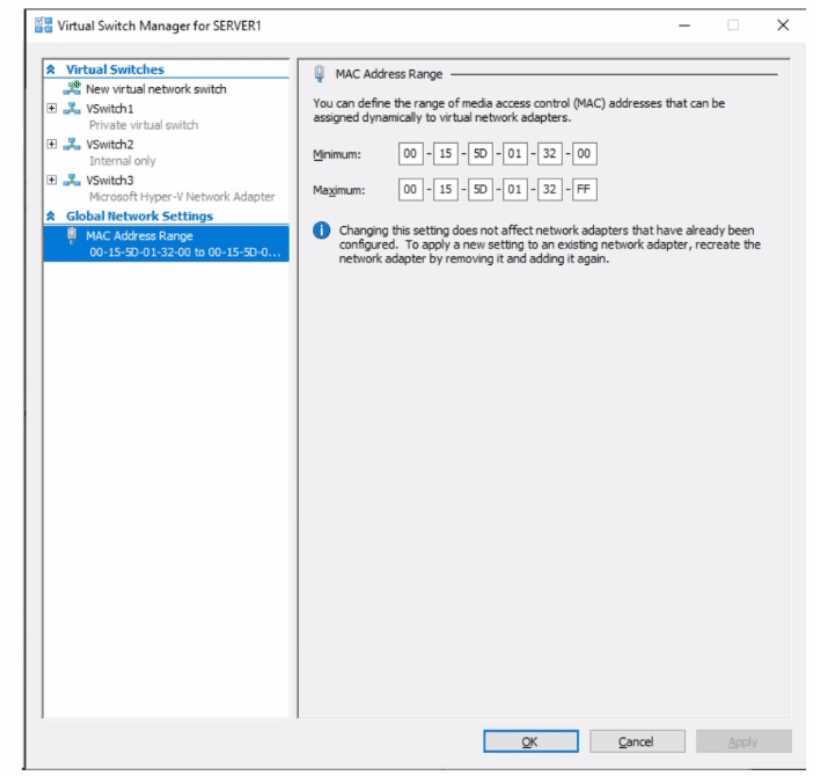
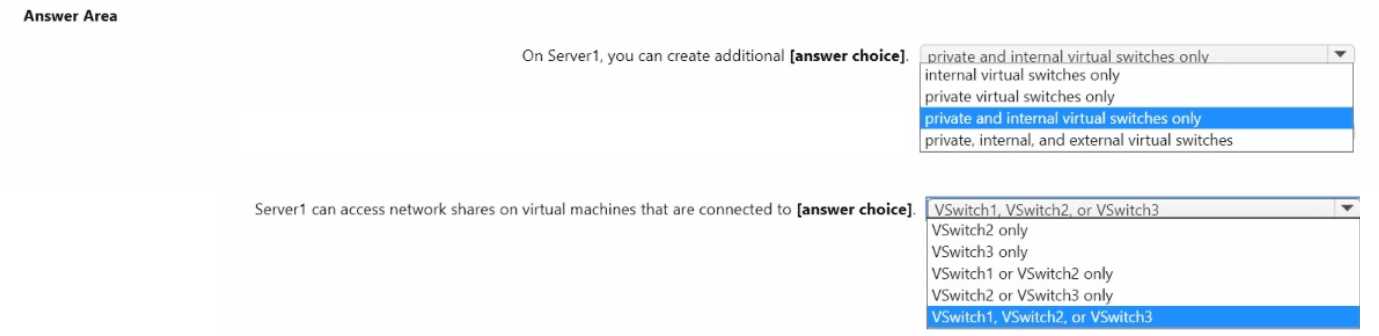
HOTSPOT You have a server named Server1 that runs Windows Server. Server1 has a single network interface and the Hyper-V virtual switches shown in the following exhibit. Microsoft AZ 800 question Use the drop-down menus to select the answer choice that completes each statement based on the information presented in the graphic. NOTE: Each correct selection is worth one point. Microsoft AZ 800 question
Your Answer
11 comments in the community discussion
2
These sequencing questions always make me sigh. Anyway, it’s gotta be: Create Azure storage account → Create Azure file share → Create sync group. You can’t set up a sync group or server endpoint until the storage and share exist in the cloud side, pretty sure that’s how Microsoft wants it. Feel free to correct me i
1
Yeah, makes sense to go Storage account → File share → Sync group. You need the Azure side (account and share) ready before you can set up the sync group linking everything, pretty sure that's the right sequence.
Question 1 of 20

Premium Access Includes

  • Quiz Simulator
  • Exam Mode
  • Progress Tracking
  • Question Saving
  • Flash Cards
  • Drag & Drops
  • 3 Months Access
  • PDF Downloads
Get Premium Access
Scroll to Top