Free AIF-C01 Practice Test Questions and Answers (2026)

View Mode
Q: 1
A social media company wants to use a large language model (LLM) for content moderation. The company wants to evaluate the LLM outputs for bias and potential discrimination against specific groups or individuals. Which data source should the company use to evaluate the LLM outputs with the LEAST administrative effort?
Options
25 comments in the community discussion
4
D . Benchmark datasets are ready-made for fairness and bias testing, so you don't have to do manual labeling or cleaning. That's way less admin work than sifting through user content or logs. Pretty sure that's what AWS wants here, but open to other thoughts.
2
Maybe C for this one. Content moderation guidelines could directly show whether the LLM is meeting company bias standards, so it feels like less admin work than gathering and labeling extra data. Not totally sure though since D is strong too, but C fits if we care about internal policy.
Q: 2
A company wants to create a chatbot by using a foundation model (FM) on Amazon Bedrock. The FM needs to access encrypted data that is stored in an Amazon S3 bucket. The data is encrypted with Amazon S3 managed keys (SSE-S3). The FM encounters a failure when attempting to access the S3 bucket data. Which solution will meet these requirements?
Options
28 comments in the community discussion
2
D , seen similar in practice exams and official docs mention data classification too.
2
I see why B might look tempting, since public access would let anything read the S3 files. But that's risky in AWS and not how you'd usually solve it. Seems reasonable for fixing a quick access error if security isn't a concern though.
Q: 3
A company is building an ML model. The company collected new data and analyzed the data by creating a correlation matrix, calculating statistics, and visualizing the data. Which stage of the ML pipeline is the company currently in?
Options
24 comments in the community discussion
3
C . Correlation matrix and stats are textbook exploratory data analysis steps. You're not creating features here, just understanding the data shape. Pretty sure that's what AWS expects.
1
C not A. They're just analyzing and visualizing data here so that's classic EDA. Don't see any mention of cleaning or transforming.
Q: 4
A company has petabytes of unlabeled customer data to use for an advertisement campaign. The company wants to classify its customers into tiers to advertise and promote the company's products. Which methodology should the company use to meet these requirements?
Options
39 comments in the community discussion
2
Probably B, since the data's unlabeled. A is tempting but that's a classic trap if you skim the question.
1
Definitely B here. Since they're dealing with petabytes of unlabeled data, clustering with unsupervised learning is what AWS tests on for this type of customer segmentation. Seen similar in exam reports, but happy to hear if someone disagrees.
Q: 5
Which technique breaks a complex task into smaller subtasks that are sent sequentially to a large language model (LLM)?
Options
27 comments in the community discussion
2
Yeah, that's prompt chaining, so B fits. It’s all about breaking a bigger problem down and sending smaller prompts to the LLM sequentially. RAG (D) comes up when external data or retrieval is involved, which isn’t mentioned here. I’ve seen similar wording on practice exams, but open to other takes if someone has eviden
1
B not C. Tree of thoughts is tempting but that's more for branching logic than sending subtasks in sequence. Pretty sure prompt chaining fits the description best.
Q: 6
Which option describes embeddings in the context of AI?
Options
34 comments in the community discussion
1
Honestly, D fits best. Embeddings are mainly about creating those dense vector representations so models can work with lower-dimensional data while preserving meaning. C is tempting but that's more about what you *do* with embeddings (like t-SNE/UMAP visualization), not what they fundamentally are. Think D is what AWS
1
C/D? I get why people pick C since embeddings help with visualization, but "describe" makes D a better fit. D is more about what an embedding actually is (lower-dim representation), C is more how you might use it. Not 100% sure though, open to pushback.
Q: 7
An AI company periodically evaluates its systems and processes with the help of independent software vendors (ISVs). The company needs to receive email message notifications when an ISV's compliance reports become available. Which AWS service can the company use to meet this requirement?
Options
37 comments in the community discussion
3
Option D is correct here. Data Exchange supports notifications for third-party (ISV) data products, like compliance reports. Trusted Advisor and Artifact are AWS-centric, so they're not the best fit for external ISV reports. C trips people up but doesn't work for this use case.
2
Makes sense to go with D here. Data Exchange is built for sharing third-party data like compliance reports, and you can set up notifications through EventBridge or SNS-pretty sure that's what the scenario's hinting at.
Q: 8
A customer service team is developing an application to analyze customer feedback and automatically classify the feedback into different categories. The categories include product quality, customer service, and delivery experience. Which AI concept does this scenario present?
Options
27 comments in the community discussion
2
B
1
I get what you're saying but I'm sticking with C. Recommendation systems use categories from feedback to suggest products, so classifying feedback seems like a fit for that. Pretty sure that's what the question is hinting at, correct me if I'm missing something.
Q: 9
A company manually reviews all submitted resumes in PDF format. As the company grows, the company expects the volume of resumes to exceed the company's review capacity. The company needs an automated system to convert the PDF resumes into plain text format for additional processing. Which AWS service meets this requirement?
Options
35 comments in the community discussion
3
A . B is a trap here since Personalize is for recommendations, not text extraction. Lex and Transcribe are speech-focused. Textract is literally made for extracting text from PDFs, so makes sense for this scenario.
1
Its A, official exam guide and practice test both mention Textract for PDF text extraction.
Q: 10
A company trained an ML model on Amazon SageMaker to predict customer credit risk. The model shows 90% recall on training data and 40% recall on unseen testing data. Which conclusion can the company draw from these results?
Options
39 comments in the community discussion
2
A That recall gap between training and test is classic overfitting.
2
Seen similar recall drop questions in the official guide, that's A. Practice exams cover this classic overfitting case too.
Q: 11
Which functionality does Amazon SageMaker Clarify provide?
Options
12 comments in the community discussion
1
Its B, because Clarify can be used to monitor deployed models for bias, not just data prep. This feels like a trap since Clarify's post-training bias analysis checks production data too. Not totally confident but B seems right from what I've seen.
D , Clarify's whole pitch is spotting and measuring bias as early as possible in the ML workflow, especially at the data prep stage. Model quality monitoring (like option B) is more SageMaker Model Monitor's thing. Not saying Clarify can't help later on, but its main job matches D best from what I've read. Open to othe
Q: 12
Which term describes the numerical representations of real-world objects and concepts that AI and natural language processing (NLP) models use to improve understanding of textual information?
Options
9 comments in the community discussion
1
A but is the question asking specifically about word-level NLP, or can it also mean image features in computer vision? That could change things.
A is the term used, since embeddings represent text (and other stuff) as numbers that models can work with. Tokens just break up the words, but embeddings carry meaning. Pretty sure that's what the question wants, but let me know if you see it differently.
Q: 13
A company wants to use large language models (LLMs) with Amazon Bedrock to develop a chat interface for the company's product manuals. The manuals are stored as PDF files. Which solution meets these requirements MOST cost-effectively?
Options
12 comments in the community discussion
1
C not D. Official guide talks about fine-tuning models with custom data, worth double-checking sample labs.
1
D imo. Knowledge base with Bedrock is made for this, plus you only pay for relevant context per prompt. Cheaper than fine-tuning or jamming all PDFs in each query. Pretty sure D is right, but open to pushback if I missed something.
Q: 14

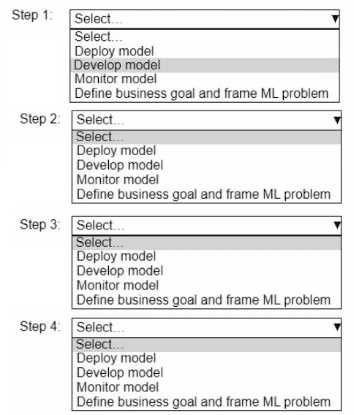
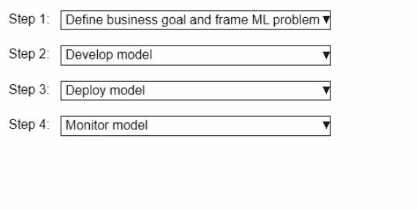
HOTSPOT A company wants to build an ML application. Select and order the correct steps from the following list to develop a well-architected ML workload. Each step should be selected one time. (Select and order FOUR.) • Deploy model • Develop model • Monitor model • Define business goal and frame ML problem Amazon AIF-C01 question Amazon AIF-C01 question

Your Answer
9 comments in the community discussion
5
Do you pick the exact AWS lifecycle order here or can steps overlap if it's an agile project?
5
That’s the typical AWS ML lifecycle. Define business goal and frame ML problem, develop model, deploy model, monitor model.
Q: 15
A publishing company built a Retrieval Augmented Generation (RAG) based solution to give its users the ability to interact with published content. New content is published daily. The company wants to provide a near real-time experience to users. Which steps in the RAG pipeline should the company implement by using offline batch processing to meet these requirements? (Select TWO.)
Options
7 comments in the community discussion
1
Practice exams and the official AWS study guide both point to B here.
1
A and C tbh, saw a similar style question in some practice sets. Generating content embeddings and building the search index can be done offline without delaying user queries.
Q: 16
An e-commerce company wants to build a solution to determine customer sentiments based on written customer reviews of products. Which AWS services meet these requirements? (Select TWO.)
Options
18 comments in the community discussion
1
I don't think it's A. Lex is mainly for chatbots and not sentiment analysis, so that's a common mistake here. B and D fit since Comprehend is made for this, and Bedrock supports LLM models for NLP tasks.
1
Looks like it's B and A, not D. Bedrock just feels like overkill from what I've seen in practice questions.
Q: 17
A company is using Amazon SageMaker Studio notebooks to build and train ML models. The company stores the data in an Amazon S3 bucket. The company needs to manage the flow of data from Amazon S3 to SageMaker Studio notebooks. Which solution will meet this requirement?
Options
12 comments in the community discussion
1
C
1
D tbh
Q: 18
A company wants to display the total sales for its top-selling products across various retail locations in the past 12 months. Which AWS solution should the company use to automate the generation of graphs?
Options
13 comments in the community discussion
1
Looks like C here since QuickSight is actually built for automated data visuals, but if the sales data was unstructured or needed code preprocessing, options like B could be in play. Pretty sure the exam expects C unless they add a weird twist.
1
C imo, EC2 is a trap here since QuickSight actually handles the graphs directly.
Q: 19
A research company implemented a chatbot by using a foundation model (FM) from Amazon Bedrock. The chatbot searches for answers to questions from a large database of research papers. After multiple prompt engineering attempts, the company notices that the FM is performing poorly because of the complex scientific terms in the research papers. How can the company improve the performance of the chatbot?
Options
16 comments in the community discussion
1
I’d say A for this one. Few-shot prompting might help the FM better understand how to interpret those scientific terms, since it gives concrete examples. Not 100 percent but seems reasonable to try before fine-tuning.
1
Not totally sure but I'd pick B here. Fine-tuning makes sense when the model struggles with domain-specific language like scientific terms.
Q: 20
Which AWS service or feature can help an AI development team quickly deploy and consume a foundation model (FM) within the team's VPC?
Options
14 comments in the community discussion
1
Probably B is correct. JumpStart actually launches foundation models directly into your team's VPC, which none of the others do. The question wants something that's private and not just a public-facing endpoint, so B makes sense here.
1
B . JumpStart is the only option here that makes it super easy to deploy a foundation model inside your own VPC. The others like C are more for public demo/testing, not production or private deployment. B just lines up with the VPC requirement in the question, pretty sure about it but open to disagreement.
Question 1 of 20

Premium Access Includes

  • Quiz Simulator
  • Exam Mode
  • Progress Tracking
  • Question Saving
  • Flash Cards
  • Drag & Drops
  • 3 Months Access
  • PDF Downloads
Get Premium Access
Scroll to Top

FLASH OFFER

Days
Hours
Minutes
Seconds

avail 10% DISCOUNT on YOUR PURCHASE