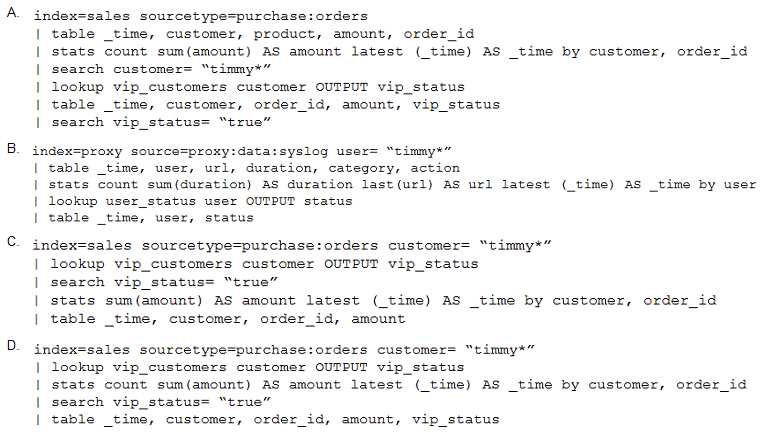
1. Splunk Enterprise Documentation, Search Manual, "Write better searches": This guide emphasizes optimizing searches by removing unnecessary commands. The final table command is unnecessary if the default output of the stats command is acceptable. The manual states, "A search is a series of commands... Every command that you add to your search adds to the processing load." (Splunk Enterprise 9.2.1, Search Manual, Chapter: "Write better searches", Section: "Quick tips for optimization").
2. Splunk Enterprise Documentation, Search Reference, "where": The documentation for the where command explicitly contrasts it with search for filtering results of other commands. It states, "The search command can be used for the same purpose, but where is more efficient because it does not use the search parsers." This confirms why Option A is incorrect. (Splunk Enterprise 9.2.1, Search Reference, Command: "where", Section: "Description").
3. Splunk Enterprise Documentation, Search Manual, "About transforming commands and searches": This section explains the nature of transforming commands like stats and table. Placing table before stats (Option B) disrupts the efficient flow of data by performing a formatting transformation before the necessary statistical transformation, which is an anti-pattern for performance. (Splunk Enterprise 9.2.1, Search Manual, Chapter: "About searches", Section: "About transforming commands and searches").

 How can the search be rewritten to maximize efficiency?
 How can the search be rewritten to maximize efficiency?