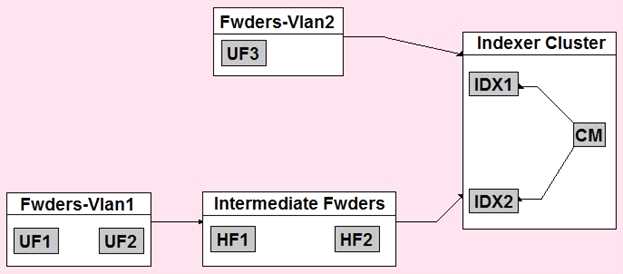
1. Splunk Enterprise Documentation, Getting Data In Manual: In the section "Configuration file locations for this manual," it states, "For index-time configurations that you make in props.conf, transforms.conf, and fields.conf, you must place the files on the Splunk Enterprise instance that performs the parsing. This is usually the indexer, but can be a heavy forwarder if you use one to parse data before it reaches the indexer." This confirms that either HFs or indexers can be the "parsing instance."
2. Splunk Enterprise Documentation, Forwarding Data Manual: The "Compare forwarder types" table explicitly lists that Universal Forwarders do not perform parsing, while Heavy Forwarders do. This supports why option A is incorrect and why HFs (in options C and D) are a potential location for parsing configurations.
3. Splunk Enterprise Documentation, Managing Indexers and Clusters of Indexers Manual: The chapter on "How indexing works" describes the data pipeline, which includes the parsing phase. This entire pipeline is executed on indexers or, in a tiered architecture, can be executed on heavy forwarders before the data reaches the indexers. This reinforces that the location of parsing is a design choice between HFs and indexers.