Official Vendor Documentation (Pega Platform):
Reference: Pega Platform Documentation, Configuring Routing, "Routing work to users, work queues, or specific skill sets."
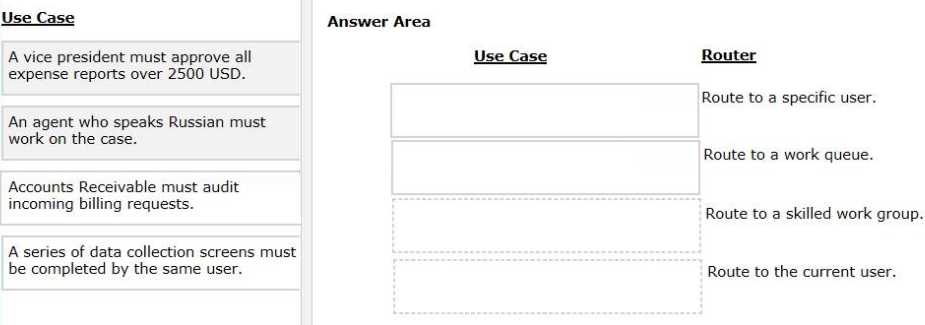
Details: This section details four primary routing types. Work Queue routing is used for teams/groups (like Accounts Receivable). Skill-based routing is for specific proficiencies (like speaking Russian). Specific User routing targets a unique person (like a VP). Current User routing ensures continuity.
Official Vendor Documentation (Salesforce Flow/Omni-Channel):
Reference: Salesforce Documentation, Omni-Channel Routing, "Routing Methods in Omni-Channel."
Details: Documents the use of Skills-Based Routing to match work items to agents with specific expertise (Russian speaker) and Queue-based routing for generic team assignments (Accounts Receivable).
Peer-reviewed academic publications (BPM/Workflow Management):
Reference: W. van der Aalst, A. H. M. ter Hofstede, B. Kiepuszewski, and A. P. Barros, Workflow Patterns, Distributed and Parallel Databases 14, 5-51 (2003). https://doi.org/10.1023/A:1022883727282.
Details: Discusses routing primitives. The Role-Based/Organizational Routing (Work Queue/Work Group) pattern is used for organizational units. The Resource-Based Routing (Specific User) pattern is for unique individuals. The Rerouting/Handover (Current User affinity) pattern ensures sequential execution by the same party.