
Q: 1
What information does the Architecture Requirements Repository within the Architecture Repository
hold?
Options
Discussion
B , because the question mentions parameters and structures and that sounds like what supports governance. I know everyone points to D from the official guides, but in some practice tests B lines up with supporting the management around requirements. If you have time, check the official guide and a few practice exams before finalizing. Agree?
Option D. The repo's purpose is to store requirements agreed by the Architecture Board, not guidelines or governance docs. Pretty sure that's what they're after here.
D tbh, B is tempting but looks like a distractor. In similar questions, only D actually matches "agreed with the Architecture Board."
D
Probably D for this. The repository is all about keeping the board-approved requirements, not templates or process stuff. Seen this phrasing on other practice sets.
Ugh, always with the similar-sounding options. D or maybe B but practice exams point to D for actually storing agreed requirements.
Pretty sure the answer is D here. Seen similar questions in official practice sets and they always point to the repository holding formally approved requirements, not guidelines or governance docs. If you have the official TOGAF guide handy, that section is worth a skim just in case I'm off.
D or maybe B. Had something like this in a mock and D was right because it's the actual agreed requirements, while B is more about governance setup. Not 100% but D matches what I remember. Anyone disagree?
Definitely D. The repo holds the requirements signed off by the Architecture Board, not templates, logs or parameters. Makes sense right?
Why does B get mentioned so often? The requirements repo is just where agreed requirements are kept, not parameters or templates.
Be respectful. No spam.
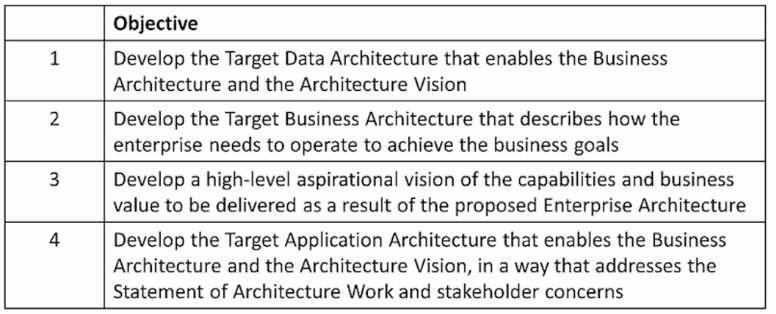 Which phase does each objective match?