View Mode
Q: 11
The application network is recomposable: it is built for change because it "bends but does not break"
Options
Q: 12
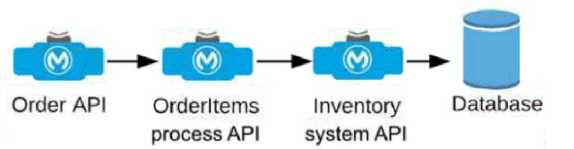
An Order API triggers a sequence of other API calls to look up details of an order's items in a back- end inventory database. The Order API calls the OrderItems process API, which calls the Inventory system API. The Inventory system API performs database operations in the back-end inventory database. The network connection between the Inventory system API and the database is known to be unreliable and hang at unpredictable times. Where should a two-second timeout be configured in the API processing sequence so that the Order API never waits more than two seconds for a response from the Orderltems process API? Salesforce MuleSoft Platform Architect I question
Options
Q: 13
What is the main change to the IT operating model that MuleSoft recommends to organizations to improve innovation and clock speed?
Options
Q: 14
Question 10: Skipped An API implementation returns three X-RateLimit-* HTTP response headers to a requesting API client. What type of information do these response headers indicate to the API client?
Options
Q: 15
What is true about API implementations when dealing with legal regulations that require all data processing to be performed within a certain jurisdiction (such as in the USA or the EU)?
Options
Q: 16
A company requires Mule applications deployed to CloudHub to be isolated between non-production and production environments. This is so Mule applications deployed to non-production environments can only access backend systems running in their customer-hosted non-production environment, and so Mule applications deployed to production environments can only access backend systems running in their customer-hosted production environment. How does MuleSoft recommend modifying Mule applications, configuring environments, or changing infrastructure to support this type of per-environment isolation between Mule applications and backend systems?
Options
Q: 17
A set of tests must be performed prior to deploying API implementations to a staging environment. Due to data security and access restrictions, untested APIs cannot be granted access to the backend systems, so instead mocked data must be used for these tests. The amount of available mocked data and its contents is sufficient to entirely test the API implementations with no active connections to the backend systems. What type of tests should be used to incorporate this mocked data?
Options
Q: 18
What do the API invocation metrics provided by Anypoint Platform provide?
Options
Q: 19
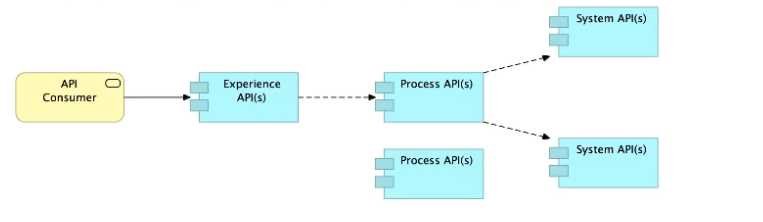
Refer to the exhibit. What is the best way to decompose one end-to-end business process into a collaboration of Experience, Process, and System APIs? A) Handle customizations for the end-user application at the Process API level rather than the Experience API level B) Allow System APIs to return data that is NOT currently required by the identified Process or Experience APIs C) Always use a tiered approach by creating exactly one API for each of the 3 layers (Experience, Process and System APIs) D) Use a Process API to orchestrate calls to multiple System APIs, but NOT to other Process APIs Salesforce MuleSoft Platform Architect I question
Options
Q: 20
Which three tools automate the deployment of Mule applications? Choose 3 answers
Options
Question 11 of 20 · Page 2 / 2

Premium Access Includes

  • Quiz Simulator
  • Exam Mode
  • Progress Tracking
  • Question Saving
  • Flash Cards
  • Drag & Drops
  • 3 Months Access
  • PDF Downloads
Get Premium Access
Scroll to Top

FLASH OFFER

Days
Hours
Minutes
Seconds

avail 10% DISCOUNT on YOUR PURCHASE