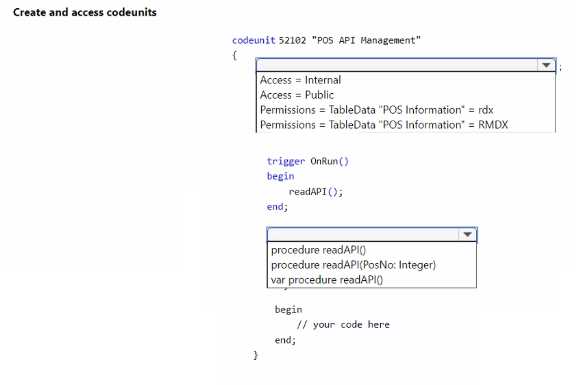
HOTSPOT You need to create the codeunit to read the POS terminal APIs. How should you complete the code segment? To answer, select the appropriate options in the answer area. NOTE; Each correct selection is worth one point.
DRAG DROP A company is implementing Business Central. The company has the following requirements for a report: • The report must be loaded for users in a specific location only. • Data entered in the request page must be validated before any further processing. • A filter must be defined for users based on the Department field defined in user setup. You need to implement the given requirements. Which triggers should you use? To answer, move the appropriate triggers to the correct requirements. You may use each trigger once, more than once, or not at all. You may need to move the split bar between panes or scroll to view content. NOTE: Each correct selection is worth one point.
Load the report for users in a specific location → OnInitReport, Validate data before processing → OnPreReport, Filter based on Department field → OnPreDataItem. Pretty standard as per exam reports-filters tied to data items always go OnPreDataItem. Disagree?
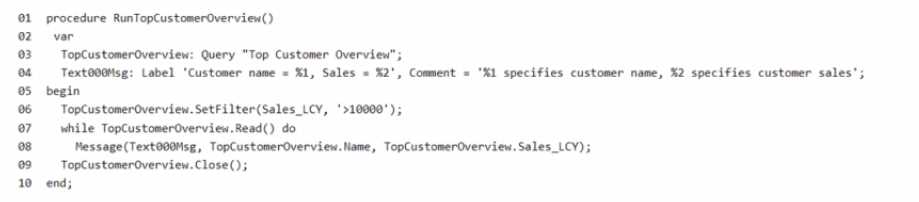
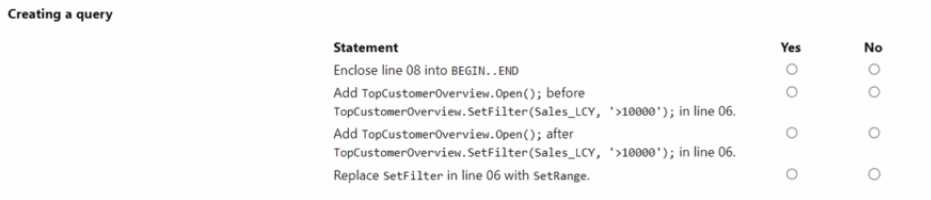
HOTSPOT You create a query that contains a procedure to display the top customers. The procedure breaks at runtime. 
Just to confirm, is the question specifically about fixing the runtime error, or are they asking for the most efficient code structure? If they wanted only to prevent the error, adding Open() after setting the filter matters. But if efficiency or code style were key, that could change things.
HOTSPOT A company plans to customize its per tenant extension reports. The company has the following requirements for the customization: • Child data items must not be displayed on the request page for some master detail reports. • Selecting key filter fields takes users too much time. The customization must decrease the amount of time to select the fields. You need to optimize the report request page. Which actions should you configure? To answer, select the appropriate options in the answer area. NOTE: Each correct selection is worth one point.
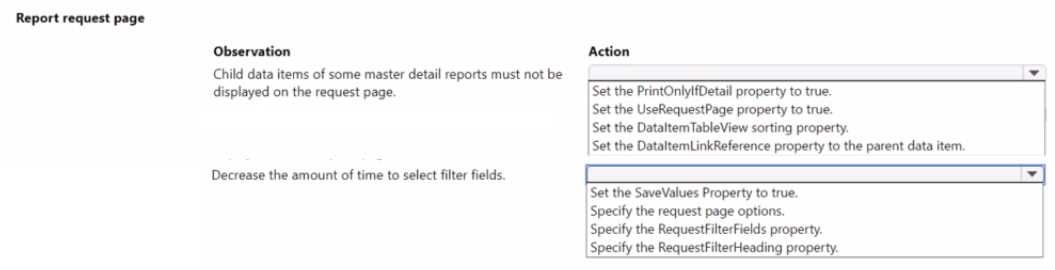
Set DataItemLinkReference on child, and use RequestFilterFields. Saw similar in some MB-820 practice reports.
Set DataItemLinkReference for the child and configure RequestFilterFields. DataItemLinkReference hides the child from the request page, while RequestFilterFields preselects key filter fields for users. Pretty sure this matches what’s needed for Dynamics report customization, anyone disagree?
Really clear scenario. For hiding child data items on the request page, setting DataItemLinkReference on the child to point to the parent is key, it makes the child tab disappear. For faster field selection, use RequestFilterFields, it lets you pick default filters so users don't have to waste time digging for them. I think these are the best ways to handle both requirements. Anyone see another approach?
For the first requirement, do you just need to set DataItemLinkReference on the child to its parent so that tab gets hidden on the request page? Also, for reducing filter field selection time, would using RequestFilterFields auto-pick what shows up by default? Or is there another property I'm missing here?
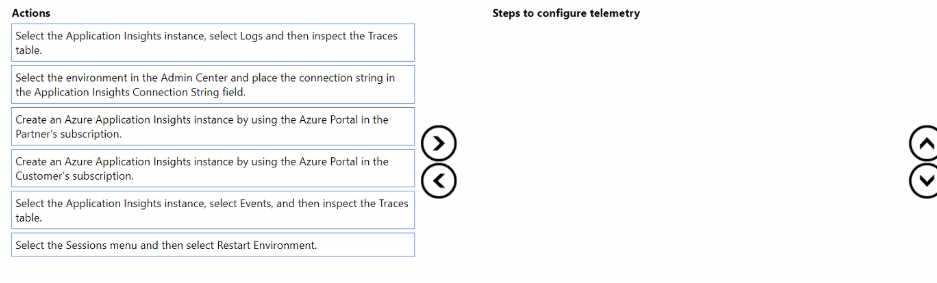
DRAG DROP You need to configure telemetry for the SaaS tenant and test whether the ingested signals are displayed. Which three actions should you perform in sequence? To answer, move the appropriate actions from the list of actions to the answer area and arrange them in the correct order.
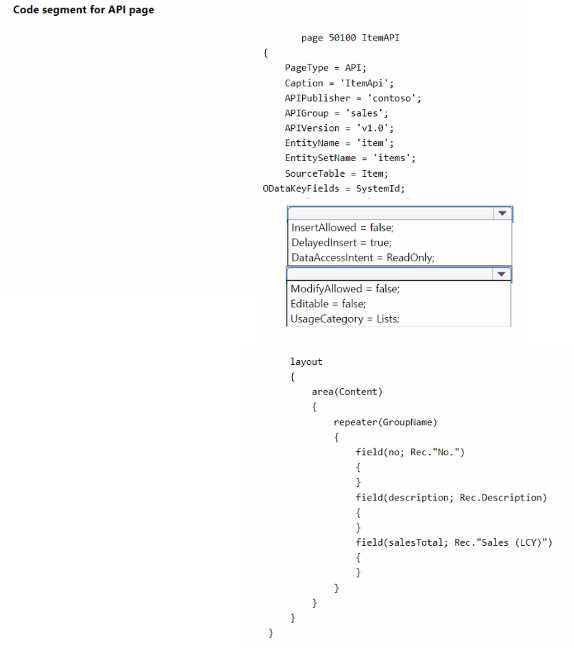
HOTSPOT You need to create the API page according to the requirements. How should you complete the code segment? To answer, select the appropriate options in the answer area. NOTE: Each correct selection is worth one point.
DRAG DROP A company plans to deploy Business Central. The company has the following deployment requirements: • Use the company hardware architecture to run the deployment. • Use sandbox environments to develop extensions. • Allow tenants to connect to Shopify with the standard connector. • Use Microsoft Power Automate to create a workflow that calls a business event. You need to identify the deployment type for each requirement. Which deployment types should you use? To answer, move the appropriate deployment types to the correct requirements. You may use each deployment type once, more than once, or not at all.
Yeah this matches what I’ve seen on similar questions. On-premises is the only way to meet the hardware requirement, but sandbox, Shopify connector, and Power Automate workflows are all standard features in Online. Easy to miss the Shopify trap here!
- Run on company hardware: On-premises
- Sandbox envs/extensions: Online
- Shopify connect: Online
- Workflow: Online
Is the "run on company hardware" requirement strict, or could they use Azure VMs too? If cloud-hosted VMs are allowed, it might shift the mapping. On-premises only makes sense if physical servers are required.
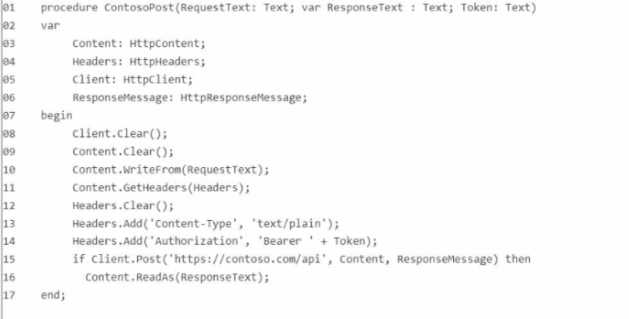
HOTSPOT You create a 'Contoso Post" procedure to send an http POST request in JSON format. You publish the procedure to your environment. You write the following procedure code: 
ReadAs isn't on the HttpResponseMessage itself. No for line 16.