1. Juniper Networks TechLibrary, BGP Path Selection. This document outlines the BGP decision process. The very first step listed is: "1. Prefer the path with the highest LOCALPREF value." This confirms the fundamental principle that a higher value is preferred, supporting the logic for both correct answers.
Source: Juniper Networks, "BGP Path Selection," Junos OS Documentation.
Reference: Section: "BGP Path Selection on a Routing Device"
2. Juniper Networks TechLibrary, Example: Configuring BGP Local Preference. This configuration example demonstrates a scenario identical to the question, where an import policy is used to set a higher local-preference (e.g., 200) for routes from the primary ISP. This directly validates option A.
Source: Juniper Networks, "Routing Policies, Firewall Filters, and Traffic Policers Feature Guide for Routing Devices," Junos OS Documentation.
Reference: Section: "Example: Configuring BGP Local Preference"
3. Juniper Networks TechLibrary, Understanding BGP Path Selection. This guide explains the role of attributes in path selection. It states, "The local preference attribute provides a mechanism to give iBGP peers a preference for a particular exit point from the local AS." This confirms that local-preference is the correct attribute for this scenario. The same logic of preferring higher values means that lowering the value on the non-preferred path (Option C) is also a valid method.
Source: Juniper Networks, "BGP Feature Guide for Routing Devices," Junos OS Documentation.
Reference: Section: "Understanding BGP Path Selection," Subsection: "Local Preference"

 Your network receives the full Internet BGP routing table from two different ISPs. You want your local
routers to use Provider A to forward all Internet traffic as long as Provider A is available.
Referring to the exhibit, which two actions would satisfy this requirement? (Choose two.)
Your network receives the full Internet BGP routing table from two different ISPs. You want your local
routers to use Provider A to forward all Internet traffic as long as Provider A is available.
Referring to the exhibit, which two actions would satisfy this requirement? (Choose two.)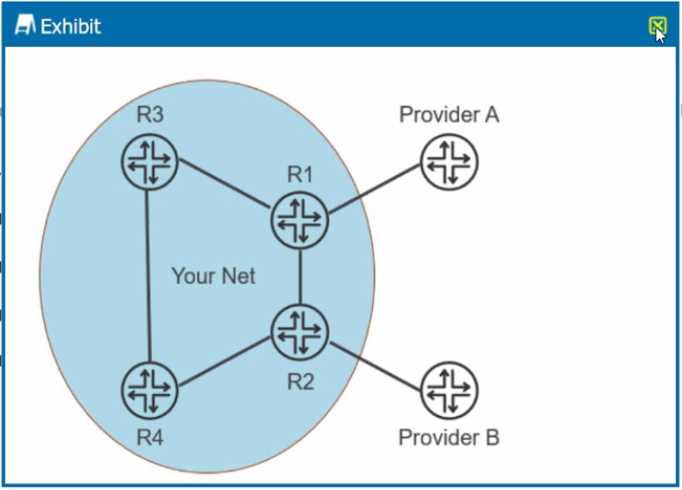 Your network receives the full Internet BGP routing table from two different ISPs. You want your local
routers to use Provider A to forward all Internet traffic as long as Provider A is available.
Referring to the exhibit, which two actions would satisfy this requirement? (Choose two.)
Your network receives the full Internet BGP routing table from two different ISPs. You want your local
routers to use Provider A to forward all Internet traffic as long as Provider A is available.
Referring to the exhibit, which two actions would satisfy this requirement? (Choose two.)