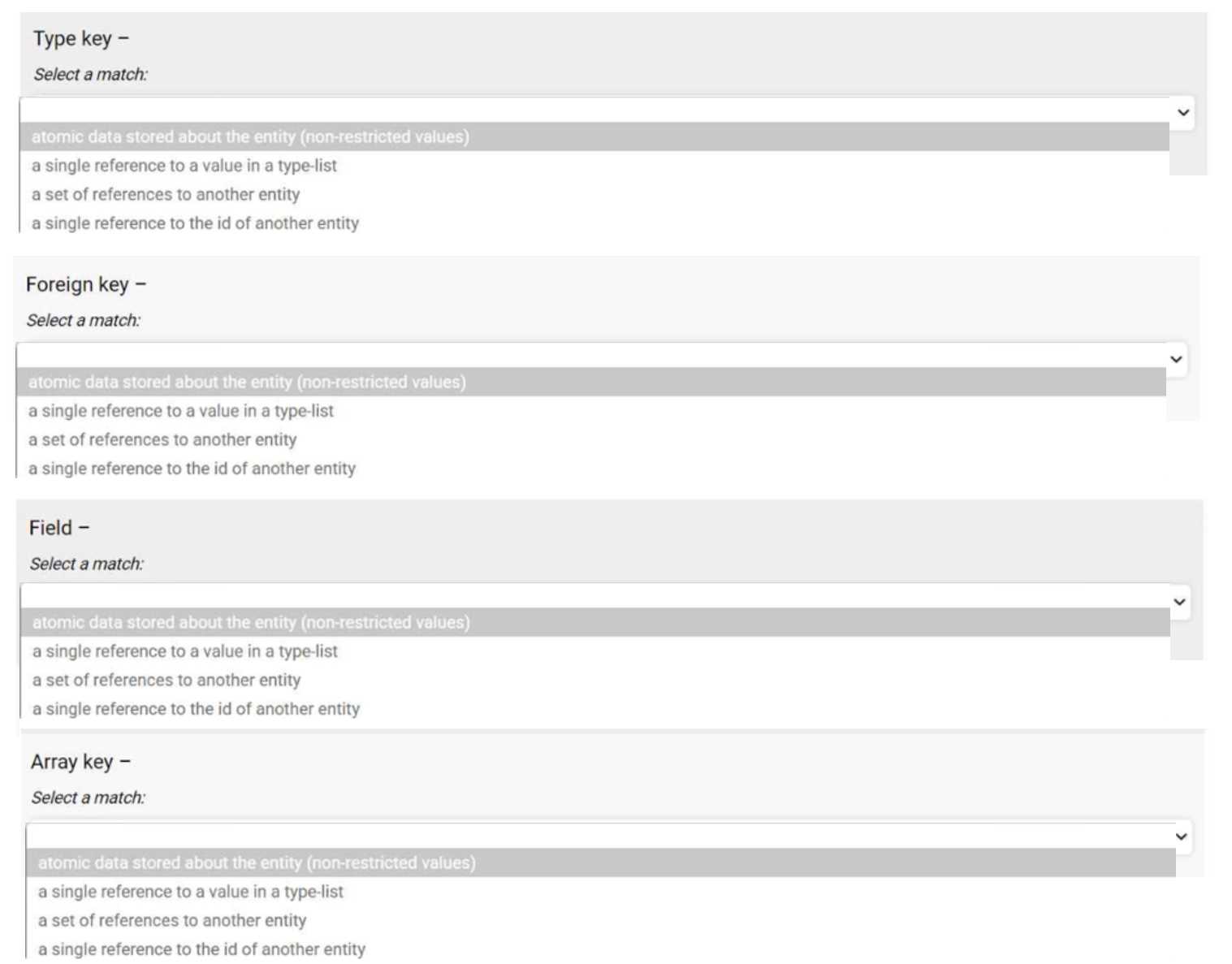
to another entity
In the Guidewire Data Model, entities consist of different types of columns/properties that define
their structure and relationships:
Type key (B): This field creates a relationship between the entity and a Typelist (a pre-defined list of
valid values, like a dropdown menu). For example, a Status field that can only be "Open", "Closed", or
"Pending" is a Type key pointing to the StatusType typelist. It references a single specific value from
that list.
Foreign key (D): This creates a link to a specific instance of another entity. It stores the unique ID of
that related object. This represents a "Many-to-One" or "One-to-One" relationship. For example, a
Claim entity has a Foreign Key to a Policy entity (because one claim belongs to one specific policy).
Field (A): Often called a "Column" or "Atomic Field," this stores raw data such as Strings, Integers,
Booleans, or Dates. It holds atomic data (e.g., "First Name", "Loss Date", "Coverage Amount") that is
not restricted to a specific list of values like a Type key is.
Array key (C): This represents a "One-to-Many" relationship. It allows the parent entity to link to a
collection (set) of child entities. For example, a Policy entity has an Array of Vehicle entities (because
one policy can cover multiple vehicles).