Isn't option C possible? Since you have to account for the TCP payload and the IP header when setting MSS, setting it wrong can cause issues like fragmentation. Not 100% sure, but I thought you need to consider both aspects when configuring these on FortiGate.
Q: 1
How will configuring set tcp-mss-sender and set tcp-mss-receiver in a firewall policy affect the size
and handling of TCP packets in the network?
Options
Discussion
C tbh, seems like a reasonable answer since the MSS config should consider headers and payload to avoid fragmentation. Trap is that C makes it sound more manual than how FortiGate handles MSS adjustment, but I still think thinking about header size matters here. Not super confident though.
I don’t think it’s B. C is more likely, since when setting MSS you have to factor in both the packet payload and headers or else you risk fragmentation. Pretty sure I saw something like this on a practice exam. Agree?
Be respectful. No spam.
Q: 2
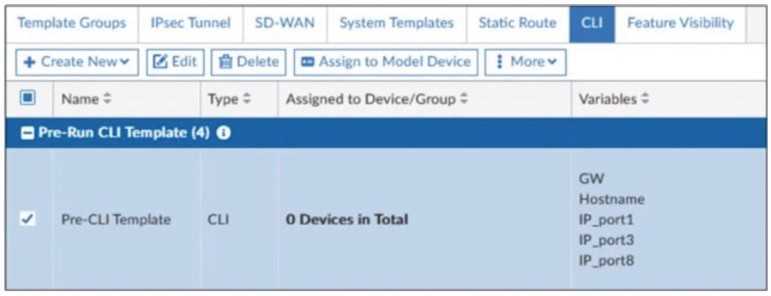
Refer to the exhibit.
A pre-run CLI template that is used in zero-touch provisioning (ZTP) and low-touch provisioning (LTP)
with FortiManager is shown.
The template is not assigned even though the configuration has already been installed on FortiGate.
What is true about this scenario?
The template is not assigned even though the configuration has already been installed on FortiGate.
What is true about this scenario?Options
Discussion
Option B, they get auto-unassigned after the first install. Pretty sure that’s how ZTP/LTP pre-run templates work with FortiManager.
Makes sense to me, I'd pick B too. FortiManager unassigns pre-run templates automatically after first use.
B FortiManager auto-unassigns pre-run CLI templates after the first install, that’s by design for ZTP/LTP. Agree?
Not A, it's B. Pre-run CLI templates are only for initial config and FortiManager auto-unassigns them after first deployment. Option C is the trap here, since you don't have to do it manually. If anyone's seen a scenario where it wasn't automatic, let me know, but I'm pretty sure that's the default.
Its B, pre-run templates get auto-unassigned by FortiManager after first use to prevent conflicts. Pretty sure that's the main difference from post-run ones. Let me know if someone saw it behave otherwise.
Be respectful. No spam.
Q: 3
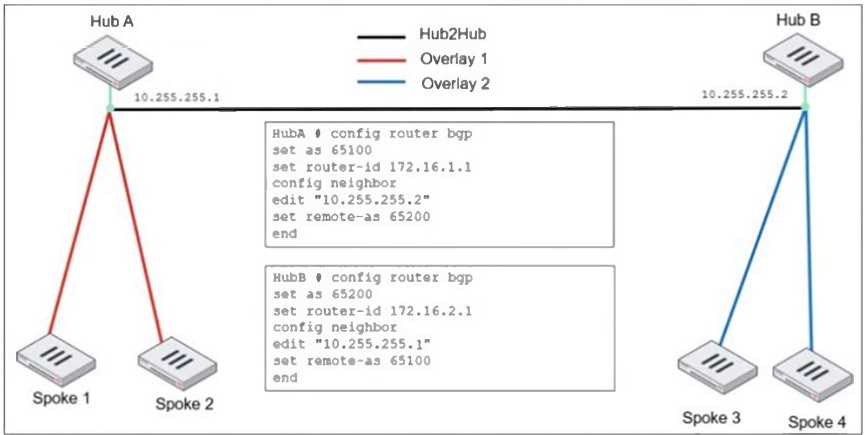
Refer to the exhibit, which shows an ADVPN network
An administrator must configure an ADVPN using IBGP and EBGP to connect overlay network 1 with
2.
What two options must the administrator configure in BGP? (Choose two.)
An administrator must configure an ADVPN using IBGP and EBGP to connect overlay network 1 with
2.
What two options must the administrator configure in BGP? (Choose two.)Options
Discussion
Probably A and B since you need ebgp-enforce-multihop for non-directly connected peers, and next-hop-self so the hub advertises itself properly. D is tempting but doesn’t apply here, I think. Agree?
Option A and B, these are needed for ADVPN with both eBGP/iBGP. Pretty sure that's right from practice tests.
Be respectful. No spam.
Q: 4
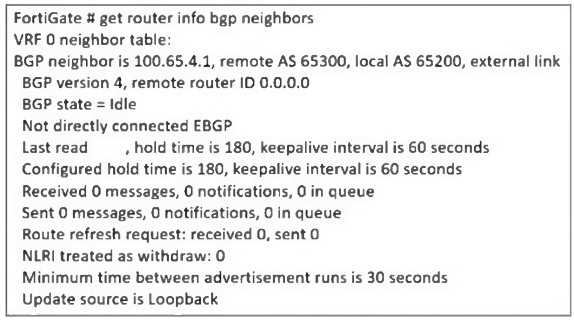
Refer to the exhibit, which contains a partial command output.
The administrator has configured BGP on FortiGate. The status of this new BGP configuration is
shown in the exhibit.
What configuration must the administrator consider next?
The administrator has configured BGP on FortiGate. The status of this new BGP configuration is
shown in the exhibit.
What configuration must the administrator consider next?Options
Discussion
Option D since eBGP by default doesn't allow multihop. Here the peer isn't directly connected, so enabling ebgp-enforce-multihop should fix it. Pretty common BGP issue on FortiGates, but let me know if I'm missing a detail.
C/D? I don't think it's B, since usually the AS is already set if you're seeing this neighbor. But C is a trap-enabling BGP on the remote side won't fix multihop issues. Pretty sure D is needed because the neighbor isn't directly connected, unless I'm missing something in the output. Open to other takes if someone sees a config detail I missed.
B or maybe A. If the local AS isn’t set to 65300, you’ll never get a session up with a remote peer expecting that, and FortiGate won’t initiate BGP correctly. Also, missing a static route could cause neighbor reachability problems even before worrying about multihop settings. I think those are higher priority than enabling ebgp-enforce-multihop in some setups. Anyone else run into this edge case and needed to fix routing/AS first?
D gets my vote. Since eBGP only forms with directly connected peers unless ebgp-enforce-multihop is on, and the neighbor IP looks like it's not directly connected, enabling that should allow sessions to form. Pretty sure that's it. Disagree?
Honestly, Fortinet's BGP setup quirks are such a pain sometimes. D imo
Be respectful. No spam.
Q: 5
An administrator is checking an enterprise network and sees a suspicious packet with the MAC
address e0:23:ff:fc:00:86.
What two conclusions can the administrator draw? (Choose two.)
Options
Discussion
A and C. No extra info needed here.
Option A and C
A and C imo
Probably A and C, saw a similar MAC address format show up in exam reports.
C/D? I remember something about the MACs but not sure, anyone confirm which is right here?
Be respectful. No spam.
Q: 6
An administrator must minimize CPU and RAM use on a FortiGate firewall while also enabling
essential security features, such as web filtering and application control for HTTPS traffic.
Which SSL inspection setting helps reduce system load while also enabling security features, such as
web filtering and application control for encrypted HTTPS traffic?
Options
Discussion
D , certificate inspection mode uses way less resources and still gets the job done for filtering HTTPS traffic.
D imo. Certificate inspection does enough for web filtering and app control by checking certs and SNI, without chewing up resources like full SSL inspection. You lose some deep inspection, but that's the tradeoff for saving CPU/RAM. Seen similar wording on practice tests-D's the efficient option here.
C tbh, since it says 'handle HTTPS traffic efficiently' and that sounds like a resource-saving mode. I thought certificate inspection (D) is too basic and might not support all security features, but maybe I'm missing something. Can someone clarify the main difference here?
D or maybe C, but pretty sure it's D. Certificate inspection mode checks just the cert info and SNI, so it supports URL filtering/app control with way less CPU/RAM use than full inspection. Clear question, nice to see specifics called out here.
Be respectful. No spam.
Q: 7
Refer to the exhibit.
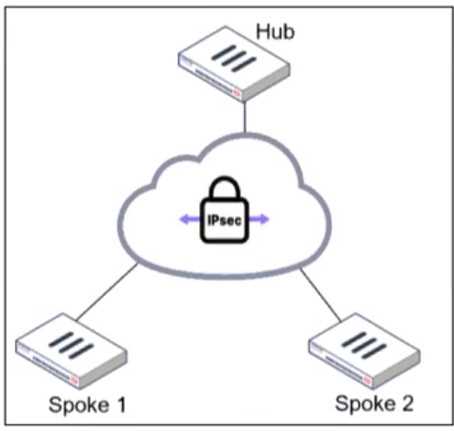
An administrator is deploying a hub and spokes network and using OSPF as dynamic protocol.
Which configuration is mandatory for neighbor adjacency?
An administrator is deploying a hub and spokes network and using OSPF as dynamic protocol.
Which configuration is mandatory for neighbor adjacency?Options
Discussion
B , setting network-type to point-to-multipoint on the hub is usually what makes adjacencies work in a hub-and-spoke OSPF setup. The others aren't required just to get neighbors up. Pretty sure it's B but open to corrections if someone's seen otherwise.
Guessing D, but is the hub interface a broadcast or non-broadcast type? That would affect the needed setting.
Be respectful. No spam.
Q: 8
An administrator must standardize the deployment of FortiGate devices across branches with
consistent interface roles and policy packages using FortiManager.
What is the recommended best practice for interface assignment in this scenario?
Options
Discussion
A is right here imo. Metadata variables let you use one policy package and swap out values per branch, so config stays clean and flexible. Install On doesn’t solve the variable interface problem as easily. Someone let me know if they’ve made B or D work for this.
A imo. Using metadata variables lets you push a single standard config but still handle each branch's unique details (like IPs or VLANs). Pretty common best practice, seen it in several official guides.
Its A. Metadata variables are made for this kind of scenario, lets you keep one standard template and just fill in the site specifics on install. Makes scaling a lot easier, I think. Anyone disagree?
Be respectful. No spam.
Q: 9
An administrator needs to install an IPS profile without triggering false positives that can impact
applications and cause problems with the user's normal traffic flow.
Which action can the administrator take to prevent false positives on IPS analysis?
Options
Discussion
Probably A but does "best" mean lowest initial impact or broadest protection? If it's about minimal disruption, A fits.
Be respectful. No spam.
Q: 10
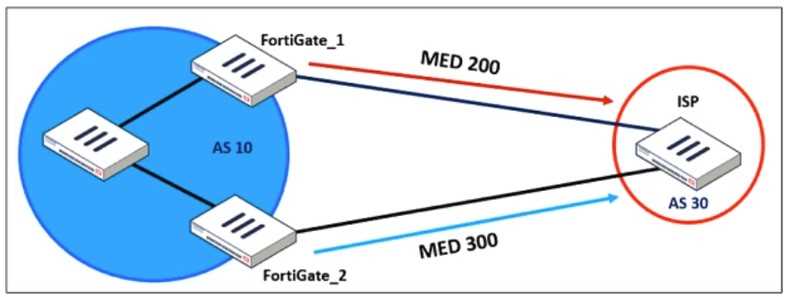
Refer to the exhibit, which shows a network diagram.
An administrator would like to modify the MED value advertised from FortiGate_1 to a BGP neighbor
in the autonomous system 30.
What must the administrator configure on FortiGate_1 to implement this?
An administrator would like to modify the MED value advertised from FortiGate_1 to a BGP neighbor
in the autonomous system 30.
What must the administrator configure on FortiGate_1 to implement this?Options
Discussion
A
Super clear diagram, thanks! Option D
Be respectful. No spam.
Question 1 of 20 · Page 1 / 2