Contoso has an Azure subscription in North Europe that contains the corporate infrastructure. The current infrastructure contains a Microsoft SQL Server 2017 database. The database contains the following tables.
The FeedbackJson column has a full-text index and stores JSON documents in the following format.
The support staff at Contoso never has the unmask permission.
Requirements
Contoso is deploying a new Azure SQL database that will become the authoritative data store for the following;
• Alworkloads
• Vector search
• Modernized API access
• Retrieval Augmented Generation (RAG) pipelines
Sometimesthe ingestion pipeline fails due to malformed JSON and duplicate payloads.
The engineers at Contoso report that the following dashboard query runs slowly.
SELECT VehicleTd, Lastupdatedutc, EngineStatus, BatteryHealth FROM dbo.VehicleHealthSumary where fleetld- gFleetld ORDER BV LastUpdatedUtc DESC;
You review the execution plan and discover that the plan shows a clustered index scan.
vehicleincidentReports often contains details about the weather, traffic conditions, and location. Analysts report that it is difficult to find similar incidents based on these details
Planned Changes
Contoso wants to modernize Fleet Intelligence Platform to support Al-powered semantic search over
incident reports.
Security Requirements
Contoso identifies the following telemetry requirements:
• Telemetry data must be stored in a partitioned table.
• Telemetry data must provide predictable performance for ingestion and retention operations.
• latitude, longitude, and accuracy JSON properties must be filtered by using an index seek.
Contoso identifies the following maintenance data requirements:
• Ensure that any changes to a row in the MaintenanceEvents table updates the corresponding
value in the LastModif reduce column to the time of the change.
• Avoidrecursive updates.
AI Search, Embedding’s, and Vector indexing
The development learn at Contoso will use Microsoft Visual Studio Code and GitHub Copilot and will
retrieve live metadata from the databases. Contoso identifies the following requirements for
querying data in the FeedbackJson column of the customer-Feedback table:
• Extract the customer feedback text from the JSON document.
• Filter rows where the JSON text contains a keyword.
• Calculate a fuzzy similarity score between the feedback text and a known issue description.
• Orderthe results by similarity score, with the highest score first
View Mode
Q: 3
You have a Microsoft SQL Server 2025 instance that has a managed identity enabled.
You have a database that contains a table named dbo.ManualChunks. dbo.ManualChunks contains
product manuals.
A retrieval query already returns the top five matching chunks as nvarchar(max) text.
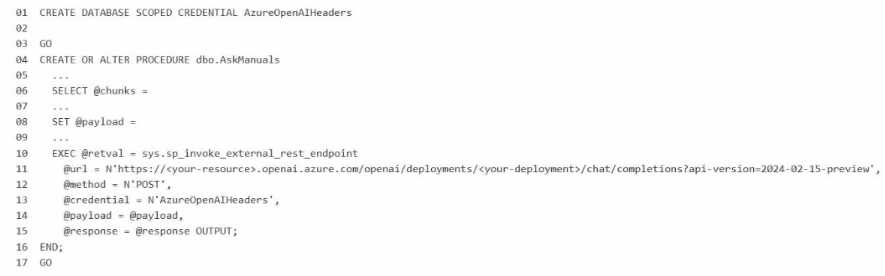
You need to call an Azure OpenAI REST endpoint for chat completions. The solution must provide the
highest level of security.
You write the following Transact-SG1 code.
What should you insert at line 02?
A)
B)
C)
D)
E)
Options
Discussion
No comments yet. Be the first to comment.
Be respectful. No spam.
Correct Answer:
B
Explanation
A database-scoped credential that uses the built-in “Managed Identity” principal allows SQL Server to obtain an access token at execution time without storing secrets. The credential name is then referenced by sys.spinvokeexternalrestendpoint, giving the highest security posture because no keys are embedded in code.
Why Incorrect
A. ‘IDENTITY=’’Shared Access Signature’’’ would expect a secret; not supported for managed identity.
C. Arbitrary identity text cannot be resolved to an Azure AD principal; call will fail.
D. ‘IDENTITY=''Access Token''' implies a token value must be stored, exposing secrets.
E. Missing WITH keyword; syntactically invalid for CREATE DATABASE SCOPED CREDENTIAL.
2. Microsoft Learn – “sys.spinvokeexternalrestendpoint” – @credentialname parameter description (learn.microsoft.com/en-us/sql/relational-databases/system-stored-procedures/sp-invoke-external-rest-endpoint)
3. Microsoft Learn – “Call Azure OpenAI from SQL with managed identity” tutorial (learn.microsoft.com/en-us/azure/azure-sql/ai/invoke-openai-managed-identity)

 What should you insert at line 02?
A)
What should you insert at line 02?
A)
 What should you insert at line 02?
A)
What should you insert at line 02?
A)
 B)
B)
 C)
C)
 D)
D)
 E)
E)

