
Q: 4
DRAG DROP You have an Azure SQL database named DB1. DB1 contains a table that has a column named Col1. You need to encrypt the data in Col1. Which four actions should you perform for DB1 in sequence? To answer, move the appropriate actions from the list of actions to the answer area and arrange them in the correct order. 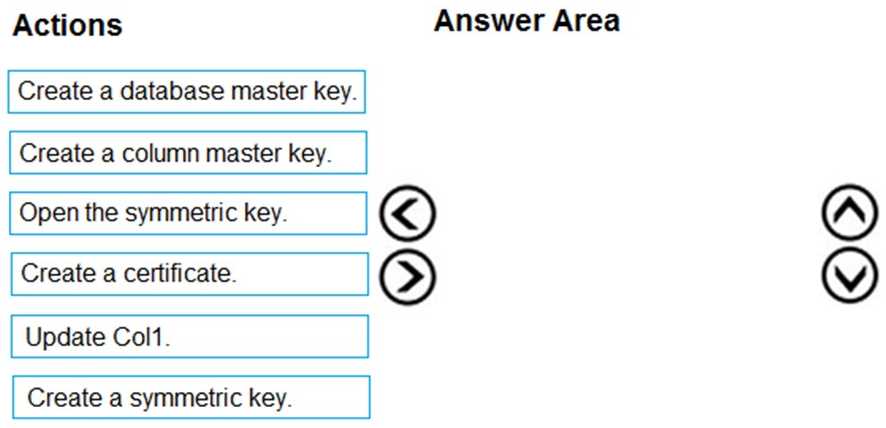
Drag & Drop
Discussion
Create database master key, then certificate, next symmetric key, finally update Col1.
If you picked column master/column encryption key steps, that's for Always Encrypted not cell-level encryption. Azure SQL's cell-level flow always needs that root (DBMK), then cert to protect the symmetric key. Almost got caught out once because I confused these on a practice set! Anyone else?
Not quite, I think the sequence is create DB master key, then certificate, next symmetric key, and finally update Col1. Easy to pick column master key by accident, but that’s for Always Encrypted not TDE/cell in this case.
Create database master key → certificate → symmetric key → update Col1. I don't think column master key or opening the symmetric key is needed here, that's more for Always Encrypted scenarios. The trap is picking those instead of sticking with cell-level encryption sequence. Let me know if I'm off, but pretty sure about this.
I don't think you need column master key here. The right sequence is: create database master key, create certificate, create symmetric key, then update Col1. Trap is mixing in Always Encrypted steps. Seen this on a few practice sets!
Yeah, that order matches cell-level encryption for Azure SQL: create database master key, then certificate, then symmetric key, and finally update Col1. The column master/key steps are only for Always Encrypted scenarios as far as I know. Pretty sure this is correct, but someone let me know if I'm missing a twist.
Create database master key → certificate → symmetric key → update Col1. That's straight from the standard cell-level encryption process for Azure SQL, not Always Encrypted. Saw similar steps in official guide practice questions too. Pretty confident, but let me know if anyone read it different.
Careful here, because if you use Always Encrypted, the order would shift to involve column master/column encryption keys. For cell-level encryption like this, you need: create DB master key → create certificate → create symmetric key → update Col1.
Create a database master key → create certificate → create symmetric key → update Col1.
That sequence matches cell-level encryption in Azure SQL. The column master key step would apply for Always Encrypted, but not here. Pretty sure this is right, but if anyone did see a question with AE let me know.
That sequence matches cell-level encryption in Azure SQL. The column master key step would apply for Always Encrypted, but not here. Pretty sure this is right, but if anyone did see a question with AE let me know.
I keep seeing the open symmetric key step in similar practice sets, so I matched it as: create database master key, certificate, open symmetric key, update Col1. Not 100% but I've seen that order before.
Create database master key, then certificate, symmetric key, and finally update Col1. That's the sequence for cell-level encryption here.
Be respectful. No spam.