1. CloudNetX Official Documentation (CNX-001). Public IP Address Management Guide
Section 4.3: "Lifecycle of Dynamic Public IPs." The guide states
"When a dynamic public IP is de-allocated from a resource
it is returned to the CloudNetX public IP pool. There is no guarantee that the same IP will be reassigned to the same account in the future. It can be immediately reused and assigned to any other customer. All internal configurations
such as firewall rules and DNS A-records
must be updated to prevent dangling references that point to the de-allocated IP."
2. Gkountouna
O.
et al. (2019). An Empirical Study of IP Address Reuse in the Cloud. Proceedings of the ACM SIGSAC Conference on Computer and Communications Security (CCS '19). DOI: https://doi.org/10.1145/3319535.3354231. This study empirically demonstrates that public IP addresses in major cloud platforms are reused rapidly
often within minutes. Section 5
"Security Implications
" details how hardcoded IP-based access controls (like firewall rules) can be subverted when an IP is reused by a different tenant
creating a significant security risk.
3. Stanford University. CS 259D: Data-intensive and Cloud Computing
Lecture 5: Cloud Security. The courseware discusses the risks associated with ephemeral cloud resources. Slide 28
"Dangling Pointers in the Cloud
" explains that de-allocating resources like public IPs without updating all references (DNS
access control lists) creates pointers to resources that are no longer controlled by the original owner
a problem directly analogous to IP reuse.

 Which of the following issues may begin to affect cloud assets after the replacement is made?
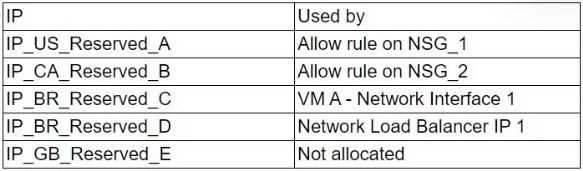 Which of the following issues may begin to affect cloud assets after the replacement is made?