View Mode
Q: 11
Maria Harris is a CFA® Level 3 candidate and portfolio manager for Islandwide Hedge Fund. Harris is commonly involved in complex trading strategies on behalf of Islandwide and maintains a significant relationship with Quadrangle Brokers, which provides portfolio analysis tools to Harris. Recent market volatility has led Islandwide to incur record-high trading volume and commissions with Quadrangle for the quarter. In appreciation of Islandwide's business, Quadrangle offers Harris an all- expenses-paid week of golf at Pebble Beach for her and her husband. Harris discloses the offer to her supervisor and compliance officer and, based on their approval, accepts the trip. Harris has lunch that day with
Options
Q: 12
Susan Foley, CFA, is Chief Investment Officer of Federated Investment Management Co. (FIMCO), a large investment management firm that includes a family of mutual funds as well as individually managed accounts. The individually managed accounts include individuals, personal trusts, and employee benefit plans. In the past few months, Foley has encountered a couple of problems. The Tasty IPO Most portfolio managers of FIMCO have not participated in the initial public offering (IPO) market in recent years. However, recent changes to the compensation calculation at FIMCO have tied manager bonuses to portfolio performance. The changes were outlined in a letter that was sent out to clients and prospects shortly before the new bonus structure took effect. Carl Lee, CFA, is one portfolio manager who believes that investing in IPOs may add to his client's equity performance and, in turn, increase his bonus. While Lee's individual clients have done quite well this year, his employee benefit plans have suffered as a result of limited exposure to the strongest performing sector of the market. Lee has placed an order for all employee benefit plans to receive an allocation of the Tasty Doughnut IPO. Tasty is an over-subscribed IPO that Lee knew would make money for his clients. When he placed the order, Lee's assistant reminded him that one pension plan. Ultra Airlines, was explicitly prohibited from investing in IPOs in its investment policy statement, due to the under-funded status of the pension plan. Lee responded that the Tasty IPO would never actually be owned in Ultra's account, because he would sell the IPO stock before the end of the day and realize a profit before the position ever hit the books. Another manager, Franz Mason, CFA, who manages accounts for about 150 individuals, is also interested in the Tasty IPO. Mason visits Lee's portfolio assistant and quizzes him about Lee's participation in the Tasty deal. Mason is sure that Lee would not have bought into Tasty unless he had done his homework. Mason places an order for 10,000 shares of the IPO. Mason returns to his desk and begins to allocate the IPO shares among his clients. Mason divides his client base into two groups: clients who are income-oriented and clients who arc capital gains-oriented. Mason believes those clients that are income-oriented are fairly risk averse and could not replace lost capital if the Tasty Doughnut deal lost money. Mason believes the capital gains-oriented accounts arc better able to withstand the potential loss associated with the Tasty IPO. Accordingly, Mason allocates his 10,000 share order of the Tasty IPO strictly to his capital appreciation clients using a pro rata allocation based on the size of the assets under management in each account. FIMCO Income Fund (FIF) Over the past three years, the FIF, with $5 billion in assets, has been the company's best performing mutual fund. Jane Ryan, CFA, managed the FIF for seven years, but resigned one year ago to start her own hedge fund. Under Ryan, the FIF invested in large cap stocks with reliable dividends. The fund's prospectus specifies that FIF will invest only in stocks that have paid a dividend for at least two quarters, and have a market capitalization in excess of $2.5 billion. Foley appointed FIMCO's next best manager (based on 5-year performance numbers) Steve Parsons, CFA, to replace Ryan. Parsons had been a very successful manager of the FIMCO Opportunity Fund, which specialized in small capitalization stocks. Six months after Parsons took over the helm at FIF. the portfolio had changed. The average market capitalization of FIF's holdings was $12.8 billion, as opposed to $21 billion a year ago. Over the same period, the average dividend yield on the portfolio had fallen from 3.8% to 3.1%. The performance of the FIF lagged its peer group for the first time in three years. In response to the lagging performance, Parsons purchased five stocks six months ago. Parsons bought all five stocks, none of which paid a dividend at the time of purchase, in anticipation that each company was likely to initiate dividends in the near future. So far, four of the stocks have initiated dividend payments, and their performance has benefited as a result. The fifth stock did not initiate a dividend, and Parsons sold the position last week. Largely due to the addition of the five new stocks, the FIF's performance has led its peer group over the past six months. Before leaving FIMCO, Ryan had told Foley that above-average returns from both the management and client side could be gained from entering into the risk-arbitrage hedge fund market. Ryan had tried to convince FIMCO management to enter the risk-arbitrage market, but the firm determined that no one had the experience or research capability to run a risk-arbitrage operation. As a result, Ryan started the Plasma Fund LLC one month after leaving FIMCO. Foley remembers seeing Ryan at the annual FIMCO client dinner parly (before she left the firm) discussing the profits to be made from risk-arbitrage investing with several large FIF shareholders. Ryan mentioned that she would be opening the Plasma Fund to these FIMCO clients, several of whom made substantial investments in the first months of Plasma Fund's life. After Ryan resigned and left her office, Foley performed an inventory of firm assets signed out to Ryan. One of the copies of the proprietary stock selection software packages, FIMCO-SelectStock, assigned to Ryan was missing along with several of the SelectStock operating manuals. When Foley contacts Ryan about the missing software and manuals, Ryan states that the reason she took the SelectStock software was that it was an out of date version that FIMCO's information technology staff had urged all managers to discard. Mason used two allocation plans for the Tasty IPO: the first decision was based on the orientation of the account (income vs. capital gains), and the second decision was based on the relative size of each account. Did Mason violate CFA Institute Standards of Professional Conduct with respect to either allocation decision?
Options
Q: 13
Andrew Carson is an equity analyst employed at Lee, Vincent, and Associates, an investment research firm. In a conversation with his supervisor, Daniel Lau, Carson makes the following two statements about defined contribution plans. Statement I: Employers often face onerous disclosure requirements. Statement 2: Employers often bear all the investment risk. Carson is responsible for following Samilski Enterprises (Samilski), a publicly traded firm that produces motorcycles and other mechanical parts. It operates exclusively in the United States. At the end of its 2009 fiscal year, Samilski's employee pension plan had a projected benefit obligation (PBO) of $320 million. Also, unrecognized prior service costs were $35 million, the fair value of plan assets was $316 million, and the unrecognized actuarial gain was $21 million. Carson believes the rate of compensation increase will be 5% as opposed to 4% in the previous year, and the discount rate will be 7% as opposed to 8% in the previous year. This past year, Samilski began using special purpose entities (SPEs) for various reasons. In preparation for analyzing the SPE disclosures in the footnotes to the financial statements, Carson prepares a memo on SPEs. In the memo, he correctly concludes that the company will be required under new accounting rules to classify them as variable interest entities (VIE) and consolidate the entities on the balance sheet rather than report them using the equity method as in the past. Under current U.S. GAAP pension accounting standards, the amount of the pension asset or liability that Samilski should report on its 2009 fiscal year end balance sheet is closes/ to a:
Options
Q: 14
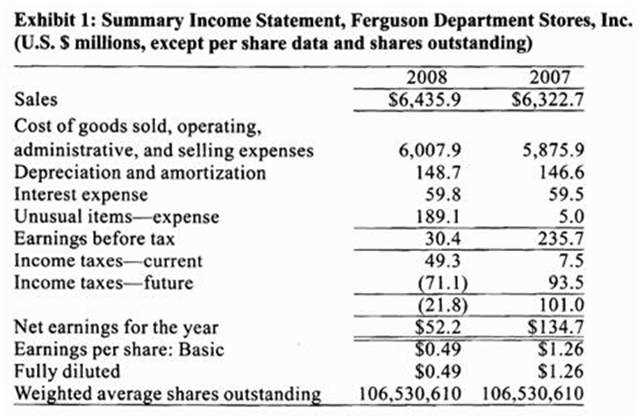
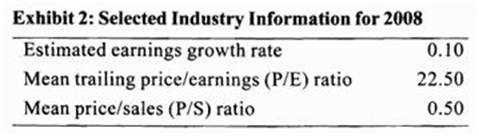
Matthew Emery, CFA, is responsible for analyzing companies in the retail industry. He is currently reviewing the status of Ferguson Department Stores, Inc. (FDS). FDS has recently gone through extensive restructuring in the wake of a slowdown in the economy that has made retailing particularly challenging. As part of his analysis, Emery has gathered information from a number of sources. Ferguson Department Stores, Inc. FDS went public in 1969 following a major acquisition, and the Ferguson name quickly became one of the most recognized in retailing. Ferguson had been successful through most of its first 30 years in business and has prided itself on being the one-stop shopping destination for consumers living on the West Coast of the United States. Recently, FDS began to experience both top and bottom line difficulties due to increased competition from specialty retailers who could operate more efficiently and offer a wider range of products in a focused retailing sector. When the company's main bank reduced FDS's line of credit, a serious working capital crisis ensued, and the company was forced to issue additional equity in an effort to overcome the problem. FDS has a cost of capital of 10% and a required rate of return on equity of 12%. Dividends are growing at a rate of 8%, but the growth rate is expected to decline linearly over the next six years to a long-term growth rate of 4%. The company recently paid an annual dividend of $1. At the end of 2008, FDS announced that it would be expanding its retail operations, moving to a warehouse concept, and opening new stores around the country. FDS also announced it would close some existing stores, write-down assets, and take a large restructuring charge. Upon reviewing the prospects of the firm, Emery issued an earnings per share forecast for 2009 of $0.90. He set a 12- month share price target of $22.50. Immediately following the expansion announcement, the share price of FDS jumped from $14 to $18. CFA Institute CFA LEVEL II question In 2008, FDS also reported an unusual expense of $189.1 million related to restructuring costs and asset write downs. CFA Institute CFA LEVEL II question In response to questions from a colleague, Emery makes the following statements regarding the merits of earnings yield compared to the P/E ratio: Statement 1: For ranking purposes, earnings yield may be useful whenever earnings are either negative or close to zero. Statement 2: A high E/P implies the security is overpriced. According to FDS's price-to-sales ratio for 2008, based on the post-expansion announcement stock price, FDS is:
Options
Q: 15
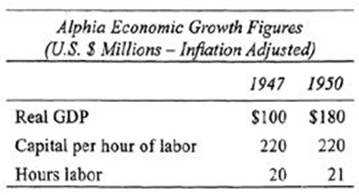
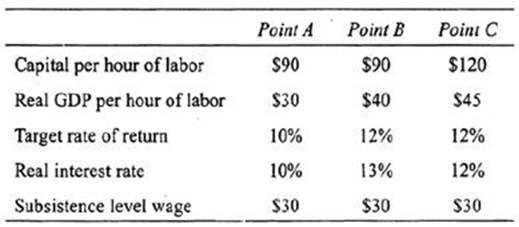
Mark Taber, CFA, is the Chief Investment Officer of the Taber Emerging Markets Fund, (TEMF). Taber uses a top-down approach to investing in countries. By interviewing government officials and the managements of foreign companies, Taber often gains economic and investment insights not yet fully understood by the foreign market. Taber is currently researching a potential investment in the emerging market country of Alphia. Taber travels to Ullom, the capital of Alphia, to discuss past, present, and future economic growth theory development with Dr. Raman Satish, managing director of the Alphia Economic Development Agency (AEDA). Dr. Satish starts the conversation with Taber by discussing the three great growth cycles that the Alphian economy has experienced over the past 120 years: (1) the classical growth era, (2) the neoclassical growth era, and (3) the new growth era. Taber takes down the following statements from the meeting with Dr. Satish's meeting. 1. The Classical Growth Era of Alphia (1850-1950) This hundred-year era was noted for periodic high levels of population growth and the sporadic introductions of technology. The average Alphianian's income was very modest and the standard of living remained almost the same over the 100-ycar period, except when new technology was introduced. Dr. Satish cites the example of the one-time introduction of electricity to the Alphian economy from 1947 to 1950. E CFA Institute CFA LEVEL II question 2. The Neoclassical Growth Era o/Alphia (1951-1990) During the neoclassical growth period, Alphia experienced a period of great economic growth. For example, from 1986 to 1990, Alphia's capital per hour of labor grew at a 9% annual rate, while real GDP grew at 7% per annum. Also, Alphia was able to achieve economic growth rates and income levels comparable with many of its neighboring countries during the neoclassical growth period. Alphian scientists, together with the engineering department of the University of Ullom, provided access to the finest technology in the world. In addition, Alphia opened up its equity markets to outside investors and allowed its currency to float. Dr. Satish believes that, given time, these capital market improvements should allow the Alphian economy to achieve an economic growth rate and per capita income level comparable to any country in the world. To understand the role of technology in the growth of the Alphian economy (using neoclassical growth theory assumptions), the following table was developed to show the increased productivity of Alphian farmers using disease resistant grains. Assume new disease resistant grain technology was introduced into the Alphian farm economy at Point A. CFA Institute CFA LEVEL II question 3. The New Growth Era (1991-Today) Since the Alphian energy crises of the late 1980s, the economy has been in transition. The AEDA goal is to have more than 50% of Alphian GDP coming from what we now call knowledge capital based industries by the year 2020. Given the large and growing population and their constant need for health care, the pharmaceutical industry was Alphia's first knowledge capital based industry. Dr. Satish believes that a focus on knowledge capital will enhance the long term growth prospects of Alphia's economy. According to the classical growth theory, Alphia would:
Options
Q: 16
Connor Burton, CFA, is the managing partner for United Partners, a small investment advisory firm that employs three investment professionals and currently has approximately $250 million of assets under management. The client base of United Partners is varied, and accounts range in size from small retirement accounts to a $30 million private school endowment. In addition to Burton's administrative responsibilities as the managing partner at United, he also serves as an investment advisor to several clients. Because United Partners is a small firm, the company does not employ any research analysts but instead obtains its investment research products and services from two national brokerage firms, which in turn execute all client trades for United Partners. The arrangement with the two brokers has enabled United to assure its clients that the firm will always seek the best execution for them by having both brokers competitively bid for United's business. A prospective client, Harold Crossley, has approached Burton about shifting some of his personal assets under management from MoneyCorp to United Partners. Burton provides Crossley with a packet of marketing information that Burton developed himself. The packet contains five years of historical performance data for the private school endowment, Unitcd's largest client. Burton states that the composite's management style and performance results are representative of the management style and returns that United can be expected to achieve for Crossley. Also included in the information packet are brief bios on each of United's three investment professionals. Crossley notices that all three of United's investment professionals are described as "CFA charterholders," but he is not familiar with the designation. In response to Crossley's inquiry. Burton explains the significance of the program by stating that the designation, which is only awarded after passing three rigorous exams and obtaining the requisite years of work experience, represents a commitment to the highest standards of ethical and professional conduct. As a condition of moving his account to United Partners, Crossley insists that all of his trades be executed through his brother-in-law, a broker for Security Bank. Security Bank is a large, New York- based broker/dealer but is not one of the two brokerage firms with which United currently does business. Burton contacts Crossley's brother-in-law and determines that Security Bank's trade execution is competitive, but Crossley's account alone would not generate enough volume to warrant any soft dollar arrangement for research materials. However, Crossley'-s brother-in-law does offer for Security Bank to pay a referral fee to Burton for directing any of United's clients to Security Bank's retail banking division. To bring Crossley on as a client, Burton agrees to the arrangement. Going forward. Burton will use Security Bank to execute all of Crossley's trades but will use research materials provided by the other two brokers to assist in the management of Crossley's account. Several months later, Burton is invited to a road show for an initial public offering (IPO) for Solution Ware, a software company. Security Bank is serving as lead underwriter on SolutionWare's IPO. Burton attends the meeting, which is led by two investment bankers and one software industry research analyst from Security Bank who covers SolutionWare. Burton notes that the bankers from Security Bank have included detailed financial statements for SolutionWare in the offering prospectus and also disclosed that Security Bank provides a warehouse line of credit to SolutionWare. After the meeting, Burton calls Crossley to recommend the purchase of SolutionWare equity. Crossley heeds Burton's advice and tells him to purchase 5,000 shares. Before placing Crossley's order, Burton reads the SolutionWare marketing materials and performs a detailed analysis of expected future earnings and other key factors for the investment decision. Burton determines that the offering would be a suitable investment for his own retirement portfolio in addition to Crossley's portfolio. United Partners, being a small firm, has no formal written policy regarding trade allocation, employee participation in equity offerings, or established blackout periods for employee trading. Burton adds his order to Crossley's order and places a purchase order for the combined number of shares with Security Bank. Burton is later notified that the offering was oversubscribed, and United Partners was only able to obtain roughly 75% of the desired number of shares. To be fair. Burton allocates the shares on a pro rata basis between Crossley's account and his own retirement account. When Burton notifies Crossley of the situation, Crossley is nonetheless pleased to have a position, though smaller than requested, in such a "hot" offering. According to CFA Standards of Professional Conduct, Burton's participation in the Solution Ware offering most likely:
Options
Q: 17
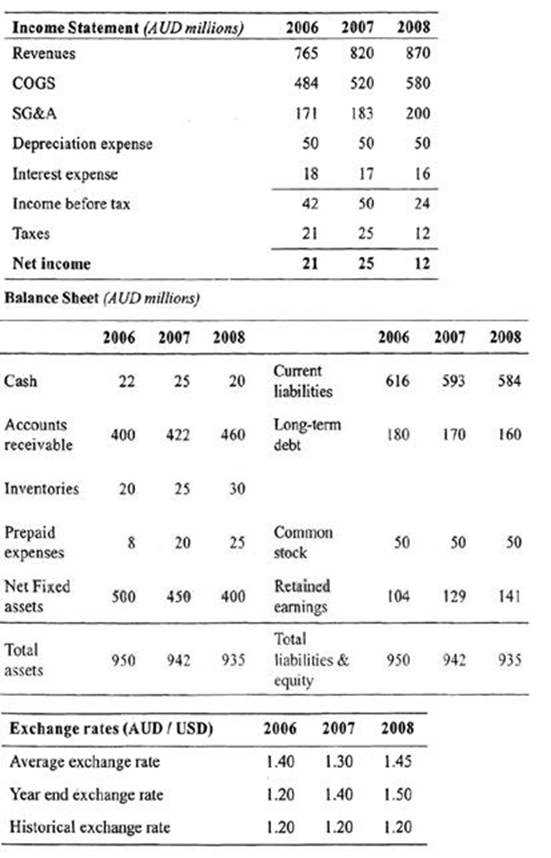
Gary Smith, CFA, has been hired lo analyze a specialty tool and machinery manufacturer, Whitmore Corporation (WMC). WMC is a leading producer of specialty machinery in the United States. At the end of 2006, WMC purchased York Tool Company (YTC), an Australian firm in a similar line of business. YTC has partially integrated its marketing functions within WMC but still maintains control of its operations and secures its own financing. Following is a summary of the income statement and balance sheet for YTC (in millions of Australian dollars - AUD) for the past three years as well as exchange rate data over the same period. CFA Institute CFA LEVEL II question Smith has discovered that WMC has a small subsidiary in Ukraine. The Subsidiary follows IAS accounting rules and uses FIFO inventory accounting. The Ukrainian subsidiary was acquired ten years ago and has been fully integrated into WMC's operations. WMC obtains funding for the subsidiary whenever the company finds profitable investments within Ukraine or surrounding countries. According to forecasts from economists, the Ukrainian currency is expected to depreciate relative to the U.S. dollar over the next few years. Local currency prices are forecasted to remain stable, however. One of the managers at WMC asks Smith to analyze a third subsidiary located in India. The manager has explained that real interest rates in India over the last three years have been 2.00%, 2.50%, and 3.00%, respectively, while nominal interest rates have been 34.64%, 29.15%, and 25.66%, respectively. Smith requests more time to analyze the Indian subsidiary. Which of the following statements regarding the consolidation of WMC's Ukrainian subsidiary for the next year is least likely correct? As compared to the temporal method, the Ukrainian subsidiary's translated:
Options
Q: 18
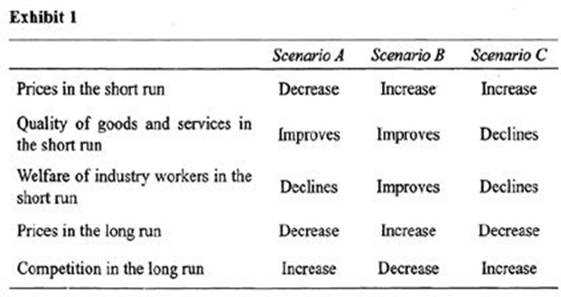
Mary Andrews and Drew McClure are economists for Gasden Econometrics. Gasden provides economic consulting and forecasting services for governments, corporations and small businesses. Andrews and McClure are currently consulting for the developing country of Wakulla, which is considering imposing new regulations on its businesses. Due to increases in industrial production in the country, the demand for electricity has increased. Unfortunately the cost of electricity has increased as well, and the Wakullian government is considering regulating the electrical utility industry by limiting the amount producers can charge. The price limits would be established so that the utilities can set their own prices as long as they do not earn a return on invested capital that is higher than the average Wakullian business. The Wakullian government has also proposed stiffer environmental regulations on its firms because the level of air quality has declined in its largest cities. Andrews advises that this regulation is likely to increase production costs that will burden smaller businesses more than larger businesses, and thus can adversely affect competition within an industry. The higher production cost from the environmental regulation will ultimately be borne by consumers, she asserts. One of the concerns of the Wakullian government is that previous regulation of the economy has been ineffective. For example, when the automobile industry was required to increase the fuel efficiency of passenger vehicles, they increased the weight of some vehicles so more could be classified as trucks, instead of passenger vehicles. The trucks were not subject to the regulation and as a result, fuel efficiency actually declined in the country due to the heavier weight of trucks. McClure comments that the regulation should have been written so that the regulation would be more effective. McClure gives another example of an ineffective regulation from the automobile industry. When airbags were required in automobiles, consumers started wearing their seat belt less often and driving at higher speeds because the airbags gave them a feeling of greater safety. Consequently, driving fatalities and injuries did not decline as much as expected. Some regulation, Andrews states, is limited in effectiveness when the regulators are chosen from the industry that is regulated. For example, Andrews states that, due to the level of scientific knowledge needed, many regulatory bodies for the pharmaceutical industry are dominated by former drug company executives and scientists. She states that, according to the share-the-gains, share-the-pains theory, regulatory decisions tend to favor the drug industry because of the close relationship between the industry and the regulator. McClure adds that another example of regulatory ineffectiveness is when telephone companies go before their regulatory bodies to ask for rate increases. He states ihat according to the capture hypothesis, telephone companies will have greater economic resources and more at stake than individual consumers. As a result, the regulatory decisions tend to favor the telephone industry. The Wakullian government is considering some of the country's industries. To illustrate the potential costs and benefits of deregulation to the Wakullian government, Andrews and McClure compose a matrix of the potential consequences of deregulation. In the matrix, three scenarios of possible economic consequences are presented in Exhibit 1. CFA Institute CFA LEVEL II question Which of the following best describes the regulation being considered by the Wakullian government for the electrical utility industry?
Options
Q: 19

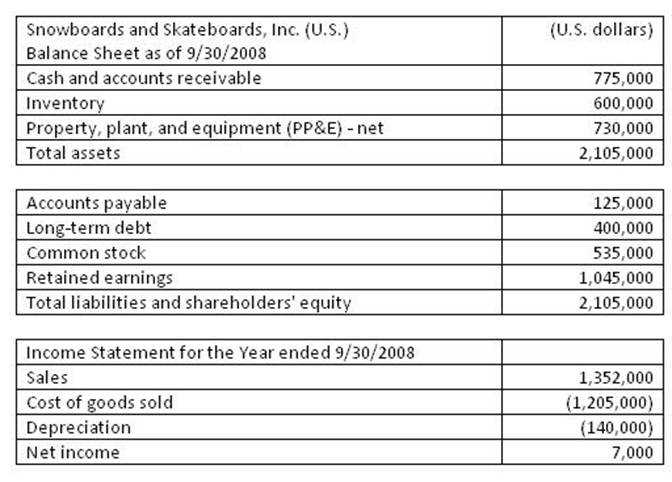
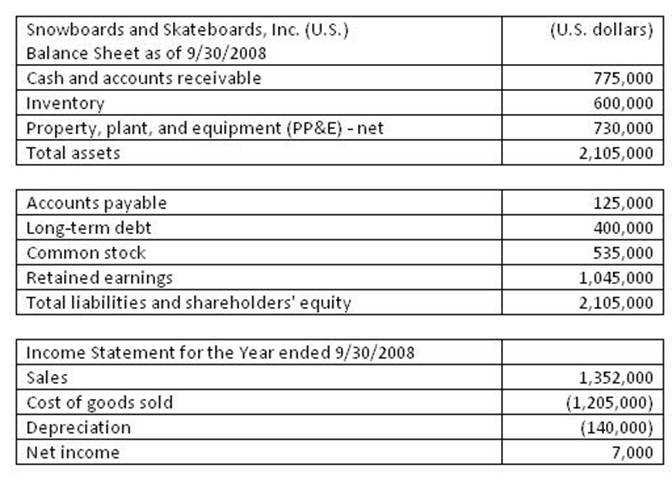
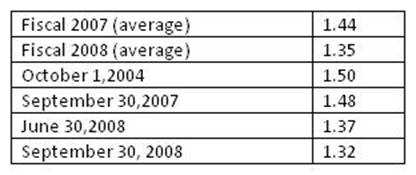
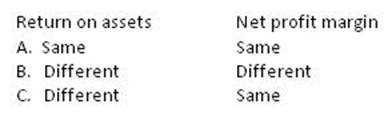
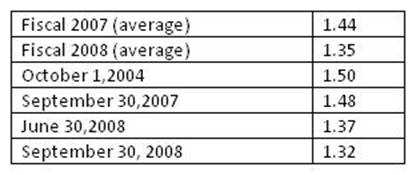
Ota L'Abbe, a supervisor at an investment research firm, has asked one of the junior analysts, Andreas Hally, to draft a research report dealing with various accounting issues. Excerpts from the request are as follows: • “There's an exciting company that we're starting to follow these days. It's called Snowboards and Skateboards, Inc. They are a multinational company with operations and a head office based in the resort town of Whistler in western Canada. However, they also have a significant subsidiary located in the United States." • "Look at the subsidiary and deal with some foreign currency issues including the specific differences between the temporal and all-current methods of translation, as well as the effect on financial ratios." • "The attached file contains the September 30, 2008, financial statements of the U.S. subsidiary. Translate the financial statements into Canadian dollars in a manner consistent with U.S. GAAP." The following are statements from the research report subsequently written by Hally: Statement 1: Subsidiaries whose operations are well integrated with the parent will use the all- current method of translation. Statement 2: Self-contained, independent subsidiaries whose operating, investing, and financing activities are primarily located in the local market will use the temporal method of translation. CFA Institute CFA LEVEL II question Other information to be considered • Exchange rates (CAD/USD) CFA Institute CFA LEVEL II question • Beginning inventory for fiscal 2008 had been purchased evenly throughout fiscal 2007. The company uses the FIFO inventory value method. • Dividends of USD 25,000 were paid to the shareholders on June 30, 2008. • All of the remaining inventory at the end of fiscal 2008 was purchased evenly throughout fiscal 2008. • All of the PP&E was purchased, and all of the common equity was issued at the inception of the company on October 1, 2004. No new PP&E has been acquired, and no additional common stock has been issued since then. However, they plan to purchase new PP&E starting in fiscal 2009. • The beginning retained earnings balance for fiscal 2008 was CAD 1,550,000. • The accounts payable on the fiscal 2008 balance sheet were all incurred on June 30, 2008. • The U.S. subsidiary's operations are highly integrated with the main operations in Canada. • The remeasured inventory for 2008 using the temporal method is CAD 810,000. • All monetary asset and liability balances are the same as they were at the end of the 2007 fiscal year, except that long-term debt was USD 467,700. • Costs of goods sold under the temporal method in 2008 is CAD 1,667,250. Suppose the parent uses the all-current method to translate the subsidiary for fiscal 2008. Will return on assets and net profit margin in U.S. dollars before translation be the same as, or different than, the translated Canadian dollar ratios? CFA Institute CFA LEVEL II question
Your Answer
Q: 20

Ota L'Abbe, a supervisor at an investment research firm, has asked one of the junior analysts, Andreas Hally, to draft a research report dealing with various accounting issues. Excerpts from the request are as follows: • “There's an exciting company that we're starting to follow these days. It's called Snowboards and Skateboards, Inc. They are a multinational company with operations and a head office based in the resort town of Whistler in western Canada. However, they also have a significant subsidiary located in the United States." • "Look at the subsidiary and deal with some foreign currency issues including the specific differences between the temporal and all-current methods of translation, as well as the effect on financial ratios." • "The attached file contains the September 30, 2008, financial statements of the U.S. subsidiary. Translate the financial statements into Canadian dollars in a manner consistent with U.S. GAAP." The following are statements from the research report subsequently written by Hally: Statement 1: Subsidiaries whose operations are well integrated with the parent will use the all- current method of translation. Statement 2: Self-contained, independent subsidiaries whose operating, investing, and financing activities are primarily located in the local market will use the temporal method of translation. CFA Institute CFA LEVEL II question Other information to be considered • Exchange rates (CAD/USD) CFA Institute CFA LEVEL II question • Beginning inventory for fiscal 2008 had been purchased evenly throughout fiscal 2007. The company uses the FIFO inventory value method. • Dividends of USD 25,000 were paid to the shareholders on June 30, 2008. • All of the remaining inventory at the end of fiscal 2008 was purchased evenly throughout fiscal 2008. • All of the PP&E was purchased, and all of the common equity was issued at the inception of the company on October 1, 2004. No new PP&E has been acquired, and no additional common stock has been issued since then. However, they plan to purchase new PP&E starting in fiscal 2009. • The beginning retained earnings balance for fiscal 2008 was CAD 1,550,000. • The accounts payable on the fiscal 2008 balance sheet were all incurred on June 30, 2008. • The U.S. subsidiary's operations are highly integrated with the main operations in Canada. • The remeasured inventory for 2008 using the temporal method is CAD 810,000. • All monetary asset and liability balances are the same as they were at the end of the 2007 fiscal year, except that long-term debt was USD 467,700. • Costs of goods sold under the temporal method in 2008 is CAD 1,667,250. Are Hally's statements regarding foreign currency translation correct?
Your Answer
Question 11 of 20 · Page 2 / 2

Premium Access Includes

  • Quiz Simulator
  • Exam Mode
  • Progress Tracking
  • Question Saving
  • Flash Cards
  • Drag & Drops
  • 3 Months Access
  • PDF Downloads
Get Premium Access
Scroll to Top

FLASH OFFER

Days
Hours
Minutes
Seconds

avail 10% DISCOUNT on YOUR PURCHASE