
Q: 1
Jane Bowman, CFA, and Frank Shrum, CFA, are analysts for Brookstonc Advisors. Brookstone
recommends investments in United States and global markets. Bowman and Shrum are responsible
for analyzing investments and conducting cyclical analysis in developed and emerging markets.
Bowman is examining the country of Waltonia for a possible investment. Currently, the country's
economy is beginning to recover from a recession. Businesses have increasing confidence in the
economy, inflation is falling, the government is stimulating the economy, and the economy has just
started to expand. Bowman identifies this is as the recovery stage of the business cycle and states
that since inflation is falling, investors should put their money in bonds.
In terms of the business cycle, Waltonia has grown slower than its neighboring country of Bergamo,
where the economy is in the early stages of an upswing. Bergamese businesses are confident and
inventories are increasing. Bowman states that an investment in commodities or stocks would be
advised because when the economy grows, these assets will rise in price.
Shrum is examining the value of a company in the United States using the franchise value model. In
it, he will generate an intrinsic P/E ratio that can be multiplied against the firm's projected earnings
to derive a value for the company. The intrinsic P/E value consists of the tangible P/E value, which
represents the firm's static value, and a franchise P/E value which represents the firm's growth value.
The franchise P/E value then consists of the franchise factor, which incorporates the required return
on new investments, and the growth factor, which factors in the present value of the excess return
from new investments. He applies this analysis to the firm of Salisbury Materials, which has the
following characteristics:
Return on Equity 20%
Dividend Payout Ratio 40%
Required Return on Equity 16%
In light of the increased inflation in the United States due to increased commodity prices. Bowman is
examining the effect of inflation on the P/E ratio. She states that when there is not full-flow-through
of inflation, a firm in a low inflation country will have a higher P/E ratio than one in a high inflation
country. She provides the following example of inflation flow-through. If the real required return is
9%, inflation is 4%, and the inflation flow-through rate is 80%, then the P/E ratio will be 10.2.
Shrum states that when valuing an emerging market, an investor should adjust their projections for
the higher inflation risk. He states that the analyst should adjust the cash flows rather than the
discount rate for the increased risks from emerging markets, such as political risk and
macroeconomic risk. Bowman adds that there are several arguments that can be made and makes
the following statements.
Statement 1: One argument is that companies respond differently to the risk in their country. For
example, exporters would benefit from a weaker local currency but importers would be hurt by a
depreciating local currency. Adjusting the discount rate by the same amount for all companies within
a country would misstate the influence of country risk on each company.
Statement 2: Additionally, country risk is one-sided and asymmetric in that the country risk to foreign
investors is much greater than that to local investors. So if a single discount rate were used to
discount cash flows, then the valuations would be inaccurate for either the foreign investors or the
local investors.
Shrum follows up with Bowman's analysis. He states that an alternative to adjusting the cash flows is
to calculate a weighted average cost of capital for the emerging country firm and add a country risk
premium to it. This discount rate would then be applied against unadjusted cash flows to value the
emerging market firm. Regarding this analysis, he makes the following statements.
Statement 3: When estimating the percent of debt and equity in the capital structure, the market
value of the firm's debt and equity should be used, not the book value.
Statement 4: The beta will be needed to obtain the cost of equity capital in the CAPM. The beta
should be estimated for the company by regressing the company's returns against a well diversified
global index, not the local market index.
Regarding Bowman's statements on inflation flow-through and the calculated P/E ratio, are both
statements correct?
Options
Discussion
No comments yet. Be the first to comment.
Be respectful. No spam.
Q: 2
George Armor, CFA, is a new stock analyst for Pedad Investments. One tool that Pedad uses to
compare stock valuations is the dividend discount model (DOM). In particular, the firm evaluates
stocks in terms of "justified" multiples of sales and book value. These multiples are based on
algebraic manipulation of the DDM. Over time, these multiples seem to provide a good check on the
market valuation of a stock relative to the company's fundamentals. Any stock which is currently
priced below its value based on a justified multiple of sales or book value is considered attractive for
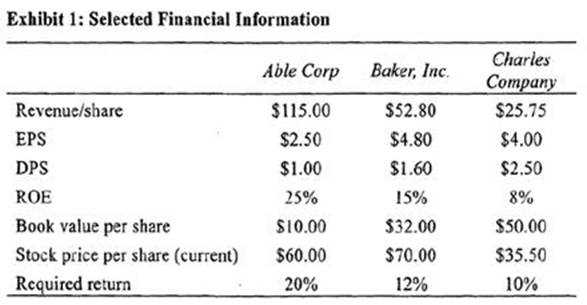
purchase by Pedad portfolio managers. Exhibit 1 contains financial information from the year just
ended for three stable companies in the meat-packing industry: Able Corp, Baker, Inc., and Charles
Company, from which Armor will derive his valuation estimates.
One of Pedad's other equity analysts, Marie Swift, CFA, recently held a meeting with Armor to
discuss a relatively new model the firm is implementing to determine the P/E ratios of companies
that Pedad researches. Swift explains that the model utilizes a cross-sectional regression using the
previous year-end data of a group of comparable companies' P/E ratios against their dividend payout
ratios (r), sustainable growth rates (g), and returns on equity (ROE). The resulting regression equation
is used to determine a predicted P/E ratio for the subject company using the subject company's most
recent year-end data. Swift has developed the following model, which has an R-squared of 81%, for
the meat packing industry (16 companies):
Predicted P/E = 2.74 + 8.21(r) + 14.21(g) + 2.81(ROE)
(STD error) (2.11) (6.52) (9.24) (2.10)
After Swift presents the model to Armor, she points out that models of this nature are subject to
limitations. In particular, multicollinearity, which appears to be present in the meat packing industry
model, can create great difficulty in interpreting the effects of the individual coefficients of the
model. Swift continues by stating that in spite of this limitation, models of this nature generally have
known and significant predictive power across different time periods although not across different
stocks.
Based on Exhibit 1, the justified price-to-sales ratio of Baker, Inc. is closest to:
One of Pedad's other equity analysts, Marie Swift, CFA, recently held a meeting with Armor to
discuss a relatively new model the firm is implementing to determine the P/E ratios of companies
that Pedad researches. Swift explains that the model utilizes a cross-sectional regression using the
previous year-end data of a group of comparable companies' P/E ratios against their dividend payout
ratios (r), sustainable growth rates (g), and returns on equity (ROE). The resulting regression equation
is used to determine a predicted P/E ratio for the subject company using the subject company's most
recent year-end data. Swift has developed the following model, which has an R-squared of 81%, for
the meat packing industry (16 companies):
Predicted P/E = 2.74 + 8.21(r) + 14.21(g) + 2.81(ROE)
(STD error) (2.11) (6.52) (9.24) (2.10)
After Swift presents the model to Armor, she points out that models of this nature are subject to
limitations. In particular, multicollinearity, which appears to be present in the meat packing industry
model, can create great difficulty in interpreting the effects of the individual coefficients of the
model. Swift continues by stating that in spite of this limitation, models of this nature generally have
known and significant predictive power across different time periods although not across different
stocks.
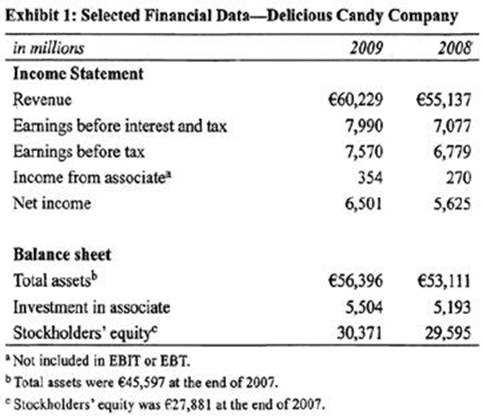
Based on Exhibit 1, the justified price-to-sales ratio of Baker, Inc. is closest to:Options
Discussion
No comments yet. Be the first to comment.
Be respectful. No spam.
Q: 3
Delicious Candy Company (Delicious) is a leading manufacturer and distributor of quality
confectionery products throughout Europe and Mexico. Delicious is a publicly-traded firm located in
Italy and has been in business over 60 years.
Caleb Scott, an equity analyst with a large pension fund, has been asked to complete a
comprehensive analysis of Delicious in order to evaluate the possibility of a future investment.
Scott compiles the selected financial data found in Exhibit 1 and learns that Delicious owns a 30%
equity interest in a supplier located in the United States. Delicious uses the equity method to
account for its investment in the U.S. associate.
Scott reads the Delicious's revenue recognition footnote found in Exhibit 2.
Exhibit 2: Revenue Recognition Footnote
_________________________________________________________________________________
_
in
millions__________________________________________________________________________
Revenue is recognized, net of returns and allowances, when the goods are shipped to customers and
collectability is assured. Several customers remit payment before delivery in order to receive
additional discounts. Delicious reports these amounts as unearned revenue until the goods are
shipped. Unearned revenue was €7,201 at the end of 2009 and €5,514 at the end of 2008.
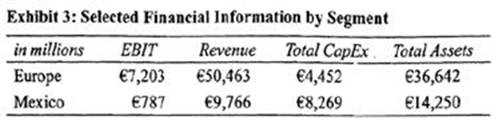
Delicious operates two geographic segments: Europe and Mexico. Selected financial information for
each segment is found in Exhibit 3.
At the beginning of 2009, Delicious entered into an operating lease for manufacturing equipment. At
inception, the present value of the lease payments, discounted at an interest rate of 10%, was 6300
million. The lease term is six years and the annual payment is 669 million. Similar equipment owned
by Delicious is depreciated using the straight-line method and no residual values are assumed.
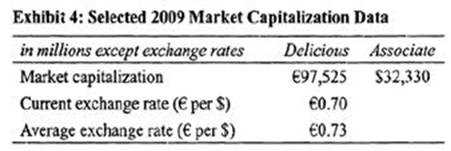
Scott gathers the information in Exhibit 4 to determine the implied "stand-alone" value of Delicious
without regard to the value of its U.S. associate.
Using the data found in Exhibit 1 and the extended DuPont equation, which of the following best
describes the impact on Delicious's return on equity (ROE) for 2009 of eliminating the investment in
the U.S. associate?
Scott reads the Delicious's revenue recognition footnote found in Exhibit 2.
Exhibit 2: Revenue Recognition Footnote
_________________________________________________________________________________
_
in
millions__________________________________________________________________________
Revenue is recognized, net of returns and allowances, when the goods are shipped to customers and
collectability is assured. Several customers remit payment before delivery in order to receive
additional discounts. Delicious reports these amounts as unearned revenue until the goods are
shipped. Unearned revenue was €7,201 at the end of 2009 and €5,514 at the end of 2008.
Delicious operates two geographic segments: Europe and Mexico. Selected financial information for
each segment is found in Exhibit 3.
At the beginning of 2009, Delicious entered into an operating lease for manufacturing equipment. At
inception, the present value of the lease payments, discounted at an interest rate of 10%, was 6300
million. The lease term is six years and the annual payment is 669 million. Similar equipment owned
by Delicious is depreciated using the straight-line method and no residual values are assumed.
Scott gathers the information in Exhibit 4 to determine the implied "stand-alone" value of Delicious
without regard to the value of its U.S. associate.
Using the data found in Exhibit 1 and the extended DuPont equation, which of the following best
describes the impact on Delicious's return on equity (ROE) for 2009 of eliminating the investment in
the U.S. associate?Options
Discussion
No comments yet. Be the first to comment.
Be respectful. No spam.
Q: 4
Maria Harris is a CFA® Level 3 candidate and portfolio manager for Islandwide Hedge Fund. Harris is
commonly involved in complex trading strategies on behalf of Islandwide and maintains a significant
relationship with Quadrangle Brokers, which provides portfolio analysis tools to Harris. Recent
market volatility has led Islandwide to incur record-high trading volume and commissions with
Quadrangle for the quarter. In appreciation of Islandwide's business, Quadrangle offers Harris an all-
expenses-paid week of golf at Pebble Beach for her and her husband. Harris discloses the offer to her
supervisor and compliance officer and, based on their approval, accepts the trip.
Harris has lunch that day with
Options
Discussion
No comments yet. Be the first to comment.
Be respectful. No spam.
Q: 5
Frank Hoskins and Paul Lanning are economists for a large U.S. investment advisory firm. Platinum
Advisors. Hoskins and Lanning use their independent research on U.S. stocks and international stocks
to provide advice for the firm's network of advisors. As the senior economist at Platinum, Hoskins is a
partner in the firm and is Lanning's supervisor. Lanning has worked for Platinum for the past four
years. At a lunch meeting, the two economists discuss the usefulness of economic theory, economic
data, and the resulting forecasts of the global economic and stock market activity.
Hoskins is investigating the growth prospects of the country of Maldavia. Maldavia is a formerly
communist country with a population of 3 million located in Eastern Europe. The Maldavian
government had been aggressive in instituting political reform and encouraging the growth of
financial markets. However, due to a recent insider trading scandal and resulting stock market
volatility, the Maldavian government is considering restrictions on further stock market growth and
the establishment of a national securities regulator. Hoskins states that these developments are not
encouraging for future economic growth.
Lanning is examining the country of Petra. Petra is a country of 25 million located in South America
and rich with natural resources including oil. The recently elected president of Petra, Carlos Basile,
has announced that he would like to diversify the country's economy away from natural resources
while nationalizing the oil industry. Lanning states that these changes would not be beneficial for the
future growth of the Petrian economy.
One of the many items they study when examining an economy or stock market is the economic
information released by governments and private organizations. Hoskins and Lanning use this
information to determine the effects on economic growth and the appropriate portfolio allocations
to the bond and stock markets. Examining information for Maldavia, Hoskins has learned that the
Maldavian private sector has embarked on an ambitious plan to increase labor productivity by
purchasing more machinery for its factories. The private sector feels compelled to do this because
Maldavia has historically relied too heavily on labor as the main input into production. Plotting the
productivity curve for Maldavia, Hoskins states that labor productivity should increase because the
productivity curve will shift upward and to the right.
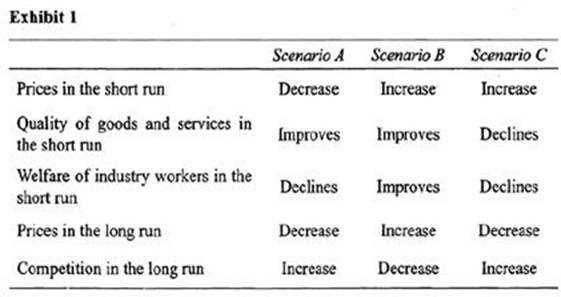
Lanning is examining the historical record of economic growth in Petra. He has gathered the data in
Exhibit 1 to determine potential economic growth.
Hoskins is also examining data for the country of Semeria. Semeria is an emerging country that has
benefited from recent changes in the political environment as well as technological advances. Its
economy is growing rapidly, and changes in the Semerian economy and society have resulted in
more opportunities for women. The Semerian economy has experienced 17 consecutive quarters of
positive growth in GDP, which is unprecedented in Semerian history. Interest rates have increased
over time because businesses have been borrowing heavily to invest in new machinery and
technologies. Most economists are forecasting further increases in interest rates in Semeria.
It has long been Platinum's policy that its economists use long-term economic growth trends to
forecast future economic growth, stock returns, and dividends in a country. Lanning is examining the
economy of Tiberia. Tiberia has a population of 11 million and is located in northern Africa. Its
economy is diversified, and its main exports are agricultural products and heavy machinery. The
country's economy has been growing at an annual rate of 6.2% for the past ten years, in part because
of technological advances in the manufacture of heavy equipment. These advances involve the use of
computer-operated welding machines that have made the manufacture of heavy equipment less
expensive. Lanning is worried, however, that the 6.2% GDP growth rate may not be sustainable and is
considering advising Platinum's portfolio managers to decrease their portfolio allocations in the
country. Before doing so, he will consult with Hoskins.
The classical growth theory is most likely to predict that Tiberia's long-run future GDP per capita will:
Hoskins is also examining data for the country of Semeria. Semeria is an emerging country that has
benefited from recent changes in the political environment as well as technological advances. Its
economy is growing rapidly, and changes in the Semerian economy and society have resulted in
more opportunities for women. The Semerian economy has experienced 17 consecutive quarters of
positive growth in GDP, which is unprecedented in Semerian history. Interest rates have increased
over time because businesses have been borrowing heavily to invest in new machinery and
technologies. Most economists are forecasting further increases in interest rates in Semeria.
It has long been Platinum's policy that its economists use long-term economic growth trends to
forecast future economic growth, stock returns, and dividends in a country. Lanning is examining the
economy of Tiberia. Tiberia has a population of 11 million and is located in northern Africa. Its
economy is diversified, and its main exports are agricultural products and heavy machinery. The
country's economy has been growing at an annual rate of 6.2% for the past ten years, in part because
of technological advances in the manufacture of heavy equipment. These advances involve the use of
computer-operated welding machines that have made the manufacture of heavy equipment less
expensive. Lanning is worried, however, that the 6.2% GDP growth rate may not be sustainable and is
considering advising Platinum's portfolio managers to decrease their portfolio allocations in the
country. Before doing so, he will consult with Hoskins.
The classical growth theory is most likely to predict that Tiberia's long-run future GDP per capita will:Options
Discussion
No comments yet. Be the first to comment.
Be respectful. No spam.
Q: 6
Martha Gillis, CFA, trades currencies for Trent, LLC. Trent is one of the largest investment firms in the
world, and its foreign currency department trades more currency on a daily basis than any other
firm. Gillis specializes in currencies of emerging nations.
Gillis received an invitation from the new Finance Minister of Binaria, one of the emerging nations
included in Gillis's portfolio. The minister has proposed a number of fiscal reforms that he hopes will
help support Binaria's weakening currency. He is asking currency specialists from several of the
largest foreign exchange banks to visit Binaria for a conference on the planned reforms. Because of
its remote location, Binaria will pay all travel expenses of the attendees, as well as lodging in
government-owned facilities in the capital city. As a further inducement, attendees will also receive
small bags of uncut emeralds (as emeralds are a principal export of Binaria), with an estimated
market value of $500.
Gillis has approximately 25 clients that she deals with regularly, most of whom are large financial
institutions interested in trading currencies. One of the services Gillis provides to these clients is a
weekly summary of important trends in the emerging market currencies she follows. Gillis talks to
local government officials and reads research reports prepared by local analysts, which are paid for
by Trent. These inputs, along with Gillis's interpretation, form the basis of most of Gillis's weekly
reports.
Gillis decided to attend the conference in Binaria. In anticipation of a favorable reception for the
proposed reforms, Gillis purchased a long Binaria currency position in her personal account before
leaving on the trip. After hearing the finance minister's proposals in person, however, she decides
that the reforms are poorly timed and likely to cause the currency to depreciate. She issues a
negative recommendation upon her return. Before issuing the recommendation, she liquidates the
long position in her personal account but does not take a short position.
Gillis's supervisor, Steve Howlett, CFA, has been reviewing Gillis's personal trading. Howlett has not
seen any details of the Binaria currency trade but has found two other instances in the past year
where he believes Gillis has violated Trent's written policies regarding trading in personal accounts.
One of the currency trading strategies employed by Trent is based on interest rate parity. Trent
monitors spot exchange rates, forward rates, and short-term government interest rates. On the rare
occasions when the forward rates do not accurately reflect the interest differential between two
countries, Trent places trades to take advantage of the riskless arbitrage opportunity. Because Trent
is such a large player in the exchange markets, its transactions costs are very low, and Trent is often
able to take advantage of mispricings that are too small for others to capitalize on. In describing
these trading opportunities to clients, Trent suggests that "clients willing to participate in this type of
arbitrage strategy are guaranteed riskless profits until the market pricing returns to equilibrium."
Based on the information given, and according to CFA Institute Standards, which of the following
statements best describes Trent's compliance procedures relating to personal trading in foreign
currencies? The compliance procedures:
Options
Discussion
No comments yet. Be the first to comment.
Be respectful. No spam.
Q: 7
Rogcrt Markets is the nation's third largest retail grocery chain, and usually has the largest or second
largest market share in every city in which it competes. In its most successful large cities, Rogert has
as much as a 25% market share, although its share is sometimes greater in small cities. Rogert is
known for its excellent customer service and has a wide variety of grocery selections in almost every
part of its stores. Its profit margins on sales are slightly above industry averages, and its return on
assets and return on equity are above average.
Rogert has an equity beta of 0.78 and a debt-to-capital ratio of approximately 50%. Recent economic
difficulties, including higher commodity prices and higher unemployment, resulted in lower profit
margins for Rogert. Still, Rogert's decline in profit margin was less than for its competitors. Rogert did
not experience substantial losses of sales from customers switching to lower-priced competitors as
its market share remained substantially constant.
Zephine Markets is one of Rogert's smaller competitors. Zephine operates in roughly 15% of the
same cities as Roger. Zephine is publicly traded, and one of the members of Rogert's board of
directors has asked the staff to evaluate an acquisition of Zephine. The staff believes that Zephine is
slightly underpriced and that it could be acquired for a 20% premium over its current price. In
recommending against the acquisition, staff member Pierre Chiraq says:
"I agree that eliminating Zephine as a rival would probably enhance our profit margins. However, I
am skeptical about this acquisition. First, because our market share is almost never dominant, much
of the benefit of eliminating a smaller rival will be shared by our other rivals. They will free-ride on
our investment. Second, if our profit margins do increase, wc will eventually attract new rivals into
our markets. And finally, our cost of capital should increase substantially because the firm will be
diversifying horizontally instead of vertically, increasing the firm's risk."
Over the last several years, grocery industry growth has tended to follow the general economy. The
competitors in the industry, like Rogert, compete for market share in a stable industry. The industry's
cyclical behavior has shown stable performance in both the ups and downs of the business cycle.
In assessing Rogert's competitive position, Chiraq makes comments about the threat of new
entrants:
"My concern about new entrants into our business is low for several reasons. Economies of scale are
achievable at a low size of operations relative to that of our firm. Our brand identity is high in the
markets in which we compete. And, finally, access to distribution channels is difficult to achieve in
the grocery business. While there are many competitive forces that concern mc, new entrants is low
on my list."
Finally, the staff discusses industry changes that might have a negative effect on Rogert's industry
position. Three phenomena are mentioned that could have such an effect. They are:
1. Industry growth rates are low and declining;
2. Several suppliers are sponsoring national television advertisements for their products;
3. The government has approved a new method of extending the shelf life of fruits and vegetables.
Rogert's success can be attributed to:
Options
Discussion
No comments yet. Be the first to comment.
Be respectful. No spam.
Q: 8
Susan Foley, CFA, is Chief Investment Officer of Federated Investment Management Co. (FIMCO), a
large investment management firm that includes a family of mutual funds as well as individually
managed accounts. The individually managed accounts include individuals, personal trusts, and
employee benefit plans. In the past few months, Foley has encountered a couple of problems.
The Tasty IPO
Most portfolio managers of FIMCO have not participated in the initial public offering (IPO) market in
recent years. However, recent changes to the compensation calculation at FIMCO have tied manager
bonuses to portfolio performance. The changes were outlined in a letter that was sent out to clients
and prospects shortly before the new bonus structure took effect. Carl Lee, CFA, is one portfolio
manager who believes that investing in IPOs may add to his client's equity performance and, in turn,
increase his bonus. While Lee's individual clients have done quite well this year, his employee benefit
plans have suffered as a result of limited exposure to the strongest performing sector of the market.
Lee has placed an order for all employee benefit plans to receive an allocation of the Tasty Doughnut
IPO. Tasty is an over-subscribed IPO that Lee knew would make money for his clients. When he
placed the order, Lee's assistant reminded him that one pension plan. Ultra Airlines, was explicitly
prohibited from investing in IPOs in its investment policy statement, due to the under-funded status
of the pension plan. Lee responded that the Tasty IPO would never actually be owned in Ultra's
account, because he would sell the IPO stock before the end of the day and realize a profit before the
position ever hit the books.
Another manager, Franz Mason, CFA, who manages accounts for about 150 individuals, is also
interested in the Tasty IPO. Mason visits Lee's portfolio assistant and quizzes him about Lee's
participation in the Tasty deal. Mason is sure that Lee would not have bought into Tasty unless he had
done his homework. Mason places an order for 10,000 shares of the IPO. Mason returns to his desk
and begins to allocate the IPO shares among his clients. Mason divides his client base into two
groups: clients who are income-oriented and clients who arc capital gains-oriented. Mason believes
those clients that are income-oriented are fairly risk averse and could not replace lost capital if the
Tasty Doughnut deal lost money. Mason believes the capital gains-oriented accounts arc better able
to withstand the potential loss associated with the Tasty IPO. Accordingly, Mason allocates his 10,000
share order of the Tasty IPO strictly to his capital appreciation clients using a pro rata allocation based
on the size of the assets under management in each account.
FIMCO Income Fund (FIF)
Over the past three years, the FIF, with $5 billion in assets, has been the company's best performing
mutual fund. Jane Ryan, CFA, managed the FIF for seven years, but resigned one year ago to start her
own hedge fund. Under Ryan, the FIF invested in large cap stocks with reliable dividends. The fund's
prospectus specifies that FIF will invest only in stocks that have paid a dividend for at least two
quarters, and have a market capitalization in excess of $2.5 billion. Foley appointed FIMCO's next
best manager (based on 5-year performance numbers) Steve Parsons, CFA, to replace Ryan. Parsons
had been a very successful manager of the FIMCO Opportunity Fund, which specialized in small
capitalization stocks. Six months after Parsons took over the helm at FIF. the portfolio had changed.
The average market capitalization of FIF's holdings was $12.8 billion, as opposed to $21 billion a year
ago. Over the same period, the average dividend yield on the portfolio had fallen from 3.8% to 3.1%.
The performance of the FIF lagged its peer group for the first time in three years. In response to the
lagging performance, Parsons purchased five stocks six months ago. Parsons bought all five stocks,
none of which paid a dividend at the time of purchase, in anticipation that each company was likely
to initiate dividends in the near future. So far, four of the stocks have initiated dividend payments,
and their performance has benefited as a result. The fifth stock did not initiate a dividend, and
Parsons sold the position last week. Largely due to the addition of the five new stocks, the FIF's
performance has led its peer group over the past six months.
Before leaving FIMCO, Ryan had told Foley that above-average returns from both the management
and client side could be gained from entering into the risk-arbitrage hedge fund market. Ryan had
tried to convince FIMCO management to enter the risk-arbitrage market, but the firm determined
that no one had the experience or research capability to run a risk-arbitrage operation. As a result,
Ryan started the Plasma Fund LLC one month after leaving FIMCO. Foley remembers seeing Ryan at
the annual FIMCO client dinner parly (before she left the firm) discussing the profits to be made from
risk-arbitrage investing with several large FIF shareholders. Ryan mentioned that she would be
opening the Plasma Fund to these FIMCO clients, several of whom made substantial investments in
the first months of Plasma Fund's life. After Ryan resigned and left her office, Foley performed an
inventory of firm assets signed out to Ryan. One of the copies of the proprietary stock selection
software packages, FIMCO-SelectStock, assigned to Ryan was missing along with several of the
SelectStock operating manuals. When Foley contacts Ryan about the missing software and manuals,
Ryan states that the reason she took the SelectStock software was that it was an out of date version
that FIMCO's information technology staff had urged all managers to discard.
Has there been any violation of CFA Institute Standards of Professional Conduct relating to either the
change in the average holdings of the FIF during the first six months of Parsons's leadership, or in
Parsons's subsequent investment in the non-dividend paying stocks?
Options
Discussion
No comments yet. Be the first to comment.
Be respectful. No spam.
Q: 9
Mary Andrews and Drew McClure are economists for Gasden Econometrics. Gasden provides
economic consulting and forecasting services for governments, corporations and small businesses.
Andrews and McClure are currently consulting for the developing country of Wakulla, which is
considering imposing new regulations on its businesses.
Due to increases in industrial production in the country, the demand for electricity has increased.
Unfortunately the cost of electricity has increased as well, and the Wakullian government is
considering regulating the electrical utility industry by limiting the amount producers can charge. The
price limits would be established so that the utilities can set their own prices as long as they do not
earn a return on invested capital that is higher than the average Wakullian business.
The Wakullian government has also proposed stiffer environmental regulations on its firms because
the level of air quality has declined in its largest cities. Andrews advises that this regulation is likely
to increase production costs that will burden smaller businesses more than larger businesses, and
thus can adversely affect competition within an industry. The higher production cost from the
environmental regulation will ultimately be borne by consumers, she asserts.
One of the concerns of the Wakullian government is that previous regulation of the economy has
been ineffective. For example, when the automobile industry was required to increase the fuel
efficiency of passenger vehicles, they increased the weight of some vehicles so more could be
classified as trucks, instead of passenger vehicles. The trucks were not subject to the regulation and
as a result, fuel efficiency actually declined in the country due to the heavier weight of trucks.
McClure comments that the regulation should have been written so that the regulation would be
more effective.
McClure gives another example of an ineffective regulation from the automobile industry. When
airbags were required in automobiles, consumers started wearing their seat belt less often and
driving at higher speeds because the airbags gave them a feeling of greater safety. Consequently,
driving fatalities and injuries did not decline as much as expected.
Some regulation, Andrews states, is limited in effectiveness when the regulators are chosen from the
industry that is regulated. For example, Andrews states that, due to the level of scientific knowledge
needed, many regulatory bodies for the pharmaceutical industry are dominated by former drug
company executives and scientists. She states that, according to the share-the-gains, share-the-pains
theory, regulatory decisions tend to favor the drug industry because of the close relationship
between the industry and the regulator.
McClure adds that another example of regulatory ineffectiveness is when telephone companies go
before their regulatory bodies to ask for rate increases. He states ihat according to the capture
hypothesis, telephone companies will have greater economic resources and more at stake than
individual consumers. As a result, the regulatory decisions tend to favor the telephone industry.
The Wakullian government is considering some of the country's industries. To illustrate the potential
costs and benefits of deregulation to the Wakullian government, Andrews and McClure compose a
matrix of the potential consequences of deregulation. In the matrix, three scenarios of possible
economic consequences are presented in Exhibit 1.
Which of the following terms best describes the response of consumers to the auto safety
regulation?
Which of the following terms best describes the response of consumers to the auto safety
regulation?Options
Discussion
No comments yet. Be the first to comment.
Be respectful. No spam.
Q: 10
Mike Zonding, CFA, is conducting a background check on CFA candidate Annie Cooken, a freshly
nudled MBA who applied for a stock-analysis job at his firm, Khasko Financiar.vZoftding does not like
to hire anyone who does not adhere to the Code and Standards' professional conduct requirements.
The background check reveals the following:
(i) While doing a full-time, unpaid internship at Kale Investments, Cooken was reprimanded for
working a 30-hour-a-week night job as a waitress.
(ii) As an intern at Lammar Corp., Cooken was fired after revealing to the FBI that one of the
principals was embezzling from the firm's clients.
(iii) Cooken performed 40 hours of community service in relation to a conviction on a misdemeanor
drug possession charge when she was 16 years old.
(iv) On her resume, Cooken writes, "Recently passed Level 2 of the CFA exam, a test that measures
candidates' knowledge of finance and investing."
During the interview, Zonding asks Cooken several questions on ethics-related issues, including
questions about the role of a fiduciary and Standard III(E) Preservation of Confidentiality. He asks her
about her internship at Kale Investments, specifically about the working hours. Cooken replies that
the internship turned out to require more time than she originally planned, up to 65 hours per week.
Zonding subsequently hires Cooken and functions as her supervisor. On her third day at the money
management boutique firm, portfolio manager Steven Garrison hands her a report on Mocline
Tobacco and tells her to revise the report to reflect a buy rating. Cooken is uncomfortable about
revising the report.
To supplement the meager income from her entry-level stock-analysis job, Cooken looks for part-
time work. She is offered a position working three hours each Friday and Saturday night tending bar
at a sports bar and grill downtown. Cooken does not tell her employer about the job.
During her first week, Cooken has lunch with former MBA classmates, including Taira Basch, CFA,
who works for the compliance officer at a large investment bank in town. Basch arrives late,
explaining, "What a day, it's only noon and already I have worked on the following requests:
1. A federal regulator called and wanted information on potentially illegal activities related to one of
the firm's key clients.
2. A rival company's employee wanted information regarding employment opportunities at the firm.
3. A potential client contacted an employee and wanted detailed performance records of client
accounts so he can decide whether to invest with the firm."
Basch goes on to say that she is responsible for developing a presentation on the differences
between the Prudent Investor and the Prudent Man rules for managing trust portfolios. Basch
explains to Cooken that the Prudent Investor rule requires a trustee to exercise five fiduciary
standards in managing the assets of a trust account, including care, skill, caution, loyalty, and
impartiality. She states that although there are many differences between the Prudent Man and the
newer Prudent Investor rule, one element of continuity is the duty of the trustee to delegate
investment authority in the event that the trustee lacks sufficient investment knowledge.
Toward the end of the lunch meeting, Basch suggests that in exchange for research published by
Cooken and Khasko, Basch can have portfolio managers at her firm send clients that are too small for
their firm to Khasko. Since Khasko specializes in clients with smaller portfolios, the arrangement
sounds like a good idea to Cooken. Cooken tells Basch that she will think the arrangement over and
get back with her next week with a decision.
According to CFA Institute Standards of Professional Conduct, which of the following statements is
most accurate with regard to the arrangement proposed by Basch to Cooken?
Options
Discussion
No comments yet. Be the first to comment.
Be respectful. No spam.
Question 1 of 20 · Page 1 / 2