
Q: 9
Mary Andrews and Drew McClure are economists for Gasden Econometrics. Gasden provides
economic consulting and forecasting services for governments, corporations and small businesses.
Andrews and McClure are currently consulting for the developing country of Wakulla, which is
considering imposing new regulations on its businesses.
Due to increases in industrial production in the country, the demand for electricity has increased.
Unfortunately the cost of electricity has increased as well, and the Wakullian government is
considering regulating the electrical utility industry by limiting the amount producers can charge. The
price limits would be established so that the utilities can set their own prices as long as they do not
earn a return on invested capital that is higher than the average Wakullian business.
The Wakullian government has also proposed stiffer environmental regulations on its firms because
the level of air quality has declined in its largest cities. Andrews advises that this regulation is likely
to increase production costs that will burden smaller businesses more than larger businesses, and
thus can adversely affect competition within an industry. The higher production cost from the
environmental regulation will ultimately be borne by consumers, she asserts.
One of the concerns of the Wakullian government is that previous regulation of the economy has
been ineffective. For example, when the automobile industry was required to increase the fuel
efficiency of passenger vehicles, they increased the weight of some vehicles so more could be
classified as trucks, instead of passenger vehicles. The trucks were not subject to the regulation and
as a result, fuel efficiency actually declined in the country due to the heavier weight of trucks.
McClure comments that the regulation should have been written so that the regulation would be
more effective.
McClure gives another example of an ineffective regulation from the automobile industry. When
airbags were required in automobiles, consumers started wearing their seat belt less often and
driving at higher speeds because the airbags gave them a feeling of greater safety. Consequently,
driving fatalities and injuries did not decline as much as expected.
Some regulation, Andrews states, is limited in effectiveness when the regulators are chosen from the
industry that is regulated. For example, Andrews states that, due to the level of scientific knowledge
needed, many regulatory bodies for the pharmaceutical industry are dominated by former drug
company executives and scientists. She states that, according to the share-the-gains, share-the-pains
theory, regulatory decisions tend to favor the drug industry because of the close relationship
between the industry and the regulator.
McClure adds that another example of regulatory ineffectiveness is when telephone companies go
before their regulatory bodies to ask for rate increases. He states ihat according to the capture
hypothesis, telephone companies will have greater economic resources and more at stake than
individual consumers. As a result, the regulatory decisions tend to favor the telephone industry.
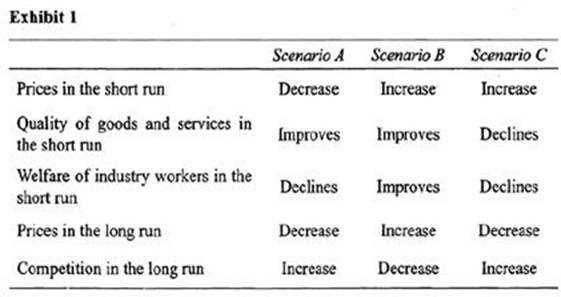
The Wakullian government is considering some of the country's industries. To illustrate the potential
costs and benefits of deregulation to the Wakullian government, Andrews and McClure compose a
matrix of the potential consequences of deregulation. In the matrix, three scenarios of possible
economic consequences are presented in Exhibit 1.
 Which of the following terms best describes the response of consumers to the auto safety
regulation?
Which of the following terms best describes the response of consumers to the auto safety
regulation?
 Which of the following terms best describes the response of consumers to the auto safety
regulation?
Which of the following terms best describes the response of consumers to the auto safety
regulation?Options
Discussion
No comments yet. Be the first to comment.
Be respectful. No spam.
