
Q: 5
Frank Hoskins and Paul Lanning are economists for a large U.S. investment advisory firm. Platinum
Advisors. Hoskins and Lanning use their independent research on U.S. stocks and international stocks
to provide advice for the firm's network of advisors. As the senior economist at Platinum, Hoskins is a
partner in the firm and is Lanning's supervisor. Lanning has worked for Platinum for the past four
years. At a lunch meeting, the two economists discuss the usefulness of economic theory, economic
data, and the resulting forecasts of the global economic and stock market activity.
Hoskins is investigating the growth prospects of the country of Maldavia. Maldavia is a formerly
communist country with a population of 3 million located in Eastern Europe. The Maldavian
government had been aggressive in instituting political reform and encouraging the growth of
financial markets. However, due to a recent insider trading scandal and resulting stock market
volatility, the Maldavian government is considering restrictions on further stock market growth and
the establishment of a national securities regulator. Hoskins states that these developments are not
encouraging for future economic growth.
Lanning is examining the country of Petra. Petra is a country of 25 million located in South America
and rich with natural resources including oil. The recently elected president of Petra, Carlos Basile,
has announced that he would like to diversify the country's economy away from natural resources
while nationalizing the oil industry. Lanning states that these changes would not be beneficial for the
future growth of the Petrian economy.
One of the many items they study when examining an economy or stock market is the economic
information released by governments and private organizations. Hoskins and Lanning use this
information to determine the effects on economic growth and the appropriate portfolio allocations
to the bond and stock markets. Examining information for Maldavia, Hoskins has learned that the
Maldavian private sector has embarked on an ambitious plan to increase labor productivity by
purchasing more machinery for its factories. The private sector feels compelled to do this because
Maldavia has historically relied too heavily on labor as the main input into production. Plotting the
productivity curve for Maldavia, Hoskins states that labor productivity should increase because the
productivity curve will shift upward and to the right.
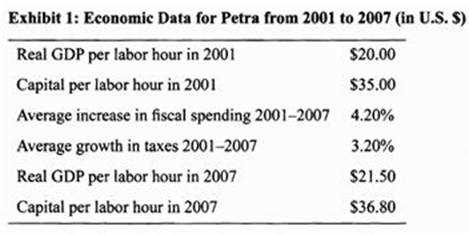
Lanning is examining the historical record of economic growth in Petra. He has gathered the data in
Exhibit 1 to determine potential economic growth.
 Hoskins is also examining data for the country of Semeria. Semeria is an emerging country that has
benefited from recent changes in the political environment as well as technological advances. Its
economy is growing rapidly, and changes in the Semerian economy and society have resulted in
more opportunities for women. The Semerian economy has experienced 17 consecutive quarters of
positive growth in GDP, which is unprecedented in Semerian history. Interest rates have increased
over time because businesses have been borrowing heavily to invest in new machinery and
technologies. Most economists are forecasting further increases in interest rates in Semeria.
It has long been Platinum's policy that its economists use long-term economic growth trends to
forecast future economic growth, stock returns, and dividends in a country. Lanning is examining the
economy of Tiberia. Tiberia has a population of 11 million and is located in northern Africa. Its
economy is diversified, and its main exports are agricultural products and heavy machinery. The
country's economy has been growing at an annual rate of 6.2% for the past ten years, in part because
of technological advances in the manufacture of heavy equipment. These advances involve the use of
computer-operated welding machines that have made the manufacture of heavy equipment less
expensive. Lanning is worried, however, that the 6.2% GDP growth rate may not be sustainable and is
considering advising Platinum's portfolio managers to decrease their portfolio allocations in the
country. Before doing so, he will consult with Hoskins.
The classical growth theory is most likely to predict that Tiberia's long-run future GDP per capita will:
Hoskins is also examining data for the country of Semeria. Semeria is an emerging country that has
benefited from recent changes in the political environment as well as technological advances. Its
economy is growing rapidly, and changes in the Semerian economy and society have resulted in
more opportunities for women. The Semerian economy has experienced 17 consecutive quarters of
positive growth in GDP, which is unprecedented in Semerian history. Interest rates have increased
over time because businesses have been borrowing heavily to invest in new machinery and
technologies. Most economists are forecasting further increases in interest rates in Semeria.
It has long been Platinum's policy that its economists use long-term economic growth trends to
forecast future economic growth, stock returns, and dividends in a country. Lanning is examining the
economy of Tiberia. Tiberia has a population of 11 million and is located in northern Africa. Its
economy is diversified, and its main exports are agricultural products and heavy machinery. The
country's economy has been growing at an annual rate of 6.2% for the past ten years, in part because
of technological advances in the manufacture of heavy equipment. These advances involve the use of
computer-operated welding machines that have made the manufacture of heavy equipment less
expensive. Lanning is worried, however, that the 6.2% GDP growth rate may not be sustainable and is
considering advising Platinum's portfolio managers to decrease their portfolio allocations in the
country. Before doing so, he will consult with Hoskins.
The classical growth theory is most likely to predict that Tiberia's long-run future GDP per capita will:
 Hoskins is also examining data for the country of Semeria. Semeria is an emerging country that has
benefited from recent changes in the political environment as well as technological advances. Its
economy is growing rapidly, and changes in the Semerian economy and society have resulted in
more opportunities for women. The Semerian economy has experienced 17 consecutive quarters of
positive growth in GDP, which is unprecedented in Semerian history. Interest rates have increased
over time because businesses have been borrowing heavily to invest in new machinery and
technologies. Most economists are forecasting further increases in interest rates in Semeria.
It has long been Platinum's policy that its economists use long-term economic growth trends to
forecast future economic growth, stock returns, and dividends in a country. Lanning is examining the
economy of Tiberia. Tiberia has a population of 11 million and is located in northern Africa. Its
economy is diversified, and its main exports are agricultural products and heavy machinery. The
country's economy has been growing at an annual rate of 6.2% for the past ten years, in part because
of technological advances in the manufacture of heavy equipment. These advances involve the use of
computer-operated welding machines that have made the manufacture of heavy equipment less
expensive. Lanning is worried, however, that the 6.2% GDP growth rate may not be sustainable and is
considering advising Platinum's portfolio managers to decrease their portfolio allocations in the
country. Before doing so, he will consult with Hoskins.
The classical growth theory is most likely to predict that Tiberia's long-run future GDP per capita will:
Hoskins is also examining data for the country of Semeria. Semeria is an emerging country that has
benefited from recent changes in the political environment as well as technological advances. Its
economy is growing rapidly, and changes in the Semerian economy and society have resulted in
more opportunities for women. The Semerian economy has experienced 17 consecutive quarters of
positive growth in GDP, which is unprecedented in Semerian history. Interest rates have increased
over time because businesses have been borrowing heavily to invest in new machinery and
technologies. Most economists are forecasting further increases in interest rates in Semeria.
It has long been Platinum's policy that its economists use long-term economic growth trends to
forecast future economic growth, stock returns, and dividends in a country. Lanning is examining the
economy of Tiberia. Tiberia has a population of 11 million and is located in northern Africa. Its
economy is diversified, and its main exports are agricultural products and heavy machinery. The
country's economy has been growing at an annual rate of 6.2% for the past ten years, in part because
of technological advances in the manufacture of heavy equipment. These advances involve the use of
computer-operated welding machines that have made the manufacture of heavy equipment less
expensive. Lanning is worried, however, that the 6.2% GDP growth rate may not be sustainable and is
considering advising Platinum's portfolio managers to decrease their portfolio allocations in the
country. Before doing so, he will consult with Hoskins.
The classical growth theory is most likely to predict that Tiberia's long-run future GDP per capita will:Options
Discussion
No comments yet. Be the first to comment.
Be respectful. No spam.
