
Q: 3
Delicious Candy Company (Delicious) is a leading manufacturer and distributor of quality
confectionery products throughout Europe and Mexico. Delicious is a publicly-traded firm located in
Italy and has been in business over 60 years.
Caleb Scott, an equity analyst with a large pension fund, has been asked to complete a
comprehensive analysis of Delicious in order to evaluate the possibility of a future investment.
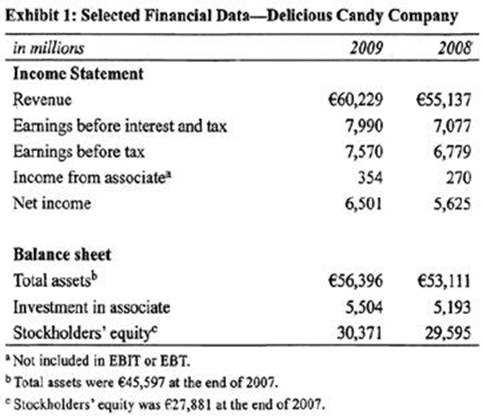
Scott compiles the selected financial data found in Exhibit 1 and learns that Delicious owns a 30%
equity interest in a supplier located in the United States. Delicious uses the equity method to
account for its investment in the U.S. associate.
 Scott reads the Delicious's revenue recognition footnote found in Exhibit 2.
Exhibit 2: Revenue Recognition Footnote
_________________________________________________________________________________
_
in
millions__________________________________________________________________________
Revenue is recognized, net of returns and allowances, when the goods are shipped to customers and
collectability is assured. Several customers remit payment before delivery in order to receive
additional discounts. Delicious reports these amounts as unearned revenue until the goods are
shipped. Unearned revenue was €7,201 at the end of 2009 and €5,514 at the end of 2008.
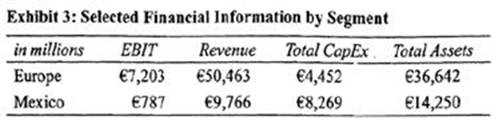
Delicious operates two geographic segments: Europe and Mexico. Selected financial information for
each segment is found in Exhibit 3.
At the beginning of 2009, Delicious entered into an operating lease for manufacturing equipment. At
inception, the present value of the lease payments, discounted at an interest rate of 10%, was 6300
million. The lease term is six years and the annual payment is 669 million. Similar equipment owned
by Delicious is depreciated using the straight-line method and no residual values are assumed.
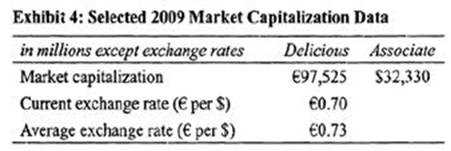
Scott gathers the information in Exhibit 4 to determine the implied "stand-alone" value of Delicious
without regard to the value of its U.S. associate.
Using the data found in Exhibit 1 and the extended DuPont equation, which of the following best
describes the impact on Delicious's return on equity (ROE) for 2009 of eliminating the investment in
the U.S. associate?
Scott reads the Delicious's revenue recognition footnote found in Exhibit 2.
Exhibit 2: Revenue Recognition Footnote
_________________________________________________________________________________
_
in
millions__________________________________________________________________________
Revenue is recognized, net of returns and allowances, when the goods are shipped to customers and
collectability is assured. Several customers remit payment before delivery in order to receive
additional discounts. Delicious reports these amounts as unearned revenue until the goods are
shipped. Unearned revenue was €7,201 at the end of 2009 and €5,514 at the end of 2008.
Delicious operates two geographic segments: Europe and Mexico. Selected financial information for
each segment is found in Exhibit 3.
At the beginning of 2009, Delicious entered into an operating lease for manufacturing equipment. At
inception, the present value of the lease payments, discounted at an interest rate of 10%, was 6300
million. The lease term is six years and the annual payment is 669 million. Similar equipment owned
by Delicious is depreciated using the straight-line method and no residual values are assumed.
Scott gathers the information in Exhibit 4 to determine the implied "stand-alone" value of Delicious
without regard to the value of its U.S. associate.
Using the data found in Exhibit 1 and the extended DuPont equation, which of the following best
describes the impact on Delicious's return on equity (ROE) for 2009 of eliminating the investment in
the U.S. associate?
 Scott reads the Delicious's revenue recognition footnote found in Exhibit 2.
Exhibit 2: Revenue Recognition Footnote
_________________________________________________________________________________
_
in
millions__________________________________________________________________________
Revenue is recognized, net of returns and allowances, when the goods are shipped to customers and
collectability is assured. Several customers remit payment before delivery in order to receive
additional discounts. Delicious reports these amounts as unearned revenue until the goods are
shipped. Unearned revenue was €7,201 at the end of 2009 and €5,514 at the end of 2008.
Delicious operates two geographic segments: Europe and Mexico. Selected financial information for
each segment is found in Exhibit 3.
Scott reads the Delicious's revenue recognition footnote found in Exhibit 2.
Exhibit 2: Revenue Recognition Footnote
_________________________________________________________________________________
_
in
millions__________________________________________________________________________
Revenue is recognized, net of returns and allowances, when the goods are shipped to customers and
collectability is assured. Several customers remit payment before delivery in order to receive
additional discounts. Delicious reports these amounts as unearned revenue until the goods are
shipped. Unearned revenue was €7,201 at the end of 2009 and €5,514 at the end of 2008.
Delicious operates two geographic segments: Europe and Mexico. Selected financial information for
each segment is found in Exhibit 3.
 At the beginning of 2009, Delicious entered into an operating lease for manufacturing equipment. At
inception, the present value of the lease payments, discounted at an interest rate of 10%, was 6300
million. The lease term is six years and the annual payment is 669 million. Similar equipment owned
by Delicious is depreciated using the straight-line method and no residual values are assumed.
Scott gathers the information in Exhibit 4 to determine the implied "stand-alone" value of Delicious
without regard to the value of its U.S. associate.
At the beginning of 2009, Delicious entered into an operating lease for manufacturing equipment. At
inception, the present value of the lease payments, discounted at an interest rate of 10%, was 6300
million. The lease term is six years and the annual payment is 669 million. Similar equipment owned
by Delicious is depreciated using the straight-line method and no residual values are assumed.
Scott gathers the information in Exhibit 4 to determine the implied "stand-alone" value of Delicious
without regard to the value of its U.S. associate.
 Using the data found in Exhibit 1 and the extended DuPont equation, which of the following best
describes the impact on Delicious's return on equity (ROE) for 2009 of eliminating the investment in
the U.S. associate?
Using the data found in Exhibit 1 and the extended DuPont equation, which of the following best
describes the impact on Delicious's return on equity (ROE) for 2009 of eliminating the investment in
the U.S. associate?Options
Discussion
No comments yet. Be the first to comment.
Be respectful. No spam.
